Global Automotive: 80% of Leads Are Not Converting, How This Automotive Brand is Reshaping Lead Growth?
A certain new energy vehicle brand built a family decision-making model through insight research GEA, restoring the car purchasing negotiation path and precisely optimizing strategies, resulting in an approximately 30% increase in lead conversion efficiency.
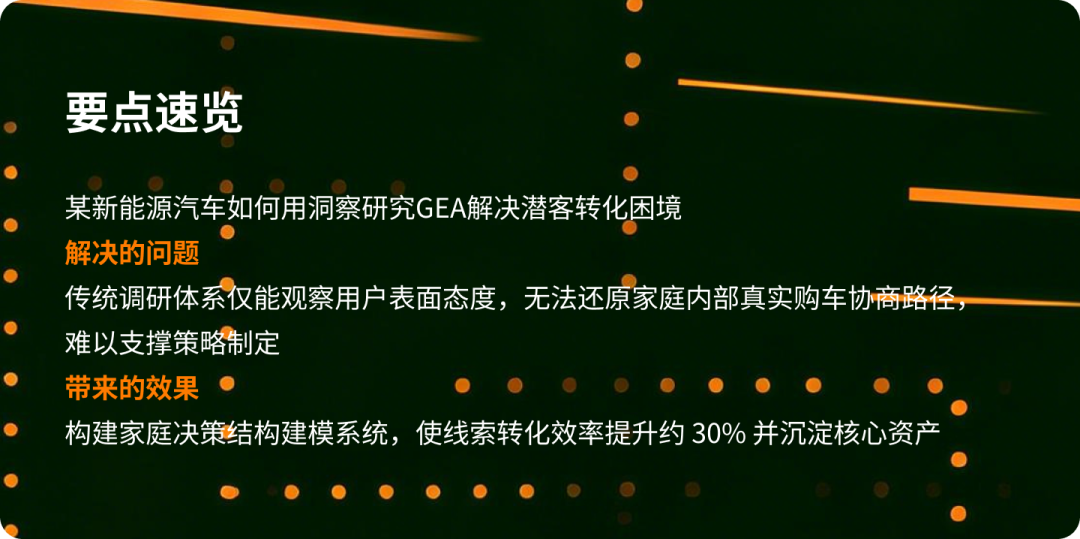
For many automotive brands, the purchase decision for new energy vehicles is not a typical individual consumer behavior but a family collaborative decision-making process.
When a certain automotive brand researched the barriers young families face when buying a car, they quickly encountered a familiar problem: the team had plenty of lead data and market research reports, but they struggled to answer a key question—why do users express interest but delay making a purchase decision? In traditional research logic, such questions are usually broken down into:
Is the price appropriate?
Is the range sufficient?
Is the safety trustworthy?
Is the brand reliable?
However, as the research progressed, the team gradually realized that the purchase of new energy vehicles is not a single parameter comparison process but a family internal negotiation mechanism. Consumers are not buying a car itself but making a comprehensive judgment about safety, budget, intergenerational relationships, and lifestyle.
Thus, the question changed. What companies need to understand is no longer whether users are willing to buy, but how families form a consensus on purchasing.

Limitations of traditional research systems: the real issue companies face is not the number of potential customers, but the mechanism of family consensus formation
In traditional research systems, such questions typically rely on:
Survey research
Focus group interviews
Lead analysis
Competitor comparison reports
These methods can provide effective references but struggle to explain the true decision-making paths within families. Research is usually conducted on an individual basis, with sample sizes limited by time and cost, making it difficult for research results to enter the strategy testing process. Companies can see what users express but find it hard to understand how they make the final decision.
For a consumption scenario like new energy vehicles, which involves high family collaboration in decision-making, this limitation is particularly evident. What truly influences purchasing behavior is often not a single variable but the judgment relationships between different family members.
Step 1: Build a real family research context, making interview data a inferable decision structure
Once the research goals for new energy vehicles enter the system, insight research GEA does not immediately generate user profiles but first constructs a layer of family decision-making research memory (Decision Context Builder). The brand organizes the one-on-one in-depth interview corpus based on real discussions among different family members regarding car purchases:
Value ranking, role division, risk concerns, budget boundaries, emotional expression methods.
This information, originally scattered in interview records, is unified into a research context structure that can be continuously referenced. User research is no longer just a report but becomes a foundational understanding of decision-making that the system can continuously operate on. This capability comes from the user simulation (AI Persona) mechanism in the GEA system, which can transform interview data into an inferable family decision-making model.

Step 2: Generate family role Personas, upgrading 'potential customer labels' to 'decision-making models'
Based on the research context, the system further generates AI Personas within the family structure. Unlike traditional potential customer labels, these Personas are not: age groups, income ranges, city tiers
but complete family decision-making roles, such as: price-sensitive decision-makers, safety-first decision-makers, parent-influenced decision-makers, brand-trust decision-makers.
The team can directly interact with these Personas to understand under what circumstances they change their judgments and which factors can drive the family to form a purchasing consensus. User research thus shifts for the first time from individual preference analysis to the ability to model family collaborative decision-making.

Step 3: Simulate the internal discussion process of families, allowing strategy testing to enter a real decision context
Once the family role model is established, the system begins to further simulate the real discussion process. Insight research GEA organizes different Personas into an AI Panel Discussion to restore the negotiation paths within families regarding car purchasing topics, such as: whether to prioritize safety features, whether to accept a higher budget, whether to trust new energy technology, whether influenced by parents' opinions.
What the team can see is no longer just the ranking of user preferences but how family members influence each other's judgments. For example, some families focus more on child safety features, some are more concerned about changes in subsidy policies, and others care more about whether the brand can reduce perceived technological risks. These differences could only be inferred through experience in the past, but now they can be systematically presented and enter the product strategy discussion process.
User research begins to shift from static observation to dynamic deduction.

Step 4: The key turning point from explaining market behavior to predicting market responses
As the research continues, the system can also conduct predictive testing on different strategies through the Persona Panel, such as: range enhancement plans, safety feature upgrade plans, financial plan adjustments, subsidy strategy changes, brand communication expressions.
Brands can complete multiple rounds of strategy validation before launching in the real market, thus predicting the impact of different measures on enhancing purchase intention. User research thus transforms from a one-time research project into a continuous operational capability for strategy validation.

Project results: Family collaborative decision-making paths transformed into product strategy basis
In this new energy vehicle research project, insight research GEA ultimately helped the team identify four core family decision-making paths:
Safety-first path
Budget negotiation path
Intergenerational influence path
Brand trust path
These paths not only explain the reasons for purchasing hesitation but also directly influence subsequent configuration design, financial plan structure, subsidy strategy arrangements, and brand communication expressions.
More importantly, these judgments did not disappear with the end of the research project but were solidified into family decision-making model assets that the company can continuously reference and enter the next round of product innovation processes.
User understanding thus no longer relies on one-time research but becomes part of the company's long-term capabilities.
Transforming the understanding of family decision-making into a continuously operational system capability
The changes brought by insight research GEA are not just improvements in research efficiency but structural changes in the way user understanding is approached.
In the past, car purchase research typically occurred before product definition, serving as a phase; now, it has become a continuous capability that runs through the entire process of product design, strategy formulation, and communication validation.
The team no longer relies on one-time research to judge direction but can continuously observe changes in family decision-making structures and adjust product expressions accordingly.
This is also the most fundamental difference between insight research GEA and traditional user research systems. It does not just help companies complete a research project faster but makes “understanding family decision-making structures” a continuously operational system capability for the first time.
If you have similar scenario needs, feel free to scan the code to schedule a corporate diagnosis.

Scan the code to download the "Business Evolution Blueprint in the AI Era" to get more GEA practice cases and understand the corporate paradigm in the Agentic AI era.
Category
Manufacturing
Date
2026-04-21
Read Time
6 min read
Share Page
Related Recommendations

Global Power Tool: Jumping Out of Expert Review 'Information Cocoon', Involving Professional Users in New Product Development from the Start

Global Industrial Manufacturing: Equipping AI with 'Business Sensitivity', How the Enterprise-Level Intelligent Agent GEA Transforms Sales Experience into Corporate Assets