Is AI Overconfident, or Is It All an Illusion? How to Solve the ROI Dilemma of Enterprise AI
Enterprise AI often falls into the 'confidence illusion' due to high intelligence and low context, leading to sluggish ROI. Tezign GEA builds a Context Layer that unifies terminology, coding rules, mapping relationships, and memory decisions, quickly solidifying enterprise-specific context, enabling AI to reach the level of a senior employee within a week and solve the ROI dilemma.
AI performance metrics are skyrocketing—reasoning ability has increased from 5% to 87.5%, and university exam scores have risen from 35% to 87%.
However, 56% of CEOs report zero returns on AI investments. Only 20% perceive significant value. Even developers using AI tools have seen their work speed decrease by 19%.
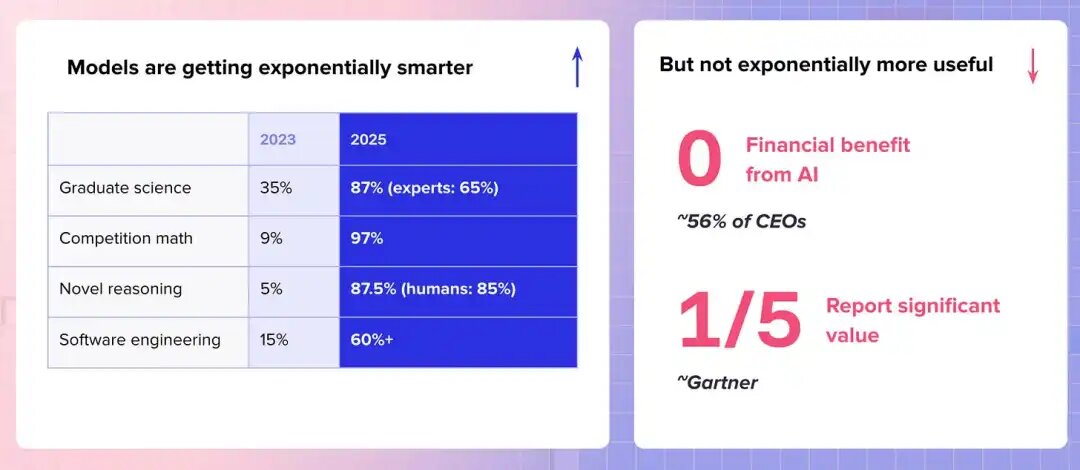
It seems contradictory, but the problem is clear: the models have become smarter, but the returns have not kept pace.
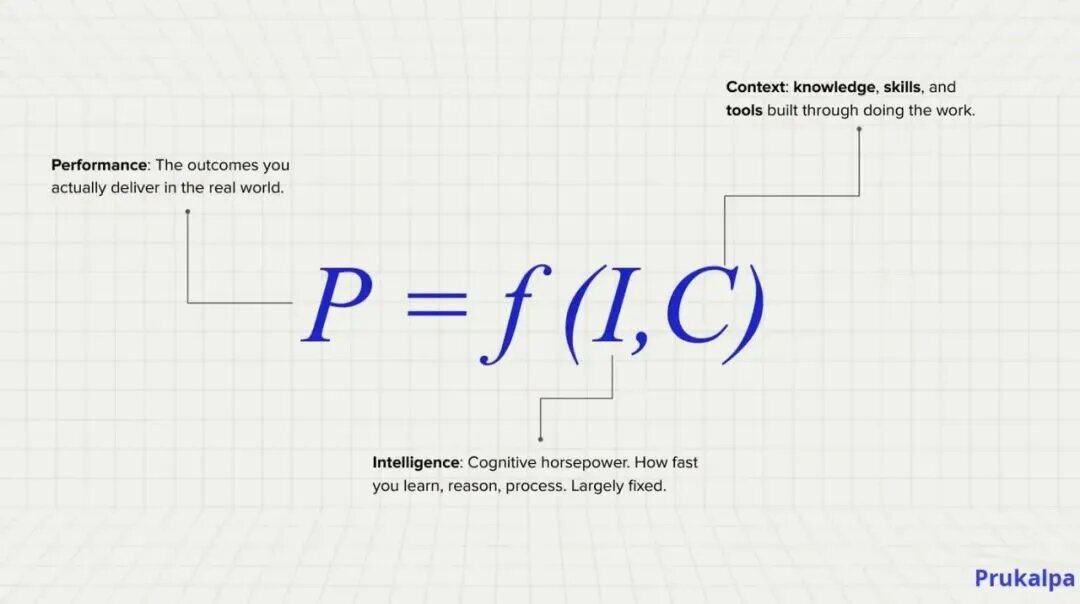
Cognitive science has a simple finding: IQ only accounts for 10% of job performance. The best employees are not necessarily the smartest, but rather the ones who understand how things actually operate here the best. They know:
The real needs of customers, not just surface-level demands
Which rules can be broken and when they should be broken
Mistakes made last time and how to avoid them this time
What determines good or bad performance/results is precisely the 'context'.
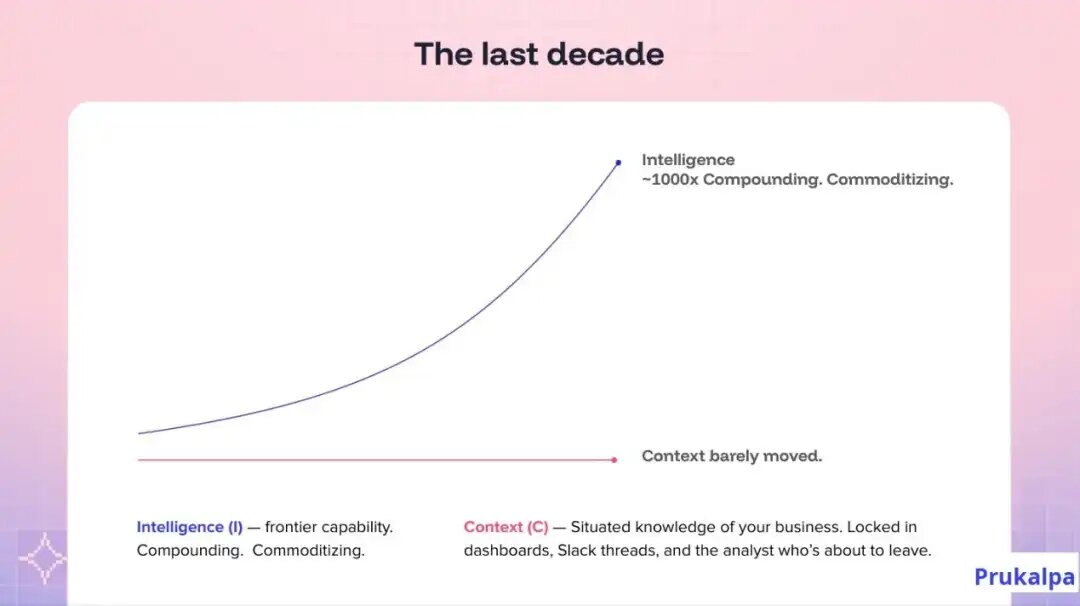
However, over the past decade, the gap between intelligence and context has been widening. You can purchase Intelligence at API prices—every company can easily acquire intelligence, but Context must be accumulated bit by bit within the organization.
How is Context accumulated? Here is a vivid example:
Maya works in customer service in Chicago.
One phone call: an angry mother whose child has been exposed to an allergen. Maya resolved the conflict, processed the refund, and prevented negative social media reviews within 90 seconds, earning a five-star rating.
What does Maya need? Four months of accumulated Context:
1. Rule knowledge — allergen policies, refund processes
2. Judgment — when an apology is enough and when compensation is needed
3. Situational understanding — is this a first-time customer or a long-time customer who has complained seventeen times
4. System understanding — is this a systemic issue at the branch or a one-time event
None of these are innate. Through documentation, training, learning from senior employees, making mistakes under supervision, and being corrected, she gradually built this capability.
This is precisely the problem facing enterprise AI today.
Current Situation: Enterprise AI is Like Maya's First Day
Every AI agent you deploy has the intelligence that Maya accumulated in four months, but it knows nothing about your business. It does not know:
The precise definition of 'revenue' when you say it
The criteria for 'resolved' complaints
Those exceptional rules
Customer history
Every deployment starts from scratch and will never grow. If viewed on two axes: Intelligence (vertical) and Context (horizontal).
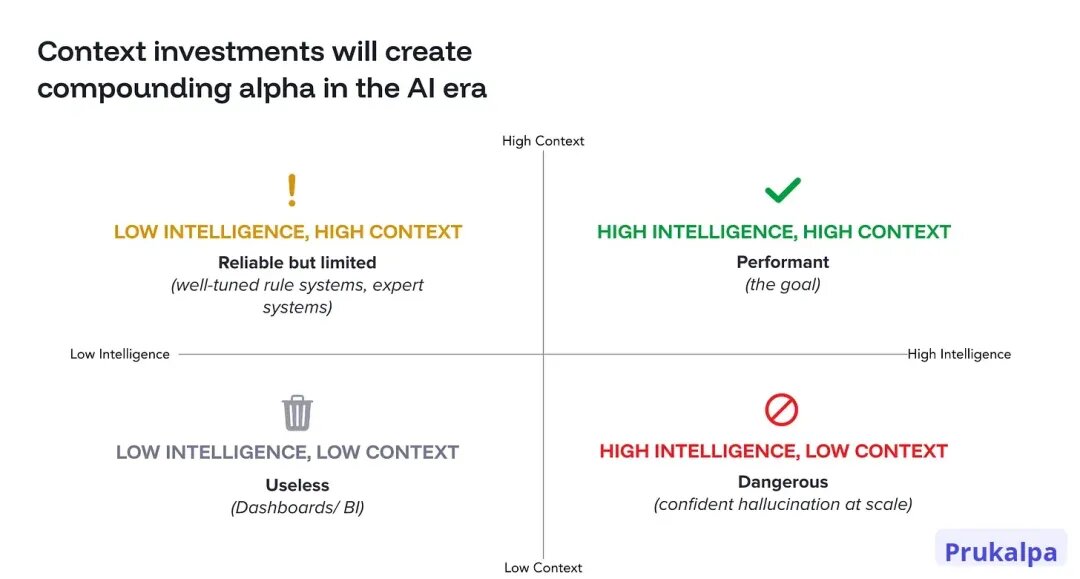
Most enterprise AIs are in the lower right quadrant: high intelligence, low context.
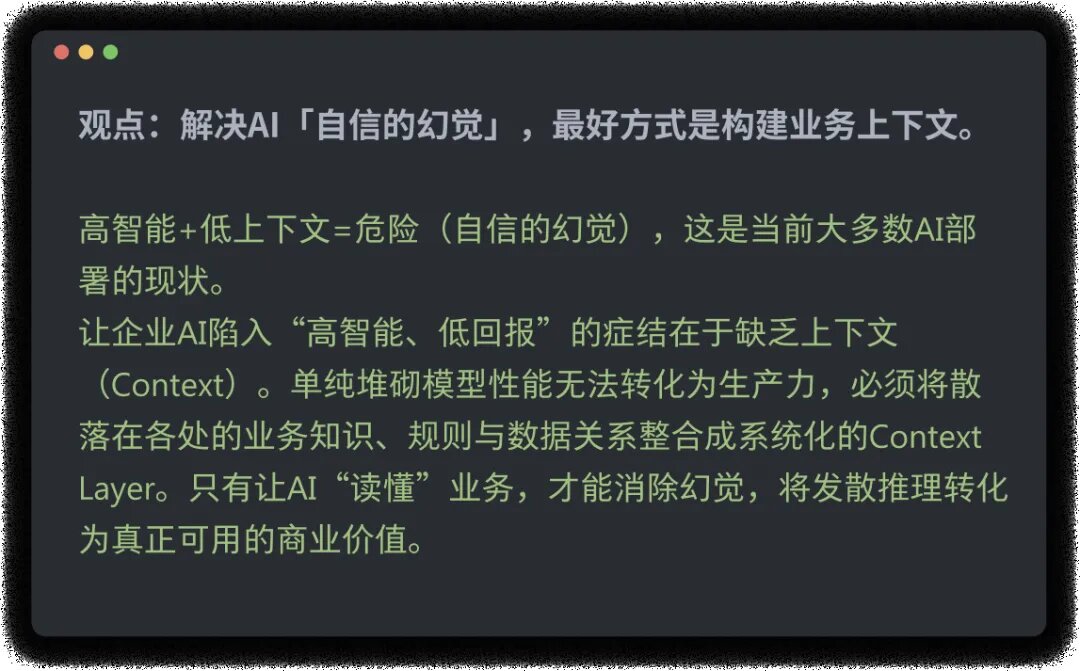
The problem is—output is confident, clear, and often wrong. The most dangerous part is that those incorrect outputs seem reasonable.'The illusion of confidence' operates at scale, turning AI from a potential asset into a liability.
The solution is not to buy better models. Instead, it is to build another axis—Context business context.
The Triple Dilemma Enterprises Face When Building Context
1. Easy to deploy, hard to build Context
Deploying agents and adding business context takes five months. Because you only realize how unfamiliar the agent is with your business when you deploy it.
2. No memory sharing between agents
Every time a new agent is deployed, it has to accumulate knowledge all over again. Agent A is corrected, but Agent B knows nothing. The tenth agent is just as unfamiliar with your business as the first.
3. Semantic conflicts among multiple agents
Agent A's 'revenue' refers to completed orders. Agent B's 'revenue' refers to confirmed income. Both seem reasonable in isolation, but when they collaborate, conflicts are exposed. The finance team ends up wasting a week coordinating data discrepancies instead of doing financial work.
How to Solve This Dilemma?
GEA's Context Layer is designed to address this issue. GEA builds an enterprise Context Layer that transforms AI from Day 1 into a senior employee. Specifically, it includes:
Unified terminology — 'active customer' may have different definitions in marketing and finance departments. GEA's Context Layer does not force synchronization but records definitions, application scenarios, and exceptions.
Rule coding — those implicit rules (three exceptions to support policies, handling of special customers) exist in employees' minds. GEA quickly identifies and codes these rules by reading existing systems (SQL, data governance documents, historical decisions).
Relationship mapping — 'customer' in CRM, 'account' in data warehouse, and 'contact' in ERP are actually the same thing. GEA maintains this consistency, allowing all agents to see a unified enterprise model.
Decision memory — every time an agent runs or a human reviews, signals are generated. Approval is data, correction is data. GEA captures these signals, and each run of the system strengthens its understanding of the enterprise. This is not a one-time configuration but self-learning.
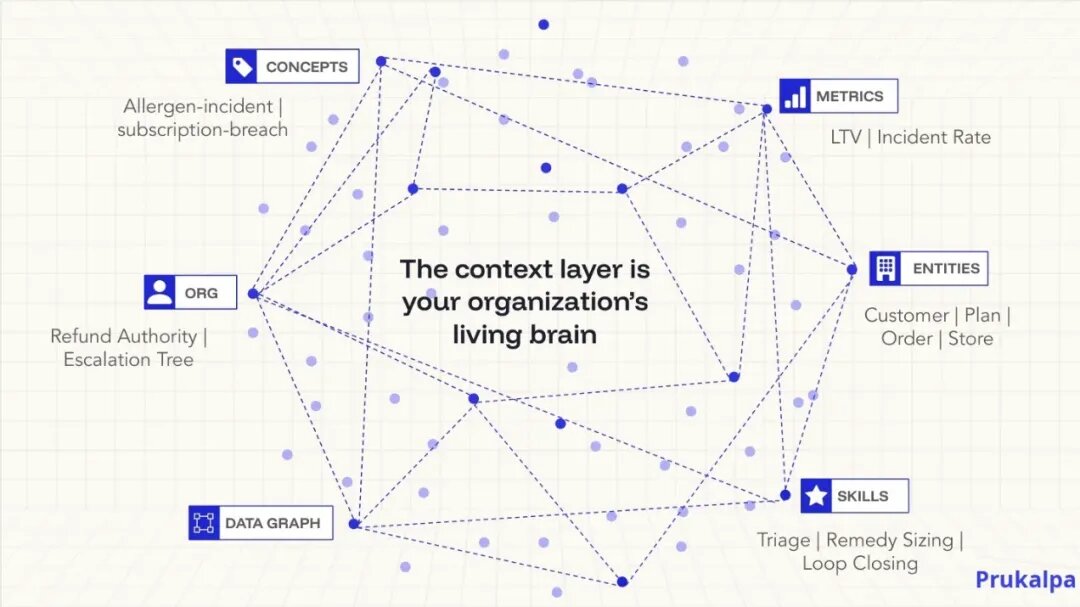
As a result, four key transformations occur
1. Existing knowledge is quickly activated
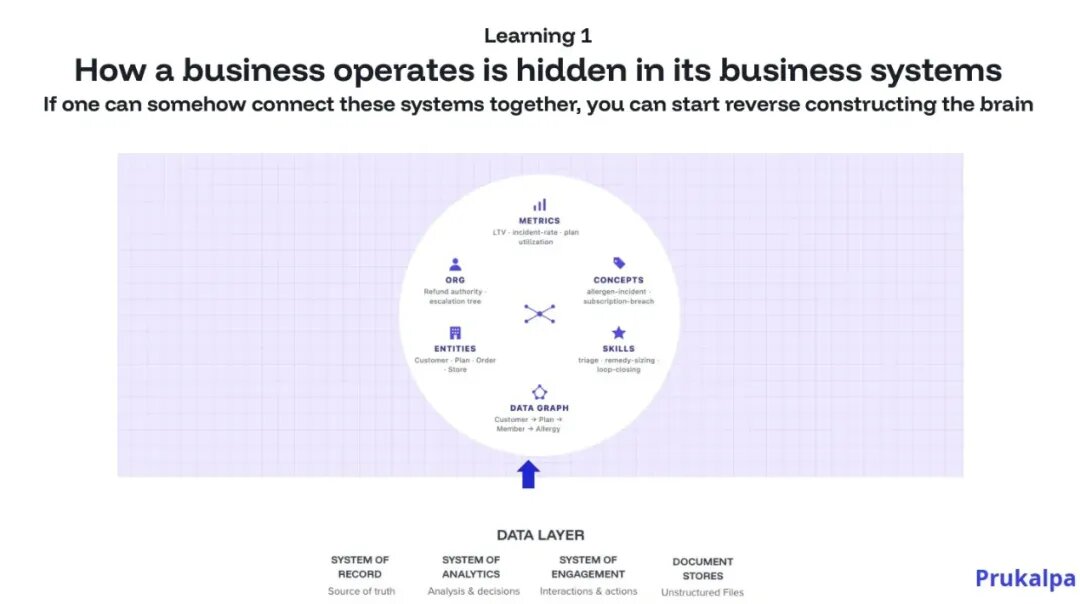
The way a company operates has already been encoded in the system: data warehouse lineage encodes dependencies, SQL encodes business logic, governance documents encode semantic intent. GEA can read these, synthesize them, and generate a draft of the enterprise semantic map in a few hours, instead of the original few months. Context building shifts from manual to automated.
2. Context quality grows exponentially
AI generates a draft → human refines → AI continues to generate based on the refined version → quality continuously rises. Data shows: the Context generated by AI (validated by humans) often exceeds the quality of what humans write from scratch. Because AI sees the whole picture, while humans only see one field. This is a flywheel, not a one-time project.
3. Interaction generates Context
Every time AI runs in a production environment and humans review the output, valuable signals are generated. Approval is data, correction is data, 'this is not our practice' is data. Most enterprises waste these signals. GEA captures them and feeds them back into the Context Layer, building advantages that external companies cannot replicate.
4. Context requires lifecycle management
Context can become invalid. Businesses change—definitions are updated, product lines are restructured. GEA's Context Layer needs to be maintained like a codebase: versioned, tested, governed. Once this is achieved, enterprises will have a truly sustainable AI decision-making system.
How to Truly Activate Enterprise Wisdom
Enterprises now face two paths: continue deploying intelligent but context-less AI, resulting in the illusion of confidence running at scale within the company, or begin building a Context Layer—giving AI the actual knowledge, unspoken rules, and decision standards of the enterprise.
This does not require inventing from scratch. This knowledge has already been encoded in the enterprise's systems; it just hasn't been systematically read. GEA's Context Layer transforms this scattered knowledge into an organizational memory that AI can call upon and continuously evolve.
A global food group’s practice on GEA shows that the system can identify 8,000 business concepts and 500 implicit rules within 72 hours. Newly deployed AI agents do not need five months to reach standards; they can achieve the performance level of senior employees within a week.
This is the turning point for AI investment: from loss to return.
Not because the models have become smarter, but because the enterprise has finally provided it with enough context.
Category
In-depth Report
Date
2026-05-28
Read Time
6 min read
Share Page
Related Recommendations

AI Can Work on Its Own, Who Manages It? The Harness Project for Enterprise-Level AI

After becoming AI-Native: What Comes Next? On Brands and Good Taste in This Era