Context System: How to Enable AI to Learn from 'Big Data' to Enterprise 'Proprietary Knowledge'?
Simply connecting databases makes it difficult for AI to understand exclusive business logic, which can lead to misjudgments. The Context System by Tezign builds a layer of business knowledge, consolidating implicit rules and dynamically maintaining them, allowing AI to adapt to the company's unique business standards.
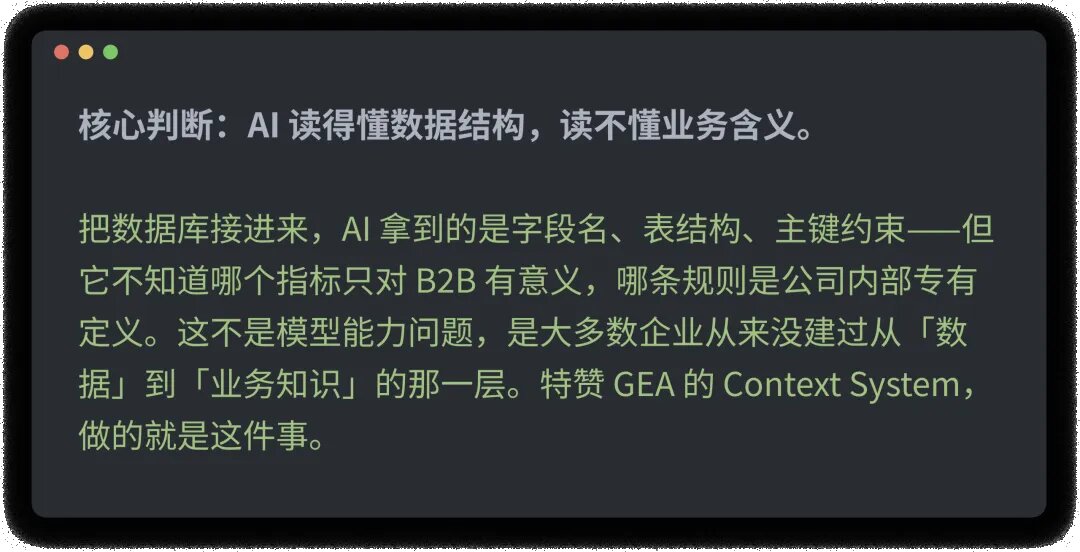
Have you ever used AI to check business data at your company? Have you ever received an answer that sounded reasonable, but your business colleagues said, 'That's not right'?
Here's a real scenario. A company's database has two fields: cust_lt_val and ltv_b2b_adj. The former, the model guessed correctly—Customer Lifetime Value, a universal concept with no ambiguity.
The latter, the model guessed as 'B2B Adjusted Lifetime Value'. It sounds reasonable, but it's wrong. The company's rule is: B2B customers can only sign sales contracts, while B2C customers can only place orders. The lifecycle calculation logic for the two types of customers is completely different; ltv_b2b_adj is a company-specific definition and is not the same as any industry-wide concept.
This rule is not in any table. It lives in the minds of business personnel and has never been documented.
When AI gets it wrong, we call it a 'hallucination'. But the accurate description is: the model used general knowledge to fill in a proprietary gap of the enterprise. With a stronger model, it would still guess—just more confidently. This is not a problem of model capability, but of semantic deficiency.
The data given to AI only represents the technical layer
The first thing many teams do when pushing AI is to connect the database. The metadata of the data warehouse is very complete—field types, primary key constraints, inter-table associations, technically flawless.
But these describe the system structure, not the business meaning. The 'B2B Customer Table' won't tell AI about the differences in contract rules between the two types of customers, under what circumstances a C-end customer will upgrade to B-end, or which metrics are only meaningful for B2B. These judgment criteria are implicit knowledge accumulated from years of enterprise operations—not found in any table and won't automatically appear in the data dictionary.
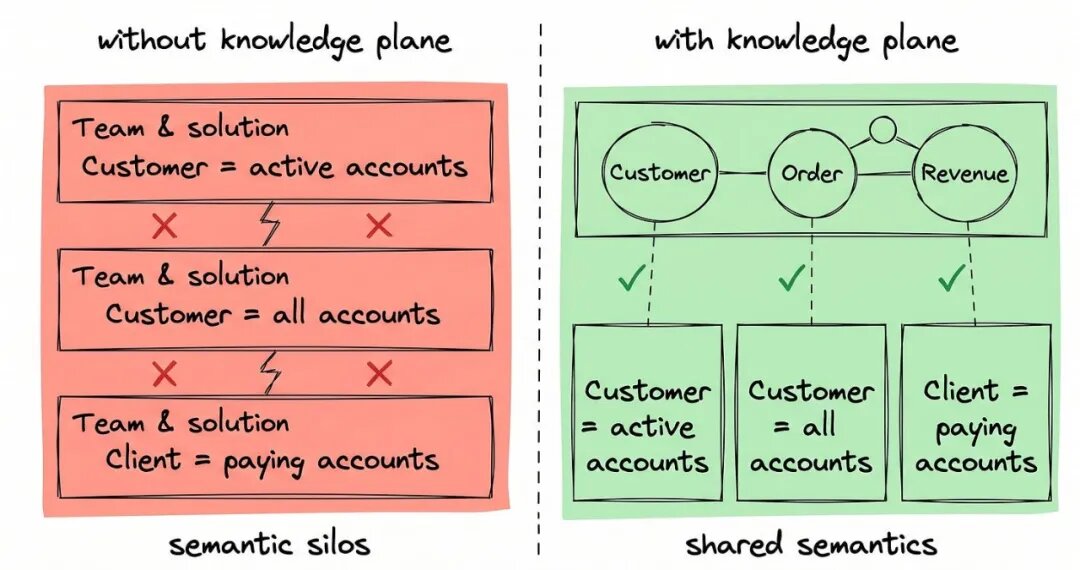
In my view, these are two different layers: the data plane contains technical objects, while the knowledge plane contains semantic understanding. Most enterprises have only built the former; the latter has never existed.
What does the Context System actually manage?
The Context System manages not the data itself, but the business meaning behind the data: what this term means in the company, the relationship between two concepts, in which scenarios a certain rule applies, and where there are discrepancies in cross-department definitions. These things are not found in any database table and won't automatically appear in technical documentation.
Returning to the previous example. The database has the field ltv_b2b_adj, which has no ambiguity at the technical level. But the business meaning requires an additional layer to record: this is a proprietary metric for B2B customers, the calculation logic depends on the contract type, it is not applicable to B2C scenarios, and it is not the same as the industry-standard LTV definition. What the Context System does is transform these judgments that 'live in the minds of business personnel' into structured knowledge that AI can read and use.
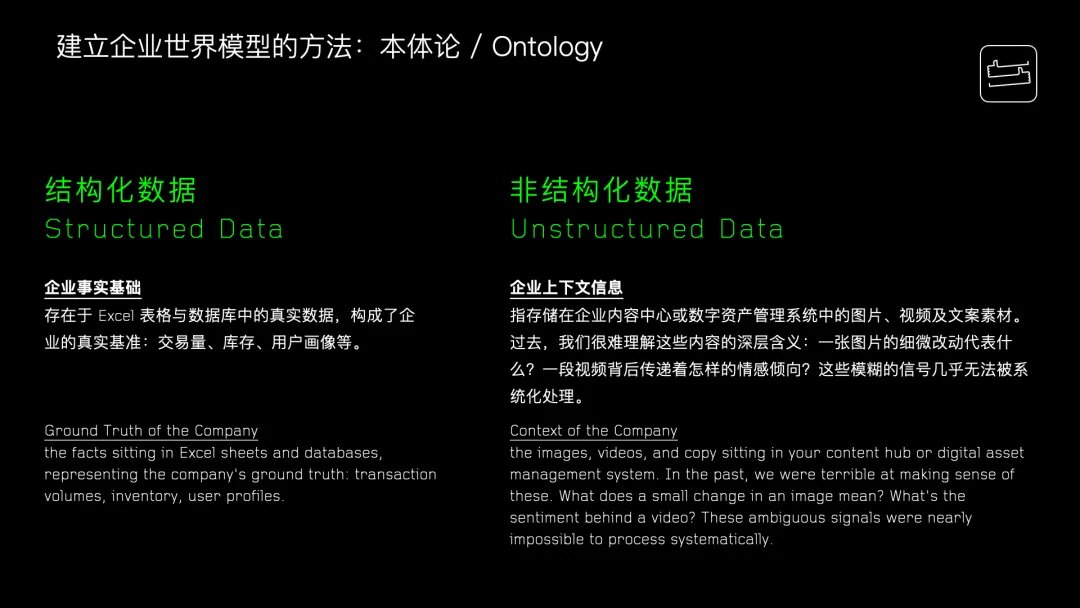
In information science, there is a methodology called Ontology, which specifically studies how to explicitly define business concepts and their relationships—what the Context System does is highly consistent with it. The difference is: Ontology is a set of research methods, while the Context System established by Tezign is a continuously operating infrastructure.
How does GEA keep this running continuously?
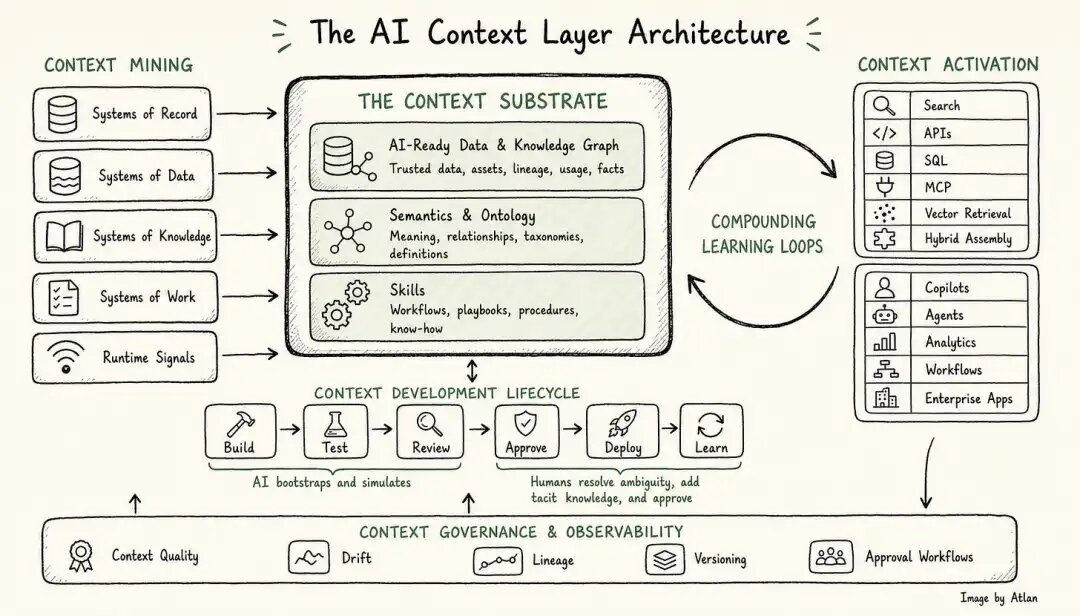
The hardest part of the knowledge plane is not 'whether to build it', but 'how to keep it updated.' Business is changing: new products are launched, definitions are modified, and discrepancies arise between departments. Relying on manual maintenance is costly, slow, and can easily lag by more than half a quarter—by the time maintenance is completed, the business logic has changed again.
GEA's Context System addresses this ongoing maintenance issue. It does not rely on one-time knowledge engineering projects, but continuously mines signals from query logs, documents, and usage behaviors of business systems—identifying which terms are used with different standards by different departments, which fields' usage deviates from their definitions, and synchronizing these updates into the knowledge layer. The knowledge plane is no longer a project, but a continuously operating infrastructure.
The result is: when AI processes ltv_b2b_adj, it receives not just the field name, but also 'B2B proprietary metric, dependent on contract type, not interchangeable with B2C'. Before executing tasks, AI already knows the rules of this company. This is 'Contextual NOT General'—not integrating a general model into the business, but enabling AI to truly learn the language of this company.
How far along are you in building this layer?
Three quick self-assessments:
1. Do your most core business metrics have a unified written definition across departments?
2. If different departments ask AI the same question, will they get different answers?
3. Have existing AI workflows ever provided incorrect conclusions due to 'insufficient context'?
If there are two 'uncertainties', this layer is not yet built.
Most enterprises' AI projects are stuck at 'usable but inaccurate'—it's not a problem with the model, but the lack of a layer that connects data to business knowledge. What the Context System does is transform this layer from 'judgments in the minds of business personnel' to 'infrastructure that AI can continuously read'. Once this layer is built, AI can truly work in your company.
How far along is your enterprise context system?
Scan the code to download the white paper 'Context Moats 2026'
Feel free to schedule a deep diagnostic session with us.
Category
In-depth Report
Date
2026-06-25
Read Time
4 min read
Share Page
Related Recommendations

After becoming AI-Native: What Comes Next? On Brands and Good Taste in This Era

The Most Valuable Knowledge in a Company Has Never Been Recorded