Where to Start for an AI Native Organization?
Most companies find it difficult to build an AI native organization by merely purchasing AI tools. Tezign proposes a practical path: first, empower everyone through hands-on practice, build small cross-functional Pod units, and simultaneously cultivate team leaders with business judgment skills, gradually increasing talent density.
Most companies discussing AI transformation are actually talking about tool migration.
Equipping everyone with Copilot, purchasing a batch of AI tool licenses, holding a few AI workshops, and sending out a motivational email encouraging the use of AI—then waiting for efficiency to improve. Is this effective? Perhaps to some extent. But it lacks an essential element that distinguishes it from a true AI native organization.
Tools are in use, but the organization hasn't changed
In the Super Organization Report released by Tencent Research Institute in 2026, Tezign founder Fan Ling mentioned an observation:
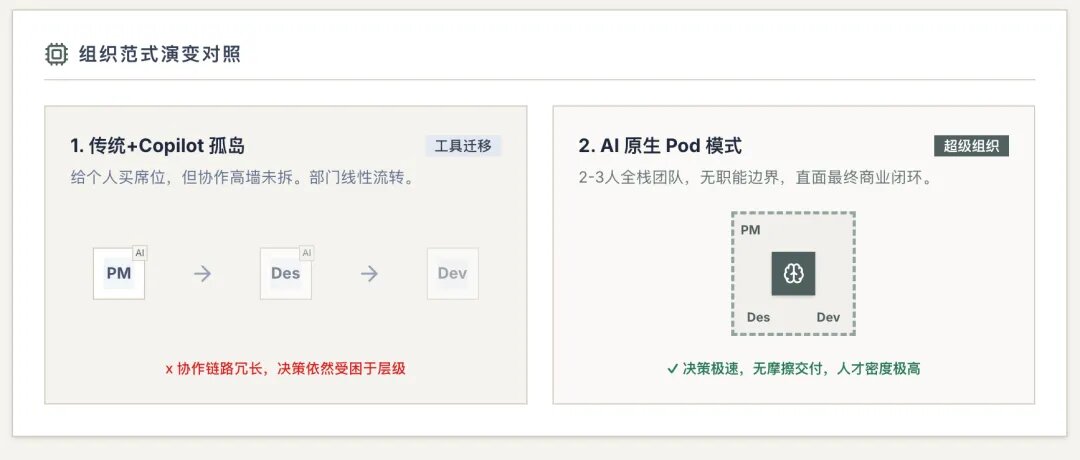
“Two years ago, the main form of AI was called copilot, which was about giving everyone an assistant to improve individual efficiency, but the organization did not change. To date, the vast majority of companies are still in the copilot form organizationally.”
This judgment still holds true today.
Currently, most companies are in a state where: some people are using AI, some are not using it at all, and some are using it but do not know how to use it effectively. AI tools have been purchased, training has been conducted, but the collaboration methods between departments have not changed,
the reporting chains have not changed, and the project decision-making processes have not changed.
Individual efficiency has improved somewhat, but the system has not changed.
This is not an issue with AI, nor is it an issue of execution. The problem lies in the fact that changes at the tool level and changes at the organizational level are two different matters that typically do not connect automatically.
From zero to one, there are real thresholds
Before discussing how the organization can change, there is a more fundamental question worth answering: Do most people really know how to use AI? Tezign encountered this issue while promoting internal organizational change. Fan Ling described a side effect of the Pod model:
"The 'zero to one' skill transition does have thresholds, and it requires support to get started."
Tezign's solution is ABC+—inviting external instructors to the company to teach employees how to use Claude Code and how to use agent tools hands-on. It’s not about letting people figure it out on their own, but rather having someone guide them through it. This may sound ordinary, but the underlying judgment is crucial: you cannot assume people will learn spontaneously.
The leap from zero to one does not rely on documentation or self-study; it relies on a specific person helping you along the way, giving you your first successful experience. With this experience, continued investment becomes possible.
Ignoring this step and directly discussing organizational change typically results in two outcomes: either it remains on paper, or it only happens to a few individuals, failing to scale.
There are no shortcuts in organizations; talent density is key
The bottleneck of an AI native organization lies not in tools, but in people. More precisely, it lies in talent density.
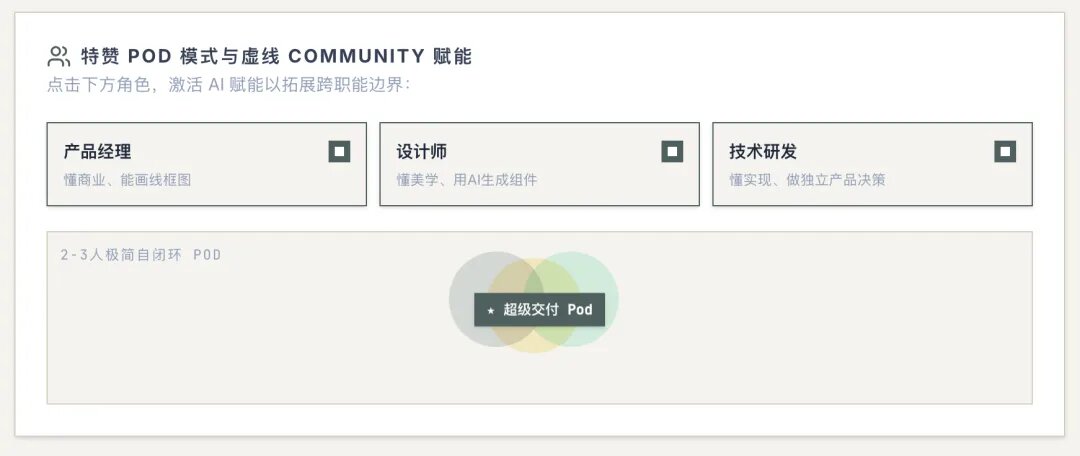
Tezign's Pod model—where two or three people fully deliver a task without functional boundaries and without passing the buck—can operate effectively only if someone among those two or three possesses cross-functional capabilities. Product managers need to be able to deliver directly, designers need to understand business logic, and developers need to make product decisions.
This cannot rely on hiring; it must be cultivated.
In Tezign's dual-track structure, the Community is responsible for this role—transforming functional lines from "solid line management" to "dotted line growth." You may come in as a salesperson, but the Community's goal is to enable you to understand the product, write some code, and lead a user interview.
Shifting from managing KPIs to helping people grow.
This transformation itself requires time. It cannot be accomplished simply by changing an organizational chart.
The scarcest resource is not AI capability, but leadership
There is another issue that is more difficult to solve than tools.
Fan Ling said something during the discussion that left a deep impression on me:
"There are still not enough people who can truly be Pod Leaders. AI capability and learning ability are now a consensus. But leadership is really hard to cultivate—being able to see P&L, having a strong sense of responsibility, and maintaining patience in a rapidly changing era."
This judgment points to a real contradiction:
AI lowers the execution threshold, but it simultaneously raises the judgment requirements.
It is true that a person plus AI can accomplish more. But this means that everyone needs to make more judgments, not fewer. Judgments are not made by tools; they rely on experience, cognition, understanding of the business, and the ability to maintain direction amidst uncertainty.
These things require time to accumulate, real battlefield honing, and guidance. AI can help you execute, but it cannot replace the process of nurturing growth.
An AI native organization is a state worth pursuing.
It probably looks like this: AI operates continuously in the background, and each person's work involves making judgments based on AI-generated results; teams are no longer divided by functional roles but are aggregated by task outcomes; collaboration costs are reduced, and everyone's energy is more focused on truly creating value.
However, the path to this state is not a single announcement, a single reorganization, or a single tool purchase.
It is a continuous construction process: first, ensure individuals truly learn to use AI; then, allow high-density talent to collaborate in small delivery units; during this process, cultivate leaders who can take on judgment responsibilities; and gradually scale up.
Where can companies start?
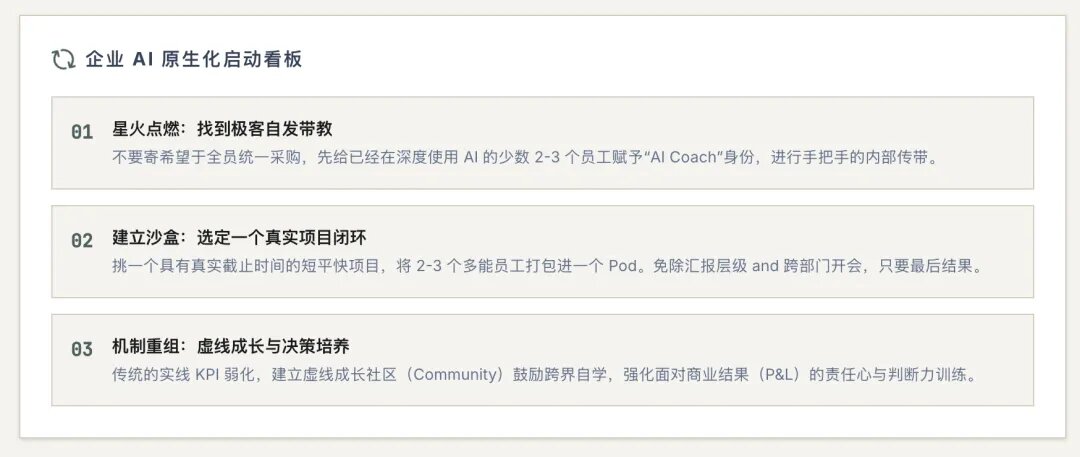
If you agree with the above judgment and want to know how to proceed, here are a few actionable starting points.
01. Find people who are already using AI and let them lead. It’s not about uniform training, but rather identifying a few individuals who are already using it spontaneously and giving them a formal role to guide others in the department hands-on. The threshold from zero to one relies on this person-to-person approach, not a one-time workshop.
02. Choose a real task and let a small team deliver it completely. Don’t change the organizational chart first; instead, find a specific project with a timeline, form a small group of two or three people, and let them be fully responsible for the outcome. This process will reveal who can truly work cross-functionally and will give people their first experience of not needing to hold many meetings or wait for many people.
03. Cultivate leadership early. The scarcest resource in the AI era is not technical ability, but individuals who can make judgments amidst uncertainty. Business judgment, a sense of responsibility towards users and outcomes, and maintaining patience in rapid change—these are worth dedicating time to cultivate and cannot wait until "the organization is restructured" to address.
This is not a project that can be completed in three months.
But every step is real progress, increasing the talent density of the organization and making the future AI native state more likely to occur. True AI native status is not just about changing the organizational form, but about each individual becoming more complete.
Category
In-depth Report
Date
2026-07-14
Read Time
6 min read
Share Page
Related Recommendations

The Choice of an AI Native CEO: Hire a GEA to Manage the Team and Seize Opportunities

AI Can Work on Its Own, Who Manages It? The Harness Project for Enterprise-Level AI