AI Can Work on Its Own, Who Manages It? The Harness Project for Enterprise-Level AI
The enterprise-level AI Harness project can automate the scheduling and verification of AI tasks, enabling AI to work autonomously. Its large-scale implementation can easily lead to quality deviations, necessitating the establishment of standards and knowledge based on the enterprise context system to ensure precise and traceable AI operations.
The Harness Project: The "Outer Director" of AI
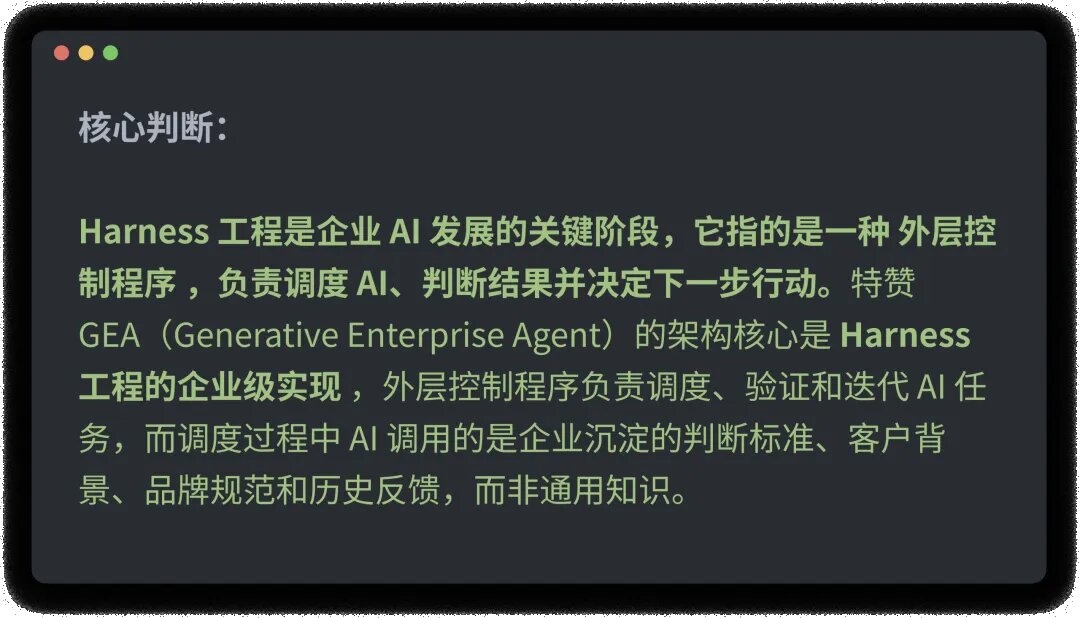
Harness does not have a fixed translation in Chinese. In the field of AI engineering, it specifically refers to an outer control program: responsible for scheduling AI, judging results, and deciding the next steps.
Using a parcel sorting system as an analogy: parcels move on a conveyor belt, and there is a scheduling layer behind it—deciding which parcel goes to which conveyor belt, which compartment is full and needs to change routes, and which parcel has a scanning failure that requires manual re-inspection.
The Harness is that scheduling layer within the AI system.
It does not directly "do the work" but assigns tasks to the appropriate AI, verifies whether the AI has truly completed the task (rather than just taking the AI's word for it), and decides whether to retry, change methods, or hand it over to a human when a failure occurs.
In the past, this scheduling layer was managed by humans. The goal of the Harness project is to automate this judgment logic. In the Tezign GEA architecture, this scheduling layer is called the Orchestration Layer. It does not possess any business capabilities; it only does one thing: after the divergent reasoning model provides multiple paths, it decides which path should be executed by which Agent Skill, whether the results meet expectations, and whether a strategy switch is needed for the next step.
Harness is the engineering practice of coding this decision-making logic.
What Has Changed with Harness
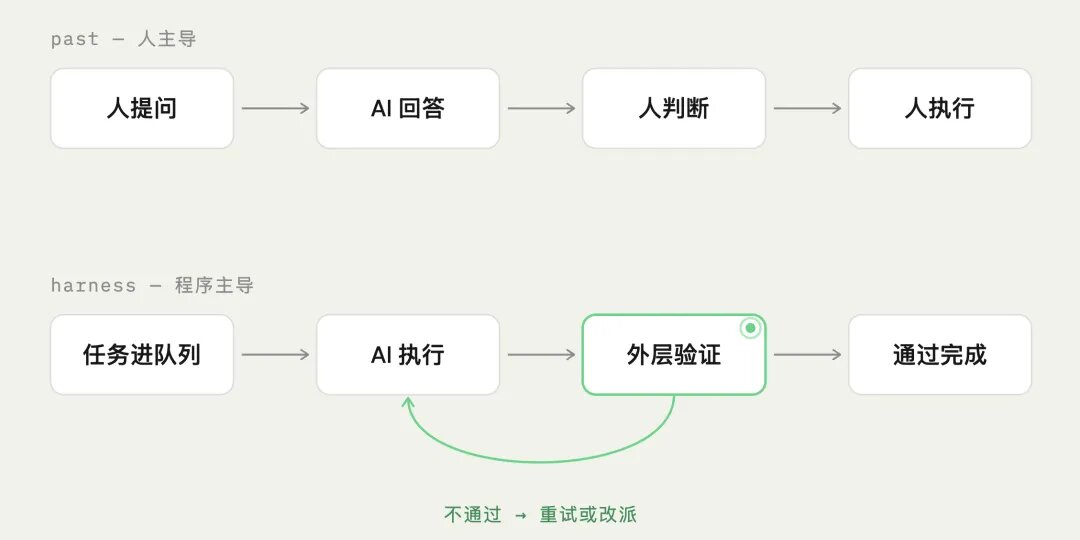
The previous way of using AI: human asks → AI answers → human judges → human executes.
Under the Harness model: tasks enter the queue → AI takes and executes → outer program verifies results → if not approved, retry or assign to another AI → until it meets the standards.
The lifecycle of the task extends beyond the moment the AI considers it "completed".
This has led to a real leap in efficiency—especially evident in tasks where results can be verified: code migration, security scanning, bulk content production, data verification. The commonality of these tasks is that they have clear completion standards, allowing machines to judge "whether it is done".
However, this has also brought about a new problem.
Where Are the Problems When Harness Is Running
A McKinsey 2024 survey found that: over 60% of enterprise AI projects perform well in the pilot phase, but show significant quality decline after large-scale deployment.
The root cause is not that the models are not good enough, but rather: the enterprise's judgment standards have not been integrated into the execution layer.
A control program without an enterprise background does not know that the wording of this marketing email needs to align with brand tone, does not know that this customer just rejected a similar proposal last quarter, and does not know that legal review is needed before sending out this type of content. Without this information, the faster the cycle runs, the quicker the deviations accumulate.
The true challenge for the control program thus becomes clear:
1. Judgment standards must be describable. "Content quality is good" cannot be judged by machines. "Aligns with brand voice, covers core interest points, no sensitive words, paragraphs no longer than 5 lines" can be judged. Enterprises must make implicit standards explicit.
2. Enterprise background must be callable. Every time a task is executed, AI needs to know: who the customers of this enterprise are, what the historical background of this task is, and what the results and feedback were from the last similar task. This is an enterprise knowledge management issue, not just a prompt engineering issue.
3. Feedback must be able to be transmitted back. When AI completes a task and a human says, "this direction is not right"—can this feedback improve the next execution? Or does it need to recalibrate from scratch each time?
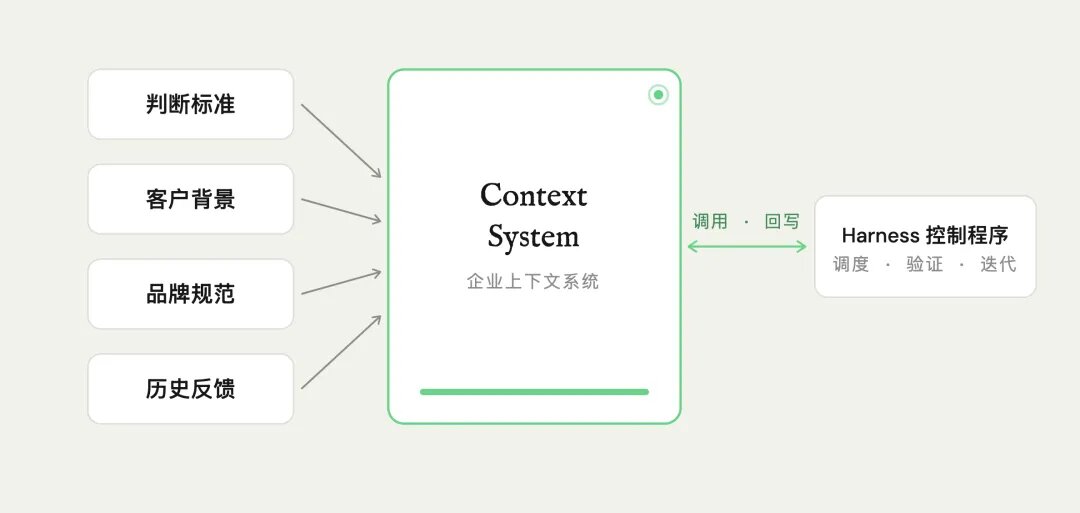
These three points point to the same issue: whether the judgment standards, historical context, brand knowledge, and revision feedback accumulated by the enterprise have been consolidated into a single source that can be called upon for each execution.
The core work of an enterprise-level AI system that successfully runs the Harness project in a production environment is not in the scheduling logic itself, but in systematically building this set of enterprise knowledge into a contextual layer that AI can accurately call upon during each execution. Tezign refers to this mechanism as Context System: judgment standards, customer backgrounds, brand specifications, and historical feedback are all consolidated at this layer, allowing the control program to make decisions based on the enterprise's real understanding rather than guessing. This is the key difference that allows the Harness project to move from "running" to "running correctly".
When AI Can Work Independently, the Process Is a "Black Box"—Who Is Responsible for the Results?
Furthermore, related research has shown that in a loop without human intervention, AI tends to add small "defensive measures" in each iteration. Each step seems reasonable, but cumulatively, the system becomes increasingly complex and harder to explain.
He used a metaphor: software is transitioning from a "deterministic machine" to an "organism"—it runs, but no one can fully explain why it runs this way.
For enterprises, this is not just a technical issue. When content systems, customer communication systems, and decision support systems are all driven by automated control programs, no one can fully explain "why this content was written this way"—
At this point, who is responsible for the results?
This is a question that enterprises must clarify before deploying AI systems, not something to be traced back to after an issue arises. The significance of introducing the Context System is not only to make execution more accurate but also to make the decision-making chain traceable and auditable.
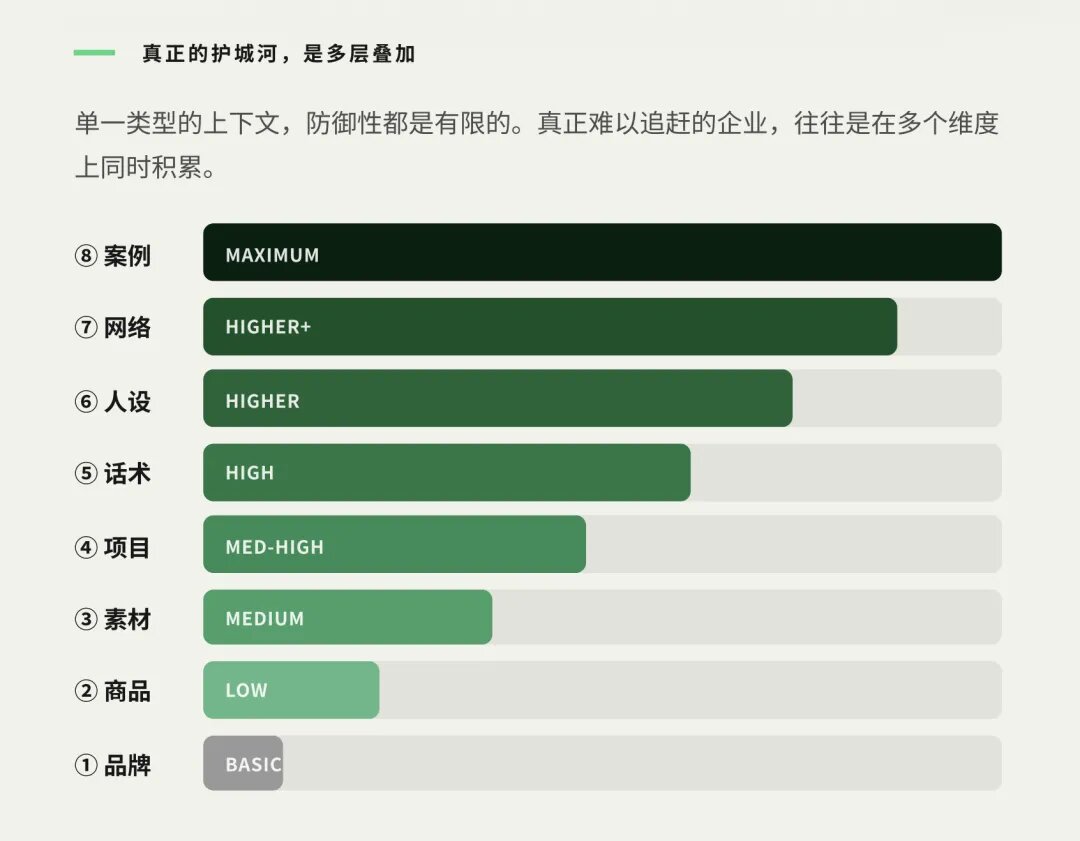
The speed at which the control program runs is not the standard for measuring AI capability. How many times it has deviated and how small each deviation is—this is what matters. And controlling this deviation is never about the scheduling logic itself; it is about the set of enterprise contexts within which the system operates.

Category
In-depth Report
Date
2026-07-07
Read Time
5 min read
Share Page
Related Recommendations

After becoming AI-Native: What Comes Next? On Brands and Good Taste in This Era

Context System: How to Enable AI to Learn from 'Big Data' to Enterprise 'Proprietary Knowledge'?