The Future Software is for Agents, But Is Your Business Ready?
Software is shifting from being designed for humans to serving AI Agents, with the core bottleneck being unstructured data. Tezign GEA uses the Context System to structure enterprise data, supporting precise AI calls and driving AI transformation.
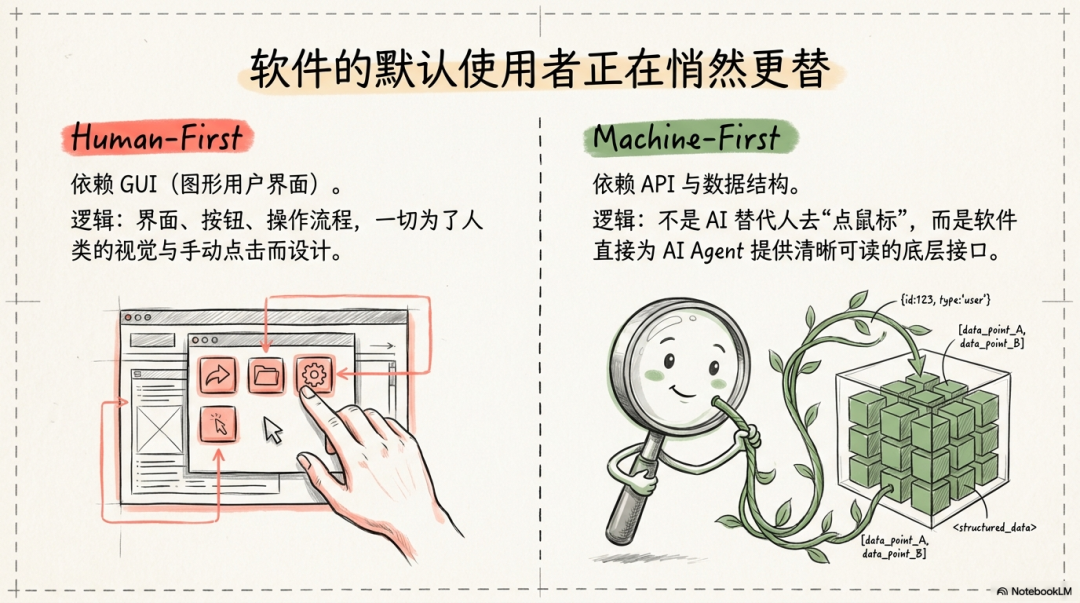
Software is ushering in its second interface era.
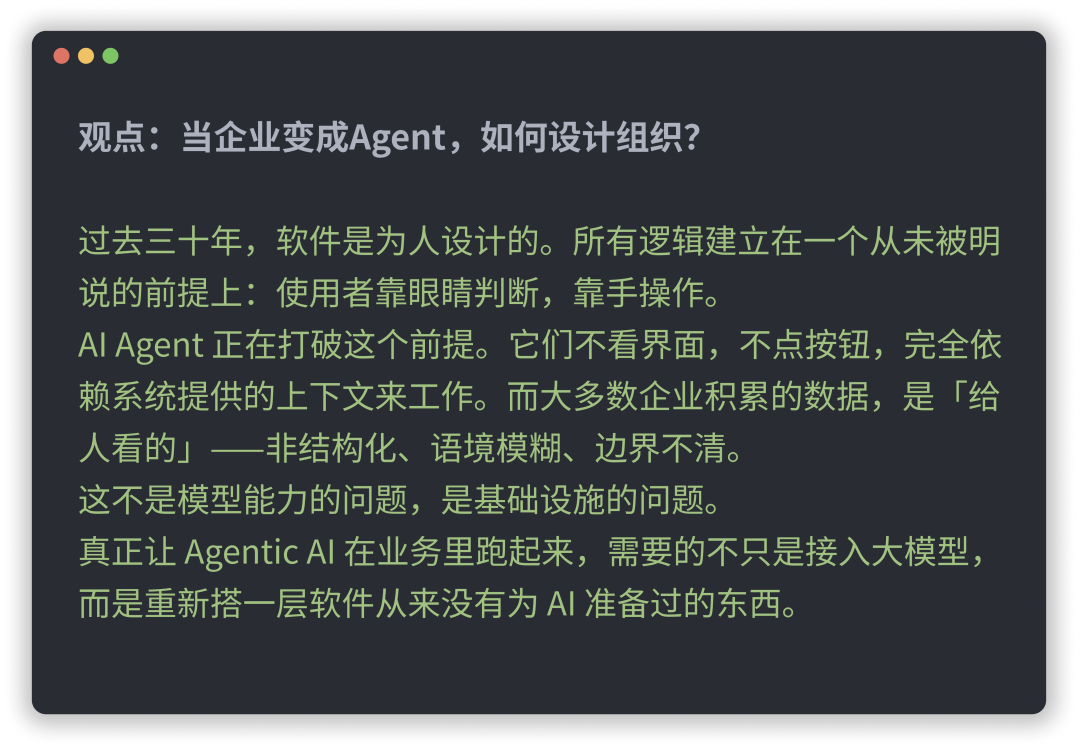
The first interface is for humans: graphical interfaces, click interactions, visual navigation. For the past thirty years, the design logic of all software has been based on an unspoken premise—users are human, relying on their eyes to judge and their hands to operate.
AI Agents break this premise. They do not look at interfaces or click buttons. To enable AI to truly call a system, software needs to provide something entirely different: clear field definitions, stable data structures, and predictable output formats. A GUI designed for humans is almost invisible to AI.
This does not mean that the original software is "not good enough." Rather, software has never been designed for AI use. This gap is becoming the most genuine obstacle for enterprises pushing for AI implementation.
Why AI Implementation is Difficult, Often Not Due to the Model
After enterprises procure large model capabilities, the most common dilemma is: AI generates output, but the output does not align with the business, or it cannot access the required data at all.
There is an easily overlooked mechanism here: the quality of AI's output is directly determined by the quality of the Context it receives.
When humans use software, if the information provided by the system is incomplete, they automatically fill in the gaps—relying on experience, memory, and judgment. AI lacks this ability. It completely depends on the content fed to it by the system: what the current state is, where the historical data is, and what the constraints are. If the Context is incomplete, the output will also be incomplete; this is not a problem that can be fixed by tuning parameters.
Most of the data accumulated by enterprises is "for human viewing"—unstructured documents, contextually ambiguous reports, and unclear content boundaries. This data is readable for humans but noise for AI. Platforms like Zapier and Make have seen rapid growth in demand over the past two years, essentially filling this gap: creating structured interfaces that AI can operate between various systems. But this is just a patch; the fundamental issue is that the way data is organized has never considered the scenarios in which AI would call it.
Taking brand content as an example: when an AI Agent needs to determine "what position this brand occupies in the industry," it must extract information from a large number of documents. Those white papers and case libraries, if they lack clear definitions and citation structures, will yield outputs from AI that are similar to random excerpts. Whether the content is well-written becomes a secondary issue. Structure is the prerequisite for AI to accurately call it. This is also the part of enterprise AI transformation that is most easily overlooked but reveals problems first.
The Infrastructure for AI Use, at Its Core, is Context System
Truly operational Agentic AI systems often share a common feature: they do not just connect to large models, but have built a structured context system between the large model and business data.
This system organizes the data accumulated by enterprises—research conclusions, brand judgments, customer cases, historical decisions—into a format that AI can accurately call. The knowledge accumulated from each project does not disappear when the project ends; instead, it settles down and becomes a starting point that can be directly built upon when the next task begins.
The Generative Enterprise Agent (GEA) architecture places the Context System at its core for this reason. The problem it solves is not "providing more data to AI," but "ensuring that the data AI receives is truly usable."
When enterprises procure software, the questions they need to ask are shifting from "what can this tool help employees do" to "can this system be effectively called by our AI workflows?" The answers to these two questions may be completely different.
Software is Just the Beginning; the Difficulty Lies in the Layer Behind
The traditional consulting approach—sending a team to diagnose and delivering a PPT—fails here. What AI transformation needs is not reports, but for the system to truly operate in the business. This is the underlying logic of what Tezign provides with its AI Full Stack:
The software layer allows AI to take over all aspects it can do better than humans—user insights, content production, innovation testing; the service layer only handles what AI cannot do, determining what is truly important, setting priorities, and driving the organization to shift from the logic of "using tools" to the logic of "transforming business units into intelligent agents."
The software layer does Intelligence, while the service layer does Judgment. Together, these two layers constitute what enterprises truly need for AI transformation.
The real threshold for enterprises to implement AI is infrastructure, not model capability. Whether data can be called, whether content can be extracted, and whether systems can be accurately understood by AI—these will not automatically be in place with the procurement of large models; someone needs to actively build them. The more challenging part comes afterward: once built, someone needs to accompany the enterprise through the entire organizational reconstruction process from "using tools" to "the business itself becoming an intelligent agent." This judgment is the aspect of AI transformation that is most easily underestimated yet most decisive for success or failure.
If you are advancing enterprise AI implementation, feel free to have an in-depth discussion with Tezign!

Scan the code to download the "Blueprint for Business Evolution in the AI Era"
Get more GEA practice cases
Learn about the enterprise paradigm in the Agentic AI era

Category
In-depth Report
Date
2026-05-08
Read Time
5 min read
Share Page
Related Recommendations

Where to Start for an AI Native Organization?

The Choice of an AI Native CEO: Hire a GEA to Manage the Team and Seize Opportunities