Two Weeks in Silicon Valley, Ten Truths
Tezign CEO Fan Ling shares observations on AI in Silicon Valley, pointing out that enterprise AI implementation focuses on value delivery, with context becoming a core barrier under model convergence, and new professions and design judgment becoming increasingly critical.

After spending two weeks in the Bay Area and attending NVIDIA's GTC, I met a lot of people. When I returned, friends asked about my takeaways. I thought about it and realized that some things that had always been vague became clear. I noted down ten points.

01. No one is saying "Wow" anymore
What surprised me most at GTC 2026 was not what was said on stage, but the expressions in the audience.
In 2024, everyone in the room had their mouths agape, and every demo received applause.
By 2025, applause had diminished, and anxiety had increased.
Jensen drew a beautiful roadmap: Generative → Inference → Intelligent Agents. But after the event, everyone was discussing the same question: So, how do we actually implement this?
Companies are no longer asking "Should we use AI?" but rather, "We’ve spent the money; why haven’t we seen results?" This is a completely different question.
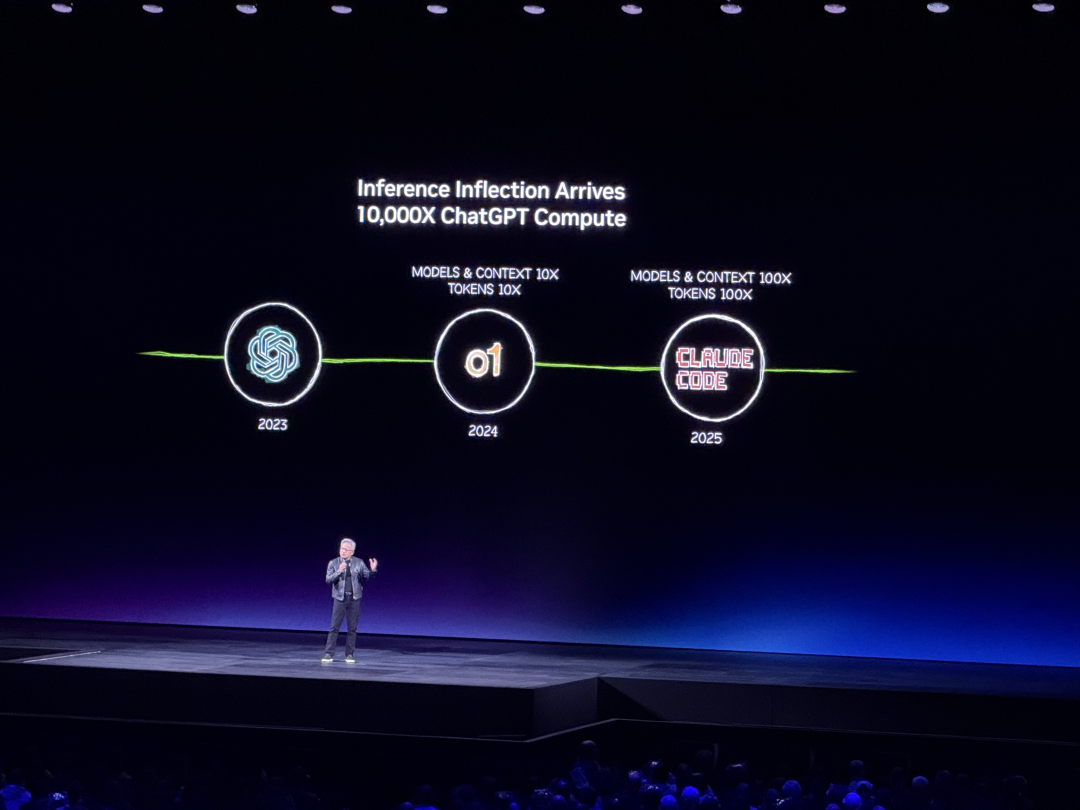
Jensen's three phases describe how technology evolves. I think there’s another axis missing—how enterprises actually adopt it, which can be divided into three categories:
Empowered (ai-empowered) — The work remains the same, but the tools are faster.
Native (ai-native) — This work cannot be done without AI.
Awakened (ai-awakened) — AI begins to create business value on its own.
Most enterprises are still in the first category. Their mindset is shifting—from “help me write” to “help me think” and finally to “help me do.” It is in this last step that the value lies. However, saying “help me do” is easier said than done; it requires truly integrating AI into the existing systems of the enterprise, not just adding another tool on the side.
What we are doingGEA (Generative Enterprise Agent) is addressing this issue. It’s not about creating diagrams or making PowerPoints, but about delivering business results.
02. Using AI has made me busier
I met with over a dozen heavy AI users—founders, engineers, investors—who all shared the same wry smile and said: “I’m busier than ever.”
The reason is simple. AI can provide you with an 80% solution in seconds. Most people see it and think it’s good enough to use. But truly exceptional individuals won’t settle for 80%—they finally see what 100% looks like and now have the energy to reach for that 100%, which makes them even busier.
The crowd has split into three categories:
Those who don’t use AI, leave work on time, and the world remains unchanged.
Those who use AI and accept 80% solutions are indeed faster.
Those who use AI and demand 120% are the most exhausted.
AI has not killed perfectionism. It has given perfectionism an engine.
So when speed is no longer the bottleneck, what is?
After thinking it over, it boils down to two words: Taste.
AI has made creating a product easier, but has made creating a good product harder. Because when everyone can produce quickly, the differentiator is not speed, but aesthetics. This aligns perfectly with Tezign's product philosophy—we are not using AI to speed up; we are using AI to create better things.
03. Some companies are already different
Some companies are implementing AI usage rates, while others are contemplating how to develop after everyone is AI-enabled. Anthropic aims to replace all entry-level knowledge work within 10 months!
It is rumored that Meta is planning to lay off at least 30% of its workforce. It’s not due to poor business—it’s because the numbers just don’t add up. A reasoning model can complete mid-level knowledge work with 80% accuracy and ten times the speed, and the bosses are not thinking about “should we lay off,” but rather, “what are these people actually doing now?”
What’s even more unsettling is that companies that have laid off employees have not worsened; in fact, they have improved. Output has increased, and cycles have shortened. The ones who remain are those who can command AI, not those who compete with AI on speed.
This has changed my understanding of service.
What enterprises need is no longer just a tool—but something that can directly deliver results. Tools combined with professional judgment, efficiency multiplied by a sense of value—this is Full Stack. What Tezign has always been doing has been amplified tenfold at this moment.
04. Models are like tap water,context is the location
I keep thinking about what Garry Tan, CEO of Y Combinator (YC), said:
“Instantly usable intelligence means that every dollar of capital contains more accumulated value than ever before.”
He then listed “things unique to humans”—taste, problem selection, trust, data rights, context, and knowing what people really want.
These are not just “human advantages”; these are new productive resources.
To put it simply. Models are now like tap water—available to every household, and the quality is roughly the same. So what determines what kind of building you can construct? It’s location. Context is the location. The type of context you accumulate determines what different things you can create with the same model.
The next battle is not a model competition, but a context competition.
Models are powerful, but no single one will dominate. A company will not automatically achieve better results just by switching to a better model—when everyone can use the best model, the context you have is the real barrier.
05. Jobs have not disappeared; they have just fragmented
There’s a set of data that left a deep impression on me: tech jobs fell 45% from their peak in 2022, but rose 16% again by early 2026.
What does this mean?
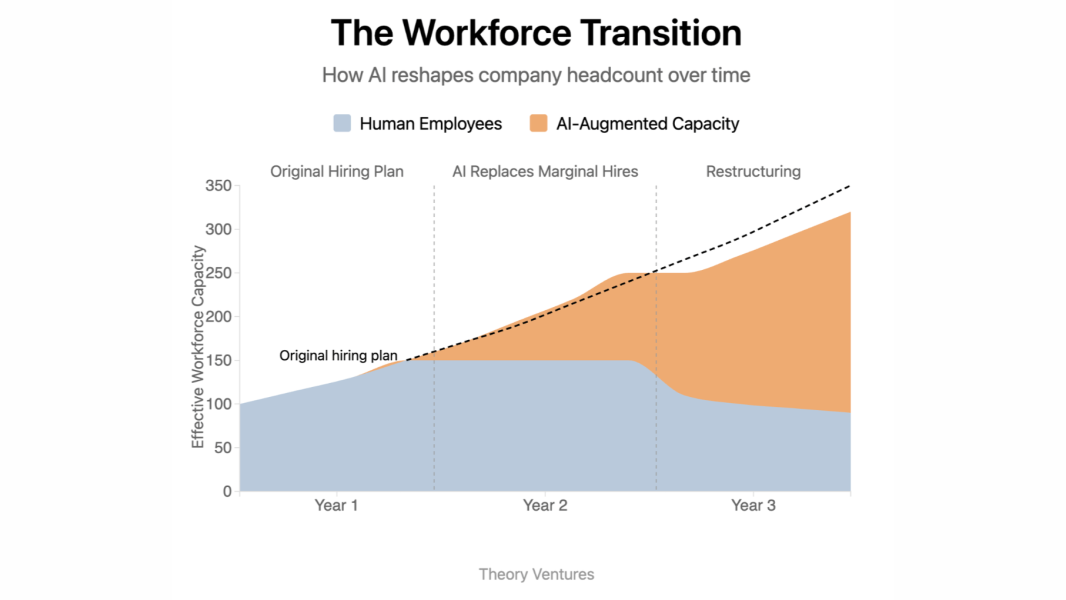
Companies are smaller, but there are more of them. Roles have changed, but there are more types. Jobs have not disappeared—they have just become more fragmented. A team that used to have six people has turned into one person plus a group of Agents. Marginal employees have been replaced by marginal Agents, but those who can provide judgment, taste, and trust have become more valuable.
I often think of 19th-century farmers; if you told them “UX designer,” they wouldn’t understand. We are now at the same moment. The most important positions in 2035 don’t even have names yet. But I don’t want to wait for them to emerge; I want to create them.
For example, “Context Builder”—someone who specializes in building and maintaining enterprise context for AI systems. This role didn’t exist three years ago, but the demand is already very real.
06. The premium of AI between China and the US is reversed
There’s something I’ve thought about for a long time, and I finally figured it out: The premium of AI business is reversed between China and the US.
In China, the premium is on the C-side. With 1.4 billion people, low patience, and unlimited substitutes—consumer-grade AI products that can survive in this environment are all “scarred,” but they are also full of experience. Chinese C-side AI products are battle-tested.
In the US, the premium is on the B-side. Trust, compliance, procurement processes, integration depth—American companies pay for certainty, are generous, have long cycles, but the LTV is on a completely different scale.
So where is the real structural opportunity?
Delivering the practical capabilities honed in the Chinese consumer market to global clients in an enterprise-grade manner. This space is huge, but almost no one is doing it.
AI applications of China for Global are not just sentiment; they are structural opportunities.

07. Evaluation is severely underestimated
The American market places far more importance on evaluation (Eval) than I expected. It’s not just “let’s test it after it goes live”—it’s treated as an independent track for investment, development, and competition.
The reasoning is quite simple. The gap between an impressive POC and a reliable launch is almost entirely due to evaluation. Did the Agent really do it right? Have you compared it with other solutions? Can you use data to persuade the procurement committee?
LLMArena has turned general model evaluation into a community platform. But there’s a big gap—no one is evaluating the output of vertical domain Agents. Everyone is comparing “which model’s code is better,” but no one is comparing “which Agent provides more accurate consumer insights.”
For enterprises, evaluation is the critical “final push” from POC to systematic launch. We are already building this system, but I didn’t realize it was such an important industry in the US.
08. Annotation is dead; teaching is eternal
For the past decade, “human data” has meant annotation—labeling images, sentiment analysis, drawing boxes. Binary, fragmented, cheap.
Now it has changed.
The new human data is called teaching. It’s not about telling AI “this is a cat,” but showing it how an expert does something well. 10 steps, 20 steps, 50 steps. Correcting it during the reasoning process, demonstrating what judgment looks like, providing it with dense, orderly, context-rich human demonstrations.
A labeled image is worth a few cents, but a 50-step expert interview demonstration is worth thousands—because synthetic data cannot produce such things.
The winners in the Agent era will not be the companies with the strongest models, but those that have accumulated the most human demonstration data in their fields.
Tezign has accumulated a wealth of creative solutions and professional processes—these are multi-step decision-making chains, not one-step annotations. Through mechanisms like Skill, they all have the potential to become truly valuable Human Data.
09. The new world has already started paying salaries
Positions that were unheard of two and a half years ago keep appearing.
Growth Engineer: A person who executes growth experiments end-to-end, writing code, deploying Agents, analyzing data, and iterating, completing the loop in an afternoon. Previously, it required 1 PM + 1 designer + 1 analyst + 3 engineers; now it’s one person plus a group of Agents, with equivalent output and five times the speed.
Model Behavior Engineer: The value of prompt engineering is declining, and this is its successor. The responsibility is to shape how AI “behaves” in thousands of conversations—spanning product design, psychology, and MLOps. When the product itself is an Agent, its tone, judgment boundaries, error patterns, and when to hand over to humans collectively shape the user experience.
Both roles share a common point: one person has taken on the functions of an entire team, and the core competency is less about technical depth and more about taste.
Great eras will inevitably give rise to new positions. In previous years, we talked about FDE, and now roles like Growth Engineer and Model Behavior Engineer are emerging—these are not just concepts; real people are working under these titles. Tezign is also actively developing these roles. Waiting for others to define them first will be too late.
10. Design is making a comeback
The last surprising thing.
I found that the topic of design is returning to the core of AI conversations. It’s not the “design thinking” from corporate training PPTs—it’s serious discussions about taste, judgment, and aesthetics.
Why?
Because when AI can generate anything, the question of “what should exist” becomes a design issue; when AI can simulate any user, understanding what people “really want” is also a design issue; when the cost of building approaches zero, “deciding what is worth building” becomes the most expensive judgment.
The past saying was: designers use AI to reduce costs and increase efficiency. Now it has reversed—design methods must be used to solve AI problems.
This is not an extension of design. This is a new frontier of design.
I have worked at the intersection of design and technology for ten years, and to be honest, I have never felt this position to be as critical as it is today.

A takeaway from this trip
The current Silicon Valley is a kind of “productive confusion.” Everyone agrees that AI will change everything, but there is no consensus on how it will change.
But I am increasingly convinced of one thing: the winners of the next decade will not be those with the strongest models, but those who understand people best—understanding how people think, hesitate, and make decisions—this is the most scarce ability in an age of surplus intelligence.
After two weeks, my biggest realization is actually an old saying: A map is not the territory.
In the realm of AI, most people are still navigating with old maps.
It’s time to draw new ones.
— Fan Ling, CEO of Tezign, founder of Atypica.AI

Category
In-depth Report
Date
2026-04-02
Read Time
10 min read
Share Page
Related Recommendations

AI Can Work on Its Own, Who Manages It? The Harness Project for Enterprise-Level AI

After becoming AI-Native: What Comes Next? On Brands and Good Taste in This Era