What Skills Everyone is Talking About, What Can’t They Do in Enterprise AI Applications?
AI architecture is shifting towards executing actions, but the more Skills there are in an enterprise, the harder the system becomes to use. Skills are responsible for execution and need to be organized and scheduled reasonably; their value lies not in quantity but in efficient management, which is key to AI advancement.
Core Concept: What are Skills?
In the current AI and Agent architecture, Skills usually refer to:
Execution capabilities encapsulated as independent units that can be called by AI Agents on demand.
A Skill is neither the model itself nor a complete Agent, but rather an "execution layer" that lies between the two. This same idea can be seen in OpenAI's Tool / Function Calling mechanism and Anthropic's Agent architecture discussions: the model is responsible for understanding and reasoning, while Skills are responsible for actually getting things done.
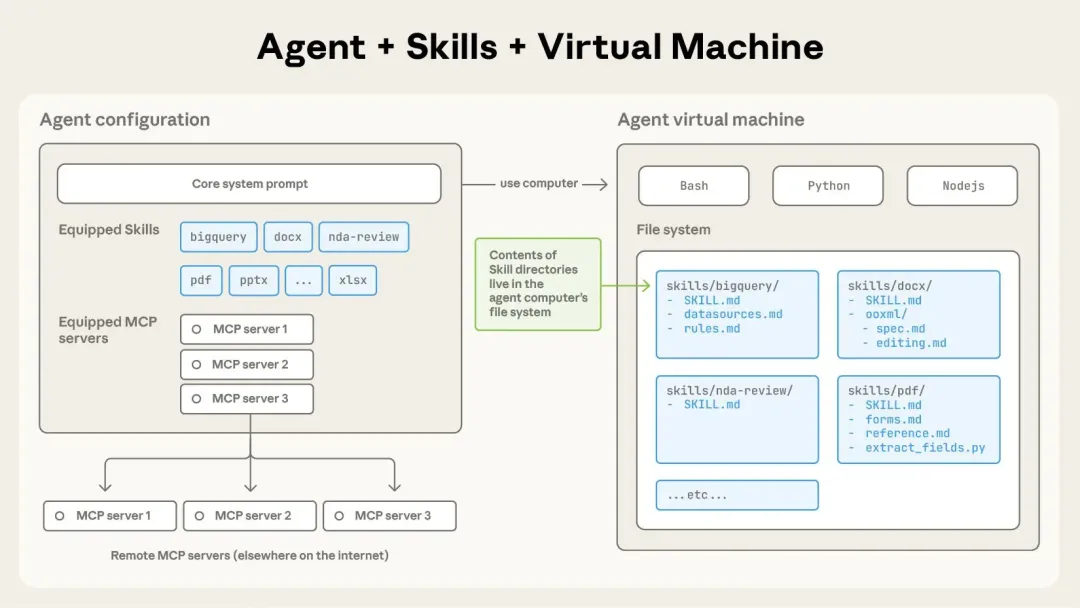
*A skill is a directory containing a SKILL.md file that contains organized folders of instructions, scripts, and resources that give agents additional capabilities.
This article references: Equipping agents for the real world with Agent Skills
Recently, almost all mainstream AI architectures have emphasized this point: AI is no longer just about "generating answers"; it is starting to execute actions, operate systems, and link processes through Skills. However, an increasingly obvious problem is emerging in enterprise practice:
The more Skills AI has, the harder the system becomes to use.
To understand this contradiction, we must first return to a fundamental question:
What exactly are Skills? What role do they play in AI systems?
Why are Skills a Core Component of AI Agents?
Models are not suitable for handling all execution details
As model capabilities have increased, a consensus has gradually formed in the industry:
Models are very good at understanding complex problems, but they are not suitable for directly handling all execution details.
The role of Skills is to separate execution from the model:
• Reduce model complexity • Improve system stability • Allow capabilities to be replaced and upgraded
Enterprises need capabilities that can "integrate into systems," not one-time answers
In an enterprise environment, whether AI is usable depends on:
• Whether it can integrate with existing systems • Whether it can be constrained by permissions, audits, and compliance • Whether it can be reused stably
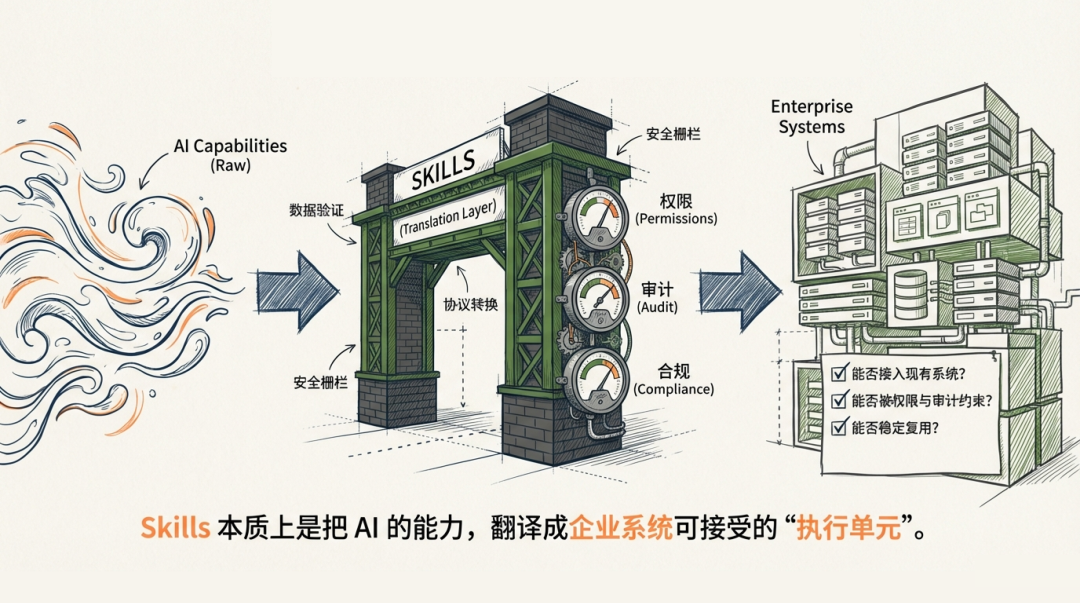
Modularizing capabilities is a prerequisite for scaling AI usage
When AI is used by multiple people and departments:
• Temporary Prompts • Impromptu logic
Will quickly become ineffective.
Skills provide:
• Reusability • Versioning • Rollback capability
This is also the fundamental reason it has become an industry consensus.
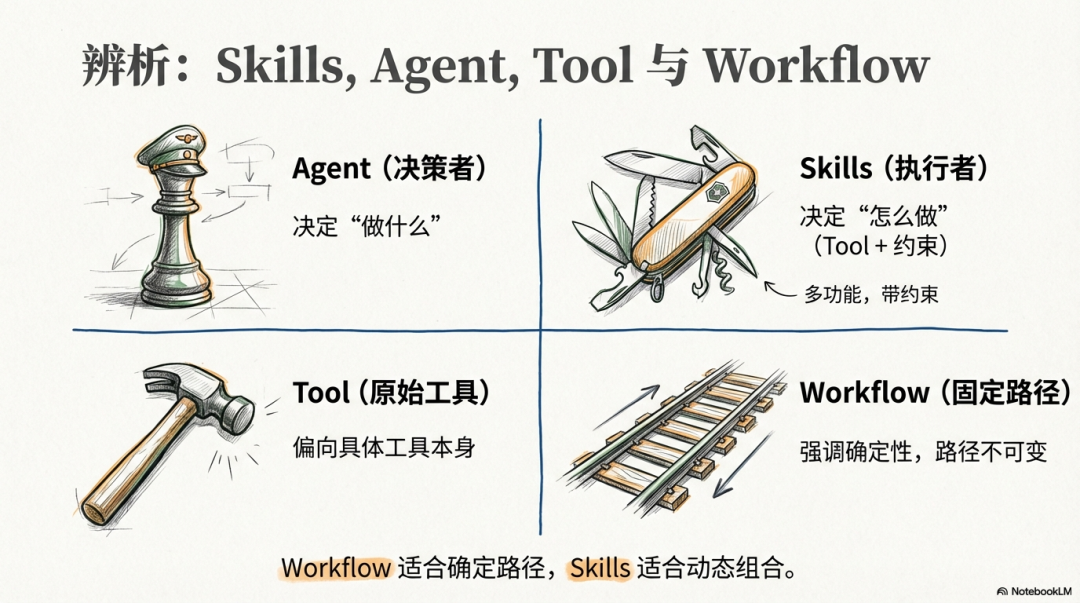
What are the differences between Skills, Agents, Tools, and Workflows?
This is one of the most frequently asked questions.
Skills vs Agent
• Agent: has goals, has state, makes decisions • Skills: Execution capabilities called by the Agent
The Agent decides "what to do," while Skills decide "how to do it."
Skills vs Tool
• Tool leans more towards specific tools • Skills typically = Tool + Usage Method + Constraints
Skills are "encapsulated action capabilities."
Skills vs Workflow
• Workflow is a fixed path • Skills are execution atoms that can be dynamically combined
Workflow emphasizes determinism, while Skills emphasize flexibility.
Common FAQs
Q1: What is the difference between Skills and AI Agents?
A: The Agent is responsible for decision-making, while Skills are responsible for execution. The Agent decides "what to do," while Skills decide "how to do it."
Q2: Why can't we rely solely on stronger models?
A: Models excel at understanding and reasoning, but enterprise execution requires controllable, auditable, and reusable capabilities, which is precisely the role of Skills.
Q3: Will Skills replace Workflows?
A: No. Workflows are suitable for fixed paths, while Skills are suitable for dynamic combinations; the two serve different problems.
Why does having more Skills make AI systems harder to use?
This is the most common confusion in enterprise practice.
When the number of Skills is very small, the calling logic is simple; when the number of Skills grows to dozens or hundreds, the problem becomes:
• Which one should be used? • Is it really necessary to use it? • How to choose when multiple Skills conflict?
If these questions are left entirely to the model to decide on the fly, the system's behavior will become unpredictable.
So where is the core of the problem?
Skills themselves are not "decision units"
A key fact is:
Skills inherently answer "how to do it," not "whether to do it."
They do not understand:
• Current business objectives • Risk boundaries • Long-term consequences
Therefore, the more Skills there are, the higher the requirements for judgment and scheduling.
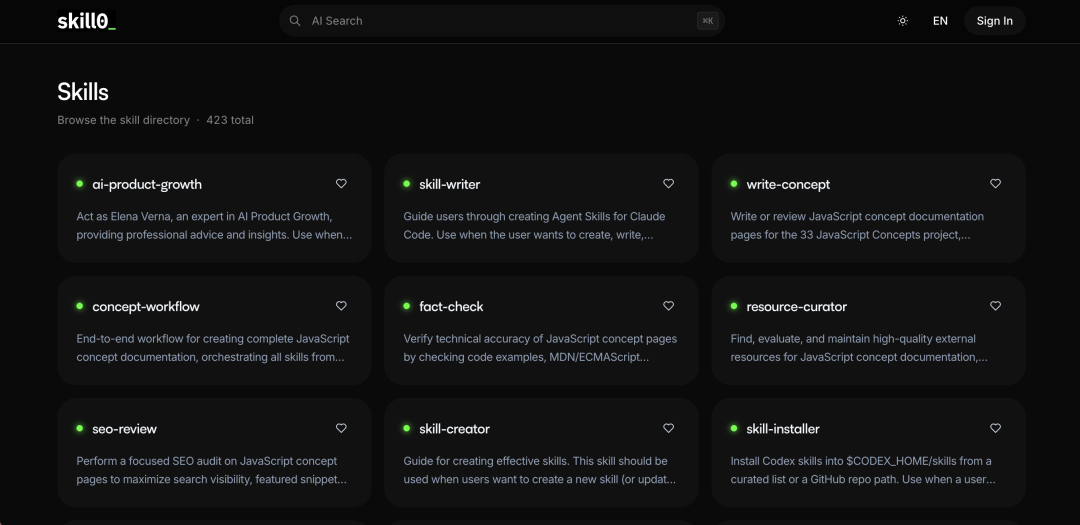
In some practical engineering explorations, especially in the long-term exploration of atypica.AI, the team began to realize an issue: when the number of Skills grows to a certain scale, the challenge is no longer about "writing another Skill," but about how to make these capabilities discoverable, reusable, and safely callable. In the practice of Tezign, we try to turn scattered Agent Skills into an indexable and manageable capability set to carry the descriptions, versions, and reuse relationships of these execution units 👉🏻skill0.io.
What is the true value of Skills?
From a system perspective, the value of Skills can be summarized in one sentence:
The value of Skills lies not in quantity, but in whether they are organized and scheduled correctly.
In a mature enterprise AI architecture:
• Skills do not determine behavior • They are merely execution resources • Behavior is determined by judgment and context
Skills address the question of "Can AI get things done?" while what enterprises truly care about is: Should AI get this done at this moment?
When capabilities are no longer scarce, how to organize, constrain, and schedule execution,
becomes a key step for AI to transition from a tool to a collaborator.
Category
In-depth Report
Date
2026-02-24
Read Time
5 min read
Share Page
Related Recommendations

The Most Valuable Knowledge in a Company Has Never Been Recorded

Is AI Overconfident, or Is It All an Illusion? How to Solve the ROI Dilemma of Enterprise AI