Two World Models
Tezan Fanling proposed the 'Two World Models': using the subjective world model to understand user contradictions and the enterprise world model to activate content, combining them into the GEA autonomous business intelligence entity.
Everyone is using AI to replace humans.
We use AI to understand people.
A 28-year-old white-collar woman in Shanghai wrote on Xiaohongshu: "I am a rational consumer." She explained that she buys skincare products "only looking at the ingredients, not the brand." But in her internal priority ranking—if her friends are using La Mer, she doesn't want to pull out a cheaper alternative. In the end, she bought La Mer but posted a note recommending it as a "ingredients-focused" choice.
What she says, thinks, does, and shows are four layers that contradict each other. But this is precisely what a real consumer is. A non-contradictory persona is fake.
The question is: Is there a model that can accommodate these four contradictions simultaneously?
Understanding People with AI
Wittgenstein once said: The limits of my language mean the limits of my world.
Conversely, if one can fully describe a person using language, it is equivalent to entering their world.
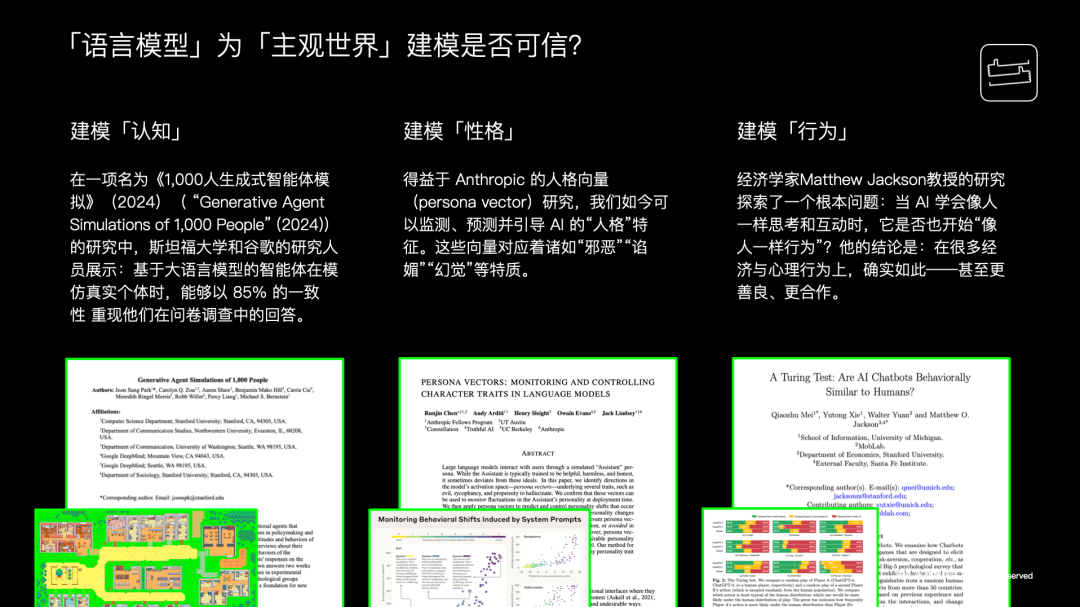
Academic progress is validating this path. Stanford University and Google have built 1,000 AI "digital avatars" to answer surveys in place of real people. The match rate between AI and real people reached 85%—and the consistency of the same person retaking the survey two weeks apart is not much better.
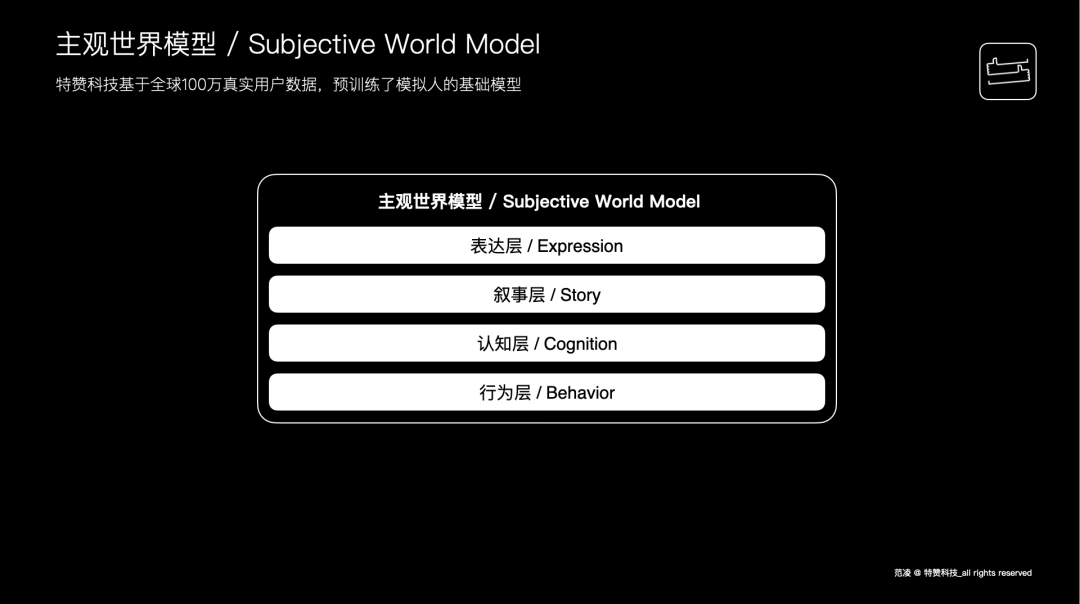
Based on data from 1 million real users worldwide, we trained a foundational model—the "Subjective World Model." It describes a person through four progressive layers:
Expression layer—what they said.
Narrative layer—how they explain themselves.
Cognitive layer—what they truly care about internally.
Behavior layer—what they ultimately did.
Only a model that can accommodate contradictions deserves to claim it understands people.
User Insights Should Be a Continuous Capability, Not a Project
No company would admit it is not user-centered. But the reality is: Most companies still understand users by conducting quarterly research, or even once a year. Those reports eventually lie quietly in drawers, never to be revisited.
We have productized the subjective world model into Atypica—an AI-native user research platform. In the past, conducting a survey with a thousand participants required weeks and a six-figure budget. Through Atypica: Speed increased by 100 times. Cost reduced by 100 times. Coverage expanded by 100 times. User insights should be a continuous capability, not a project.
A maternal and infant brand found that young mothers say, "I only buy cost-effective products," but the purchase data shows they repeatedly buy the most expensive products. Surveys cannot solve this problem—they can only capture the layer users are willing to express.
Atypica allows AI to engage in deep conversations with 2,000 real users—asking follow-up questions like a friend, delving deeper until reaching the true decision logic.
But a more critical step is: Consumer decisions are never made by one person alone. What does her husband think? What does her mother-in-law say? What are her friends recommending? We model multiple roles within a family as AI Personas, allowing them to converse, debate, and compromise in simulated scenarios.
The mother says "cost-effectiveness," but when her mother-in-law states, "You can't skimp on the child's things," her choice immediately flips.
This is not a report—this is a living consumer cognition system that can be repeatedly invoked.
Enterprise World Model: From Managing Content to Empowering Decisions
Jack Dorsey recently wrote an article titled "From Hierarchy to Intelligence." His insight is sharp: The core function of middle managers is not to make decisions, but to convey "context." This information routing mechanism has not changed for two thousand years, from Roman legions to multinational corporations.
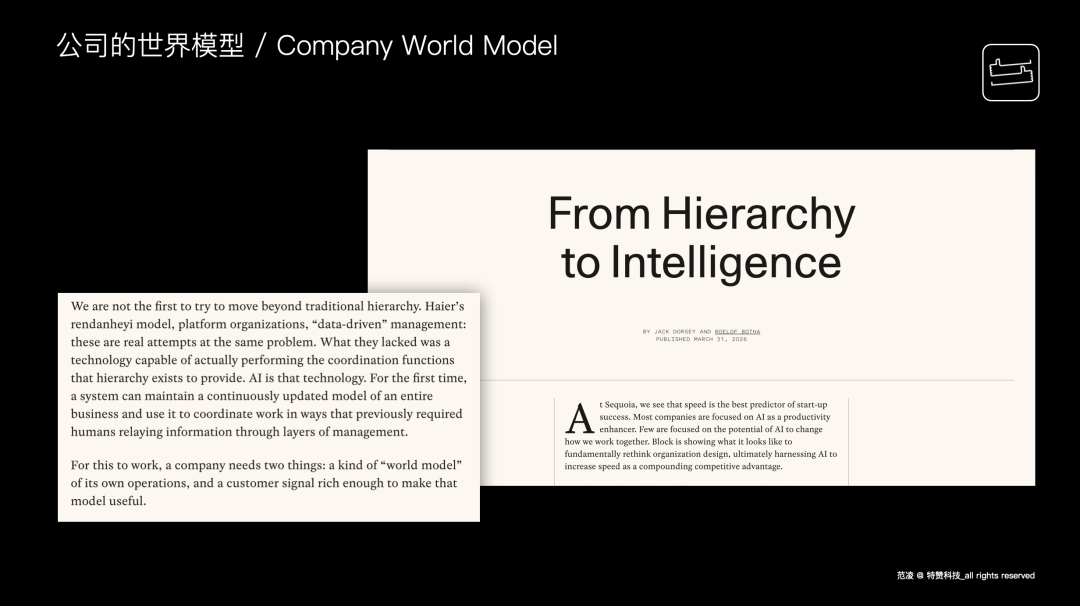
Large language models have, for the first time, made it possible for AI to take over this task.
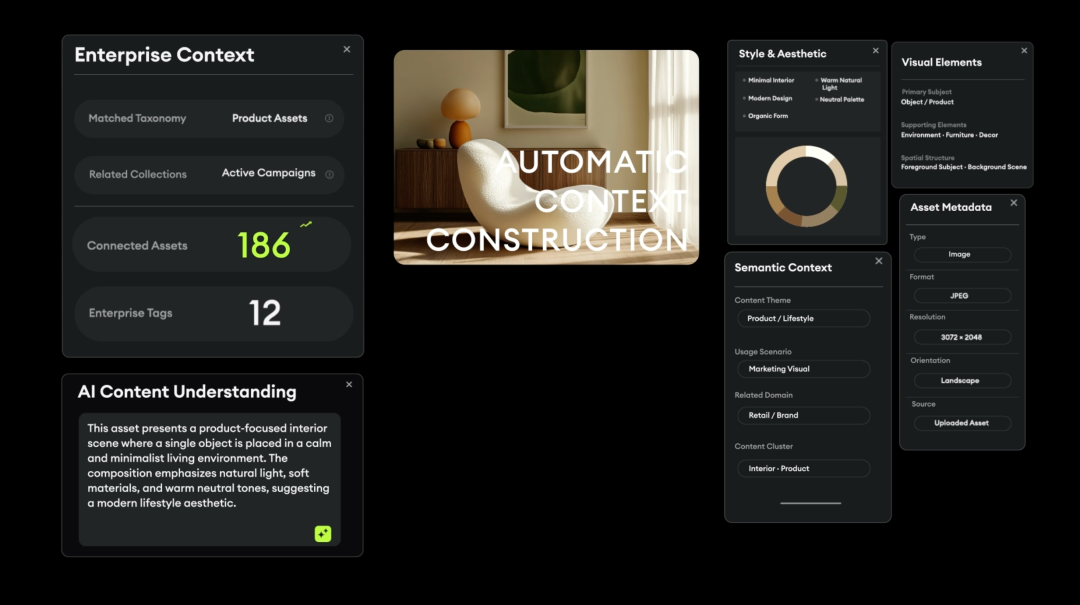
Where does the enterprise world model come from? It already exists, just scattered everywhere. Research reports, design drafts, advertising videos, user feedback… A key insight hidden in a report from three years ago may be highly relevant to today's new products—but no one remembers it.
Over the past decade, Tezan has helped enterprises manage vast amounts of creative content—we call it the "content system." But we gradually realized: Context is the goal, and content is merely a means to convey context. When unstructured content is understood and activated by large language models, it upgrades from "content assets" to "cognitive assets." This is the evolution from content systems to context systems: from "managing content" to "empowering decisions."
When the results of each decision are recorded, and every success and failure becomes new cognition—it transforms into a continuously self-evolving enterprise world model.
When Two World Models Meet
"World models" are a computable and inferable description of complex systems. Humans are complex systems, and so are enterprises.
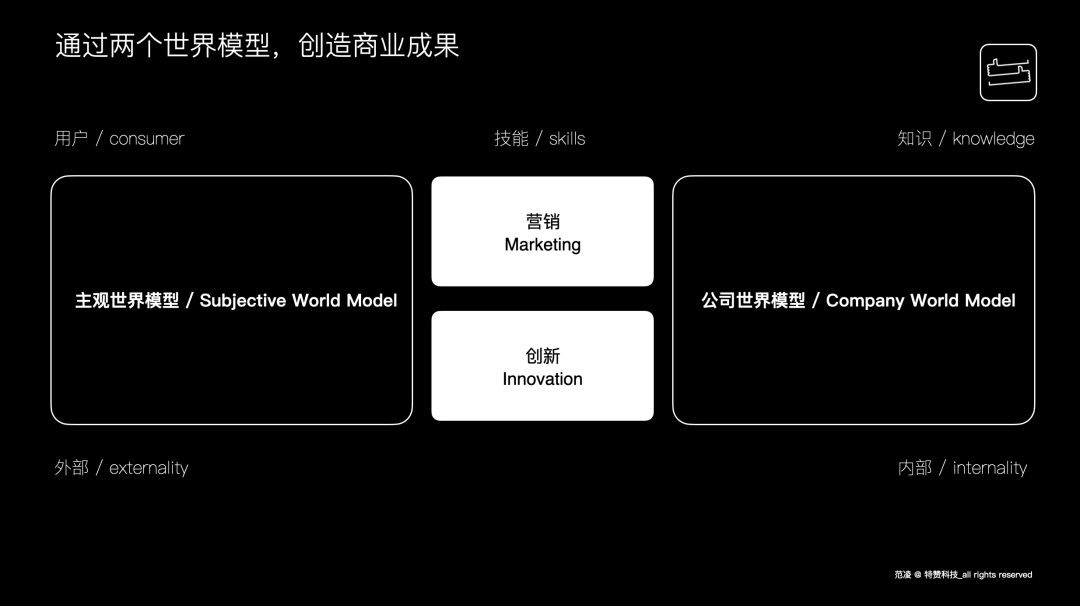
Subjective world model—from the outside in: understanding who the user is, what they want, and why they do it.
Enterprise world model—from the inside out: understanding who they are, what capabilities they have, and what cognitions they have accumulated.
When both intersect within the same system, we obtain a self-operating business intelligence entity—GEA (Generative Enterprise Agent).
A world-renowned food group is one of the first users of GEA. It operates autonomously 24/7: scanning global industry trends, automatically generating new product concepts, and then using AI Personas to simulate consumer validation. Humans only need to provide judgment at key points.
Business begins to operate like an intelligent entity.
We Choose to Answer Another Question
Most discussions about AI implementation focus on the supply side—how to do things faster, cheaper, and more efficiently. Text auto-generation, instant image output, self-writing code, 24/7 customer service responses.
The end of this path is already visible: As the marginal cost of production approaches zero, supply is no longer a barrier. What you can do, your competitors can also do, just as quickly and just as cheaply.
So what determines who wins?
It is no longer about "how to do it," but "what to do." What products to make, for whom, and why this one and not that one. The essence of these questions is understanding demand.
The answers are not in the existing data. They lie in the silent parts of users, in the forgotten corners of enterprises, and in the collisions that have yet to occur between the two.
The subjective world model understands people, the context system understands enterprises, and GEA allows the two to continuously collide and evolve autonomously. This is the system that Tezanis building—not to make decisions for people, but to help them see the possibilities that have yet to be considered.
Tezan's vision is "to empower the imagination of business and society with technology."
AI is not only about machines producing more but also about bringing business closer to people.
Recently, I was a guest on @Shen Shuai Bo, discussing AI-native organizations, how enterprises can transform, how organizations can change, and why context is the real barrier. The complete podcast content is welcome for everyone to listen to👇🏻
Category
In-depth Report
Date
2026-05-22
Read Time
6 min read
Share Page
Related Recommendations

After becoming AI-Native: What Comes Next? On Brands and Good Taste in This Era

Context System: How to Enable AI to Learn from 'Big Data' to Enterprise 'Proprietary Knowledge'?