AI Implementation: 70% of Challenges Are Not Technical, But Organizational
At WAIC 2026, Tezign showcased the GEA Enterprise Intelligent Agent, with founder Fan Ling proposing the AI implementation 1:2:7 rule, emphasizing organizational adaptation as the core, and simultaneously launching a subjective world model to deepen user understanding.
Unlike previous years, the 2026 World Artificial Intelligence Conference, which opened yesterday, saw the most lively discussions not centered on 'whose parameters are larger,' but rather on 'Has AI been implemented?' and 'Is it really useful?'. Embodied robots are now on automotive production lines, AI systems are entering mine safety monitoring, and enterprise-level intelligent agents are helping consumer goods companies reduce user research cycles to one-tenth of the original time... A clear signal is that AI is moving from technical demonstrations to real business applications.
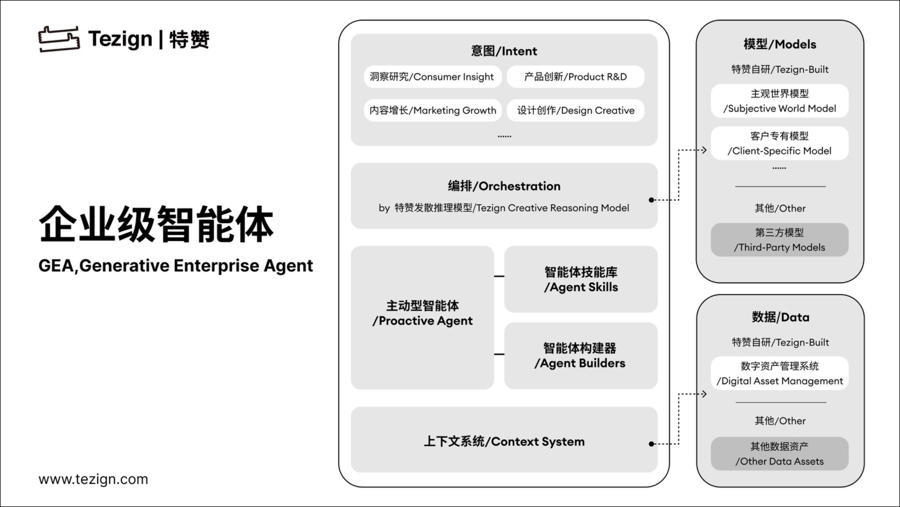
This year, Tezign Technology presented at the conference with the theme 'Digital Forest'. Its core product, GEA (Generative Enterprise Agent), covers four product lines: insight research, content growth, design creation, and product innovation, and has achieved large-scale deployment in industries such as consumer goods, fast-moving consumer goods, and technology exports.
The so-called 'Digital Forest' is a vivid metaphor—different AI intelligent agents operate independently within the same corporate context, connecting with each other to form a continuously growing enterprise intelligence ecosystem, rather than being one-off tools. So far, Tezign has served over 180 enterprise clients, including more than 60 Fortune Global 500 companies, with over 1 million professional users on the platform, and products operating in more than 50 countries and regions worldwide.
Fan Ling, founder of Tezign Technology, is also a professor at Tongji University and director of the Design Artificial Intelligence Laboratory. He started his entrepreneurial journey as a scholar in 2015, focusing on the symbiotic relationship between humans and AI. He proposed that 70% of the challenges in AI implementation are not technical but lie in the adaptation and adjustment of people and organizations—'the reshaping of organizational processes and the enhancement of human capabilities require patience.' He also emphasized that the more capable AI becomes, the more valuable human judgment, aesthetics, and taste become.
During a live broadcast, Fan Ling outlined the evolution of generative AI over the past few years in three stages:
The 'Conversational' stage represented by GPT, the 'Reasoning' stage represented by DeepSeek, and the current 'Capable' stage where AI can operate computers and autonomously complete tasks. 'The shift from being able to converse to being able to work is, in fact, a change from AI being able to talk to you to really helping you get work done,' he said. This change significantly amplifies the energy of ordinary individuals—what used to require many functional collaborations can now be handled by AI taking on multiple roles, 'filling in the gaps of human shortcomings.'
However, he added a note of caution to this optimism. He summarized a 1:2:7 ratio in his research: in the weight of whether AI can truly be implemented in industry, model capability accounts for 10%, industry-specific data accounts for 20%, and the adaptation and adjustment of people and organizations account for 70%. 'The seven may involve organizational adjustments, enhancements in human capabilities, and the reshaping of processes. Our current stage needs to address that 7 before we can achieve true industrial implementation.' He referenced the historical transition from steam engines to electric motors, which took about 30 years, saying, 'This requires patience, the kind of patience reflected in the 1:2:7 ratio.'
At Tezign, Fan Ling is putting this judgment into practice in their products. The self-developed enterprise-level intelligent agent GEA (Generative Enterprise Agent) is fundamentally about transforming the content assets, decision-making experiences, and business contexts accumulated by enterprises over the years into 'corporate memory' that AI can truly utilize, allowing the intelligent agent to provide specific services for the concrete business objectives of specific enterprises rather than generating generalized content. Since its launch in April this year, GEA has already covered four product lines: insight research, content growth, design creation, and product innovation, currently serving over 60 Fortune Global 500 companies, with over a million professional users on the platform. This time, Tezign also brought the practices from various industries to the exhibition site of the 2026 World Artificial Intelligence Conference.
This is also where Tezign's competitive barrier lies: it is not about competing on model parameters, but rather accumulating context that is difficult to replicate in the business scenarios of each enterprise. Recently, Fan Ling led the team to train another model—the 'Subjective World Model'—which also points to the same logic: it is not about statistically analyzing user click behaviors, but rather about trying to help AI understand a person's intrinsic motivations, preferences, and cross-context judgment methods. 'This also deserves our reflection: when AI can do many things, what is our role as humans? Humanity, aesthetics, and taste become the foundation that distinguishes us from machine intelligence.'
'I hope AI understands humans rather than engages in internal competition,' Fan Ling said. This statement reflects his research direction and serves as a reminder to the entire industry.
(Source: Shangguan News Author: Xinmin Evening News Zhang Jiongqiang)
Category
Media & Press
Date
2026-07-22
Read Time
4 min read
Share Page
Related Recommendations

Witness the WAIC Model 'Mind Reading'! Live Event is on Fire

On the first day of WAIC2026, you’ll understand why tickets are hard to come by after visiting these booths