Design Creation GEA: From Design Execution to a Continuously Evolving Brand Expression System
Tezign GEA is a brand expression system that assetizes brand knowledge, models brand genes, generates design assets at scale, and evolves them continuously, driving efficient consistency and sustained evolution of brand expression.
For a long time in the past, design has been a highly centralized practice: a single brand manual and a set of visual specifications were uniformly implemented by the design team.
Today, however, the scenarios of brand expression have undergone fundamental changes. They now span social media, e-commerce pages, offline venues, short-video content, as well as diverse countries and markets. The scope of expression scenarios has expanded dozens of times, and design participants have grown from a single team to multiple departments, cross-regional teams and external creators.
This gives rise to a core contradiction: brands require a high degree of consistency while needing to continuously generate new expressions.
In real enterprises, design creation has evolved into a complex yet fragmented workflow. The process — from demand understanding and design direction setting to design asset production and asset operation — is often scattered across different teams and tools, relying heavily on manual alignment and empirical judgment.
Enterprises do not lack design capability. What they truly lack is a systematic capability that enables brand expression to operate and evolve sustainably.
Core Technology: A Brand Gene-Driven Design System
The core of Design Creation GEA is not merely generating individual design works, but building a sustainable operating system that integrates brand knowledge, design production and asset evolution.
Under the GEA architecture, design creation is collaboratively driven by the Context System, Creative Reasoning Model, and Proactive Agents, forming a closed-loop workflow from brand genes to design assets.
Centered on this framework, Design Creation GEA establishes four core technical capabilities:
(1)Brand Knowledge Assetization (Brand Knowledge → Agent Skills)
Settle brand guidelines, visual systems, channel standards and expert methodologies into callable Agent Skills, transforming brand knowledge from static documents into executable capabilities.
(2)Brand Genome Modeling & Design Direction Generation
Leveraging historical design assets and industry trends, the Creative Reasoning Model generates multi-path design directions, shifting design from experience-driven to systematic reasoning-driven.
(3)Scalable Creative Production
Combining Agent Skills with multi-model capabilities, one single design direction is automatically extended into a complete portfolio of design assets adapted to different channels, markets and specifications, realizing the rollout from one creative idea to global implementation.
(4)Design Asset Precipitation & Continuous Evolution (Contextualized Asset Evolution)
Supported by the Context System, every design output is associated with task context, enabling design assets to be traceable, reusable, and continuously involved in subsequent design iterations.
Under this mechanism, design creation is no longer merely "following specifications", but becomes a systematic capability capable of continuous generation and iterative optimization.
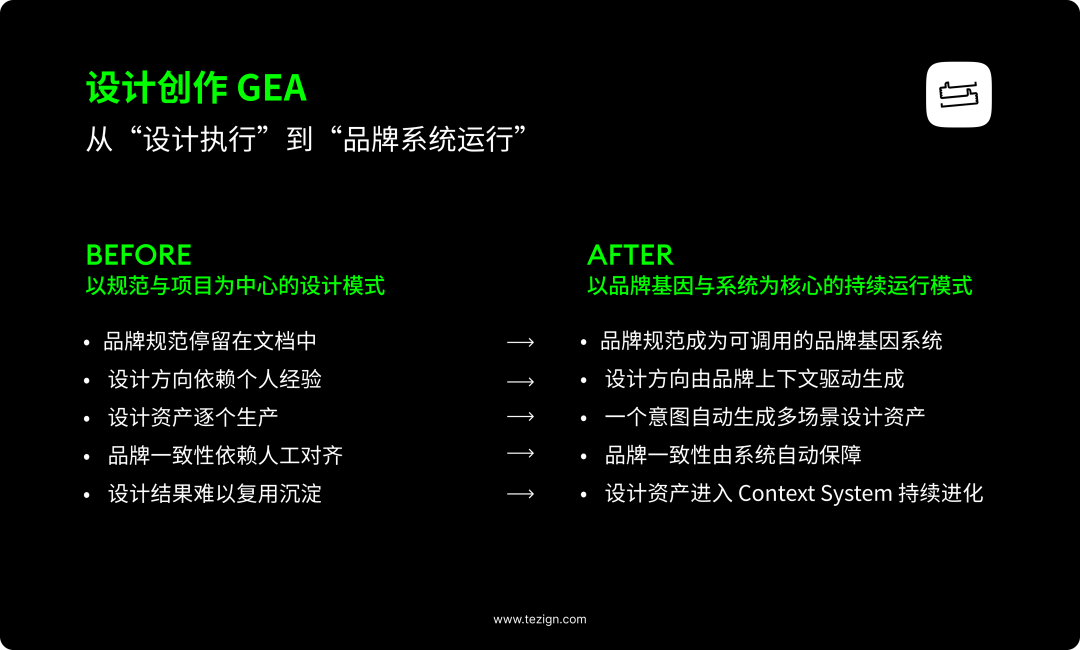
Typical Case:From "Design Execution" to "Brand System Operation"
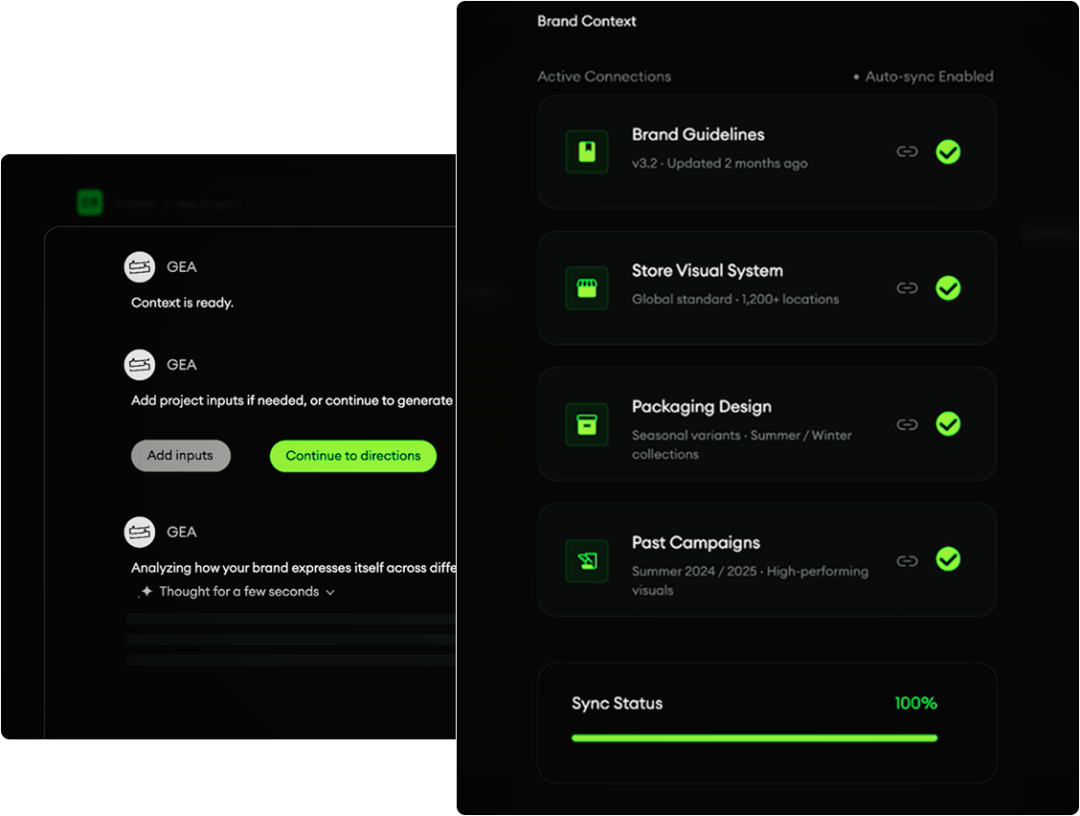
Use Case 1 Brand Knowledge Integrated into the Design Process(Design Driven by Brand Genes)
Within a global brand group, before every design project kicks off, teams have to repeatedly refer to brand manuals, verify visual specifications, and clarify expression boundaries. The problem lies not in the lack of guidelines, but that such brand knowledge cannot be embedded into the actual design workflow.
In the GEA system, the Memory Builder first builds brand memory, and precipitates brand tonality, visual specifications, channel templates and other standards into Agent Skills. Afterwards, when design intentions are input into the system, Orchestration automatically invokes the Context System to bring brand context into the current task.
Ultimately, the Creative Reasoning Model generates a set of multi-dimensional design directions based on brand genes and industry trends, rather than relying on a single creative inspiration.
What enterprises gain is no longer mere reference materials, but a brand system that can continuously generate design directions.
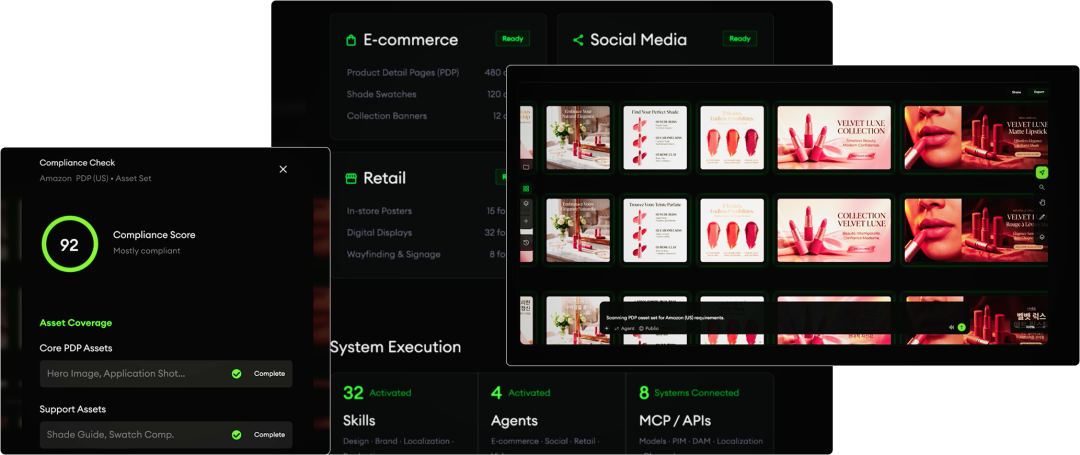
Use Case 2: One Creative Idea, Global Large-Scale Rollout(Batch Generation of Design Assets)
For a beauty brand launching hundreds of SKUs every year, a single design direction needs to be extended into a large number of assets, including social media visuals, e-commerce images, video covers, and localized versions for different countries. In the traditional model, this is an extremely high-intensity and highly repetitive workload.
Within GEA, based on design intentions or existing designs, the system automatically decomposes tasks via Orchestration, and leverages Agent Skills and multi-model capabilities to generate design versions for diverse scenarios:
social media visuals, short-video visuals, e-commerce page designs, and multi-region & multi-specification versions.
Meanwhile, the system automatically verifies brand specifications to ensure all outputs comply with brand consistency standards.
What enterprises obtain is not just a single design delivered faster, but a complete portfolio of global design assets ready for direct deployment.
Use Case 3: Design Process Evolves From "Passive Response" to "Proactive Advancement"
In most enterprises, design teams work in a passive mode: waiting for demands, briefs and feedback. However, the market and user landscape keep changing continuously, leaving design perpetually lagging behind under this model.
In GEA, Proactive Agents stay continuously connected to external market signals and internal project status. They capture trends, competitor dynamics and channel changes via MCP/APIs, and make judgments with the Context System. The system proactively triggers subsequent design actions, such as:
Initiating a new round of visual exploration
Expanding existing design directions
Optimizing current design expressions
The design process shifts from merely "responding to demands" into a dynamic system that advances continuously around business goals.
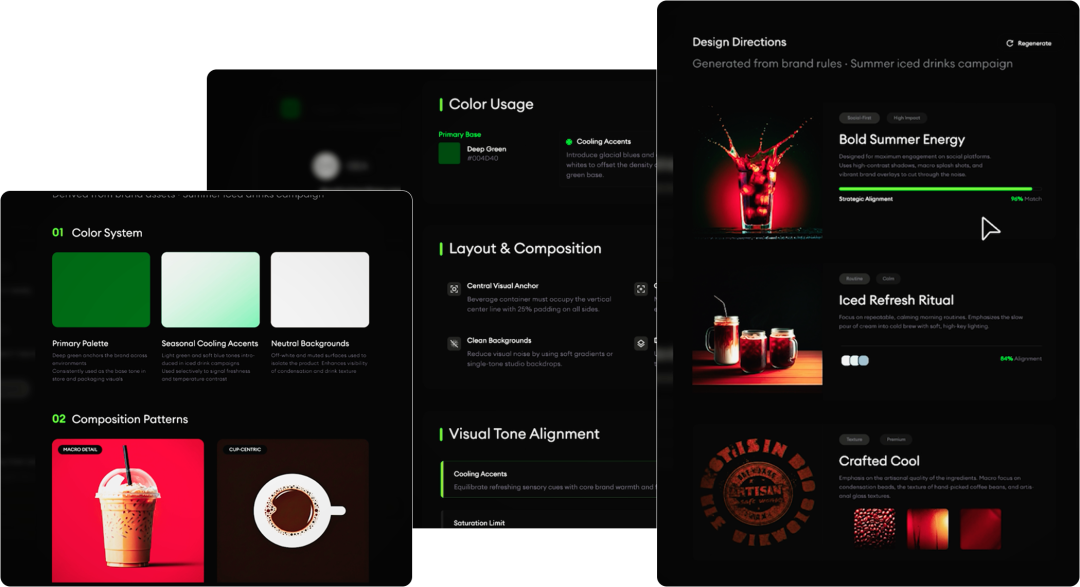
Use Case 4: Traceable, Reusable and Evolvable Design Outcomes(Continuous Evolution of Design Assets)
In traditional workflows, the design process ends once deliverables are completed. Design assets are scattered across various tools, making them hard to reuse and trace.
Within GEA, all design outputs including images, videos and pages are associated with corresponding tasks, contextual information and historical versions, and permanently stored in the Context System.
Teams are enabled to:
Trace design origins and decision-making paths
Rapidly reuse historical design assets
Conduct iterative optimization based on existing works
Design assets are no longer merely final deliverables, but serve as the starting point for the next round of design creation.

From Design Execution to a Continuously Evolving Brand Expression System
Under the GEA architecture, design creation is no longer a standalone creative link, but an integral part of enterprise system operation.
The Context System provides brand memory and contextual awareness; the Creative Reasoning Model undertakes design direction generation and logical reasoning; Proactive Agents are responsible for content production, collaboration and process advancement. The three form a closed loop, turning brand expression into a continuously evolving system.
Enterprises no longer rely on sporadic design projects to maintain brand consistency. Instead, they leverage the system to continuously generate brand expressions, unify brand cognition, and optimize outputs iteratively.
The essence of design creation is being reshaped: it is no longer about delivering a one-off design set, but about building a self-sustaining, continuously operable brand system.
Category
Product Updates
Date
2026-05-07
Read Time
5 min read
Share Page
Related Recommendations

Clipo idea Launch! A Social Media Team That Never Stops Working

Subjective World Model: The First Fundamental Model Aimed at Understanding Humans