Xinmin Evening News | The enterprise-level 'lobster' has arrived, Tezign releases the enterprise-level intelligent system GEA
Tezign has released the enterprise-level intelligent agent GEA, which uses a four-layer architecture and contextual system to upgrade AI from a tool to a system capability that participates in business and continuously delivers results.

An enterprise-level openclaw was born in Shanghai. Today, the Shanghai-based enterprise intelligent agent company Tezign launched the enterprise-level intelligent agent GEA (Generative Enterprise Agent), allowing AI to move from answering questions to participating in real business workflows.
Against the backdrop of continuous leaps in large model capabilities, enterprises' demand for artificial intelligence is shifting from 'tool efficiency' to 'system operation'.
As large model capabilities continue to advance, more and more enterprises are beginning to realize a new issue: models are rapidly becoming public infrastructure, but the actual working methods of enterprises have not changed in sync.
Tezign's founder and CEO Fan Ling stated at the press conference that in the past two years, the progress of artificial intelligence capabilities has been very rapid; writing copy, generating images, and analyzing data have become very easy. However, the real work that enterprises face every day is not about generating tasks repeatedly, but understanding the market, defining products, researching users, formulating strategies, and driving growth, which are all continuous operational judgment chains. 'These tasks are rarely completed with just one prompt. What enterprises truly need is not more AI tools, but a new system that can genuinely participate in work, understand business, and continuously deliver results,' he said.
GEA is proposed based on this judgment as a set of enterprise-level intelligent agent architecture. Unlike traditional Copilot-style tools, it is not designed around single-point efficiency improvement but attempts to enable AI to continuously operate around real business goals, from understanding intent to breaking down paths, and then executing actions to form a complete closed loop. Fan Ling stated that the goal of GEA is not complicated: 'To make AI not just answer questions but truly participate in the work of enterprises, understand objectives, organize capabilities, and continuously drive results.'
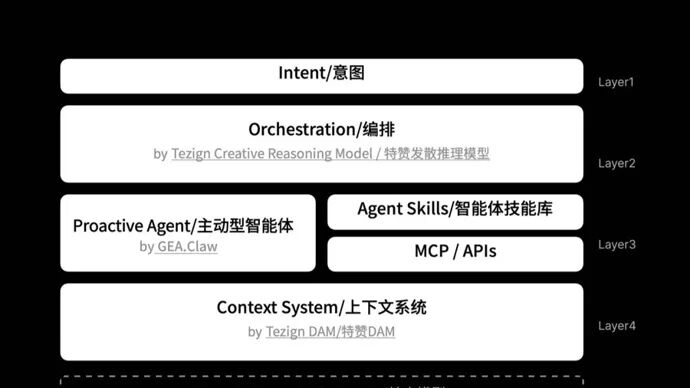
In terms of technical path, GEA adopts a four-layer intelligent agent architecture, allowing business objectives to directly enter system operation. The first layer is Intent: the enterprise presents not operational instructions, but goal-oriented intents such as growth opportunity identification, product positioning optimization, or communication strategy formulation. The system will convert these business languages into structured tasks and break down execution paths through the second layer, Orchestration, and then call different models and agent capabilities to complete collaborative execution. The core reasoning capability comes from Tezign's self-developed Creative Reasoning Model, which is a reasoning system characterized by a preference for divergence.
Fan Ling explained that traditional reasoning models typically converge to a single answer when facing complex problems, while real business problems often do not have a unique optimal solution. 'The key lies in possibilities, not certainties.' Therefore, the Creative Reasoning Model first explores different paths, then evaluates value and selects execution directions. This large model has already been registered with the national authorities.
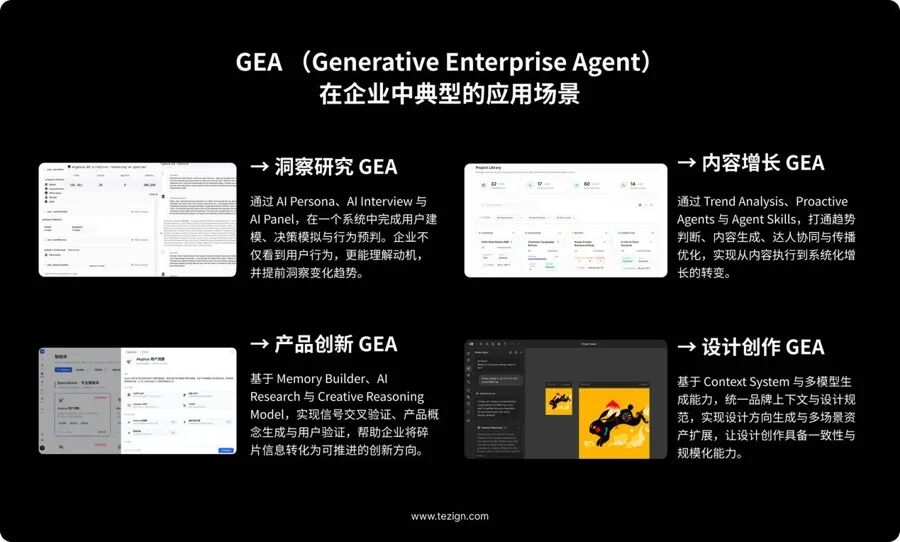
At the same time, the third layer, Proactive Agent, begins to work. GEA is not a single intelligent agent but a group of proactive intelligent agent systems that can operate continuously. The system has already accumulated over 400 Agent Skills modules, covering common business scenarios such as content generation, consumer insights, data analysis, and creative evaluation, and can actively monitor data changes, identify execution deviations, and generate strategic recommendations, rather than waiting for manual task triggers. It can also connect with other enterprise systems through MCP/API. This means that enterprises are beginning to shift from 'using AI tools' to 'operating AI systems'.
This time, the Context System was also highlighted, which is an upgrade of Tezign's DAM digital asset management system accumulated over the past decade, built around this judgment. The system can automatically identify unstructured content such as enterprise images, videos, design drafts, brand assets, and project materials, and establish semantic relationships, transforming information that was originally scattered across different departments and systems into a unified contextual network that can be called by intelligent agents. This means that the historical experience, brand specifications, project trajectories, and even user understanding of enterprises can become the basis for continuous reasoning and decision-making by intelligent agents, rather than just passive stored data materials.
Fan Ling strongly stated: 'In the past decade, enterprises bought software; in the past three years, enterprises experimented with models; starting today, enterprises need an intelligent system that understands context, possesses judgment, and continuously evolves.'
It is understood that the Tezign GEA system currently serves over 180 enterprise clients, including more than 60 Fortune 500 companies, and has over 1 million professional users in 50 countries worldwide. As model capabilities gradually converge, building enterprise-level AI infrastructure around contextual systems and intelligent agent orchestration capabilities is becoming a new competitive direction in the industry, and the emergence of the enterprise-level intelligent agent GEA is also seen as an important step for domestic enterprises to explore the path of Agentic AI implementation.
Original title: 'The enterprise-level
Category
Media & Press
Date
2026-04-09
Read Time
4 min read
Share Page
Related Recommendations

Gartner Releases 'Innovation Insight: Enterprise Agent Competency', Recognized as One of the Global Five Representative Vendors

Tezign Technology GEA Selected as One of Quantum Bit's 'AIGC Products to Watch in 2026'