Tezign Technology x China Europe International Business School 'AI + Business Evolution: System · Closed Loop · Intelligent Efficiency' Forum Successfully Held, Promoting 'Intelligent Efficiency' Upgrade with GEA Enterprise-Level Intelligent Agents
China Europe and Tezign jointly released the AI Business White Paper, proposing an upgrade from 'Human Efficiency' to 'Intelligent Efficiency', reconstructing enterprise processes with GEA intelligent agents to facilitate deep AI implementation and business innovation.
Against the backdrop of the national policy to continuously promote the 'Artificial Intelligence +' initiative and accelerate the cultivation of new quality productivity, generative artificial intelligence is transitioning from a stage of technological capability breakthroughs to a stage of industrial system reconstruction. With the continuous development of reasoning capabilities, multimodal capabilities, and enterprise-level intelligent agent systems, artificial intelligence is transforming from an auxiliary tool to an important infrastructure driving the upgrade of business operations, accelerating its entry into core business processes such as product innovation, brand growth, user insights, and organizational collaboration. In this trend, how to promote artificial intelligence from point applications to system operations has become a key issue for enterprises to achieve high-quality development.
On April 10, 2026, the 'AI + Business Evolution: System · Closed Loop · Intelligent Efficiency' forum, co-hosted by China Europe International Business School and Tezign Technology, successfully took place at the China Europe Shanghai campus, marking the release of the white paper 'Business Evolution Blueprint in the AI Era (2026)' by the China Europe × Tezign Artificial Intelligence and Business Innovation Research Fund. Experts, scholars, and business managers from academia and industry gathered to engage in in-depth discussions on new paths for AI-driven upgrades in business operations.
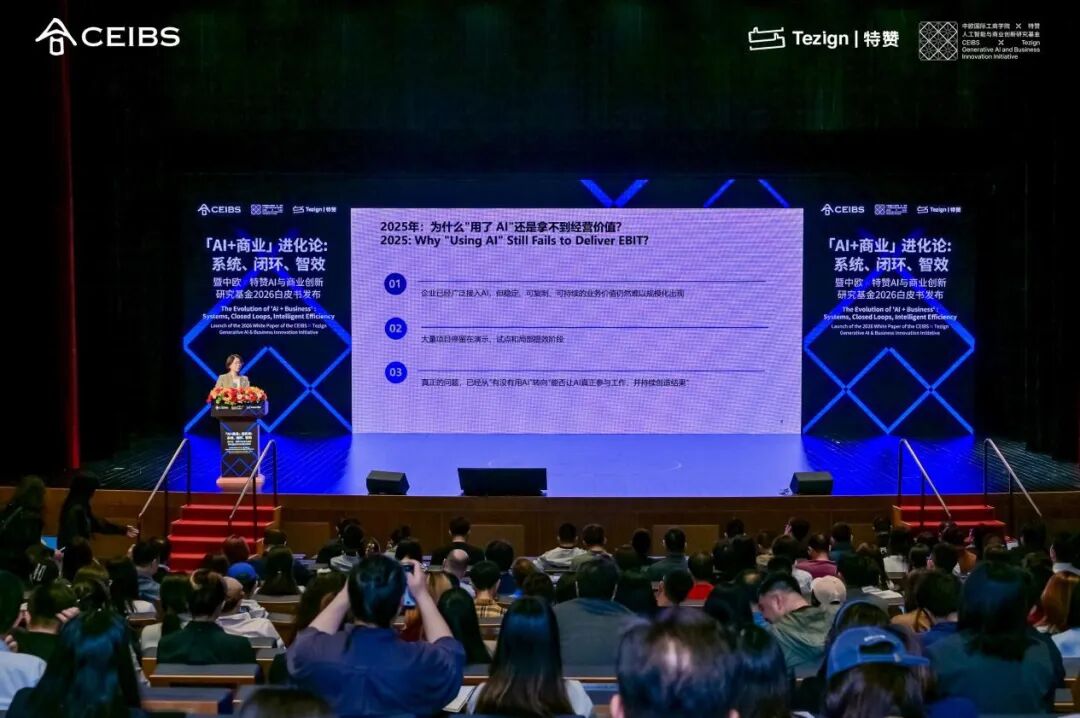
*Forum Scene
Wang Hong, Dean of China Europe International Business School, Professor of Management, and Chair Professor of Management at Hengdian Group, delivered the opening speech. She pointed out that we are currently at a critical watershed in the commercialization of AI. In the past year, artificial intelligence has evolved from 'co-pilot' to 'intelligent agent', transforming from an auxiliary tool to a task bearer. She stated that amidst the excitement, we must remain clear-headed: many enterprises' AI applications are still at the demonstration, pilot, and localized efficiency improvement stages, with few projects truly crossing departmental boundaries, entering core processes, and forming solid returns. There remains a deep mismatch between old processes, old organizations, and new capabilities.
Wang Hong believes that the future competitive moat for enterprises will no longer be the level of model capabilities, but who can first complete the strategic leap from 'Human Efficiency' to 'Intelligent Efficiency'. 'Human Efficiency' essentially refers to individual efficiency improvements led by humans with AI as a supplement; while 'Intelligent Efficiency' requires intelligent agents to independently, accurately, and closed-loop create value in complex businesses, forming a new production mechanism that is continuously optimized through system feedback and formally adopted by the organization. As a top business school rooted in China, connected to Europe, and facing the world, China Europe always adheres to the motto of 'Seriousness, Innovation, Pursuit of Excellence'. Our responsibility is not to chase fleeting technical buzzwords, but to help enterprises translate technical language into management language, elevate localized practical capabilities to systemic cognition, and transform temporary efficiency dividends into long-term effective organizational capabilities.
The white paper 'Business Evolution Blueprint in the AI Era (2026)' released at today's forum is the result of deep cooperation between China Europe and Tezign Technology in industry-academia-research collaboration, providing a complete judgment framework for enterprises to identify stages, calibrate directions, and reconstruct systems. In the future, China Europe is willing to walk alongside entrepreneurs, becoming thought partners and practical think tanks in this systemic transformation.
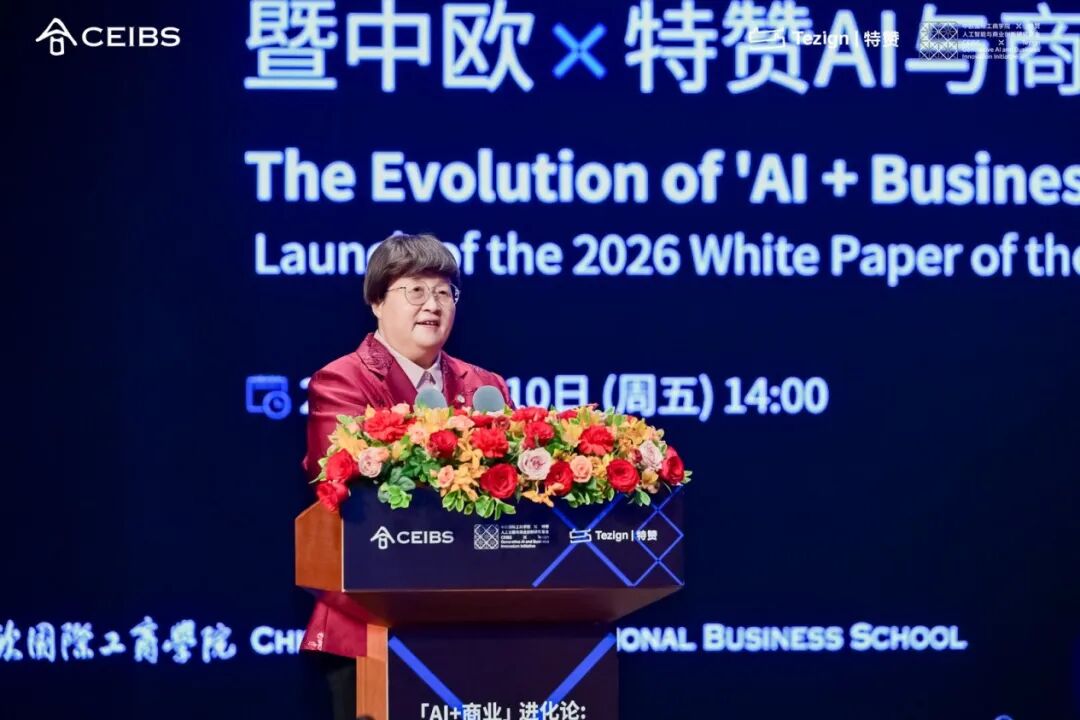
*Wang Hong, Dean of China Europe International Business School, Professor of Management, Chair Professor of Management at Hengdian Group delivering the opening speech
The forum officially released the 'Business Evolution Blueprint in the AI Era (2026)' white paper. Wang Qi, Professor of Marketing and Department Head at China Europe International Business School, and Chair of the China Europe × Tezign Artificial Intelligence and Business Innovation Research Fund, provided a systematic interpretation of the white paper's research findings. She pointed out that although AI has been widely implemented in enterprises over the past year to reduce costs and increase efficiency, the applications are highly similar—intelligent customer service, content generation, and digital humans have almost become 'standard configurations'. When everyone's level is generally leveled, how long can the dividends of cost reduction and efficiency improvement last? Where is the real differentiated competition? Most enterprises still regard AI as a 'patching' tool for existing processes and have not yet made a clear contribution to revenue and profit.
Wang Qi stated that true transformation lies in redesigning workflows with AI as the main body, breaking down departmental walls, and forming self-closed-loop, executable, and optimizable enterprise-level intelligent agents. Wang Qi emphasized that when intelligent equity becomes the norm, true scarcity will no longer come from the large models themselves, but from the unique data assets, industry experience, and strategic choices of enterprises. She called on enterprises to upgrade AI from 'passive dialogue' to 'active deployment', building a systematic competitive moat through insights, actions, execution, and optimization.
Through a year of research on pioneering enterprises, the white paper summarizes and presents three key transformations: first, enterprises are beginning to shift from 'dialogue-based AI' to 'proactive intelligence', achieving full-process automation of insight-decision-execution-optimization through closed-loop systems; second, organizational structures are breaking through traditional divisions, with AI serving as the operating system to 'break down departmental walls'; third, competitive barriers are shifting from technological capabilities to a strategic combination of 'private data assets + industry know-how'. Wang Qi specifically pointed out that 2026 will become a turning point for enterprise AI applications, with leaders upgrading AI from 'auxiliary tools' to 'business foundations', achieving systemic transformation through 'points-lines-planes' progression. She urged entrepreneurs to not only focus on cost reduction and efficiency improvement but also to think about 'how to do what they previously wanted to do but couldn't', exploring new dimensions of growth. China Europe will continue to track the deep-water practices of enterprises, working together with the industry to move towards a new stage of systematic intelligent efficiency.
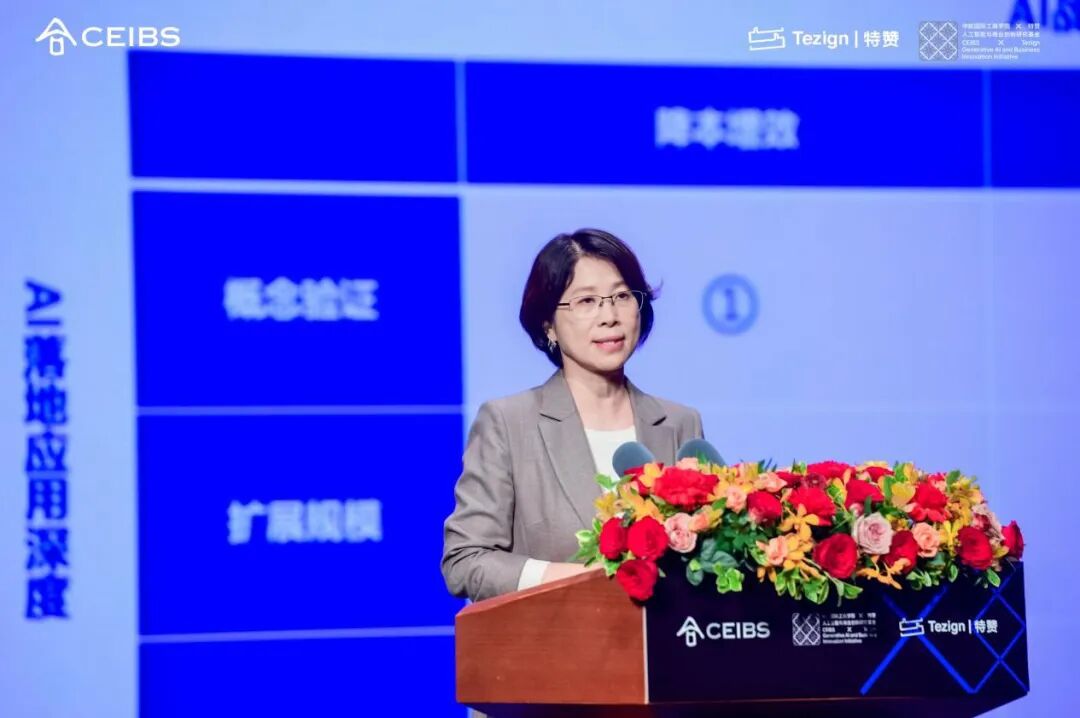
*Wang Qi, Professor of Marketing and Department Head at China Europe International Business School, Chair of the China Europe × Tezign Artificial Intelligence and Business Innovation Research Fund
'Business Evolution Blueprint in the AI Era (2026)' white paper proposes a 3×3 analysis matrix for enterprises to move towards 'systematic intelligent efficiency', systematically depicting the evolutionary path of enterprises from localized experiments to systematic operational capabilities from three dimensions: strategic level, business level, and organizational level. The following are some chapters.
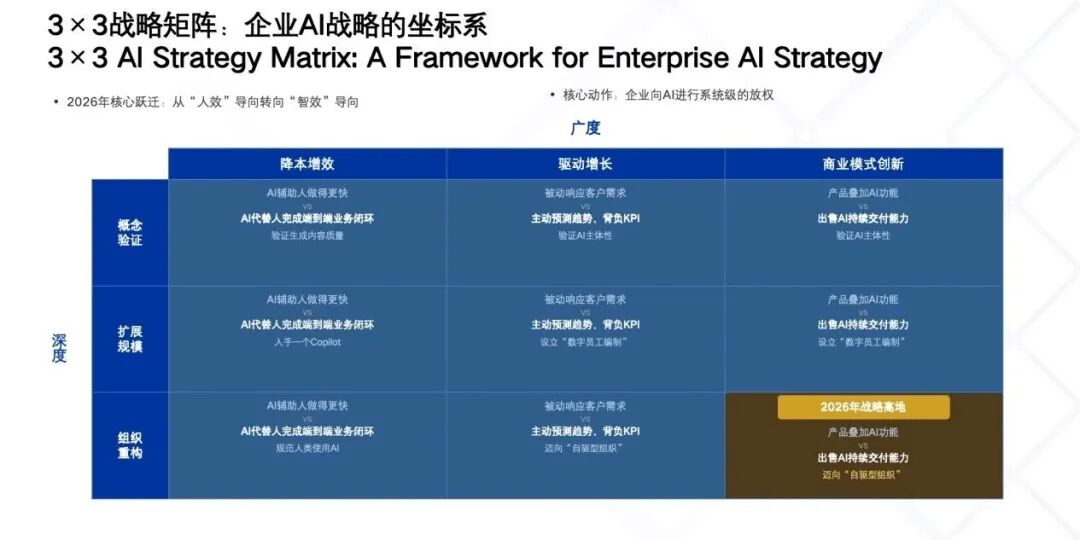
*Part of the chapter from the 'Business Evolution Blueprint in the AI Era (2026): Activating Proactive Intelligence, Strategic Leap from 'Single Point Human Efficiency' to 'Systematic Intelligent Efficiency'' white paper (scan the code at the end to download the complete white paper)
Fan Ling, Founder and CEO of Tezign Technology, Professor/Doctoral Supervisor at Tongji University, Director of the Design Artificial Intelligence Laboratory, Chair of the China Europe × Tezign Artificial Intelligence and Business Innovation Research Fund, shared his observations on 'Business Becoming Intelligent Agents (Agentic Business)'. He mentioned that after the breakthrough of generative AI in 2023, reasoning capabilities emerged in 2024, and autonomous execution was achieved in 2025. This technological evolution is reshaping the underlying logic of business. Enterprises need to establish 'Agentic Business' thinking, which is fundamentally about creating new users through AI rather than just optimizing existing processes.
Fan Ling pointed out that with the development of reasoning capabilities and contextual system capabilities, artificial intelligence is evolving from an auxiliary decision-making tool to a system capability that can participate in business execution, gradually becoming an important infrastructure for enterprises to continuously create business results. Tezign Technology has developed the GEA (Generative Enterprise Agent) enterprise-level intelligent agent system, which is an intelligent agent operating system aimed at the real business processes of enterprises. GEA focuses on enterprise business objectives, constructing a complete closed loop of 'Intent Layer - Orchestration Layer - Agent Skills Layer - Context Layer', enabling AI to truly understand the enterprise context, participate in business decision-making, continuously execute tasks, and optimize results, already delivering effects in typical business scenarios such as insight research, product innovation, and content growth.
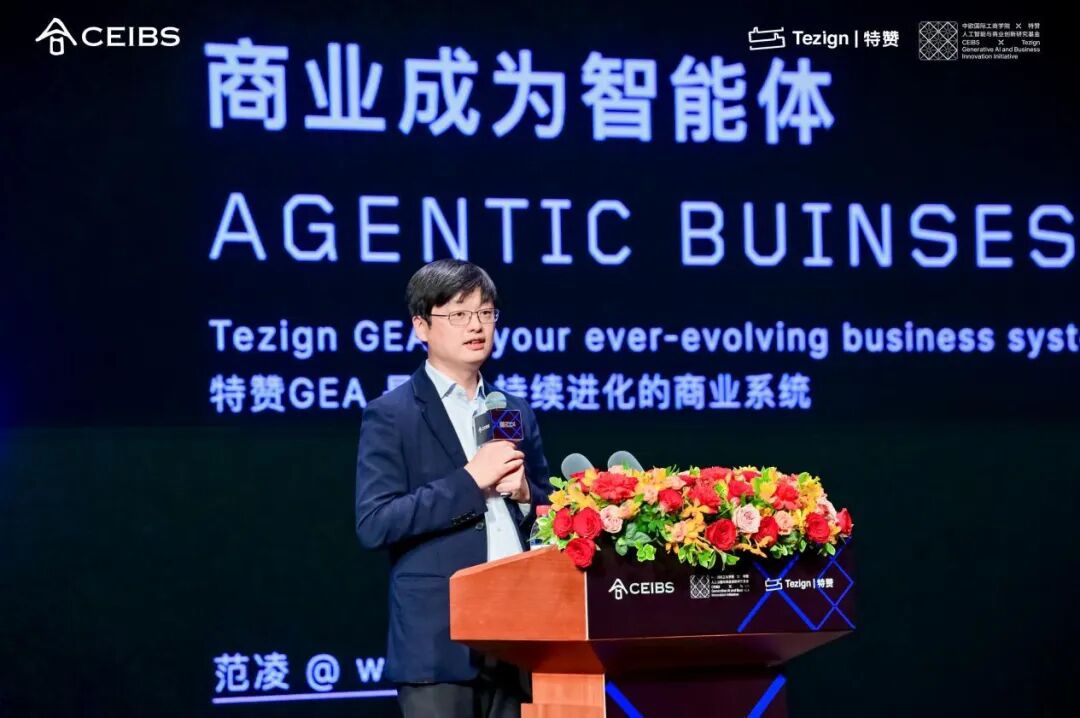
*Fan Ling, Founder and CEO of Tezign Technology, Professor/Doctoral Supervisor at Tongji University, Director of the Design Artificial Intelligence Laboratory, Chair of the China Europe × Tezign Artificial Intelligence and Business Innovation Research Fund sharing on-site
Gong Yin, Chief Information Officer of Anker Innovations shared the four-stage practical path of enterprise AI transformation: from AI capability exploration in 2023 to AI capability system construction in 2025, enterprises need to complete the leap from tool application to system reconstruction. He emphasized that AI must be a top-down initiative, demonstrating AI value through benchmark projects. On the intelligent agent development platform AIME, enterprises have deployed 600-800 intelligent agents, achieving a closed loop of business data extraction - model orchestration - full-stack services. In terms of organization and talent, Anker has cultivated a new type of effective worker, promoting the transition from industrial-era division of labor to AI-era capability integration. Gong Yin concluded that the real competitive barrier is not the technology itself, but the ability to transform AI into the organizational gene.
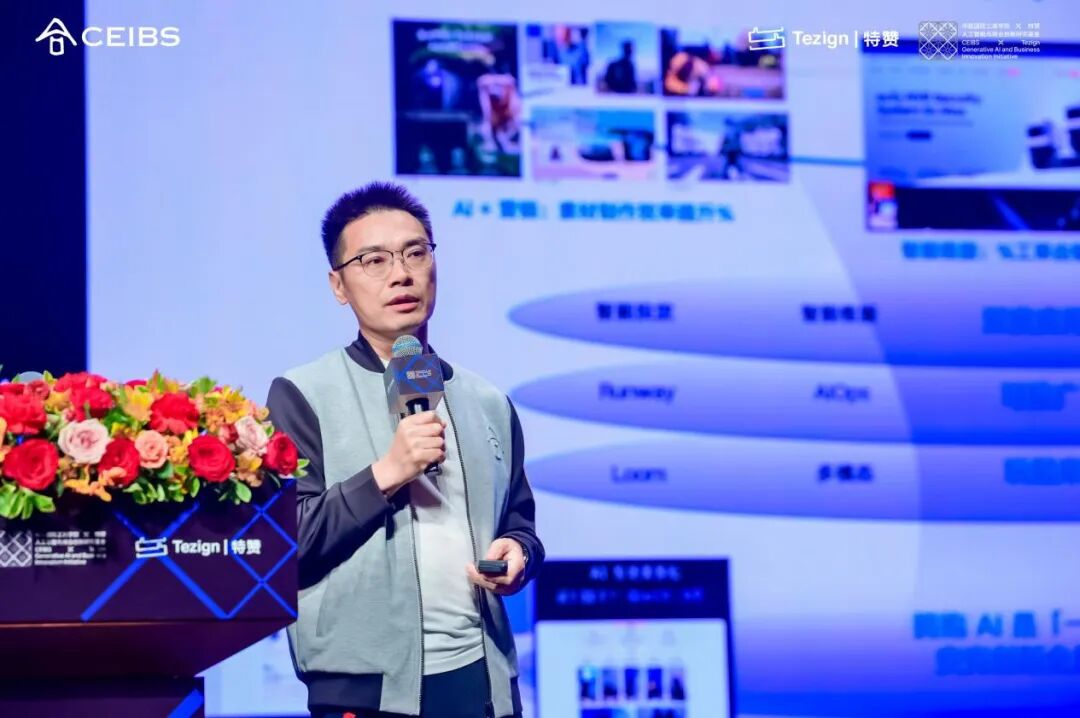
*Gong Yin, Chief Information Officer of Anker Innovations sharing on-site
During the roundtable discussion, Gu Yue, Vice President of Schneider Electric and Head of Marketing for China and East Asia, and Guo Wei, Associate Professor of Strategy and Entrepreneurship at China Europe International Business School and Vice Chair of the Executive Committee of the China Europe × Tezign Artificial Intelligence and Business Innovation Research Fund, shared practices and views on enterprise platform transformation and AI strategy.
Gu Yue mentioned that Schneider Electric's AI transformation has evolved from 'tool assistance' to 'autonomous decision-making', with AI currently permeating the four quadrants of the enterprise: internal tools, external services, auxiliary decision-making, and autonomous execution. He emphasized that data assets and scenario implementation are key competitive advantages and proposed a three-fold methodology of 'self-benchmarking - business scenarioization - partner specialization', believing that enterprises need to first internally validate AI value, then focus on segmented scenarios, and finally integrate professional ecological partners to achieve a closed loop.
Guo Wei mentioned that enterprises need to break through the 'AI toolization' mindset, integrating technological transformation into the underlying strategic design. She warned that traditional enterprises face the challenge of 'digital disconnection', where governance of unstructured data and cross-departmental circulation are prerequisites. She emphasized that the competitive barrier of industrial AI does not lie in computing power, but in whether industry know-how can be transformed into an iteratable 'enterprise judgment system', and through co-research and co-creation achieve precise matching of technology and scenarios.
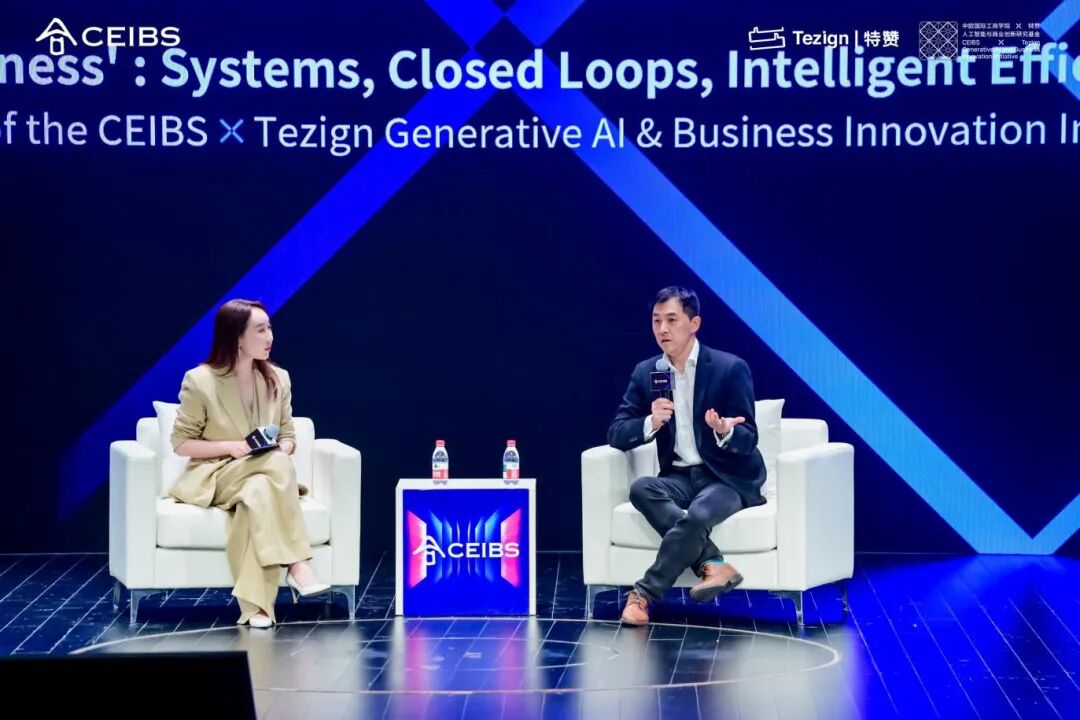
*Gu Yue, Vice President of Schneider Electric and Head of Marketing for China and East Asia (right)
*Guo Wei, Associate Professor of Strategy and Entrepreneurship at China Europe International Business School and Vice Chair of the Executive Committee of the China Europe × Tezign Artificial Intelligence and Business Innovation Research Fund (left)
Lü Zhichao, Global Chief Digital Officer of Bosch Group's Global Power Tools Division, Chen Zhuo, Assistant Professor of Strategy at China Europe International Business School and Advisor Professor of the China Europe × Tezign Artificial Intelligence and Business Innovation Research Fund, and Ren Yuan, Chief Strategy Officer of Tezign Technology, Vice Chair of the Executive Committee of the China Europe × Tezign Artificial Intelligence and Business Innovation Research Fund, engaged in a discussion on the construction path of enterprise-level intelligent agent systems, exploring how AI can transition from strategic design to business value.
Lü Zhichao mentioned that enterprise AI applications need to focus on core competitiveness, 'doing difficult but correct things'. Bosch integrates AI into the entire process of product innovation through virtual customer companies and expert models, but faces three major challenges: organizational inertia, data governance, and process reconstruction. He emphasized that AI applications should start from user needs and promote transformation through a gradual 'apprenticeship' approach.
Chen Zhuo mentioned that AI applications need to return to the essence of business, focusing on 'what problem to solve' rather than 'what can be done with AI'. She observed that AI drives bottom-up transformation, and the enhancement of employees' AI capabilities will force process reconstruction, suggesting that enterprises maintain a dynamic perspective and tolerate the 'imperfect AI' during the trial and error period.
Ren Yuan mentioned that AI product design needs to break through 'data dependence', achieving knowledge distillation through the construction of industry-specific contexts. She advocates the practical philosophy of 'slow to speak, quick to act', suggesting decoupling positions from manpower, accelerating AI integration through task flow reorganization, and emphasizing that the collaborative evolution mechanism between AI and human experts is the future development direction.
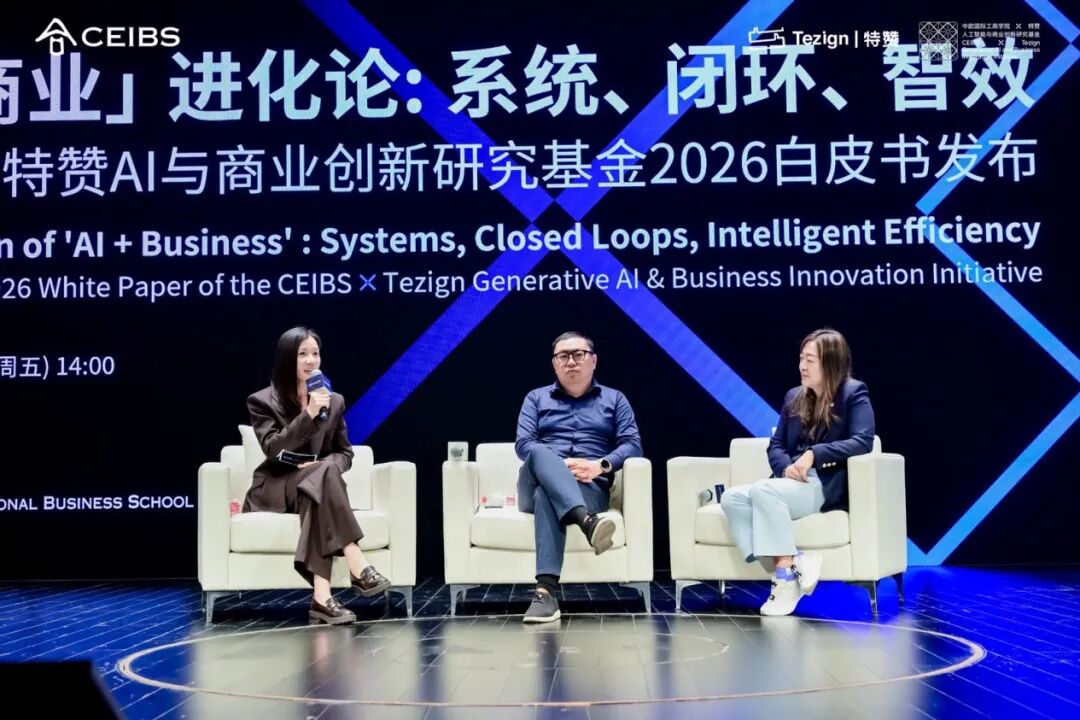
*Lü Zhichao, Global Chief Digital Officer of Bosch Group's Global Power Tools Division (center)
*Chen Zhuo, Assistant Professor of Strategy at China Europe International Business School and Advisor Professor of the China Europe × Tezign Artificial Intelligence and Business Innovation Research Fund (left)
*Ren Yuan, Chief Strategy Officer of Tezign Technology, Vice Chair of the Executive Committee of the China Europe × Tezign Artificial Intelligence and Business Innovation Research Fund (right)
Finally, Yuan Hong, CEO of Senchuang Qirui and Senior Director of Balabala, shared the practical path of Semir Group's AI transformation. Through cultural leadership, business collaboration, ecological activation, and technological breakthroughs, a full transformation is achieved. Through the combination of 'AI + BI + RPA', business processes are reshaped, and ten key elements for AI implementation are proposed, including strategic binding, path planning, and evaluation systems. He pointed out that the future competitive gap lies not in technology, but in the organizational capabilities built around AI reconstruction, suggesting a dual-track strategy of 'top-down leadership + bottom-up growth' to promote organizational and business AI upgrades.
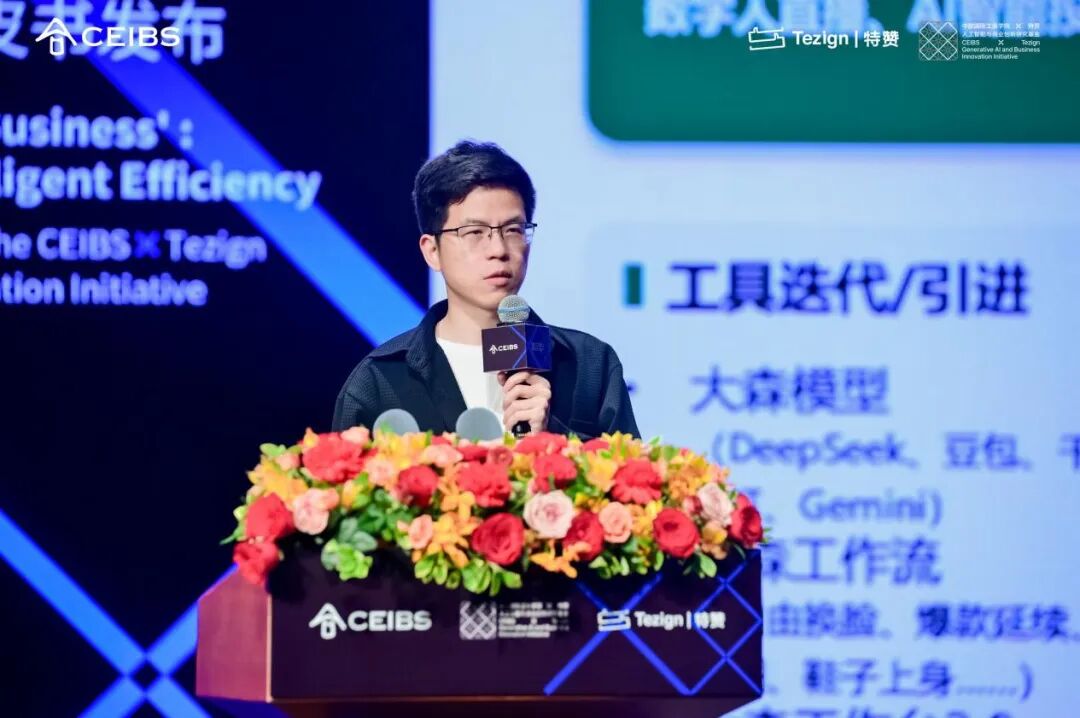
*Zhang Jiadong, CEO of Senchuang Qirui and Senior Director of Balabala
As one of the important annual achievements of the China Europe × Tezign Artificial Intelligence and Business Innovation Research Fund, the release of the 'Business Evolution Blueprint in the AI Era (2026)' white paper systematically presents the research progress and industrial practice paths of enterprise-level intelligent agents entering real business processes. In the future, China Europe International Business School will continue to collaborate with Tezign Technology, relying on the research fund platform to continuously promote cutting-edge research in the field of artificial intelligence and business innovation, fostering a methodological system that combines academic depth with industrial value, helping enterprises transition from efficiency optimization to value creation, achieving systematic upgrades towards the era of intelligent agents.
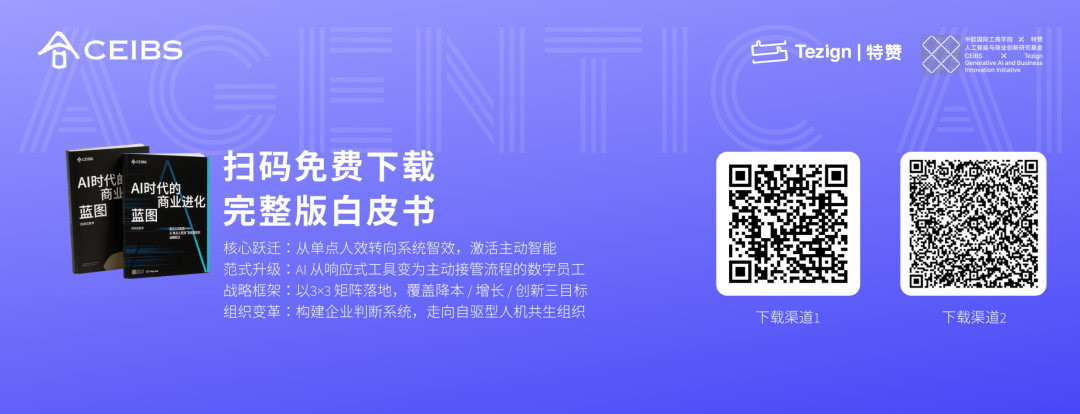
Introduction of the white paper creative team:
China Europe International Business School:Founded in 1994 by the Chinese government and the European Union, it is the only business school in China jointly established by the governments of China and foreign countries. The school always adheres to the motto of 'Seriousness, Innovation, Pursuit of Excellence', committed to cultivating leaders who possess both deep understanding of China and global breadth, actively taking on social responsibilities. It has formed a global educational pattern with campuses in five locations across three continents (Shanghai, Beijing, Shenzhen in China, Zurich in Switzerland, and Accra in Ghana), praised by leaders of China and the EU as 'a cradle for many outstanding management talents' and 'a model of successful cooperation between China and Europe'. China Europe was the first in mainland China to obtain dual accreditation from the European Quality Improvement System (EQUIS) and the Association to Advance Collegiate Schools of Business (AACSB). Currently, China Europe has ranked first in Asia for ten consecutive years in the Financial Times Global MBA Rankings and has been in the top two globally for six consecutive years in its Global EMBA Rankings.
China Europe × Tezign Artificial Intelligence and Business Innovation Research Fund:Jointly established by China Europe International Business School and Tezign Technology, it aims to strengthen the connection between technological innovation and industrial development, establish an operational framework for 'AI Business', support research in management fields and AI commercialization, and promote industrial upgrading and economic transformation.
Tezign Technology:Tezign Technology is a leading enterprise-level Agentic AI company in China, based on its self-developed Generative Enterprise Agent (GEA) architecture, building an enterprise-level intelligent agent system that can understand business contexts, participate in complex decision-making, and continuously drive results. GEA uses the enterprise context system as a single source of truth, combining self-developed Creative Reasoning Models and over 400 Agent Skills to achieve reasoning, orchestration, and execution closed loops in real workflows, serving over 180 global enterprise clients and covering more than 1 million professional users in over 50 countries worldwide.
Category
Events
Date
2026-04-16
Read Time
13 min read
Share Page
Related Recommendations

Exciting Preview | 2026 World Artificial Intelligence Conference (WAIC): GEA Enters Various Industries, Digital Forest

The Cosmic AI Gala is Here: SuperAI@Singapore, Tezign is Here!