The 'Subjective World Model' in the CCTV Live Studio, They Are All Checking In Here! | WAIC Exhibition Notes
The 2026 WAIC showcases the Subjective World Model (SWM), which differs from general LLMs by modeling human inner decision-making through a four-layer data structure, paired with GEA enterprise agents to implement multiple business applications. Founder Fan Ling guest-starred in the CCTV live studio to share the technical philosophy.
WAIC 2026 is as vibrant as the recent temperatures in Shanghai, fiery and somewhat surreal 🔥 On the first day of public access yesterday, the media visiting the venue set the pace for this conference—just in the Tezign exhibition area, CCTV News, 36Kr, and Yicai all visited in one afternoon... along with a large number of self-media, wandering through the Expo Exhibition Hall, exploring, live streaming, and checking in.
Almost every visitor stops at the first tree at the main entrance of the Tezign booth, and after pausing there, everyone starts to ask about the technical details—what model is running behind this? How is it different from LLMs? Where does the data come from? What is the accuracy rate? How can I use it?...

In fact, on the opening day of WAIC on July 17, Tezign founder Fan Ling discussed this direction in the CCTV News live studio. He said: "AI, besides working, is also starting to understand humans—understanding how a person's psychology works, understanding those descriptions that cannot be expressed. We created something called the Subjective World Model, which is actually trying to do this."

What is the Subjective World Model
So what is the Subjective World Model (SWM)? What is the essential difference from large models?
The training goal of large language models (LLMs) is to predict the 'next word'—essentially modeling the statistical distribution of human language. Whether it’s GPT, DeepSeek, or Claude, regardless of the differences in parameter scale and architectural details, this fundamental goal remains consistent. LLMs are very good at generating 'text that sounds like it was spoken by a human,' but their modeling target is language, not the person speaking it.
The training goal of the Subjective World Model (SWM) is something else: it models not the language itself, but the psychological structure of the specific individual behind the language—their cognitive biases, decision logic, behavioral tendencies in different contexts, and those unspoken motivations that genuinely influence behavior.
This is not fine-tuning or domain adaptation of LLMs; SWM is an independently designed model architecture, with different training goals, data systems, and evaluation methods.
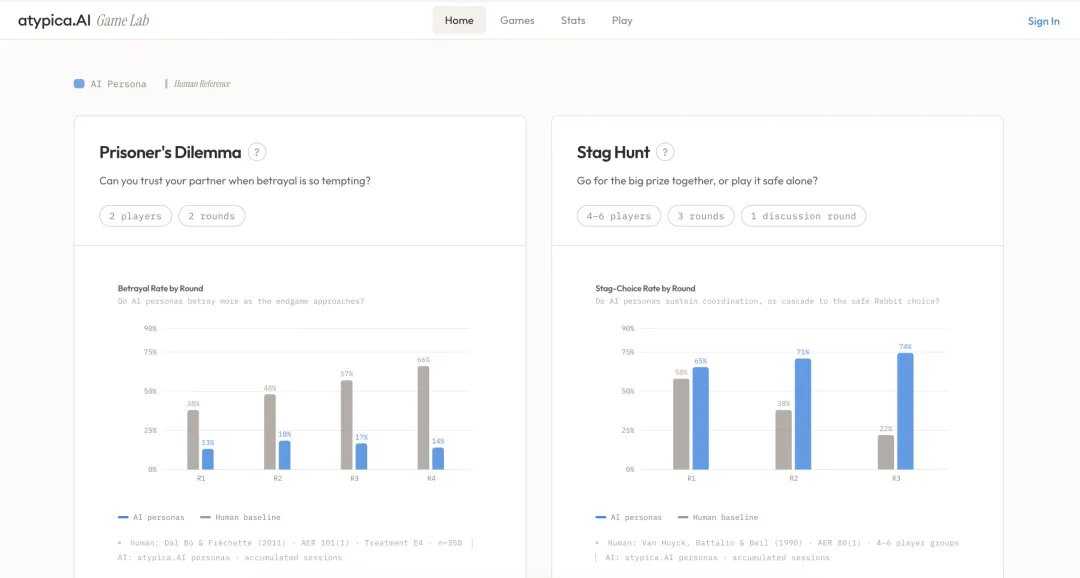
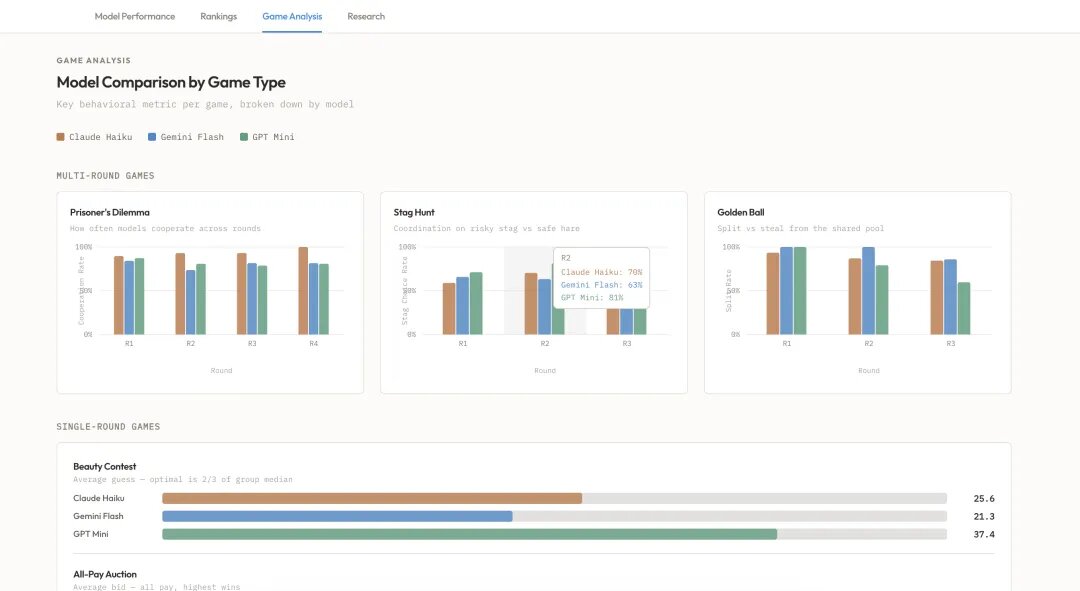
Four-Layer Data Architecture: Why It Must Be Designed This Way
The training data for SWM is divided into four layers, each addressing different dimensions of the 'understanding humans' problem; missing any layer would result in distortion in some dimension:
Expression Layer
Billions of native social media data points train the model to recognize the high-dimensional mapping relationship between language style and identity signals. The same consumer opinion expressed by a 25-year-old designer on Xiaohongshu and a 45-year-old factory manager on Weibo differs in word frequency distribution, emotional packaging, and implicit value judgments. The expression layer models the demographic and psychographic signals behind the surface of language.
Story Layer—Core Barrier
Tens of thousands of hours of one-on-one in-depth interviews, each lasting 1-2 hours, producing 5,000-20,000 words of unstructured data per interview. This layer captures the causal chain of behavioral motivations—not 'what you bought,' but 'in what context you made this decision, what factor triggered you, how you explained this purchase to yourself.'
This type of data cannot be crawled, synthesized, or generated by AI. It relies on real research relationships, professional interview design, and time accumulation. Tezign's data comes from real client projects over ten years, creating a starting gap that latecomers cannot bridge in the short term.
Cognition Layer
Behavioral judgment questionnaires and psychological scales restore the individual's true value weight system and risk preference coefficients. People exhibit systematic biases when expressing preferences—the gap between what they say and their actual decisions is measurable. The cognition layer is used to model this gap, rather than believing what consumers say.
Behavior Layer
Economic game experiments and real transaction records quantify behavioral economics parameters such as loss aversion coefficient, temporal discounting rate, and sensitivity to social norms. This layer allows the model to infer behavior in new contexts, rather than just reciting history.
Through collaborative training across four layers, SWM outputs an AI Persona that maintains consistent character logic, emotional responses, and decision tendencies under new prompts. Official benchmark: behavioral simulation accuracy of 85%, close to the reliability and validity level of real in-depth interviews. Single research coverage: 300,000+ AI Personas (social data sources), 10,000+ high-precision AI Personas (in-depth interview data sources).
There’s More at the Booth, Welcome to Check In at H1-C135 GEA for Practical Applications in Various Scenarios
The Subjective World Model addresses the 'understanding consumers' aspect. However, insights need to be transformed into real business results, which requires another system to take over.
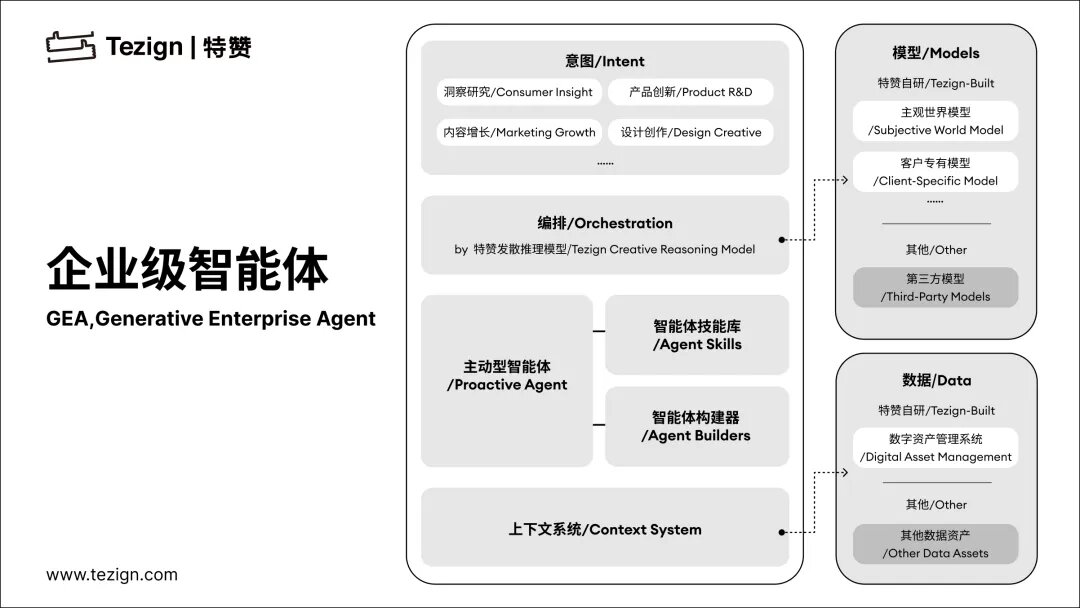
This is GEA (Generative Enterprise Agent)—Tezign's self-developed enterprise-level intelligent agent architecture, with the core logic of structuring and sedimenting the enterprise's knowledge, brand genes, and historical insights into a 'corporate memory' that can be continuously accessed by intelligent agents, executed by over 400 modular professional skills. The orchestration layer is driven by Tezign's self-developed Creative Reasoning Model, capable of coordinating over 30 foundational models for a single task, deployed in over 50 countries and regions globally, with a monthly average token deployment exceeding 10 billion.

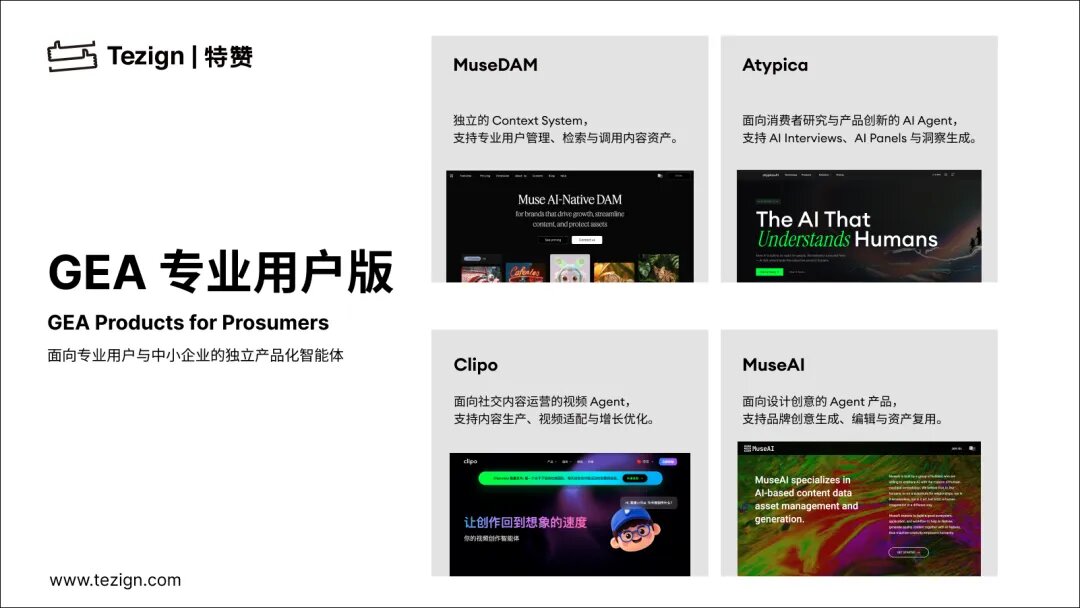
GEA showcased intelligent agent practices at the WAIC booth in the contexts of insight research, product innovation, brand design, and content growth. The WAIC 2026 exhibition continues until July 20, with Tezign's booth at H1-C135.
Come check in!

Category
Events
Date
2026-07-19
Read Time
4 min read
Share Page
Related Recommendations

Exciting Preview | 2026 World Artificial Intelligence Conference (WAIC): GEA Enters Various Industries, Digital Forest

The Cosmic AI Gala is Here: SuperAI@Singapore, Tezign is Here!