Food & Beverage
Consumer Goods Group: Building a Product Innovation System That Improves with Every Cycle
This enterprise has partnered with Tezign to create the 'Enterprise-Level Intelligent Agent System GEA', addressing pain points such as information fragmentation, slow feedback, and disjointed processes in traditional innovation workflows. It redefines the innovation model, enhancing design efficiency and making the innovation process sustainable and scalable, resulting in long-term compounding innovation capabilities.
Category
Food & Beverage
Date
2026-03-13
Read Time
7 min read
Background and Current Situation:
This is a global consumer goods group with a matrix of dozens of brands, covering core categories such as food, beverages, and personal care. In the Chinese market alone, it completes hundreds of new packaging designs and thousands of communication content each year. In the highly competitive fast-moving consumer goods industry, the speed of new product iterations is increasing, and consumer preferences are diversifying. In terms of packaging innovation, as part of new product innovation, it is not only about visual expression but also a key touchpoint for brand positioning and scenario strategy.
However, the innovation process still follows a traditional linear structure: trend research, consumer insights, concept incubation, design proposals, external execution, and testing verification are all disjointed. A new product's packaging often requires dozens of meetings and repeated modifications. Trends change by the hour, yet decisions are still made on a monthly basis.
For the group's CMO and innovation leaders, this is no longer just a design efficiency issue; it is a question of whether innovation capabilities can be scaled.
Challenges and Pain Points: The Problem Lies Not in Creativity, but in System Structure
When trends update daily, insights cannot flow back
Market research and consumer data are scattered across different departments and agencies. There is a lack of a unified enterprise context management system, making it difficult for information to form long-term assets. Each innovation feels like starting over, as historical experiences cannot be intelligently recalled.
Why do packaging review meetings always end up being overturned?
Creative validation relies on manual integration of materials and proposal writing, resulting in long feedback cycles. By the time proposals reach decision-makers, the market window has often changed. The slow validation is not due to insufficient design capabilities, but because the process heavily relies on manual connections.
From strategy to shelf, why does it feel like a relay race?
The innovation process is highly linear, lacking the ability to parallelize strategy, creativity, and execution. Production capacity cannot be expanded, and organizational collaboration costs continue to rise.
In such a structure, even the introduction of general generative AI can only enhance local efficiency, making it difficult to form true content asset governance and long-term compounding.
Solution: Making Product Innovation a Continuously Operating System
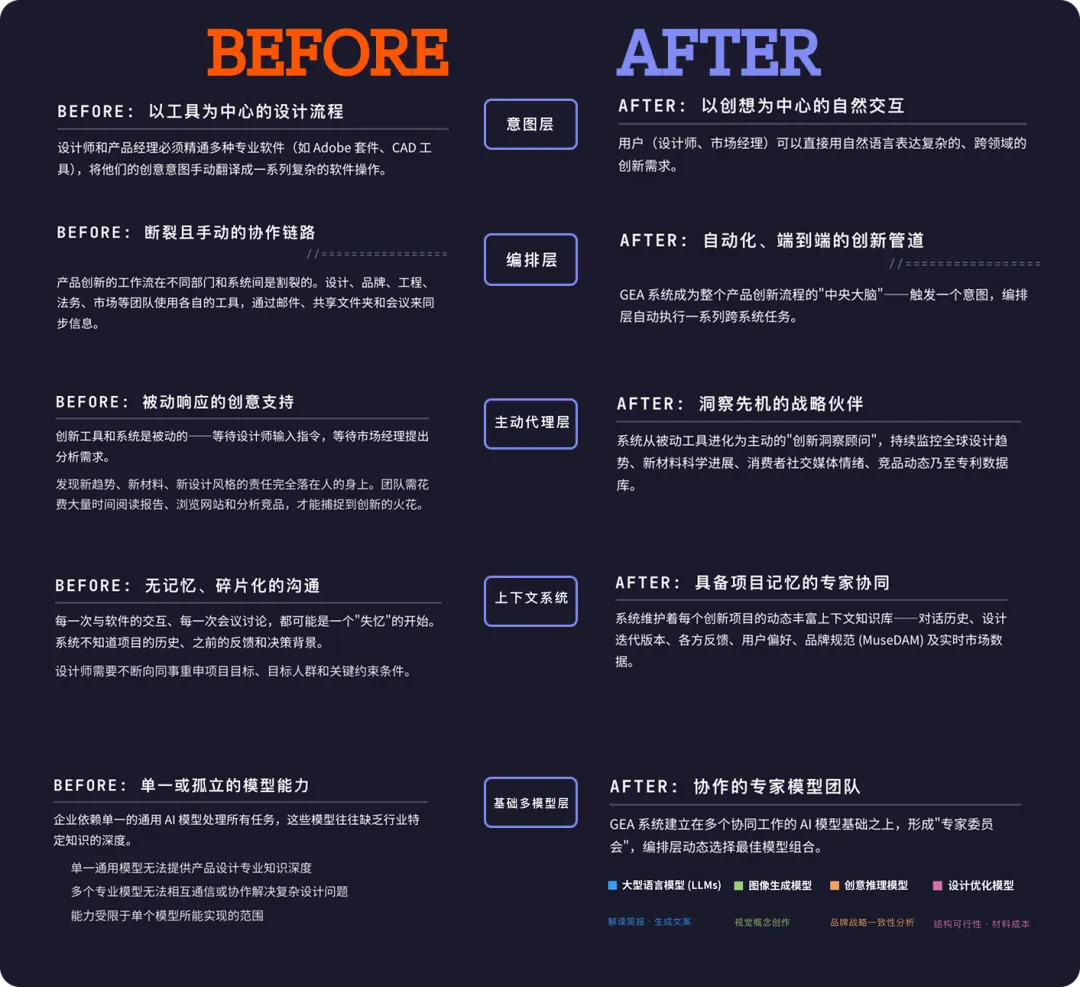
Tezign has built an enterprise-level intelligent agent system GEA (Enterprise Agentic AI System) for a leading global consumer goods group. This system is not just a single design tool, but an intelligent system that continuously operates around business Outcomes. Its core lies in integrating insights, creativity, design, and validation under the same Context through an enterprise context management system (Context System), forming a closed-loop workflow.
Through the five layers of the GEA architecture (Intent, Orchestration, Proactive Agent, Context System, Foundational Multi-Models), we provide an end-to-end solution for brand innovation processes, helping enterprises achieve rapid decision-making and innovation in a constantly changing market.
1. Intent Layer: Clarifying Brand Business Goals and Innovation Needs
In the GEA system, the Intent layer is the starting point of the entire system. The brand's innovation goals must be clearly defined. For example, the brand needs to quickly iterate new packaging to adapt to changing market trends and consumer demands. By clearly defining the brand's innovation goals (such as improving market fit, reducing design cycles, and increasing compliance pass rates), the GEA system can provide customized solutions for these objectives.
During the new product initiation phase, the brand's goals are not limited to 'creating a new packaging design', but ensuring that the innovative design aligns with brand tone, market needs, and compliance requirements. Therefore, the GEA system understands these goals through the Intent layer and begins to reason about subsequent execution paths.
2. Orchestration Layer: Path Evaluation and Task Allocation through Creative Reasoning Models
At the Orchestration layer, the GEA system relies on the Creative Reasoning Model for path evaluation. The creative reasoning model first breaks down brand goals into multiple feasible paths through divergent reasoning, for example:
• Generating different product propositions and visual directions based on historical data. • Creating different design solutions for each channel and market, ensuring layouts and content meet specific requirements.
The creative reasoning model does not merely seek optimal solutions in one direction but weighs and selects the best options among multiple paths. By assessing the value of each path, the system can quickly filter out the most promising design solutions in the early stages and adjust creative directions based on trend changes. The core function of this layer is to orchestrate multiple tasks through the Creative Reasoning Model, ensuring that each sub-task can be scheduled to the most suitable models and tools, thereby efficiently driving the generation of packaging designs.
3. Proactive Agent Layer: Actively Generating Creativity and Executing Design Tasks
Entering the Proactive Agent layer, the intelligent agents of the GEA system begin to play a real role. In the creative phase, the Proactive Agent does not just respond to commands; it actively pushes design proposals based on the brand's contextual data. Specifically, the Proactive Agent will:
• Automatically generate design solutions that comply with brand VI specifications, covering the needs of different channels and sizes. • Generate targeted creative proposals for different markets and consumer groups. • Automatically optimize creativity based on historical designs and consumer feedback, ensuring alignment with brand tone and market trends.
This layer is the core execution layer of the GEA system, where the intelligent agents can automatically identify potential issues in designs and adjust design directions in a timely manner. Through continuous feedback and optimization, the Proactive Agent can achieve 'continuous reasoning' during the design process, ensuring that design proposals are always highly aligned with brand goals.
4. Context System Layer: Context Data Management and Real-Time Updates
Context System (上下文系统) is supported by MuseDAM , becoming the memory and knowledge base of the entire system. DAM (Digital Asset Management System) structures all brand data, market reports, consumer feedback, historical packaging cases, and continuously updates through the Context Graph.
In the Context System layer, brand visual specifications, historically high pass-rate layouts, consumer preferences, and other data are continuously integrated to form a unique enterprise context. When new design proposals are generated, the system compares them in real-time with historical data to ensure that each round of design can be further optimized based on existing knowledge.
Through DAM, the GEA system ensures that design is not just a one-time creative process but a system that continuously evolves based on long-term accumulated brand data and market feedback. Each optimization of the design is an accumulation for future decision-making, making innovation sustainable and compounding.
5. Foundational Multi-Models Layer: Multi-Model Support and Skill Library
In the Foundational Multi-Models layer, the GEA system completes tasks by integrating multiple different models. These models include reasoning models, generative models, visual models, data models, etc., with each model providing support in its area of expertise.
In the design innovation process, the GEA system automatically selects the most suitable model to execute tasks. For example, when generating images, the system will call upon the image generation model; when generating text, it will use the language model; and when analyzing data, the system will invoke the data model for support. This flexible switching and combination of models enable the GEA system to consistently perform at its best across different tasks, ensuring the diversity and quality of packaging designs.
From Efficiency Improvement to Capability Upgrade: The Compounding of Innovation
After the system is operational, the team's working methods undergo structural changes. The packaging design cycle is significantly shortened; the ability to produce innovative solutions is enhanced; and the pace of new product testing completes the loop faster. More importantly, the innovation process no longer relies on individual senior creatives or high-intensity manual coordination, but forms a replicable and scalable end-to-end workflow.
The creative team can focus more on strategic judgment and brand storytelling rather than repetitive data organization. The competitive logic of the enterprise has shifted from 'doing more' to 'doing faster and right.'
In today's environment of frequent new products and increasingly fierce market competition, enterprise-level intelligent agents not only enhance design efficiency but also make the innovation process sustainable and scalable, bringing long-term compounding innovation capabilities.
The practice of the GEA system shows that true upgrades do not come from increasing design resources, but from building an intelligent-driven layer based on Context, making brand innovation faster, more precise, and capable of long-term evolution and continuous optimization.
Category
Food & Beverage
Date
2026-03-13
Read Time
7 min read
Related Recommendations
Maveric x Tezign: Hot Topics Don't Sleep, How AI Manages World Cup Campaigns?
Home Appliance and Furnishing Product Content Operation Upgrade, GEA Ensures Timely User Engagement with Every Product Update