Consumer Electronics
Technology Brand: Turning Hit-Making Instinct into an Enterprise System
The company collaborates with Tezign to create an 'AI Social Media Matrix', using a hybrid process of 'AIGC generation + human review' to form a reusable matrix operation SOP, stabilizing content production rhythm; reducing cross-department collaboration costs; enabling earlier risk identification; and significantly shortening data feedback cycles.
Category
Consumer Electronics
Date
2026-03-03
Read Time
4 min read
Background and Current Situation: When Social Media Becomes the Consumer Entry Point, Growth Begins to Test System Capabilities
As platforms like Douyin and Xiaohongshu become core consumer entry points, brand competition is no longer just a battle of creativity but a competition of scalable operational capabilities.
This global technology brand has a dense rhythm of new product launches, with frequent holiday marketing and co-branding activities. Content not only needs to be fast but also cover multiple accounts, multiple contexts, and multiple markets, while strictly adhering to brand standards and platform rules.
Problems Gradually Emerge:
• Content can be exciting but cannot be amplified consistently; • The larger the account matrix expands, the higher the collaboration costs and compliance risks; • A single traffic limit or controversy can negate months of accumulation.
For CMOs and social media leaders, this is not a question of 'how to create a hit', but how to establish a compliant and controllable growth infrastructure with long-term compound benefits.
Challenges and Pain Points: The Real Complexity of Matrix Operations
Why do we need to hold dozens of meetings for a new product launch?
From creative proposals to script reviews, to platform releases and data retrospectives, each link involves different teams and agencies. Information breaks down during circulation, and modification records are difficult to trace.
The larger the matrix scale, the higher the communication costs. The tug-of-war between creativity and compliance gradually consumes efficiency.
Does having more accounts really disperse risks?
In large-scale deployment scenarios, platform rules become core variables. A single expression error or a timing mistake can lead to traffic limits or public opinion risks. Traditional deployments rely on experiential judgment, lacking a unified data foundation and risk warning mechanisms.
After a hit, why is growth difficult to replicate?
The success of a single piece of content does not mean the success of the system. Topic logic, expression methods, and deployment rhythms often rely on individual experience, lacking structured sedimentation. When team members change or the market shifts, growth capabilities become difficult to reuse.
Solutions: Making Matrix Operations a Continuously Running System
In this project, Tezign built an AI social media matrix architecture centered around an enterprise-level intelligent system for the brand. We call this architecture GEA 企业级智能体系统. The system uses the enterprise context management system (DAM) as the only trusted source, structuring brand standards, historical deployment data, platform rules, and content assets into a Context Graph. Based on this, it operates around four key scenarios: 'Persona Modeling - Content Generation - Distribution Scheduling - Data Feedback'.
1. Topic Selection is No Longer Based on Feelings, but on Persona and Contextual Reasoning
During the content planning phase, the system constructs representative persona models (AI Persona) based on social media behavior data and semantic analysis. Different personas correspond to different expression contexts and topic pools. By clarifying the communication goals and audience effects; combining historical performance and trending changes, the topic direction is inferred; the Skills layer calls and loads skill packages adapted to different channels, generating scripts and expression versions that match the platform context. Topic selection shifts from experience-driven to context-driven, reducing blind investment and misfire risks.
2. Content Production Capacity Doubles, Compliance Standards Are Not Sacrificed
In the content production phase, a hybrid process of 'AIGC generation + human review' is adopted. AI generates scripts, titles, and visual references in bulk; human teams perform aesthetic judgments and compliance checks; modification paths and review standards are sedimented into the system, forming reusable rules. Deployment adopts a batch verification and gradual scaling strategy. First, small-scale tests are conducted, and then coverage is expanded based on data performance to avoid large-scale risks at once. AIGC and compliance engineering are designed in parallel, rather than as a remedial measure afterward.
3. Data Feedback Truly Guides the Process, Real-Time Iteration
All deployment data enters a unified data platform. The system monitors exposure, interaction, and comment sentiment in real-time, identifying abnormal fluctuations and risk signals, triggering manual reviews. This shifts from 'post-deployment reporting' to 'in-deployment iteration'. This is the transition from Reactive AI to Proactive Agent: the system not only executes tasks but also proactively suggests strategy adjustments based on data changes.
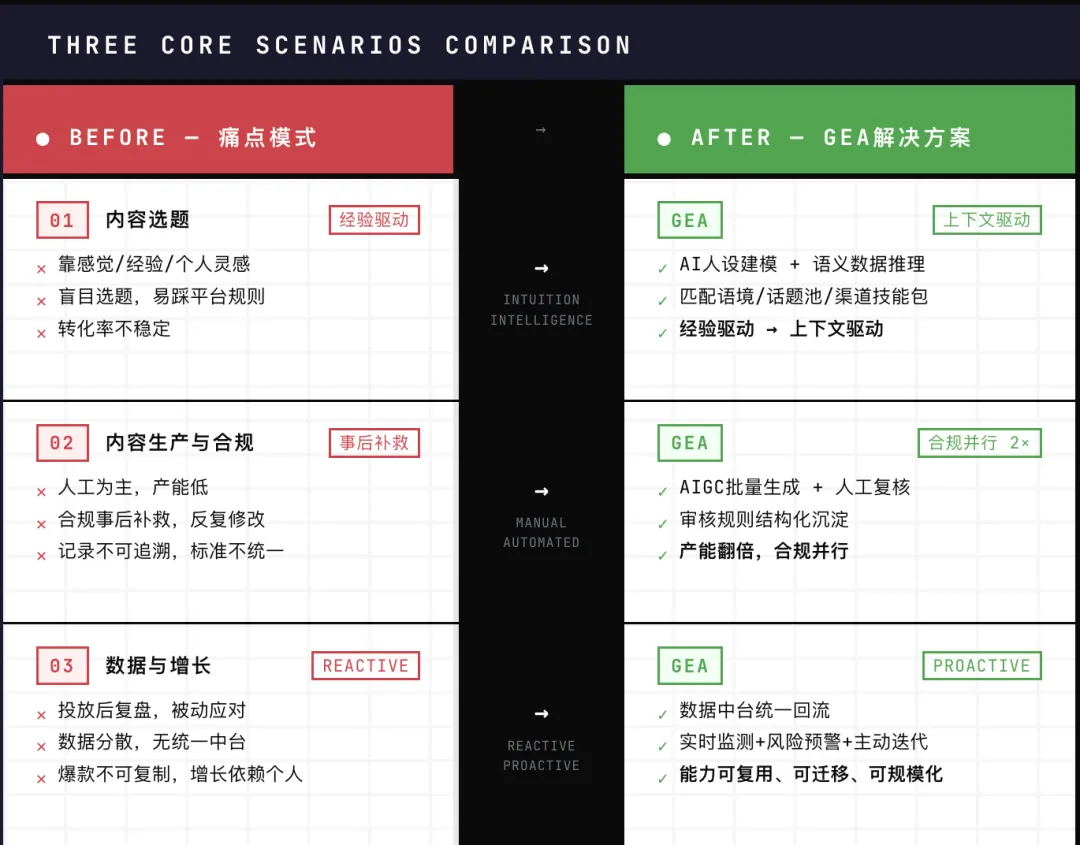
From 'Just Getting It Out' to 'Getting It Out Better', Matrix Operations Are Not About Volume, But Engineering
After the project runs, the brand forms a reusable matrix operation SOP, including a topic library, template system, monitoring panel, and compliance manual. Content production rhythm becomes more stable; cross-department collaboration costs decrease; risk identification occurs earlier; data feedback cycles are significantly shortened.
In today's increasingly complex social media ecosystem, a brand's competitiveness comes from whether it has an enterprise-level intelligent agent (Enterprise Agentic AI System) and a clear context management system (System of Context). If matrix operations lack the support of processes and technical foundations, they will only amplify chaos.
When Context becomes the unified foundation, when compliance is embedded in the generation phase, and when data flows back in real-time, social media growth can achieve long-term compound benefits. The practice of this global technology brand shows that true upgrades are not about 'producing more content', but about building a compliant, controllable, replicable, and sustainably evolving AI social media matrix system.
Category
Consumer Electronics
Date
2026-03-03
Read Time
4 min read
Related Recommendations

Global Smart Device Brand: Running Confidential User Tests Around the Clock

Consumer Technology Brand: Building a Repeatable Overseas Content Growth System with GEA