Beauty
When AI Starts to 'Call' Designers: This Beauty Brand Uses GEA to Solve the New Product Launch Challenge for 80 SKUs
The beauty brand faces issues such as difficulty in creative judgment and high rework rates during quarterly new product launches. By introducing the GEA system, they have restructured the process, significantly reducing costs and improving efficiency while accumulating proprietary brand intelligence.
Category
Beauty
Date
2026-09-29
Read Time
6 min read
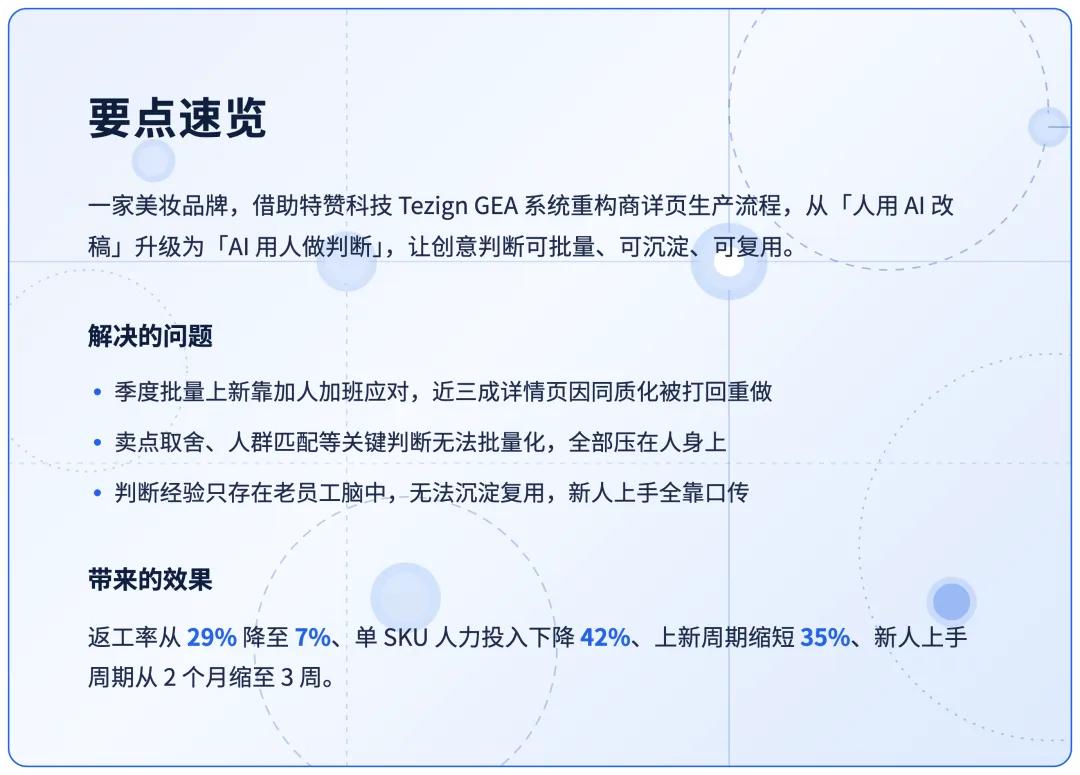
Every time a quarterly new product launch approaches, the first reaction of the operations team is to 'add more people'.
This beauty brand experienced this last quarter—hiring 6 contractors, working overtime to rush the work, and ultimately nearly 30% of the detail pages were sent back by the sales department for rework, citing that they looked too similar to the previous SKU.
The root cause lies not in execution, but in judgment: each SKU must undergo a judgment before going live—whether to focus on what the 'ingredient enthusiasts' care about, which is 'not being seen as marketed to', or what first-time users are concerned about, which is 'what others are using'; which selling points to emphasize in the main image on Tmall and the cover on Xiaohongshu; and how to adjust the selling point order based on different price segments. Once these judgments become bulk tasks, relying on human brains will start to make mistakes, and templates cannot cover the variables.
The problem is not low efficiency, but the inability to scale judgment. A deeper issue is that these judgments cannot be accumulated.
The design team repeats judgments that have already been made with each new launch, and newcomers have to learn them all over again. The insight from last quarter that 'the main image for this price segment SKU should emphasize effectiveness rather than ingredients' has no place to be recorded, and next time it still relies on oral tradition from experienced staff.
More seriously, there is almost no visible difference between good and poor judgments in results—both go live and both generate sales, but which selling point is effective and which type of user is truly engaged is not tracked or accumulated by any system.
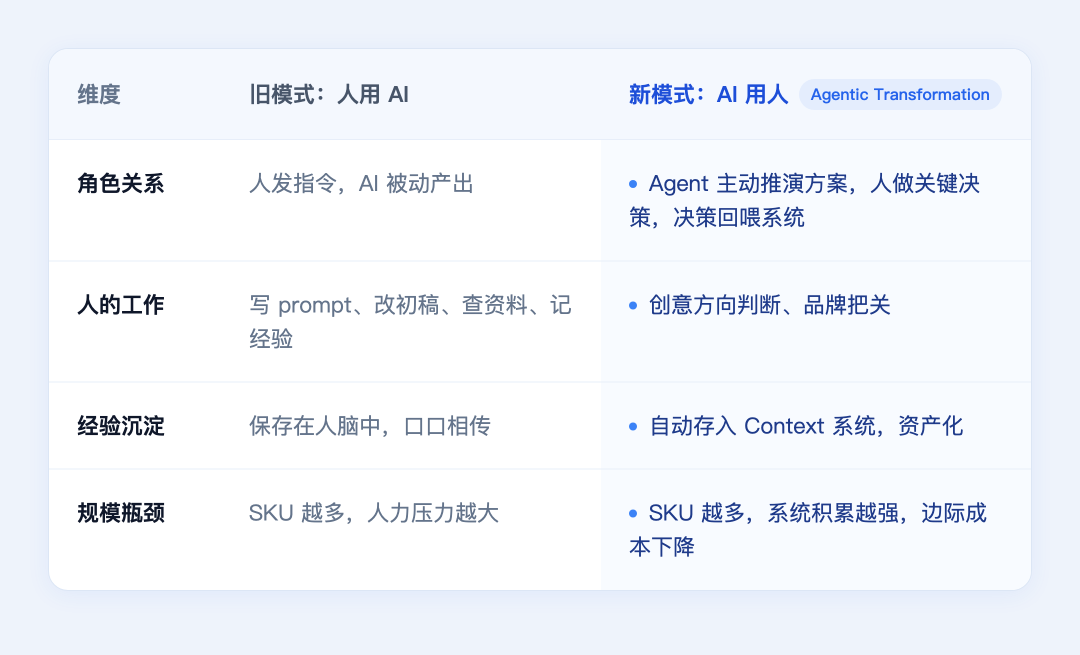
Not just another Agent, but letting AI call on humans
Common tools on the market can be roughly divided into two categories: traditional automated templates that assign judgment to structure, and general large models that can provide a qualified version. However, the core variable of the detail page is not parameters or a single correct answer, but 'what this brand's target users care about'—this is a question without a standard answer.
Additionally, the team also attempted to introduce a general large model to lighten the load: Operations first organizes SKU information and writes briefs, then hands it over to AI to generate the initial draft of the product details; Designers receive the AI output, reassess whether the selling points match the target audience and whether the brand tone is consistent, manually adjust, and revise repeatedly; E-commerce leaders conduct the final review. AI is only responsible for 'writing content', while all key judgments, user insights, selling point trade-offs, and historical experience retrieval are placed on humans.
This brand began to use GEA to reshape this business process, reorganizing the judgments, generation, and feedback that were originally scattered among people and processes.
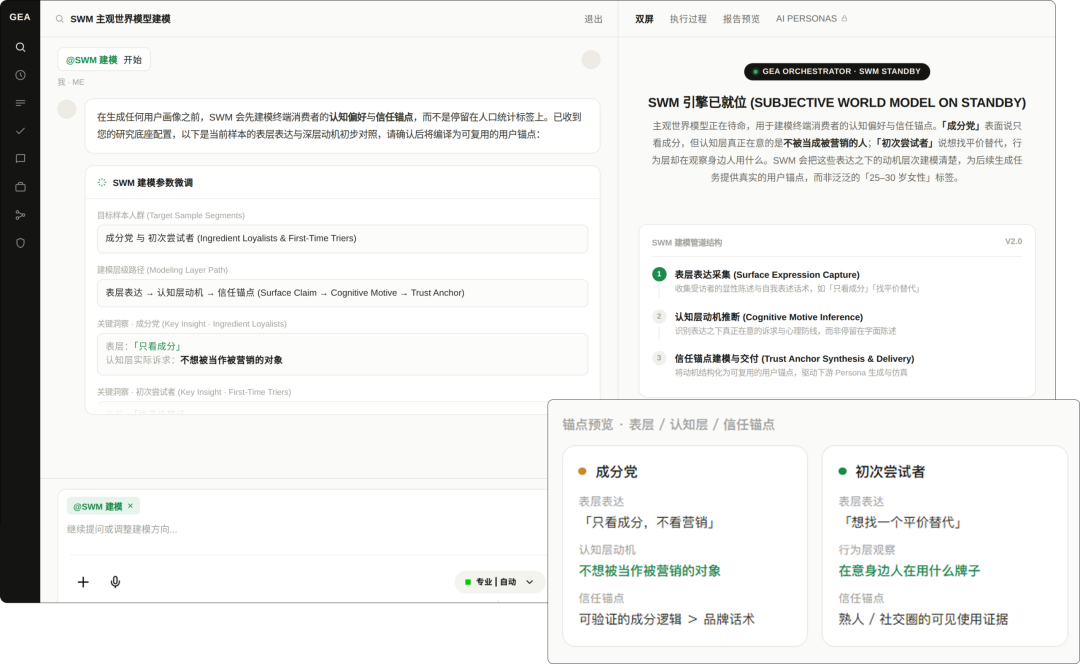
Step One: Model User Cognition to Provide Real Judgment Basis for Creative Direction
SWM (Subjective World Model) first models the cognitive preferences and trust anchors of end consumers. There is no longer a need for operations to manually organize user insights into briefs. 'Ingredient enthusiasts' may superficially claim to only care about ingredients, but what they truly care about on a cognitive level may be 'not being seen as marketed to'; 'first-time users' may say they want affordable alternatives, but behaviorally they are observing what others are using. SWM clarifies the motivational layers beneath these expressions, actively outputs user anchors, and hands them over to humans for verification and calibration, rather than waiting for humans to input all insights.
Step Two: Diverge Multiple Directions and Leave Judgment to Humans
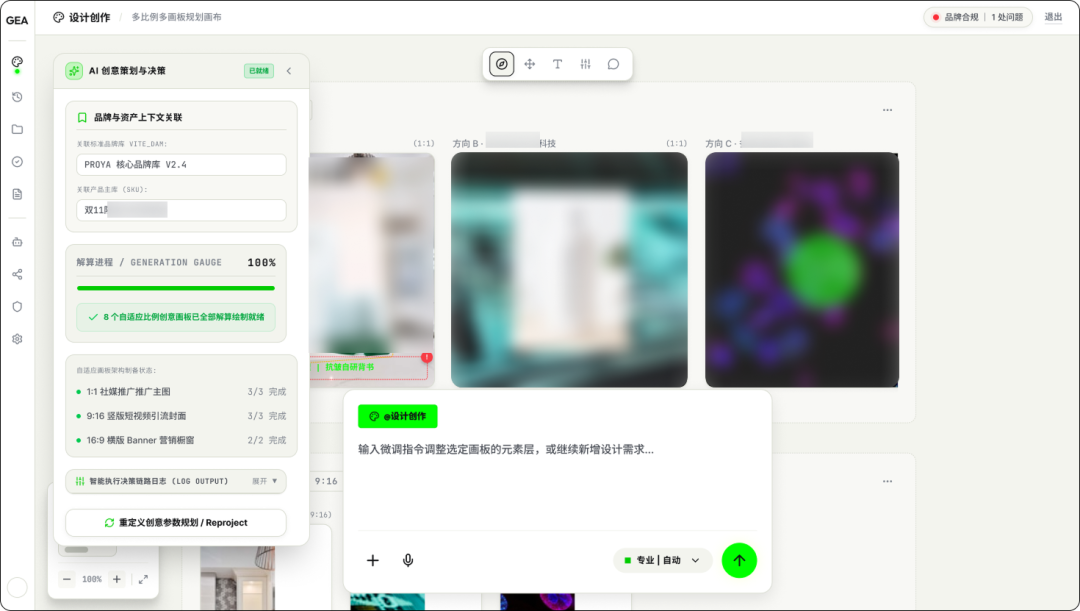
CRM (Divergent Reasoning Model) diverges multiple possible directions based on this user anchor—rather than just providing one qualified answer. Each direction develops specific plans based on brand context and user insights, allowing designers to compare, choose, and iterate, ultimately converging on the most suitable version.
Designers are no longer just writing prompts for AI or modifying AI drafts, but making choices and fine-tuning creative directions among the multiple paths provided by the Agent. Designers A/B test which direction is more accurate, whether the brand tone is consistent, and whether it differentiates from competitors. Every choice, rejection, and modification made by humans will be captured by the Agent and stored in the context system. This is 'AI using humans': the Agent is responsible for exhaustively exploring possibilities and aligning historical information; humans provide high-level aesthetics and brand judgments, and human decisions themselves are the most important input for system training.
What designers receive is no longer a 'template filling task', but a 'direction decision task'—A/B testing which direction is more accurate, whether the brand tone is consistent, and whether it differentiates from competitors. Designers can focus their energy on areas that truly require creative judgment.
Step Three: Write Results Back to Build on the Accumulation of the Previous Batch of SKUs
The conclusions from this round of judgments and the A/B test data after going live are written back to the Context System. The next time 80 SKUs are launched, GEA does not start from scratch, but builds on the judgments and effects from the previous round—understanding which direction converts better in this price segment and which selling point combinations have higher trust levels for this audience.
General models can generate a seemingly usable version, but they do not inherently understand this brand's target users, existing judgments, and historical feedback. Most AI tools are humans using AI: humans input commands, and AI outputs content all at once, with human decisions unable to be accumulated in the process. The difference of the GEA Agentic system is that: the Agent continuously handles information processing and plan development, iterating the system itself with human creative judgments. With each new launch, the system absorbs the brand's unique decision-making experience.
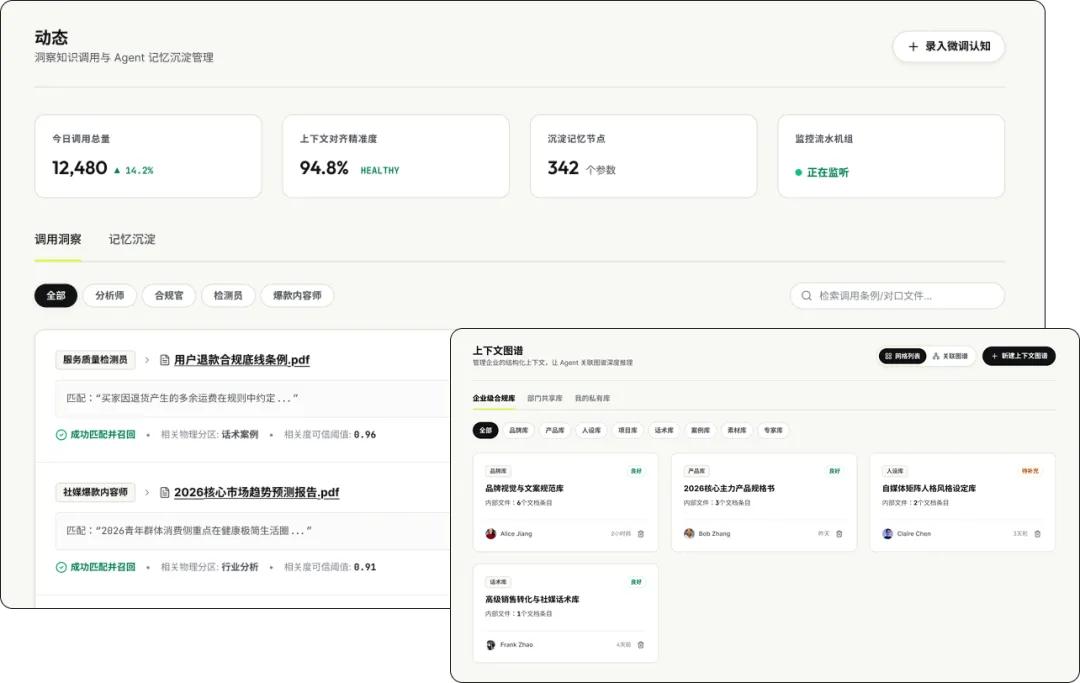
After the system went live, the rework rate for detail pages dropped from 29% to 7%; the manpower input for single SKU detail production decreased by 42%, eliminating the need for temporary large-scale hiring of contractors; the new product launch cycle shortened by 35%, and the team no longer has to work overtime for quarterly launches. The onboarding period for new designers has reduced from 2 months to 3 weeks, no longer relying on experienced staff for oral tradition.
This brand is extending this capability to promotional decision-making scenarios—before major promotions, conducting signal tests on different promotional strategies (discount levels, bundling options, gift selections), transforming 'relying on intuition to develop plans' into 'relying on signals to select plans'.
With each new product launch, the system gains a better understanding of this brand's target users. In the future, the brand's understanding of consumers will no longer depend on any specific individuals but will become a cognitive asset that the enterprise can accumulate and reuse. This is the 'proprietary intelligence' belonging to this beauty brand.
Category
Beauty
Date
2026-09-29
Read Time
6 min read
Related Recommendations

How to Achieve Personalized Production for Thousands of Products Online? GEA Enters the Footwear and Apparel Brand Worksite
Maveric x Tezign: Hot Topics Don't Sleep, How AI Manages World Cup Campaigns?