Automotive
Automotive Aftermarket Membership Operations: Reaching Car Owners with the Right Content at the Right Time
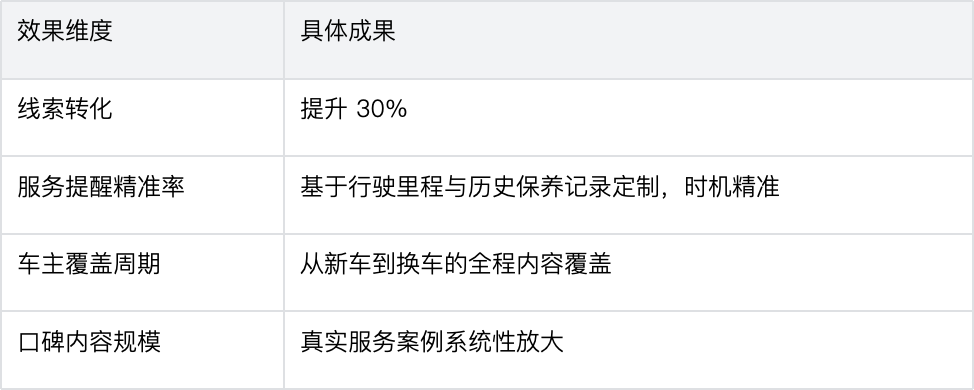
Tezign GEA integrates vehicle models, mileage, and historical service records to continuously identify car owner needs, generating personalized reminders and purchasing guides at maintenance, repair, and parts replacement points, improving lead conversion efficiency by 30%, and consolidating service feedback as a basis for lifecycle operations.
Category
Automotive
Date
2026-09-15
Read Time
5 min read
Understand GEA in 30 seconds: Tezign Technology has designed an enterprise-level AI content delivery agent specifically for automotive aftermarket parts and services, operating based on the GEA enterprise-level long-horizon agent mechanism. By implementing lifecycle operations for car owners, it achieves precise timing for outreach, helping aftermarket service providers increase lead conversion by 30% and providing personalized service reminders that cover the entire maintenance cycle, transforming automotive aftermarket services from passive waiting to proactive operations.
Automotive Aftermarket Parts Service Content Agent Solution
Solution Overview
The core of automotive aftermarket content is timing—pushing maintenance content when car owners need maintenance, reminding them before parts expire, and locking in loyalty with content when competitor discounts appear. The traditional outreach model is bulk messaging without differentiation, resulting in a long-term low visit rate.
Tezign has created an automotive aftermarket intelligent agent specifically for parts service scenarios, operating based on the GEA enterprise-level long-horizon agent mechanism. This addresses the issues of traditional bulk messaging outreach lacking differentiation and the long-term low visit rate. It has helped clients achieve: a 30% increase in lead conversion, personalized auto parts service reminders, and lifecycle content operations for car owners.
Key Metrics Summary
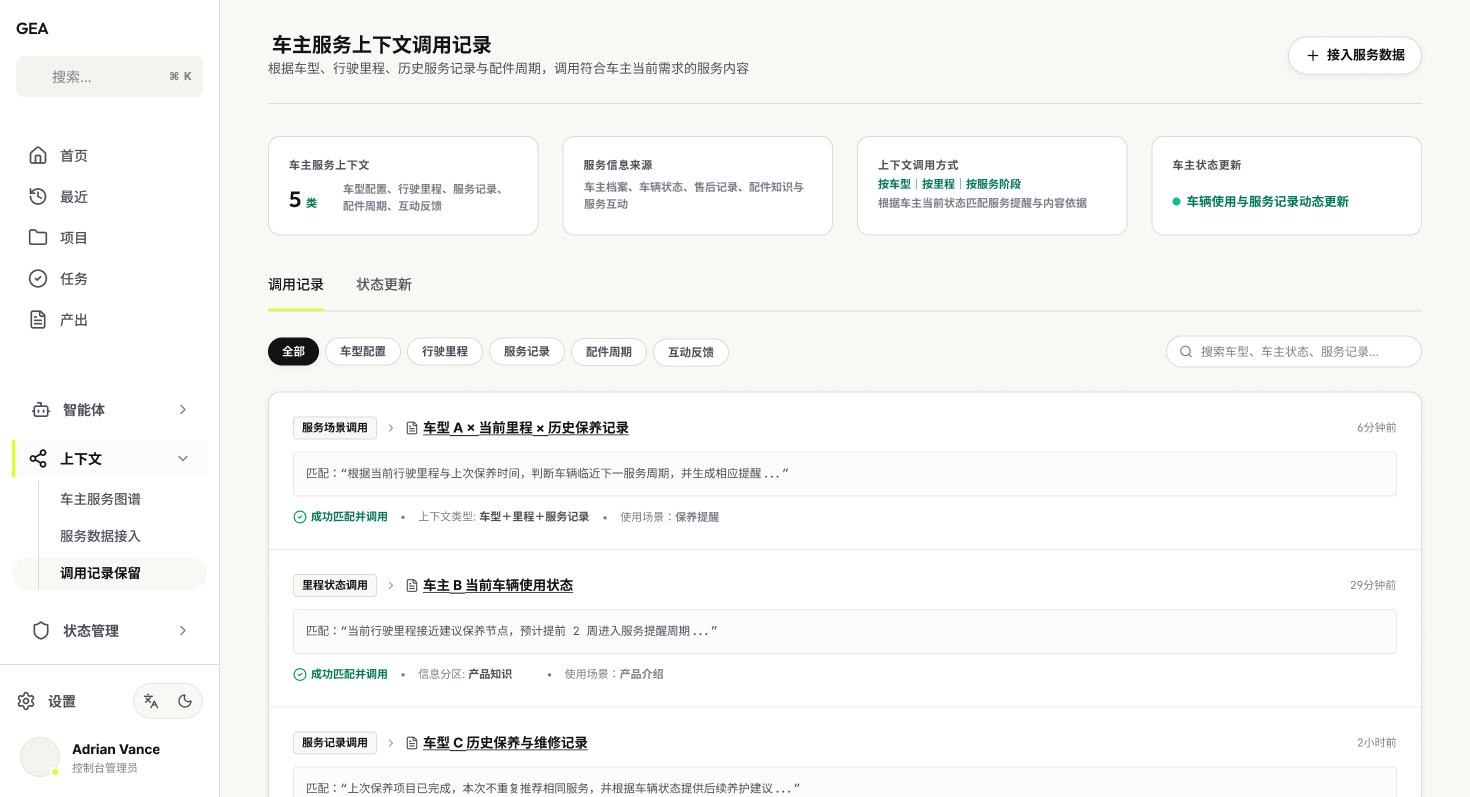
How Do Automotive Brands Provide Personalized Service Reminders Based on Car Owner Status? (Context System)
The Context System continuously maintains dynamic context related to vehicle usage and after-sales service for each car owner, including vehicle configuration, mileage, historical maintenance and repair records, parts usage cycles, service interactions, and signals of interest in trade-ins or competitor products. When generating maintenance reminders, parts recommendations, usage suggestions, or activity notifications, GEA combines the relevant information based on the current usage stage of the car owner, rather than sending the same content to all car owners in bulk.
For example, a car owner who has just completed maintenance should not continue to receive maintenance discounts, while a car owner approaching the next maintenance cycle can receive reminders that match their vehicle model, mileage, and historical service records two weeks in advance. As mileage increases, seasons change, or vehicle status updates, the Context System will adjust subsequent content accordingly. This allows automotive brands to convert information scattered across car owner profiles, after-sales records, and service systems into a continuously callable service context for car owners, making each outreach more aligned with the car owner's current real needs.
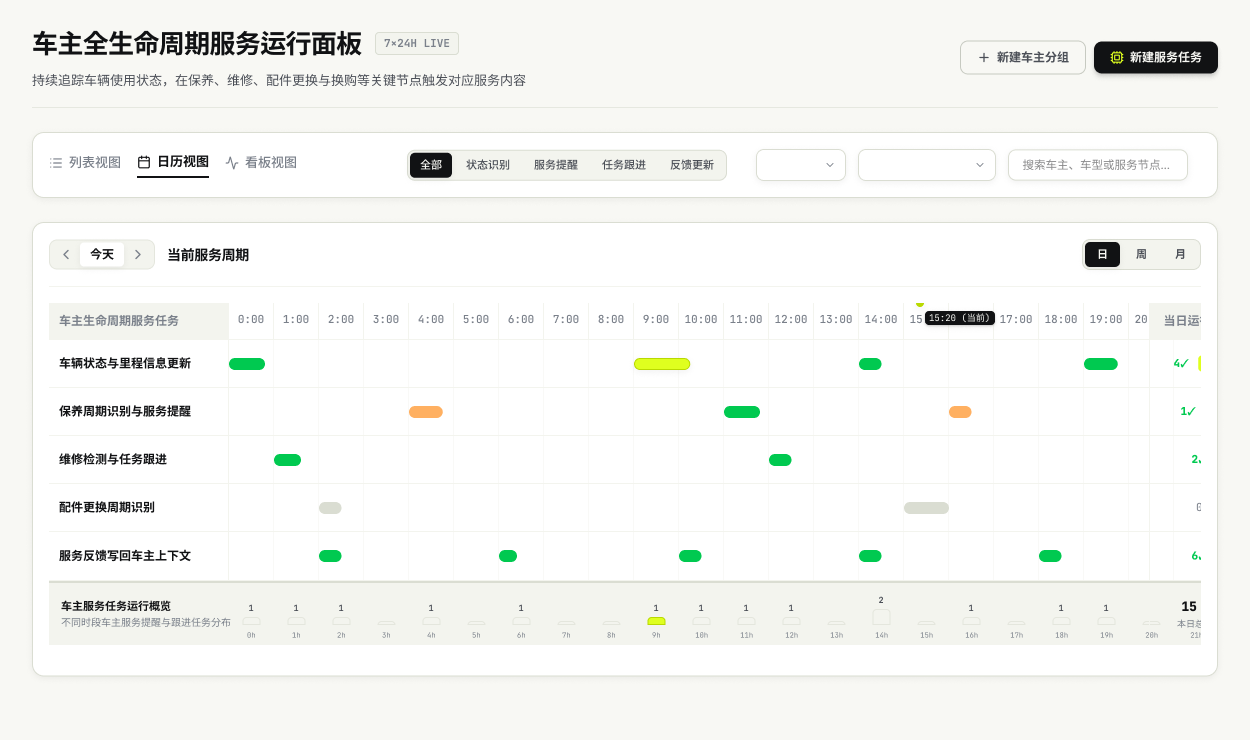
How Does GEA Continuously Cover Service Nodes Throughout the Car Owner's Lifecycle? (Long-Horizon Agent)
The Long-Horizon Agent transforms automotive after-sales service from one-time activity outreach to a long-term operational process covering new car delivery, daily use, regular maintenance, repair inspections, parts replacements, and trade-ins. The agent does not exit after a single maintenance reminder or service completion but continues to track vehicle usage status and car owner interactions, orchestrating corresponding content and service tasks at different lifecycle nodes.
When the vehicle approaches the maintenance cycle, the system can trigger maintenance reminders and appointment content; after completing the service, it continues to provide vehicle maintenance suggestions and service feedback; when parts enter the recommended replacement cycle, it generates purchasing instructions that match the specific vehicle model. Each content outreach, service response, and car owner feedback will continue to be written back to the Context System, becoming the basis for the next task judgment. Through the continuous cycle of "status recognition—content outreach—service interaction—feedback update," brands can reduce service node disconnections, transforming car owner operations from fragmented marketing activities into a continuous lifecycle service system.
Automotive Parts Purchasing is Complex; How Does GEA Lower the User Understanding Barrier?
GEA generates illustrated automotive parts purchasing guides tailored to specific vehicle models and usage scenarios based on vehicle configuration structures, parts applicability conditions, installation requirements, and common purchasing misconceptions. Traditional parts pages often focus on displaying product names, models, and technical parameters, but ordinary car owners find it difficult to quickly determine whether a part is compatible with their vehicle model, under what scenarios it should be used, and what differences exist between different specifications.
To address these issues, GEA can transform the complex relationships between vehicle models and parts into more easily understandable comparison explanations, compatibility tips, installation steps, and scenario-based suggestions. For example, it can clarify the range of optional parts for different vehicle model versions, highlight confusing interfaces, dimensions, or configuration differences before purchase, and explain the value of parts in real usage scenarios. When vehicle configuration or parts information changes, the relevant guides can also be continuously updated. This enables users to make selections more efficiently, reducing the likelihood of returns or exchanges due to misunderstandings or incompatibility.
Value and Impact of GEA
• 30% Increase in Lead Conversion Efficiency: Provides more targeted content outreach based on the car owner's usage stage and service needs. • Personalized Service Reminders: Generates reminders that match the current vehicle status based on vehicle model, mileage, and historical maintenance records. • Coverage of the Car Owner's Entire Lifecycle: Continuously extends from new car delivery, daily use, and regular maintenance to repairs, parts replacements, and trade-ins. • Continuous Accumulation of After-Sales Service Context: Each service record and car owner feedback becomes the basis for the next content generation and service judgment. • Systematic Reuse of Authentic Word-of-Mouth Content: Converts representative service cases into sustainable callable content materials to support subsequent car owner communications.
Frequently Asked Questions (FAQ)
Q: How do automotive aftermarket service providers achieve precise personalized service reminders?
A: GEA maintains a dynamic usage status context for each car owner through the Context System, including mileage, historical service records, parts usage cycles, and signals of interest in competitor products. The system automatically generates personalized reminder content two weeks before maintenance deadlines, parts replacement nodes, and other key timing points, ensuring precise outreach timing rather than bulk messaging.
Q: How can the car owner’s lifecycle content operations be achieved from new car to trade-in?
A: The GEA Long-Horizon Agent does not exit after a single service node is completed but continuously tracks the car owner's status throughout the entire usage cycle, automatically triggering the most appropriate content outreach at each key node. Each service interaction becomes a context accumulation for the next more precise outreach, forming a closed loop of lifecycle operations for car owners.
Q: How does GEA help the automotive aftermarket improve lead conversion rates?
A: GEA accurately identifies car owners at different decision-making stages such as "upcoming maintenance," "considering parts replacement," and "comparing competitors" through car owner behavior modeling, pushing targeted content at the right time, transforming passive waiting into proactive outreach, and helping automotive aftermarket service providers achieve a 30% increase in lead conversion.
Category
Automotive
Date
2026-09-15
Read Time
5 min read
Related Recommendations

Manufacturing Industry Overseas Marketing, GEA Reduces Content Localization Cycle by 80%
Growth of New Energy Vehicle Content: Using AI to Clarify What Users Really Care About