Consumer Electronics
Consumer Technology Brand: Turning Product Pricing from a One-Off Decision into a Living System
The company has introduced the Tezign GEA architecture to create an intelligent pricing system for consumer goods brands, addressing the pain points of traditional pricing reliance on experience, regional fragmentation, and lack of feedback, achieving full-process pricing intelligence through a five-layer architecture, significantly enhancing decision-making and testing efficiency, and building sustainable pricing governance capabilities.
Category
Consumer Electronics
Date
2026-03-25
Read Time
8 min read
Background and Current Situation:
A certain consumer goods brand has been continuously expanding over the past few years, with a product line spanning multiple price ranges, covering online e-commerce, offline supermarkets, membership systems, and regional agency channels. On the surface, the company has a complete cost accounting model and competitive price monitoring mechanism, but when it comes to actual pricing decision meetings, problems repeatedly arise: price suggestions from different regions conflict with each other, the sales team emphasizes sales pressure, the finance team emphasizes gross profit targets, and the brand team worries about the impact of pricing on long-term positioning.
In the consumer goods industry, pricing has never been a purely financial action, but rather a convergence of brand strategy, channel strategy, and user perception. Every price adjustment can affect sales structure, gross margin performance, and brand premium capability. Especially in the case of multi-region and multi-channel parallel operations, the complexity of the pricing system far exceeds expectations.
More critically, each price adjustment is often viewed as an independent project. Sales and gross profit change data after price adjustments are recorded but do not enter the reasoning chain for the next round of pricing decisions. Pricing decisions seem rational but lack contextual accumulation. In this context, the company realizes that the pricing issue is not a lack of models, but a lack of a system that can continuously reason and act within the company's exclusive context.
Challenges and Pain Points: Pricing Models are Scientific, but Why Does Price Increase Feel Like a 'Gamble'?
From a decision-making structure perspective, traditional pricing has three types of high-risk issues.
Pricing Relies on Human Experience.
Although supported by cost models and market data, the final judgment often rests on a few core decision-makers. While experience is important, the lack of explainable and traceable reasoning paths makes it difficult for organizations to replicate successful experiences.
Different Regional Pricing Systems are Fragmented.
There are significant differences in regional sales structures, channel sensitivities, and user payment capabilities, yet there is a lack of a unified analytical framework. A price that performs well in one region does not necessarily mean it will be equally effective in another. Regional differences become latent risks in pricing governance.
Lack of Historical Feedback Mechanism.
After price adjustments, sales and gross profit change data are scattered across different systems, making it difficult to structure and accumulate. The company cannot clearly answer a key question: which pricing strategies truly bring long-term compounding benefits, and which are merely short-term fluctuations?
When pricing decisions cannot form an end-to-end workflow closed loop, the organization can only repeatedly probe between profit and sales, making it difficult to establish a long-term stable profit structure.
Solution: Say Goodbye to the Static Pricing Era, System Upgrade of Pricing Decisions
In response to the above challenges, a certain consumer goods brand has introduced the GEA 企业级智能体系统 system, leveraging its five-layer architecture (Intent, Orchestration, Proactive Agent, Context System, Foundational Multi-Models) to transform traditional pricing decisions into an automated, intelligent continuous optimization system. GEA is not just a pricing tool, but a decision engine embedded in the brand's daily workflow, driving pricing decisions from experience-led to data-driven, from one-time decisions to long-term compounding.
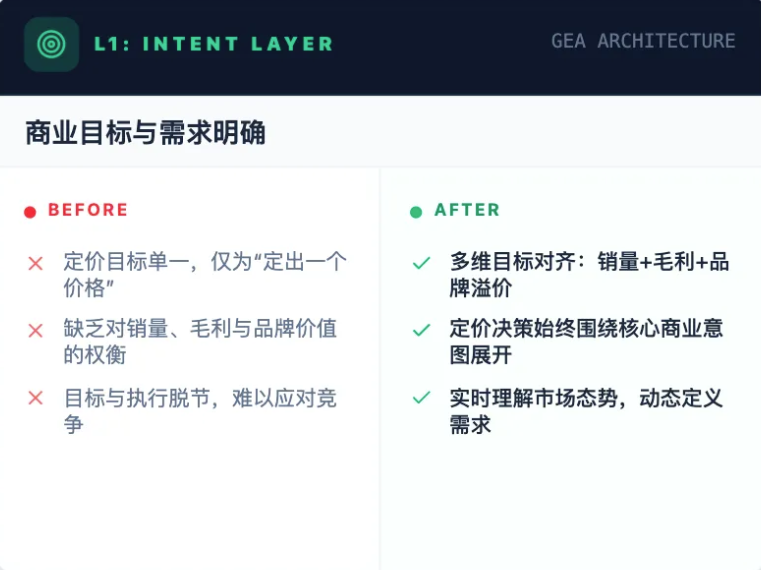
1. Intent Layer: Clearly Define Pricing Business Goals and Needs
At the Intent layer, the GEA system first helps the brand clarify its pricing goals. This is not just about 'setting a price', but ensuring that pricing helps the brand maintain competitiveness in a fierce market. At this stage, GEA identifies three main objectives:
• Support Sales Growth: Price adjustments must help increase product sales, especially in highly competitive markets. • Ensure Gross Profit Stability: At the same time, pricing must protect the brand's gross margin, avoiding profit erosion from price wars. • Ensure Long-term Brand Value: Prices cannot be based solely on short-term benefits, but must also consider the brand's long-term positioning and market premium capability.
GEA understands these business goals through the Intent layer, ensuring that every subsequent decision step revolves around these goals.
2. Orchestration Layer: Choose the Best Pricing Strategy from Multiple Paths
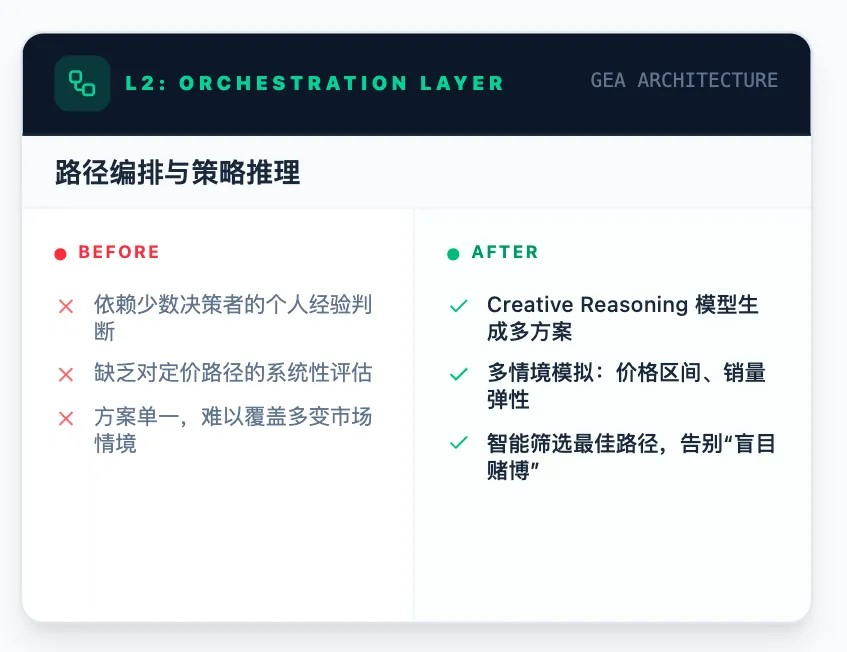
Entering the Orchestration layer, the GEA system begins to evaluate different pricing paths through the Creative Reasoning Model. Traditional pricing is often judged by a few decision-makers based on experience, while GEA generates multiple pricing schemes through intelligent reasoning at this layer and evaluates the potential effects of each scheme. For example, GEA may evaluate the following pricing paths:
• Price Range Model: Customize price ranges for different regions, channels, and consumer groups, ensuring that price adjustments in each market meet local demands. • Sales and Gross Profit Balance: While ensuring sales growth, GEA will optimize gross profit stability through price elasticity simulations. • Multi-scenario Testing: Conduct multi-scenario simulations for different pricing schemes, helping decision-makers see the potential market responses to each pricing scheme.
The Creative Reasoning Model does two things here: first, it divergently explores various possibilities, then orchestrates, filters, and optimizes paths, helping the brand find the most suitable pricing scheme.
3. Proactive Agent Layer: Actively Drive Sales and Pricing Adjustments
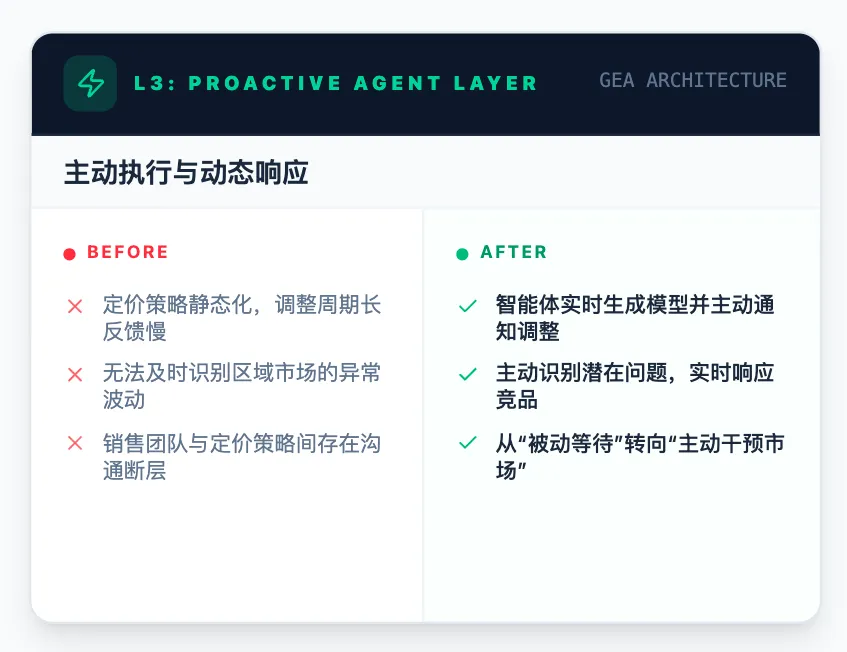
Entering the Proactive Agent layer, the intelligent agents of the GEA system begin to actively execute tasks, driving pricing decisions to implementation. At this layer, the Proactive Agent has the following capabilities:
• Dynamic Price Adjustment: Based on market feedback and competitive changes, the Proactive Agent will generate new pricing models in real-time and actively notify the sales team to make adjustments. • Identify Potential Issues: If a pricing strategy in a certain region fails to drive sales as expected, the system will proactively analyze the reasons, identify potential issues, and propose adjustment suggestions. • Real-time Market Response: GEA continuously monitors market changes, quickly capturing competitor actions and fluctuations in consumer behavior, allowing for rapid strategy adjustments.
This means that pricing is no longer static but an actively responsive process, with the Proactive Agent continuously optimizing pricing strategies based on real-time market feedback, rather than waiting for data accumulation before making adjustments.
4. Context System Layer: Continuously Optimize Pricing Based on Contextual Data
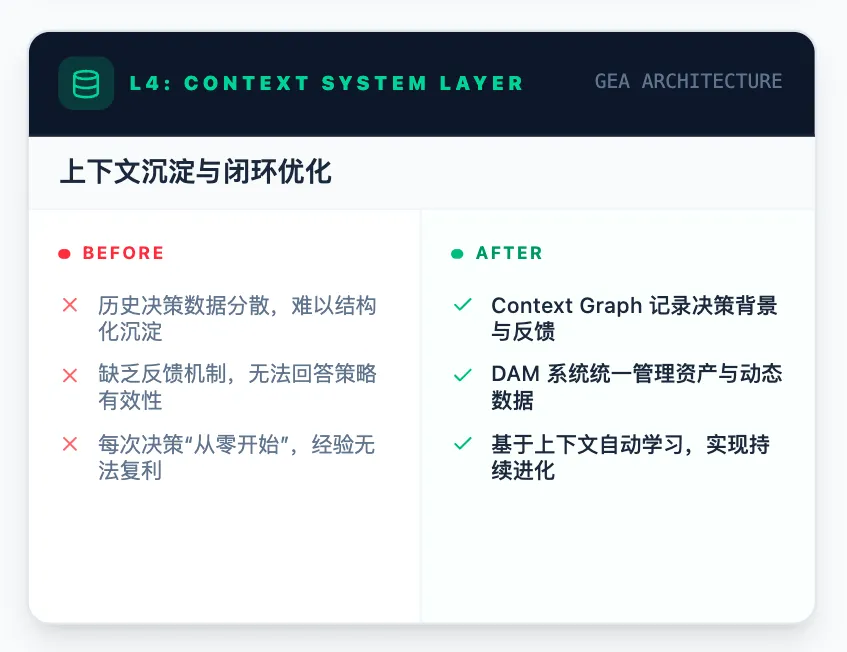
The Context System layer achieves unified management of the brand's historical decisions and market data through DAM (Digital Asset Management System). All historical data related to pricing, sales, and gross profit are structured into a Context Graph for the system to call at any time. Through this system, GEA ensures that every pricing decision is based on long-term accumulated contextual data.
• Historical Sales Data: The decision background, adjustment reasons, and sales feedback for each pricing decision are recorded in the Context Graph. This way, the brand can reference past experiences in future pricing decisions, avoiding starting over. • Market Dynamic Feedback: All market feedback and competitive data are updated in real-time within the Context System, helping the system optimize based on the latest situation.
Through the Context System, GEA can automatically learn and optimize with each pricing decision, ensuring that pricing strategies remain in the best state in an ever-evolving market environment.
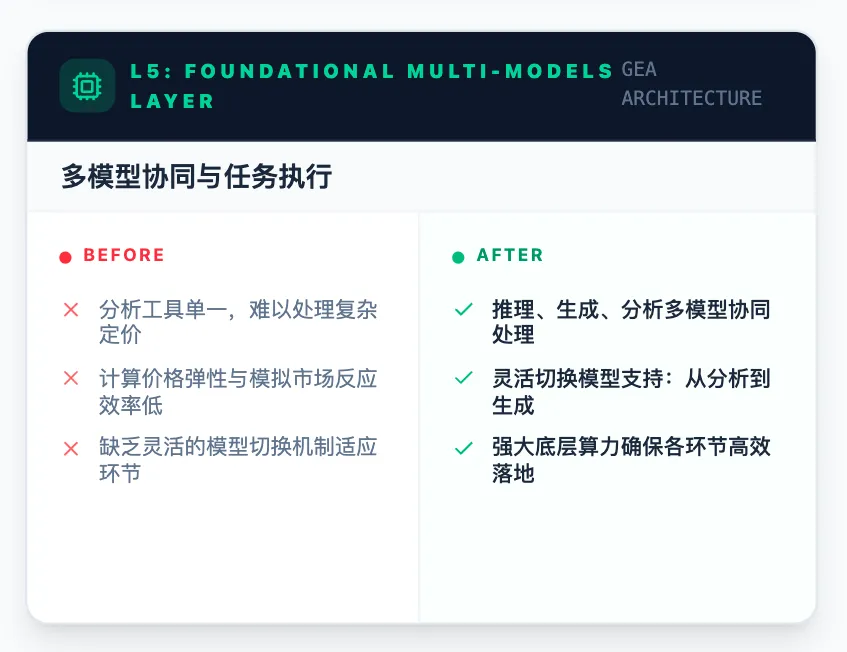
5. Foundational Multi-Models Layer: Multi-model Support and Flexible Task Execution
At the Foundational Multi-Models layer, the GEA system relies on multiple specialized models to handle complex pricing tasks. For example, during the pricing process, GEA may simultaneously use:
• Reasoning Model: Analyze market data and infer the most suitable pricing strategy based on historical sales behavior. • Generative Model: Generate new pricing schemes based on sales data and market changes. • Data Analysis Model: Calculate price elasticity and assess the impact of different pricing on sales and profits.
Through the collaborative work of multiple models, GEA can flexibly switch models based on task needs, ensuring that every aspect of the pricing process receives the most effective support.
Validated Judgments Begin to Form Compounding Benefits
In actual operation, three changes can be observed.
First, the pricing decision cycle has shortened by nearly 70%. The process that originally required multiple rounds of cross-department discussions and data integration has been structured into a reasoning and simulation process within the system.
Second, the efficiency of price testing has significantly improved. Through small-scale validation and simulation mechanisms, the company can more quickly assess the impact of different price ranges on sales and profits.
Third,decision transparency and governance capabilities have significantly increased.Price adjustments no longer rely on a few experienced judgments but are based on traceable reasoning paths and contextual management systems.
A deeper change is that the company has begun to incorporate pricing into a long-term contextual management and content asset governance framework. Price data, sales feedback, and profit structures are no longer isolated indicators but become intelligent capital that can be called upon by enterprise-level intelligent agents.
In the highly competitive consumer goods market, pricing is both a growth lever and a source of risk. The real challenge lies not in whether there are models, but in whether there is a system that can continuously reason, continuously learn, and continuously optimize. When enterprise-level intelligent agents (GEA, Enterprise Agentic AI System) are embedded in real workflows and establish a unified contextual management system, pricing is no longer a one-time judgment but becomes a sustainable operational capability.
This capability will form compounding benefits in long-term competition.
Category
Consumer Electronics
Date
2026-03-25
Read Time
8 min read
Related Recommendations

Global Smart Device Brand: Running Confidential User Tests Around the Clock

Consumer Technology Brand: Building a Repeatable Overseas Content Growth System with GEA