No Longer Relying on Intuition to Find Bestsellers, An AI Product Innovation Experiment by a Food Brand
A well-known food brand leveraged Tezign's product innovation GEA to integrate market trends and brand capabilities, generating four new product directions through divergent reasoning in parallel, resolving two months of internal disputes in just 5 days, and shortening the innovation validation cycle by 60%, with market feedback and predictions aligning at 82%.
Category
Date
2026-08-04
Read Time
3 min read
Product innovation in food brands is often a gamble based on experience.
Product managers rely on past feelings, focus groups provide biased opinions from limited samples, and judgments in internal discussions are hard to validate against external signals. This is not to say these methods lack value—experience and intuition remain important in innovation. But the question of 'where the next bestseller comes from' needs answers from a signal space larger than internal discussions.
A certain food brand planned to launch new products, but internal disputes over several directions lasted two months without consensus. Everyone said 'I think,' but no one could clarify 'where the market signals point.' This was not a team division, but a lack of information density. They decided to rerun this with GEA.
Sense: GEA integrates two types of data into the Context System—market-side signals (changes in consumer descriptions of flavors on social media, the diffusion speed of emerging flavor trends across different age groups, and preference differences among segmented populations) and brand-side assets (historical product success and failure data, combinable dimensions of the ingredient database, and process constraints). These two types of data coexist in the system, forming a brand-specific 'innovation feasibility map.'
Reason: The Creative Reasoning Model conducts multi-path divergence based on a tree-like thinking chain: generating feasible directions in the intersection area of 'market acceptance' and 'brand realization capability.' Each direction comes with: target audience profiles, expected acceptance reasons, main risk points, and the degree of differentiation from the brand's existing product line. What is provided to the product team is not one answer, but four evidence-based directions for parallel evaluation.
Act: Based on the output directions, the product team quickly designs small-scale validation plans, rather than launching a full market test right away. The validation costs for each direction are significantly reduced because the directions themselves have already undergone signal screening.
Write Back: The process and results of hypothesis validation are written back to the Context System—whichever direction's hypothesis is validated by the market, this judgment remains in the system for direct reuse in the preference logic of similar future audiences. Innovation experience does not just stay in the memory of a single product manager.
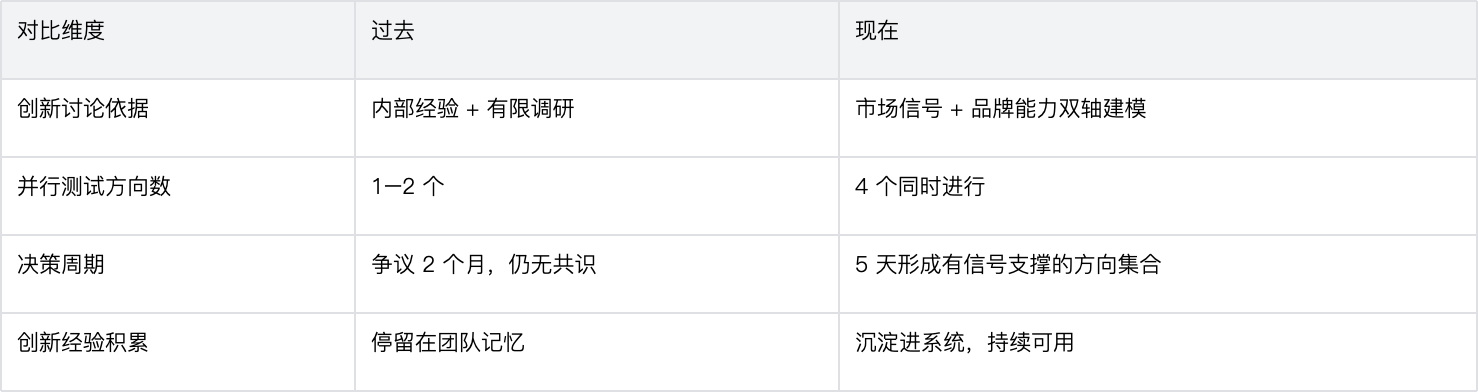
From two months of disputes to forming four directions for testing, it took 5 days. The final market direction aligned with the system's recommended direction, with market feedback and predicted direction matching at 82%. The cycle entering the validation phase was shortened by 60%.
The change in the quality of product innovation discussions lies in shifting from 'whose feeling is right' to 'where the signals point.'
The experience of product managers has not been replaced but has a larger signal background to validate intuition. When intuition aligns with market signal directions, it can be advanced with more confidence; when there is a deviation, that itself is a signal worth exploring.
The value of the product innovation GEA is not to decide which product the brand should make, but to expand innovation hypotheses from the judgments of a few individuals to a reasoning process supported by systematic signals. This process becomes increasingly accurate because the results of each innovation experiment update the foundational judgments of the system.
Category
Date
2026-08-04
Read Time
3 min read
Related Recommendations

Fast-Moving Consumer Goods R&D Innovation. Transforming New Product Development from a Single Project to Systematic Operation