Footwear
How to Achieve Personalized Production for Thousands of Products Online? GEA Enters the Footwear and Apparel Brand Worksite
Footwear and apparel brands face cyclical pressure for new product launches. With Tezign GEA, leveraging multi-model capabilities to produce differentiated materials in bulk, efficiency is increased by 3.5 times, freeing up designers' energy and accumulating brand visual assets.
Category
Footwear
Date
2026-10-09
Read Time
3 min read
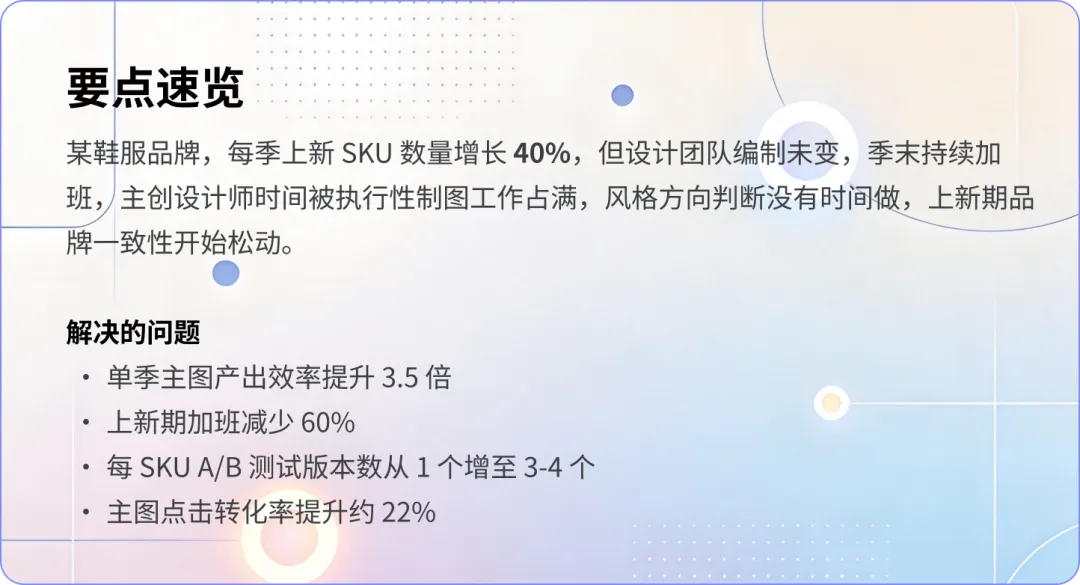
The seasonal pressure for new product launches in footwear and apparel brands is a cyclical overload issue, not an occasional one. Each season, hundreds of SKUs require main images, detail pages, model composites, and size adaptations for different channels—these tasks are highly repetitive but cannot be fully standardized: each SKU has different colors, fabrics, and silhouettes, corresponding to varying scenes, lighting effects, and compositions.
Doing it purely by hand cannot keep up with the volume; using only templates leads to a loss of differentiation, making all SKUs visually look the same, losing the ability to stand out on the shelf.
One footwear and apparel brand saw a 40% increase in the number of new SKUs each season, but the design team's structure did not change accordingly.
High-frequency launches and high-quality creativity began to sacrifice each other
The issue of excessive execution volume is not just about the large quantity, but rather that the large quantity leaves no space for valuable work.
"The hardest part for designers is not creating images, but determining the style direction at the very beginning of each season—this judgment sets the tonal baseline for all SKUs of the season. But just when they want to focus on this, a batch of extension requests comes in," said the brand's design director.
For this matter, they decided to run it again using Tezign's GEA technology.
In this scenario, GEA operates in three steps.
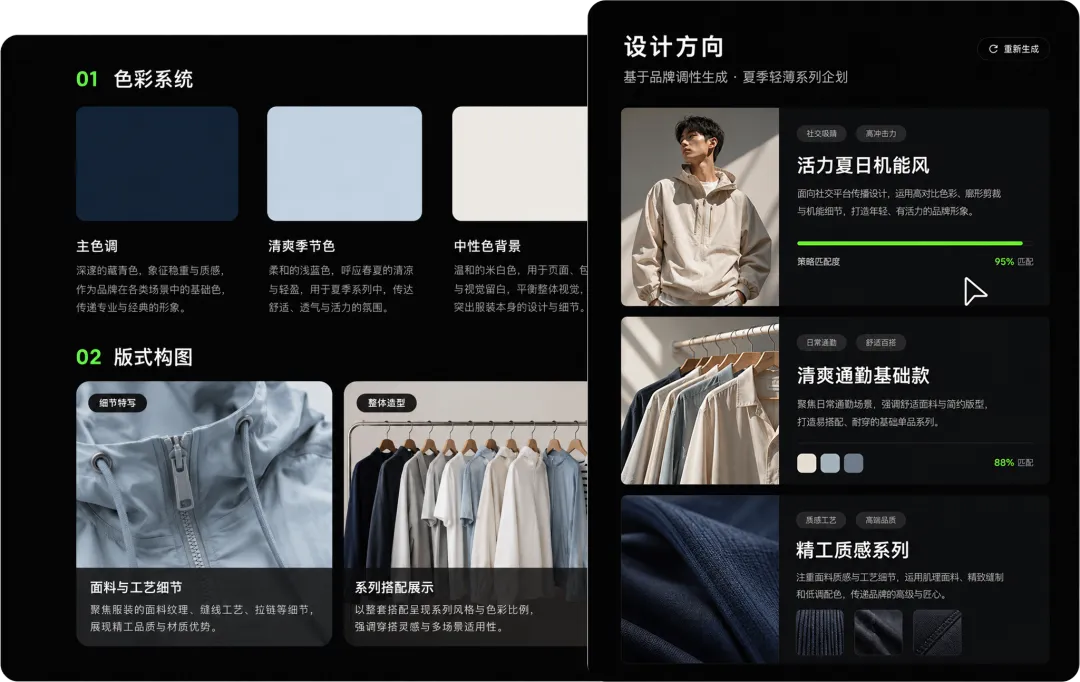
Step 1: Read Brand Tone from Context System and Identify Visual Features of Each SKU
GEA calls the brand's visual tone parameters and historical high-conversion main image data from the Context System while identifying the visual features of each SKU—main color, fabric texture, silhouette type, and target wearing scene. These feature combinations determine how this SKU should be presented in terms of scene tone.
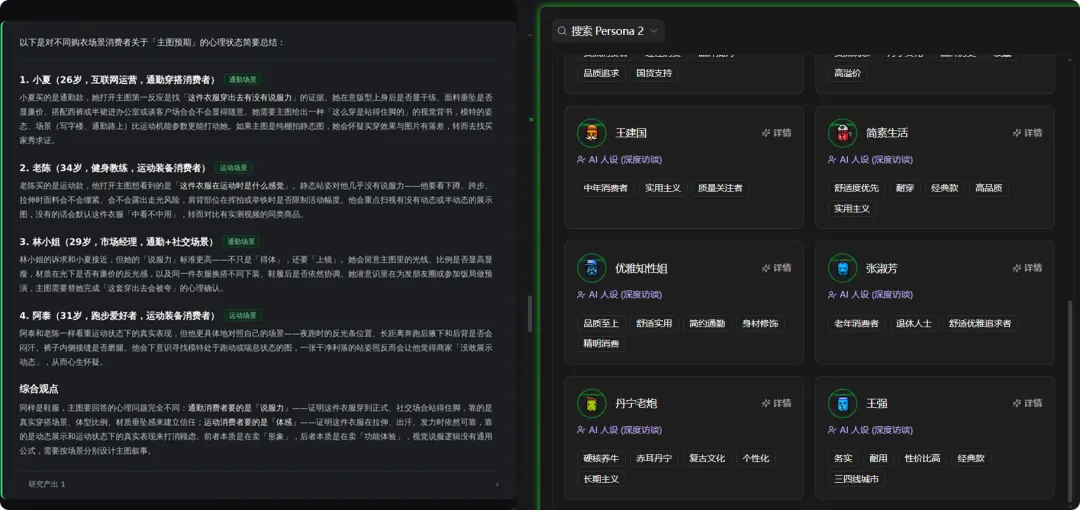
Step 2: Understand the Psychological State of Target Consumers in This Scene
SWM (Subjective World Model) models the psychological state of target consumers in different wearing scenarios—consumers buying workwear expect to see "does this outfit have persuasive power" in the main image; consumers buying sportswear expect to see "what does this outfit feel like during exercise" in the main image. Although both are footwear and apparel, different wearing scenarios correspond to completely different visual persuasion logic.
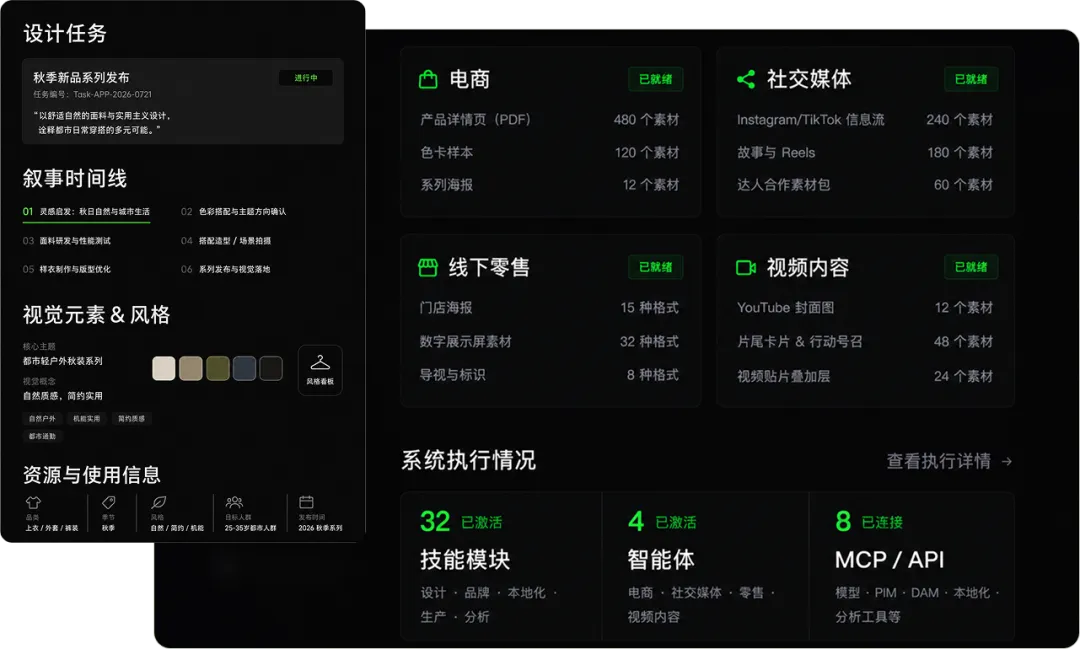
Step 3: Generate Differentiated Main Images for Each SKU, Not Using Generic Studio Backgrounds
CRM (Divergent Reasoning Model) builds on the psychological foundation established by SWM to deduce the optimal main image scheme for each SKU—scene matching, color coordination, and multi-dimensional model synthesis, averaging 3-4 A/B candidate versions generated for each SKU. Designers set the overall style direction for the season, and GEA generates candidates in bulk within this framework, allowing designers to make the final selection and refinements.
The execution results of each season are accumulated in the Context System, optimizing the new product launches in the next season directly based on the effective visual logic from the previous season— the more it is executed, the deeper the brand's visual understanding becomes.
3.5 Times Efficiency Improvement, 60% Less Overtime
The brand is already planning to extend this capability to live streaming scenarios—quickly generating SKU display images that adapt to live streaming backgrounds and lighting conditions, allowing new products to have optimized visual materials for the live streaming scene on the day of the broadcast.
High-frequency launches and high-quality creativity are no longer a choice of mutual sacrifice—designers' most valuable time can finally be spent on tasks that truly require human judgment. This is precisely the core value of Tezign GEA in the design creation scene: proprietary intelligence increasingly understands itself, and each execution shortens the distance to the optimal solution.
Category
Footwear
Date
2026-10-09
Read Time
3 min read
Related Recommendations

When AI Starts to 'Call' Designers: This Beauty Brand Uses GEA to Solve the New Product Launch Challenge for 80 SKUs
Maveric x Tezign: Hot Topics Don't Sleep, How AI Manages World Cup Campaigns?