Home Appliance Brands Integrate Multi-Source User Data, How to Build a New Paradigm of "User Insights"
Appliance brands leverage the GEA insight research to integrate device operation logs, social media shares, and customer service records, identifying discrepancies between actual usage paths and product design, discovering three high-frequency scenarios that were never included in planning, and directly incorporating two of them into the feature prioritization for the next generation of products.
Category
Date
2026-08-04
Read Time
3 min read
The R&D logic of home appliance products is usually one-way: product managers envision usage scenarios, engineers develop according to requirements, and users explore the product on their own. Brands can only passively gather feedback from after-sales complaints and e-commerce reviews—by the time issues are discovered, the plans for the next generation of products are almost finalized.
The fundamental problem with this feedback mechanism is not its slowness, but its narrow coverage. The users who can write reviews are few, even fewer are willing to write, and even less can be systematically analyzed. The real user experiences of most users have never entered the brand's decision-making system in any form.
When a certain appliance brand was planning the next generation of products, they found significant internal disagreement on 'how users use existing products': every department spoke of 'typical scenarios', but no one knew where this 'typical' came from, how many users actually used it this way, and how large the discrepancies were between users' actual operation paths and product design paths. They decided to rerun this with GEA.
Perception (Sense): GEA integrates three types of behavioral data into the Context System—device operation records from the app (frequency of feature use, order of operations, at which step users stopped, what the most common errors were), user-generated tips and unexpected modification solutions shared on social media, and recurring misunderstandings and operational bottlenecks from customer service records. These three types of data represent 'what actually happened', 'how users solved unmet needs', and 'where the problems occurred'.
Reasoning (Reason): By integrating and analyzing the three types of data in the Context System, they distilled systematic discrepancies between actual usage paths and product design paths: which features are hardly used (but occupy core positions in the interface), which features considered 'main selling points' are actively bypassed by users, and which unexpected uses occur frequently (indicating real needs that have not been formally productized). This is not about conducting user research, but about finding patterns in existing behavioral data that product managers were not aware of.
Action (Act): The insights directly enter the planning documents for the next generation of products, influencing feature prioritization and interface design logic. They are not treated as 'reference information', but as data-supported decision-making bases.
Write Back (Write Back): After each product iteration is launched, the usage behavior data of the new version is written back into the Context System, forming a usage behavior archive across generations of products. For the first time, the product team has a 'user behavior baseline' that can be continuously tracked.
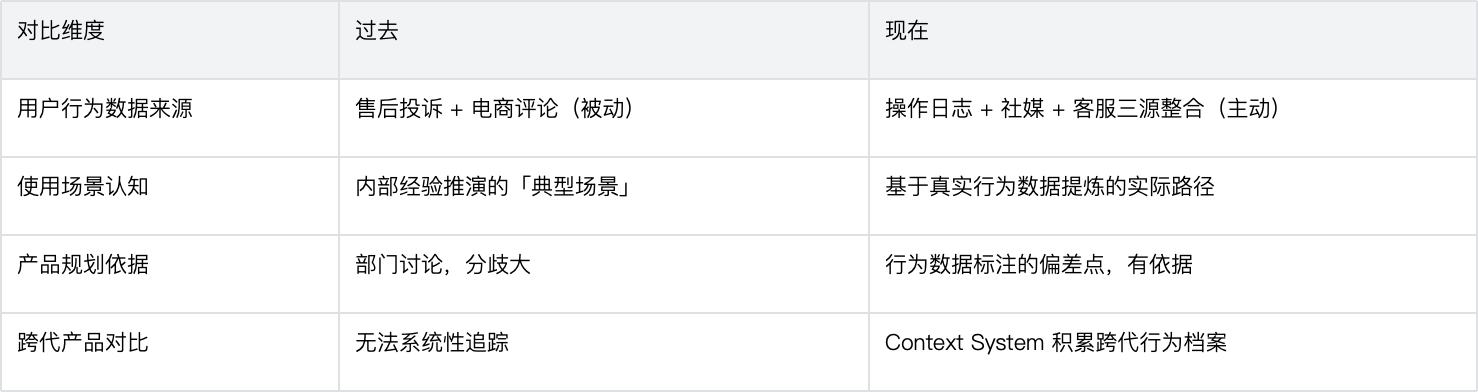
This review discovered 3 high-frequency usage scenarios that had never appeared in any previous product planning documents, of which 2 directly influenced the feature prioritization for the next generation of products.
The most core change is: for the first time, the product team systematically sees what users 'are really doing', rather than 'what they should be doing'.
This is not a supplement to user research, but a qualitative change in the underlying data for product decisions. In the past, 'typical scenarios' were consensus reached through internal discussions; now, they are behavioral patterns distilled from hundreds of thousands of operation records. The discrepancies between the two often represent the most important optimization directions for the next generation of products.
The core value of the GEA insight research in the appliance scenario: it provides the product team with a starting point based on real behavioral data for every new product planning, rather than starting from a 'feeling' about the previous generation of products.
Category
Date
2026-08-04
Read Time
3 min read
Related Recommendations

How GEA Understands a Family's Car Purchase Decision? Nordic Luxury Car Brands Reshaping Vehicle Development

When Consumer Insights Transition from Quantitative Surveys to a Continuous AI Panel System