Don't Let Globalization Become 'Translation', How GEA Solves the Multi-Market Content Dilemma for Global Manufacturing Giants
Global manufacturing brands leverage GEA to establish unified brand rules and localized market configurations, generating differentiated content according to the decision logic of customers in different regions, and continuously optimizing through feedback from local teams, reducing content coordination costs by 55% across 12 markets and decreasing production time by 65%.
Category
Date
2026-08-12
Read Time
3 min read
The first action for manufacturing brands going global is usually to find a translator. This is an understandable starting point, but it quickly becomes apparent that it only addresses surface issues.
The real challenge is: German customers care about engineering precision and certification systems; North American customers ask about after-sales response speed and spare parts supply chains; Southeast Asian customers focus on localized service capabilities and pricing structures; Japanese customers prioritize quality stability and long-term cooperation reliability. The same product requires completely different explanations in different markets. This is not a language issue, but a narrative issue: the core value of the brand remains unchanged, but the answer to 'why choose me' in each market needs to be expressed in a logic that local people find convincing.
Translation alone cannot achieve this. Translation converts the Chinese expression into German, but the narrative logic of the Chinese is organized according to the decision logic of Chinese customers—after being translated into German, the German reader still encounters a Chinese-style business logic written in German.
A certain manufacturing brand entered 12 markets, with content in each market written from scratch by local teams, resulting in uneven quality and a gradually diverging brand image across markets— the same company appears to be a completely different brand on websites in different countries. They decided to run it through GEA again.
Perception (Sense): GEA first establishes a 'localization rules layer' for the brand in the Context System—clearly defining two types of content: the unchanging parts (core brand positioning, product differentiation advantages, visual identity standards, non-negotiable expressions) and the variable parts (appeal angles, customer case references, language style, industry terminology preferences). At the same time, the perception layer continuously receives local signals from each market: hot topics of customer inquiries, local media reporting language habits, and the main narrative angles of competitors in the area.
Reasoning (Reason): Based on the brand's unchanging rules and local variable configurations, GEA generates content versions for each market—not translations, but reorganized content using the logic that locals understand. The German version emphasizes engineering parameters and certification qualifications; the North American English version highlights after-sales support and response speed; the Southeast Asian version discusses local service networks and pricing transparency; the Japanese version emphasizes long-term cooperation cases and stability records. The core brand message remains unchanged, but each market reader sees content optimized for their decision logic.
Action (Act): Local teams take on the review work—confirming that the content fits the local context and supplementing local details not covered by the system (specific policies, local customer cases, industry terminology preferences). Local teams no longer write content from scratch but optimize from a sufficiently good version for the final mile.
Write Back (Write Back): Every revision suggestion from local teams is written back to the Context System, and the localization rules are iteratively updated with each revision. The longer the market is entered, the more accurately the system understands the narrative logic of that market, and the fewer modifications local teams need to make.
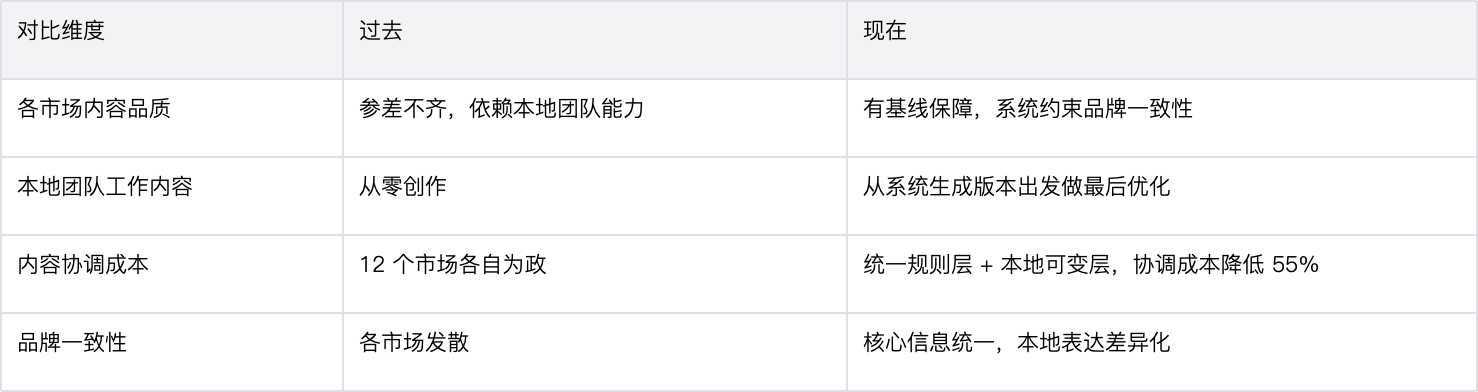
The content coordination costs across 12 markets have been reduced by 55%, and the content production time for local teams has decreased by 65%. The consistency of core brand information across market websites has improved from 'uneven' to 'baseline guaranteed'.
Localization has transformed from 'starting from scratch every time' to 'rapid adaptation within the brand framework'—this is a fundamental change in global content management.
In the past, the quality ceiling of global content was determined by the weakest local team capability; now, the baseline provided by the system is higher than any starting point of a local team working alone, and the work of local teams is to do the final mile of localization from a good starting point rather than starting from a blank page.
The boundaries that the brand can control are clear—core information, visual standards, non-negotiable expressions, all guaranteed by the system; the space for local teams to operate is also clear—narrative angles, local cases, cultural adaptations, all judged by people. The division of labor between the two is the core design logic of content growth GEA in global scenarios.
Category
Date
2026-08-12
Read Time
3 min read
Related Recommendations

Sustaining Good Taste Online: How Global Jewelry Brands Reshape Brand Growth Engines with GEA

Turning Employee Knowledge into a Growth Engine, A Food Brand's GEA Content Growth Practice