Pharma
High Professional Barriers and Difficulty for Newcomers? How GEA Solves the Sales Training Challenges for Global Pharmaceutical Brands
Globally renowned pharmaceutical brands rely on GEA to build a dynamic sales knowledge system, create customer decision models, and embed them throughout the visit process, achieving instant knowledge retrieval and transforming static training into a sustainable enterprise sales intellectual asset.
Category
Pharma
Date
2026-08-04
Read Time
5 min read
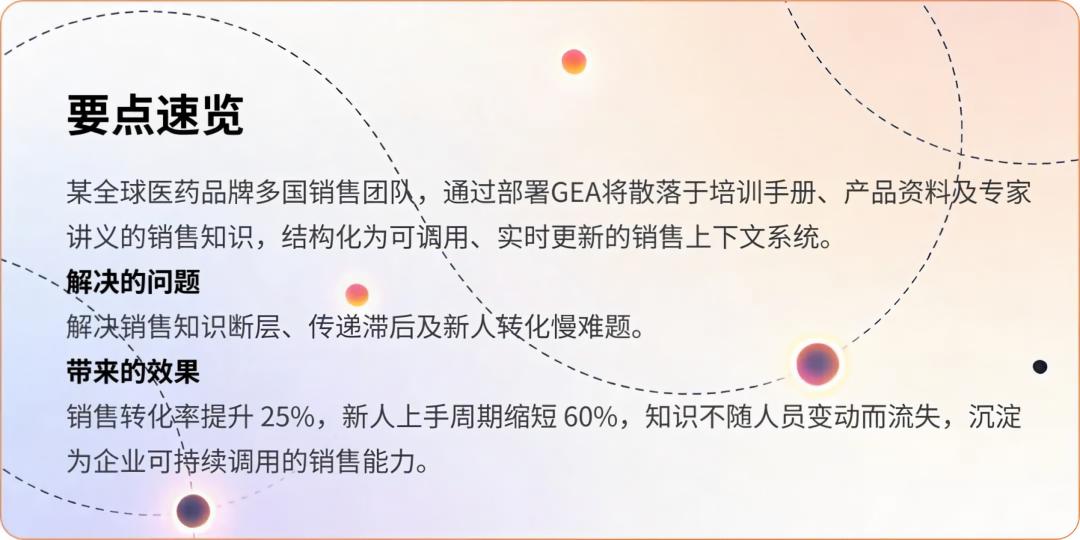
For many pharmaceutical companies, the issue of sales capability is often defined as a training problem: Is the material comprehensive enough? Are the trainers good enough? Is the assessment strict enough?
This global pharmaceutical brand had followed this path for many years. They had a training system, a team of trainers, and manuals — but they could never answer a truly critical question: Why, after so much training, do frontline sales still rely on experience when facing real customers, and why can’t the growth cycle for newcomers be shortened?
After reinterpreting this question, they realized they were actually facing another issue:
Training solves the issue of 'knowledge transfer', but what the company truly needs to establish is 'the capability structure that allows sales knowledge to be correctly retrieved at the right moment.'
These two matters have never been the same question.
Sales knowledge is not lacking, but cannot be retrieved when needed
The sales team of this brand faces typical challenges in the pharmaceutical industry: complex product lines, rapid changes in competitors, and deep inquiries from customers (doctors/hospitals). A single visit often requires the simultaneous retrieval of product mechanism knowledge, clinical data, competitive comparison logic, and compliance boundaries.
The core limitation of traditional training systems lies not in content quality, but in the retrieval method.
Knowledge is produced in units of training projects, concentrated quarterly, and after transmission, it enters a 'wait for the next update' state; the customer response experience accumulated by veteran sales has never been systematically organized and only exists in personal memory; newcomers lack immediate knowledge support when visiting customers and can only rely on incomplete training memories, thus extending the conversion cycle.
This limitation is particularly evident in pharmaceutical sales scenarios where product updates are frequent.
When policy adjustments, new competitor launches, and new clinical data releases occur, the lag of the knowledge system is not just an efficiency issue, but directly affects customer trust and transaction outcomes.
The experience of 'master craftsmen' becomes a sustainable asset
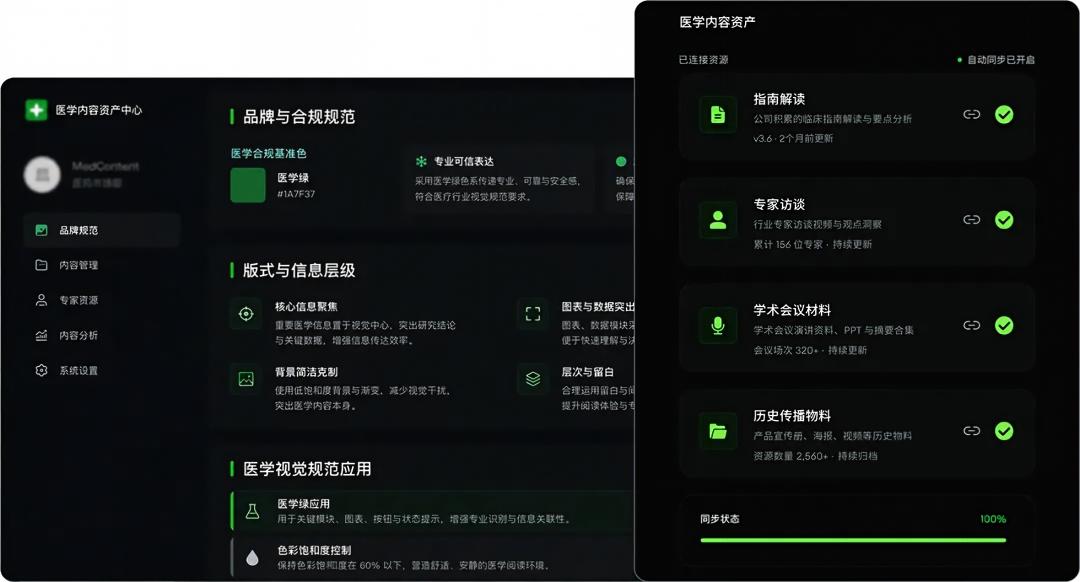
The training manuals, product descriptions, clinical materials, excellent sales scripts, common customer questions, and response strategies accumulated by the company over the years have been systematically organized into a structured sales context system.
These pieces of knowledge, originally scattered across emails, folders, and personal notes, have for the first time formed a knowledge foundation that can be continuously retrieved, automatically updated, and searched by scenario.
Sales materials are no longer static documents but have become a knowledge infrastructure that the system can continuously respond to.
The direct result is: the same set of product knowledge can automatically generate response suggestions for different departments of doctors, different competitive scenarios, and different customer concerns without relying on the teachings of veteran sales, rather than depending on personal memory for on-the-spot performance.
The shortening of the newcomer onboarding cycle begins here.
From static customer labels to dynamic behavior understanding and modeling
Once knowledge can be retrieved, the next question the system faces is: What does the same product information mean to different doctors?
Traditional customer classification usually stays at the label level — department, position, prescription volume. These labels can guide visit priorities but cannot answer more detailed questions:
- For evidence-based medicine-oriented chief physicians, and grassroots doctors who rely on clinical experience, which evidence is more likely to establish trust?
- Which expressions will be directly ignored?
- Which types of clinical scenario descriptions are more likely to generate follow-up willingness under the time pressure of outpatient doctors?
Based on the sales context, the system understands human behavior decisions based on the subjective world model and generates behavior models for different types of doctor customers. The sales team can retrieve these population models before visits to understand the decision structure of specific customers.
Sales preparation thus shifts from 'memorizing materials' to 'understanding the decision paths of specific customers.'

Starting from the customer decision path, GEA embeds the entire sales visit process
Once the customer decision path is clear, the system can continuously provide support throughout the entire visit process:
- Before the visit: Automatically generate visit strategy suggestions based on customer profiles
- During the visit: Provide response references based on the latest product data and compliance boundaries when customers raise complex questions
- After the visit: High-quality response cases are automatically accumulated back into the knowledge base, becoming a reference starting point for the next sales
This represents a structural change in the way sales capabilities are built: from centralized training to continuous knowledge growth embedded in workflows.
The project ultimately helped the team identify three core decision paths for doctor customers: evidence-based trust-building path, risk assessment path, and long-term medication habit path. These judgments did not disappear with the end of the project but were consolidated into a sales intelligence model that the enterprise can continuously retrieve — and entered into the strategy design for new product launches and new market expansions.
Sales training has always been a necessary investment for pharmaceutical companies. However, there has always been a gap between it and 'sustained frontline conversion capability.'
This gap is an issue of knowledge retrieval structure, not training quality.
In the past, sales knowledge mainly existed in the memories of veteran sales and quarterly training materials, representing a phase accumulation that disappears with the departure of individuals; now, it has become a continuous capability that runs through the entire visit process.
When sales knowledge can continuously operate, update, and adapt to different customer decision paths within the system, it truly transforms from a one-time training output into a growth capability that the enterprise can rely on long-term.
Category
Pharma
Date
2026-08-04
Read Time
5 min read
Related Recommendations

Life Sciences Communication: Bringing Research Achievements Out of Papers and into the Public Eye

Scaling Reuse of Healthcare Content, From Medical Material Rewriting to a Multi-Channel Continuous Dissemination Engine