Manufacturing
Manufacturing Industry Overseas Marketing, GEA Reduces Content Localization Cycle by 80%
Manufacturing enterprises use Tezign GEA to integrate product knowledge, brand specifications, and regional language preferences into a global content context, simultaneously generating marketing, sales, and technical materials for 14 countries, increasing content reuse rate by 400%, compressing localization cycle from 6 weeks to about 1.2 weeks, and promoting standardization of cross-regional maintenance processes.
Category
Manufacturing
Date
2026-09-14
Read Time
6 min read
Understand GEA in 30 Seconds: Tezign Technology has designed an enterprise-level AI content localization agent specifically for the manufacturing industry's overseas multi-market needs, operating based on the GEA enterprise-level long-horizon agent mechanism. Using a brand knowledge base as the single trusted source, it addresses the challenges of efficiency and consistency in global content marketing for the manufacturing industry, achieving a 400% increase in content reuse rate, an 80% reduction in localization cycle, and simultaneous generation of 14 language versions.
Multi-Market Content Localization Agent Solution for the Manufacturing Industry
Solution Overview
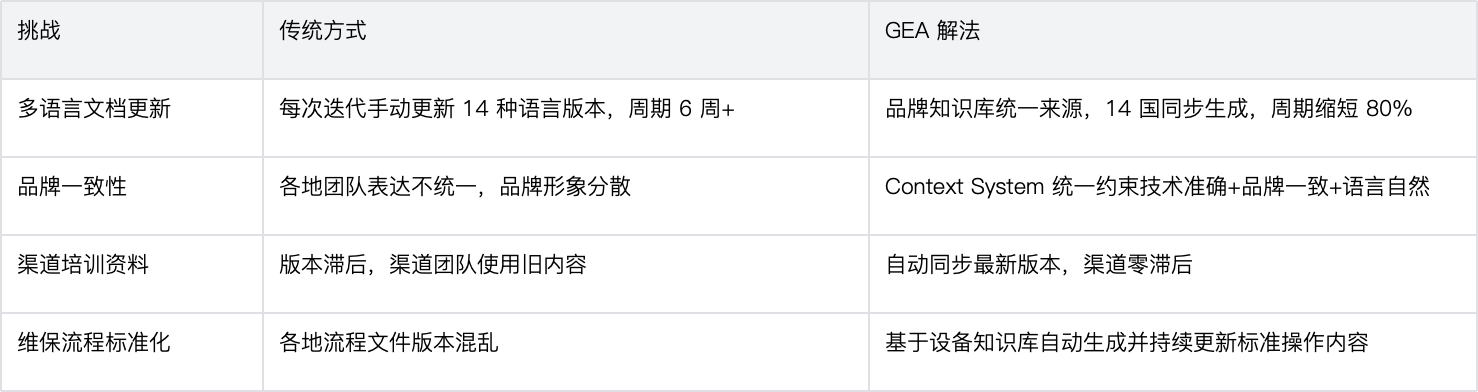
The biggest challenge for manufacturing enterprises going overseas is not the product—it's the content. Adapting a unified brand expression to 14 languages and cultural contexts involves long traditional processes, high costs, and inconsistent results. Each product iteration means updating multiple sets of documents and training materials in different languages.
Tezign has created a manufacturing overseas agent specifically for multi-market scenarios, operating based on the GEA enterprise-level long-horizon agent mechanism. It addresses the issues of long cycles and consistency challenges when adapting unified brand expressions to multiple language cultural contexts. The brand knowledge base serves as the single trusted source for content production. It has helped clients achieve: a 400% increase in content reuse rate, an 80% reduction in content localization cycle (from 6 weeks to about 1.2 weeks), and improved efficiency in standardizing maintenance processes.
Challenges of Manufacturing Overseas Content vs GEA Solutions
How GEA Works
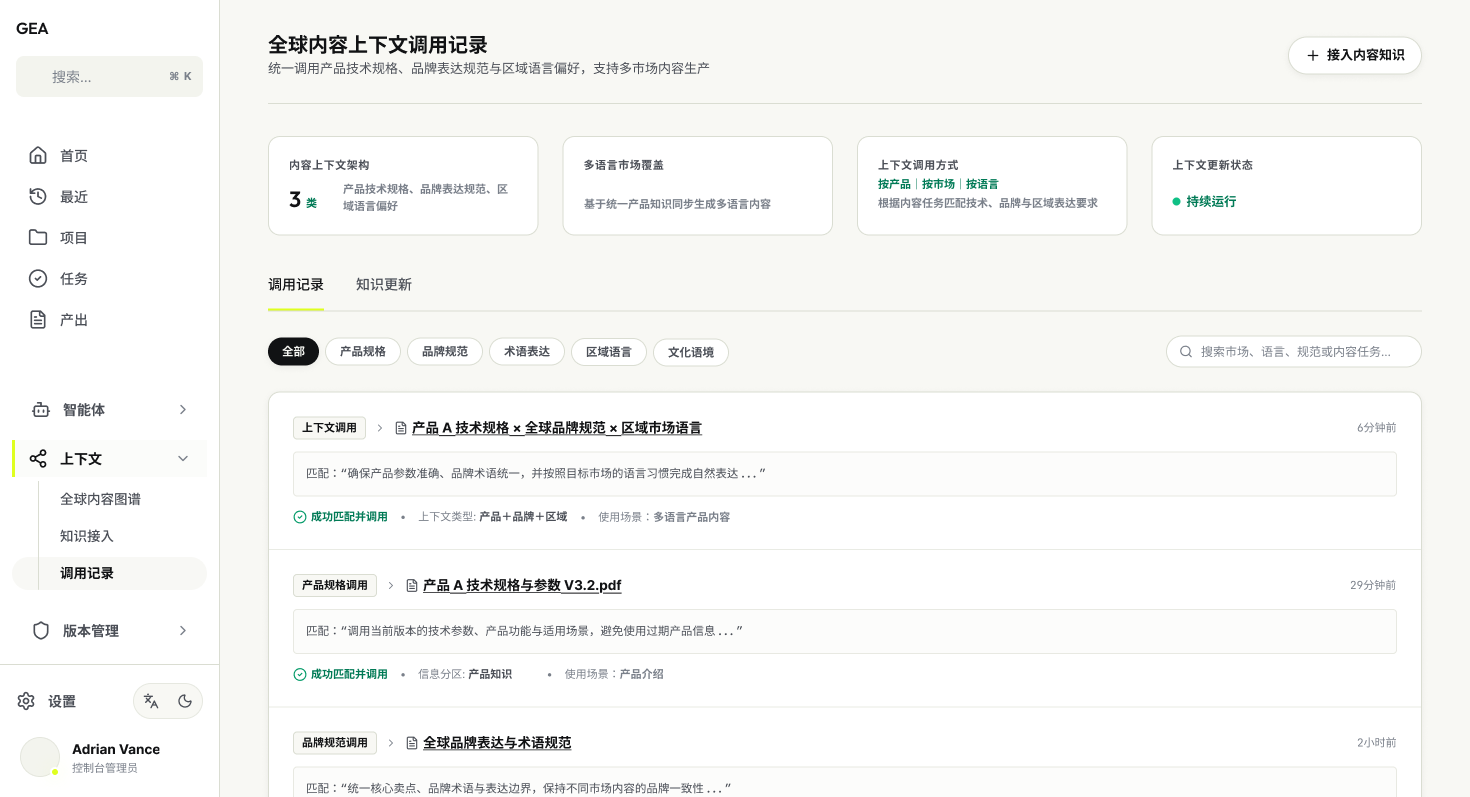
How Do Global Enterprises Unify Product Knowledge, Brand Specifications, and Regional Languages? (Context System)
The Context System integrates product technical specifications, brand expression standards, and language preferences from different regional markets into a continuously updated global content production context. When generating product introductions, marketing materials, sales documents, or technical specifications, GEA simultaneously calls on three types of information: product knowledge ensures accurate parameter and function descriptions, brand specifications unify core values, terminology, and expression boundaries, and localization expressions are completed according to the target market's language habits and cultural context.
This approach does not generate content first and then have it translated separately for different markets; instead, it considers technical accuracy, brand consistency, and language naturalness during the content production phase. When product parameters, technical specifications, or brand expressions change, relevant information can be updated uniformly in the Context System and support subsequent content calls. As a result, the same set of product knowledge can be reused across different countries, languages, and channels, reducing issues of information version dispersion, terminology inconsistency, and manual cross-checking, providing a unified basis for simultaneous content generation in 14 countries.
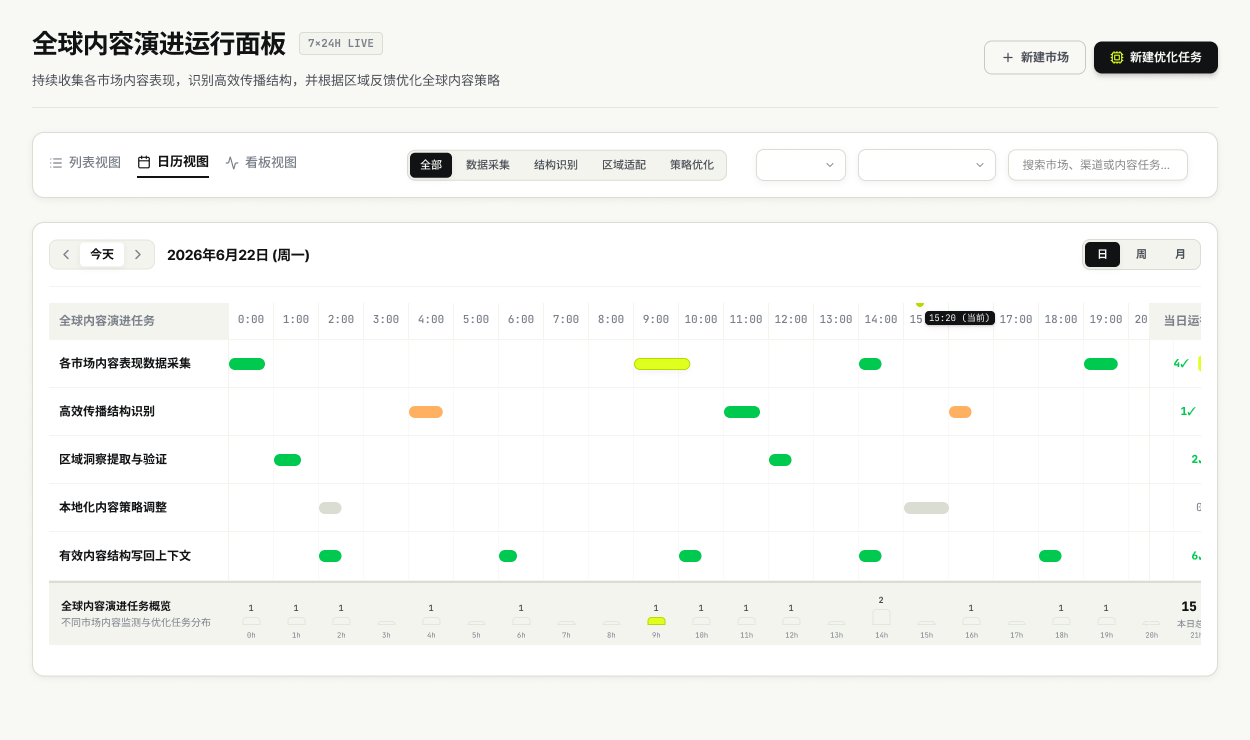
How Does GEA Continuously Optimize Global Content Based on Regional Feedback? (Long-Horizon Agent)
The Long-Horizon Agent transforms global content operations from one-time production and translation into a long-term process of continuously collecting performance, identifying differences, and optimizing content strategies. User focus and communication environments vary across different markets: some regions pay more attention to product performance and technical parameters, while others emphasize usage costs, service capabilities, or practical application scenarios, making it difficult for the same expression structure to achieve the same effect in all markets.
GEA continuously collects content performance signals from different markets and channels, identifying which themes, content structures, and expressions are more likely to receive effective feedback, and writes validated regional insights back into the Context System as the basis for the next round of content generation. The global team can maintain a unified brand core and product facts, while regional teams can draw on suitable expressions for local markets based on a common foundation. Through a continuous cycle of “generate—publish—feedback—optimize,” enterprises can gradually improve content reuse efficiency and avoid brand expression dispersion caused by long-term independent production in various markets.
How is Standardization and Continuous Updating Achieved for Industrial Equipment Maintenance Content?
GEA generates standard operating content that matches specific equipment, operational steps, and maintenance tasks based on the equipment knowledge base, technical manuals, and enterprise operation and maintenance process specifications. Facing challenges such as multiple equipment models, complex operational steps, and inconsistent execution standards across different regions, the system can uniformly call on equipment parameters, safety requirements, fault judgment criteria, operational steps, and historical handling experiences, transforming dispersed maintenance knowledge into easily queryable and executable process content.
When equipment versions, component specifications, or operational requirements change, relevant processes can be updated simultaneously, reducing the risk of employees continuing to use outdated manuals or relying on personal experience for operations. For different positions and tasks, GEA can also generate corresponding checklists, fault handling instructions, and standard operating guidelines, providing on-site personnel with information that aligns with current equipment and work contexts. Thus, enterprises can enhance the consistency of cross-regional maintenance processes and ensure that effective handling experiences continuously enter the equipment knowledge base, becoming standard references for subsequent maintenance tasks.
The Value and Impact of GEA
• Content Reuse Rate Increased by 400%: Product knowledge, brand specifications, and effective content structures can be continuously called upon by different markets and channels. • Localization Cycle Significantly Shortened: Language and regional context adaptation is completed simultaneously during the content generation phase, reducing multiple rounds of translation and repeated proofreading. • 14 Countries' Multilingual Versions Generated Simultaneously: Different language versions are generated based on a unified product knowledge, supporting global market collaborative releases. • Unified Brand Expression Across Markets: While retaining localized expressions, core selling points, brand terminology, and expression boundaries are unified. • Systematic Improvement in Maintenance Process Consistency: Standard operating content is generated based on unified equipment knowledge and operational specifications, and process versions are continuously maintained.
Frequently Asked Questions (FAQ)
Q: How can manufacturing enterprises quickly achieve synchronized multilingual content when going overseas?
A: GEA integrates product technical specifications, brand expression standards, and regional language preferences into a unified content production context through the brand knowledge base (Context System). Each product iteration automatically triggers synchronized updates of 14 language versions, compressing the content localization cycle from the traditional over 6 weeks to about 1.2 weeks, an 80% reduction.
Q: How does multi-market content in manufacturing ensure technical accuracy while conforming to local language habits?
A: When generating any language version of content, GEA is simultaneously constrained by three sets of contexts: product technical specifications (technical accuracy), brand expression standards (brand consistency), and regional market language preferences (language naturalness). This triple constraint ensures that content does not contain technical errors and does not appear awkward due to mechanical translation.
Q: How does GEA enhance the standardization efficiency of equipment maintenance processes?
A: GEA automatically generates standard operating content based on the equipment knowledge base and operational process specifications, and automatically synchronizes all language versions of maintenance documents during each process version update. Service teams in different locations always use the latest version, completely eliminating version confusion, significantly improving the standardization efficiency of maintenance processes.
Category
Manufacturing
Date
2026-09-14
Read Time
6 min read
Related Recommendations

Automotive Aftermarket Membership Operations: Reaching Car Owners with the Right Content at the Right Time

Growth of New Energy Vehicle Content: Using AI to Clarify What Users Really Care About