Pharma
We Summarized Five Key Points for Successfully Deploying GEA in This Multinational Pharmaceutical Company
The pharmaceutical industry faces pain points such as knowledge retention challenges, inefficient compliance, and difficulties in scaling content production. By leveraging Tezign's GEA enterprise intelligent agent architecture, we achieve efficient and compliant mass production of pharmaceutical content across all categories through privatized deployment, knowledge retention, and embedded compliance.
Category
Pharma
Date
2026-08-11
Read Time
10 min read
Background: Pharmaceutical companies have long outsourced content production to agencies, with project cycles measured in weeks. Academic materials aimed at doctors may integrate data from dozens of literature pieces, requiring manual selection by medical editors, alignment of messaging by brand teams, and line-by-line review by regulatory departments before final delivery.Challenges: The need for global compliance, privatized deployment requirements that restrict data from leaving the domain, and compatibility with existing CMS systems create a triple constraint that requires a complete deployment of GEA under these rigid conditions, covering all types of content production including long-form articles, PPTs, and videos, without relying on generic cloud solutions.Results: Hundreds of documents → dozens of pages of professional PPTs can be completed in a single conversation; compliance pre-review is embedded throughout the production chain; video generation for pharmaceutical scenarios runs from zero to one; global privatized deployment is completed.
In the first half of this year, we completed the initial deployment of GEA 企业级智能体系统 for this client: the Context System retains medical knowledge and compliance rules, the content production agent takes over the entire generation process, and the proactive agent runs continuously rather than on-demand, ensuring data compliance boundaries through global privatized deployment. This note focuses on several truly challenging nodes on-site—shared here after desensitization for communication and learning, as well as how GEA plays a role at these nodes.
It should be noted that GEA 企业级智能体系统 is not a "content generation tool" but an enterprise-level intelligent agent architecture—centered around a divergent reasoning model as the core reasoning engine, with the Context System serving as the foundation of enterprise knowledge, supporting various business functions such as insights research, product innovation, marketing growth, and customer service through specialized agents. The proactive agent is responsible for continuous monitoring and proactive triggering, while global privatized deployment ensures data sovereignty. The content growth scenarios shared in this article are just one module of this system.
This pharmaceutical project chose to start with content production precisely because the pain points in this scenario are the clearest, compliance requirements are the most rigid, and it can best validate GEA's implementation capabilities in a high-constraint environment. The depth of the Context System, the embedded compliance mechanisms, and the privatized deployment architecture validated here have value far beyond content production. Understanding this, we can better see what level of problems GEA is solving by looking at the five on-site nodes below.
First, why is marketing growth in the pharmaceutical industry more challenging than in most other industries?
Pharmaceutical companies have long outsourced content production to agencies, with project cycles measured in weeks. An academic piece aimed at doctors may need to integrate data from dozens of literature pieces, requiring manual selection by medical editors, alignment of messaging by brand teams, and line-by-line review by regulatory departments before final delivery.
This process has three structural issues:
First, knowledge cannot be retained. Each new project requires medical editors to re-read literature, re-establish data frameworks, and re-organize the boundaries of indications. The judgments and experiences accumulated from previous projects are lost with the turnover of agency teams.
Second, compliance relies on manual processes. Issues such as exceeding indication boundaries, non-standard data citations, and suggestive language in expressions—these problems are checked one by one by medical affairs or regulatory departments, and the compliance review cycle for a brand's materials typically exceeds two weeks. Encountering significant issues that require starting over is not uncommon.
Third, scaling is impossible. When content needs expand from long-form articles to PPTs and short videos, and from a single market to multiple regions, relying on adding personnel is neither economical nor reliable.
This client faces even more rigid constraints: global compliance red lines, privatized deployment requirements that restrict data from leaving the domain, and compatibility with existing CMS systems, all running in parallel. Generic cloud solutions are excluded at the bidding stage, and GEA must be fully deployed under these rigid conditions, covering all types of content production including long-form articles, PPTs, and videos.
This is not a problem that can be solved by simply "adopting an AI tool."
Node One: Integrating Multiple Literature to Build Context and Reorganizing by Narrative Logic
Content in the pharmaceutical industry has its unique production logic: any material aimed at doctors may need to integrate data from dozens of academic literature pieces, which may differ in research design, inclusion criteria, and observation endpoints, making inconsistent or even contradictory data a norm.
In the past, this selection and organization work relied on medical editors to complete manually—slow, difficult to scale, and requiring a fresh start each time. Generic AI's approach is to recall and stitch together, failing to resolve conflicts and not tracking sources. In the face of compliance requirements in pharmaceutical scenarios, this is unacceptable.
GEA's solution is to structurally embed multi-source medical knowledge into the Context System, allowing the content production agent to trace sources and assemble by narrative logic during generation, rather than outputting all literature mixed together.
*The image below is a schematic of a non-client system
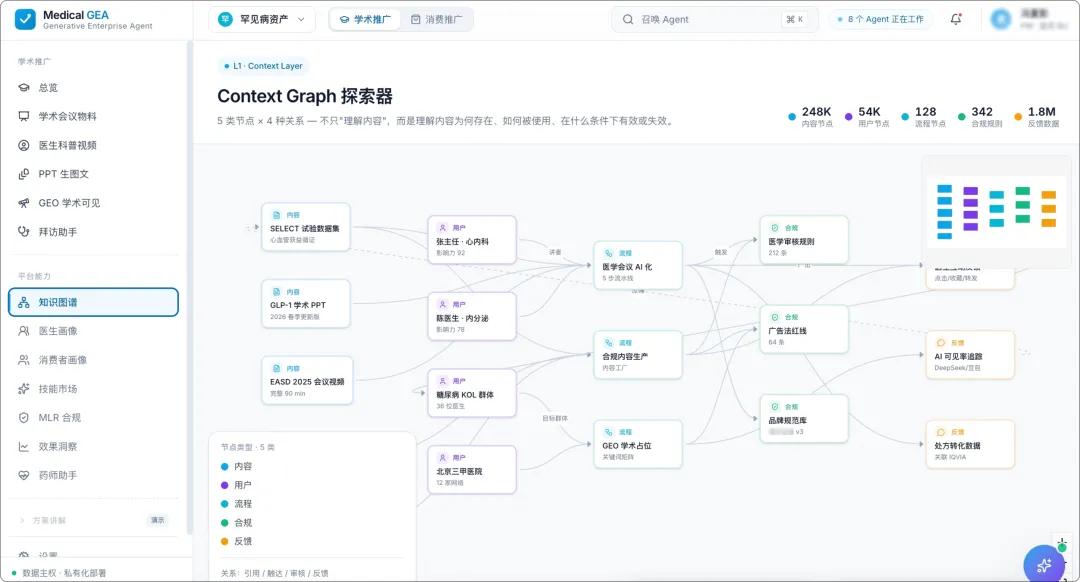
The core engine of this process is the divergent reasoning model. When there are data conflicts among hundreds of literature pieces—for example, when two studies reach inconsistent conclusions on the same endpoint, or differences in the inclusion population lead to data that cannot be directly compared—generic large models tend to choose the "most common" or "most fluent" expression, while the divergent reasoning model explores multiple reasoning paths simultaneously: comparing the design schemes, inclusion criteria, observation endpoints, and statistical standards of different studies to determine which evidence chain is more suitable for the current content's narrative goals and audience levels, ultimately outputting a justified selection result rather than a muddled conclusion.
More importantly, every step of reasoning is traceable. Medical reviewers see not only the final generated PPT but also "why this data was selected from literature A rather than literature B" and "how the narrative logic of these two pages was derived from three groups of evidence." This transforms the review from "re-doing a judgment" to "verifying whether the agent's judgment is reasonable," improving both efficiency and quality.
Hundreds of literature pieces inputted, dozens of pages of professional PPT outputted in a single conversation, with each data point traceable back to the original literature. This means that medical reviews no longer need to "guess where this data came from" but can directly locate the original page number.
Node Two: Medical Charts Eliminate Free Play
Forest plots, K-M curves, subgroup analyses—these medical statistical charts have strict visualization standards. How to label axes, how to draw confidence intervals, how to arrange subgroup components—all have industry consensus and review standards. Versions generated arbitrarily by generic AI almost certainly fail medical review.
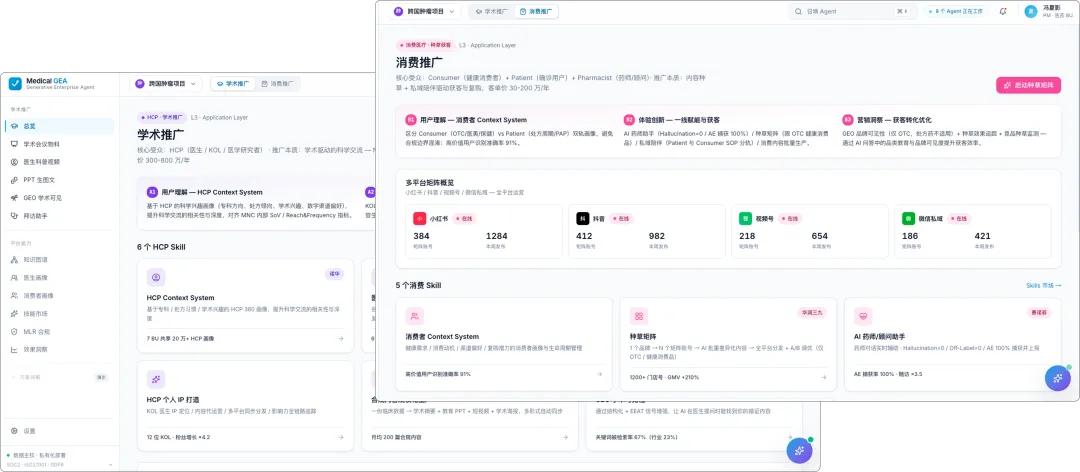
We embed pharmaceutical-specific design standards into the Context System, allowing the content production agent to follow clear style constraints when generating charts, rather than having free rein.
The value of this is not just in "generating correctly once." The same standard library ensures visual consistency across materials for different drugs, requiring only color adjustments when switching drugs, without needing to realign design standards each time. For pharmaceutical companies with multiple product lines, this means that brand visual consistency shifts from "relying on design teams for manual control" to "system-level assurance."
*The image below is a schematic of a non-client system
Node Three: Compliance Transitions from Post-Filtering to Full-Process Constraints
The traditional model of content compliance in pharmaceutical companies is: after content production is completed, medical affairs or regulatory departments review it line by line, returning it for modification upon discovering issues such as exceeding indication boundaries, non-standard data citations, or suggestive language in expressions. The compliance review cycle for a brand's materials typically exceeds two weeks, and encountering significant issues that require starting over is not uncommon.
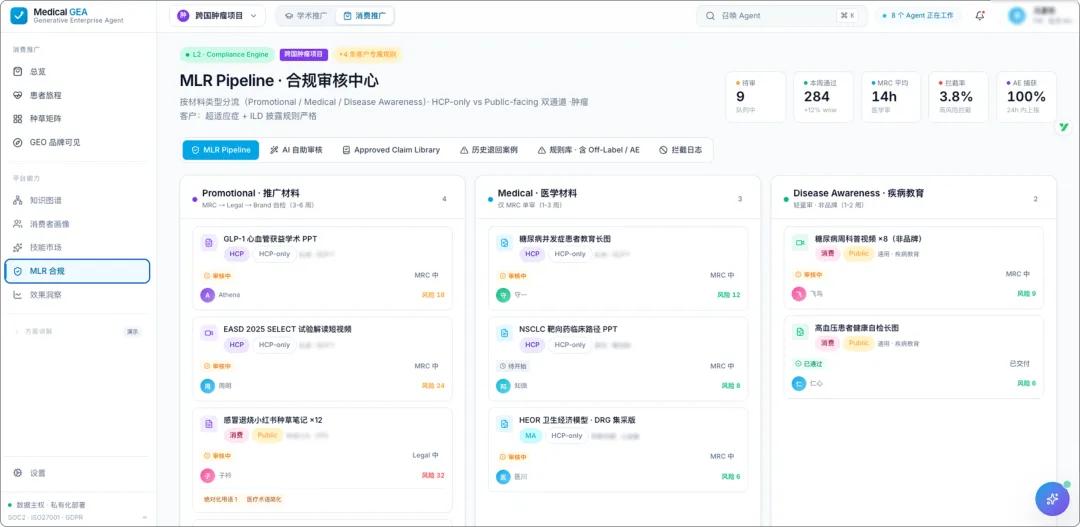
GEA's compliance mechanism is embedded. The Context System retains the client's indication boundaries, brand standards, and compliance rules, allowing the content production agent to operate within this set of constraints throughout the generation process, followed by a risk scan that outputs a structured rectification plan—not "there's a problem here," but "what the problem is and how to fix it." The final manual review shifts from finding problems to confirming that the issues have been addressed by GEA.
The cognitive shift behind this is: compliance is not a step in content production but the operational environment of content production.
*The image below is a schematic of a non-client system
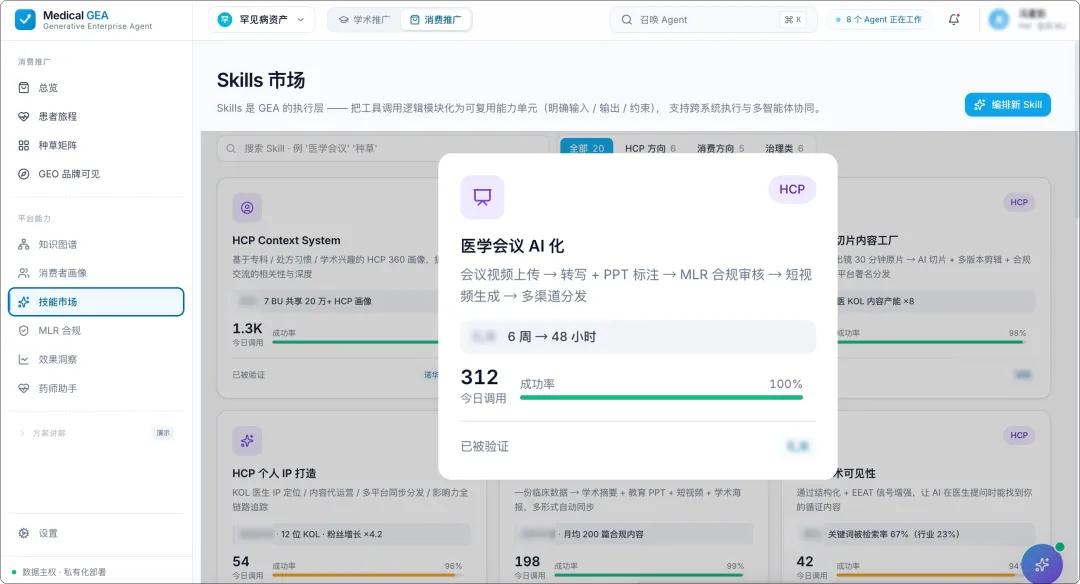
Node Four: Zero to One Video Generation for Pharmaceutical Scenarios
The demand for pharmaceutical video content falls into two categories: one is to edit existing academic presentations and conference content into short clips, and the other is to create content from scratch based on literature and data materials. The challenge of the latter lies in the script—pharmaceutical scripts must find a balance between colloquial expression and professional accuracy, ensuring that they are understandable to doctors while also passing compliance review on every data point and indication expression.
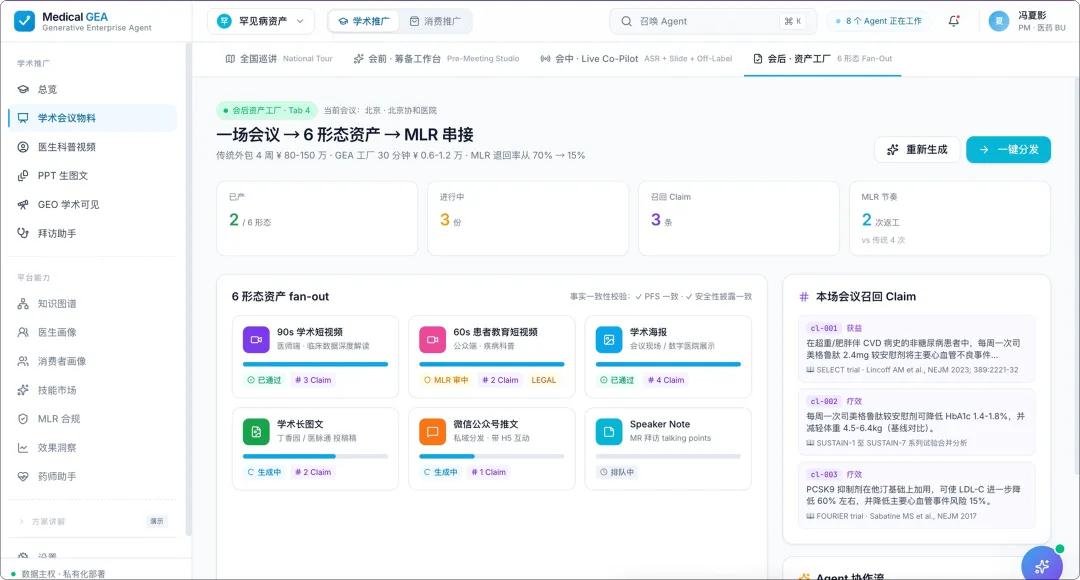
Based on the methodological accumulation in the pharmaceutical content field, GEA completes script generation under the constraints of medical knowledge and expression standards retained in the Context System, outputting differentiated versions based on doctor dimensions. Doctors from different departments and with different titles may see varying depths of content and expression styles, but the underlying data and compliance boundaries remain completely consistent. This is not just an optimization of editing efficiency.
*The image below is a schematic of a non-client system
Node Five: Global Privatized Deployment, Avoiding Reinventing the Wheel
IT compliance requirements for multinational pharmaceutical companies typically include: independent deployment across multiple regions, strict data isolation, and compatibility with existing enterprise IT systems, without introducing new global dependencies.
This means that the solution cannot be "a single cloud service for everything," nor can it be "starting over to build a new system."
Based on the global deployment experience accumulated from multiple multinational client projects, we helped this company complete a multi-region deployment and data isolation plan, integrating flexibly and combinatorially with existing systems—avoiding reinventing the wheel and not introducing new global dependencies while meeting all compliance requirements. Data is strictly isolated across regions, with the central layer only synchronizing desensitized knowledge assets and rule templates. This is a hard requirement in the pharmaceutical industry: multiple regulatory laws in different regions impose clear restrictions on the cross-border flow of medical data.
*The image below is a schematic of a non-client system
GEA's Implementation in High Compliance Industries: The Depth of the Context System is the Deciding Factor
Reflecting on this project, we increasingly feel that GEA's value does not lie in "using AI to generate content" itself—that is just the surface capability. After GEA went live, the changes occurred on three levels:
First, compliance transformed from a cost center to a system capability. It no longer relies on the experience of a few senior reviewers but is structured, reusable, and traceable, embedded in the Context System.
Second, content production shifted from a linear process to a parallel network. Content across multiple markets, languages, and channels is no longer "centralized output → layered distribution," but rather parallel generation and adaptation based on the same knowledge foundation.
Third, content management transitioned from publication as the endpoint to continuous operation. The proactive agent allows content assets to enter a "generation—publication—monitoring—update" closed loop, rather than a one-time delivery.
Medical knowledge, compliance rules, design standards—these are the things the Context System retains, which are the boundary conditions for GEA to make correct judgments. The more complete the Context System, the more stable the output, and the more it aligns with the real requirements of the industry. By embedding these into the system, GEA truly becomes the organization's own capability, rather than just integrating an external AI tool.
This judgment applies not only to the pharmaceutical industry—any scenario with high professional barriers and strict compliance requirements follows the same logic.
Disclaimer:
This article is a desensitized project experience sharing, with specific client names, system details, and data metrics all processed for desensitization. The effects described in the article are the actual results of the project and do not represent that all pharmaceutical companies can achieve the same results after deploying GEA; actual outcomes depend on factors such as the existing system foundation, the degree of knowledge asset retention, and team collaboration.
Category
Pharma
Date
2026-08-11
Read Time
10 min read
Related Recommendations

Life Sciences Communication: Bringing Research Achievements Out of Papers and into the Public Eye

Scaling Reuse of Healthcare Content, From Medical Material Rewriting to a Multi-Channel Continuous Dissemination Engine