How a Fast-Moving Consumer Goods Brand Reconstructed Its Design Process from Manual Creation by Designers to GEA Taking Over Bulk Extensions?
Facing a concentrated surge of 240 packaging extension demands before the Q4 promotional period, a leading fast-moving consumer goods brand leveraged Tezign GEA's structured brand visual rules to generate specifications, holiday, and channel-adapted versions in bulk, compressing the production cycle from 3 weeks to 4 days and enhancing cross-channel visual consistency.
Category
Date
2026-08-05
Read Time
3 min read
The packaging visual work of fast-moving consumer goods brands consumes a lot of time on extensions rather than on creativity.
Once the main packaging design is set, the next steps involve twenty specification versions, four gift box variants, three holiday themes, and six channel adaptations—each requiring independent operation by designers to maintain consistency in the brand's core visuals while adapting to different sizes and display needs. This work is highly repetitive but cannot be fully standardized: each extension version contains details that require human judgment on where to save and where not to, relying on the designer's understanding of the brand's tone.
As the promotional period approaches, these demands become more concentrated. Before the Q4 promotional period, a fast-moving consumer goods brand experienced a concentrated surge in extension demands, with the design team's schedule overloaded for two months, and the quality of the outsourced team varying. The visual presentation of the brand across different channels and specifications began to show discrepancies. They decided to run this through GEA again.
Perception (Sense): GEA breaks down the main packaging design into the Context System—vector representation of brand color schemes, semantic labeling of main visual elements (which core elements must be retained, which can be flexibly treated as decorative elements), structural rules of layout grids, font hierarchy specifications, and display constraints for each channel. These are not specifications stored in documents for reference but structured rules that can be directly invoked by the system to constrain generation.
Reasoning (Reason): Based on latent space feature fusion technology, automatically generate corresponding versions under different extension demands. When specifications change, the main elements maintain consistent visual weight amidst background and composition changes; for holiday theme versions, newly added holiday visual elements are integrated without compromising core brand recognition; for channel adaptations, information priority is rearranged according to the display logic of each platform. The core brand visuals do not distort during the extension process, which is where traditional outsourced teams often encounter issues.
Action (Act): After completing the main packaging design, designers submit the extension demand list to GEA, which generates candidate versions in bulk for final review. The lead designer is freed from the task of 'doing extensions one by one,' allowing time to be spent on higher-priority creative judgments.
Write Back (Write Back): Which types of extensions have high brand consistency scores in which channels, and which types of holiday themes are handled well—this data is accumulated in the Context System, so the next promotional extension work starts from the optimal version of the last time.
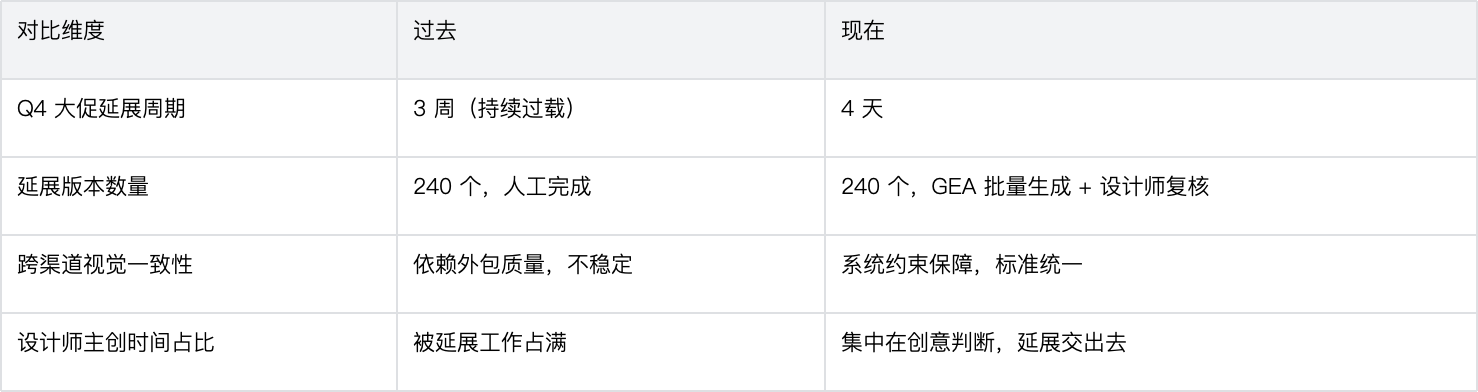
During the Q4 promotional period, 240 extension versions were completed in 4 days, far exceeding the three weeks required in the past. The consistency of the brand's core visuals in cross-channel deployment has significantly improved, and feedback regarding 'inconsistent brand style' in channel and internal reviews has decreased by 70%.
The design rhythm during promotional periods has shifted from 'capacity determines response speed' to 'creativity determines response speed.'
In the past, the speed of the brand's response to promotional rhythms depended on how many people the design team had and how much workload they could handle; now, bulk extension work is undertaken by GEA, shifting the design team's capacity bottleneck from 'execution ability' to 'creative judgment ability'—and this is a more valuable bottleneck that deserves continuous investment.
This is the core value of GEA in design creation: it is not about helping brands do more extensions, but about enabling brands to allocate their design team's time to more important matters.
Category
Date
2026-08-05
Read Time
3 min read
Related Recommendations

Is Creativity Solely Dependent on Genius? How Enterprise AI Agents Solve the Growth Dilemma for Fashion Brands

When the Narrative Consistency of Consumer Brands Transitions from Manual Review to System Self-Constraint