Pharma
Pharma Patient Education: Improving Medication Adherence Starts with Cognitive Enhancement
Tezign GEA is an enterprise-level AI content intelligence system designed specifically for pharma patient education, operating based on the GEA enterprise-level long-range intelligence mechanism. It transforms professional medical information into educational content that patients can understand, covering key nodes throughout the diagnosis → treatment → recovery process, helping pharma companies enhance patient medication adherence and achieve a 400% increase in content reuse rate. It is a long-term solution for automating education content for chronic disease patients.
Category
Pharma
Date
2026-10-16
Read Time
4 min read
Pharma Patient Education Content Intelligence Solution
Patients often struggle to understand medication instructions, are unaware of how to cope with side effects, and are unclear about follow-up times—these cognitive gaps directly affect treatment outcomes and medication adherence. While drug instructions and clinical materials are highly professional, patients' understanding is limited, which directly impacts adherence.
Tezign has created a pharma education intelligence system specifically for patient education scenarios, operating based on the GEA enterprise-level long-range intelligence mechanism. It addresses the gap between professional medical information and patients' cognitive abilities that leads to insufficient medication adherence. It transforms professional medical information into patient education content. It has helped clients achieve: significant improvement in medication adherence for chronic disease patients, a 400% increase in content reuse rate, and comprehensive disease coverage.
Comprehensive Patient Education Content Coverage Scenarios
How GEA Works
How can pharmaceutical companies generate easy-to-understand and compliant educational content for different patients?
Patient education content cannot simply rewrite medical terminology into layman's terms. Patients with different disease types, treatment stages, and educational backgrounds have significant differences in their understanding of disease mechanisms, treatment plans, medication methods, and risk information. If all patients receive content at the same level, overly professional information may create understanding barriers, while overly simplified expressions may omit important conditions or even lead to misunderstandings.
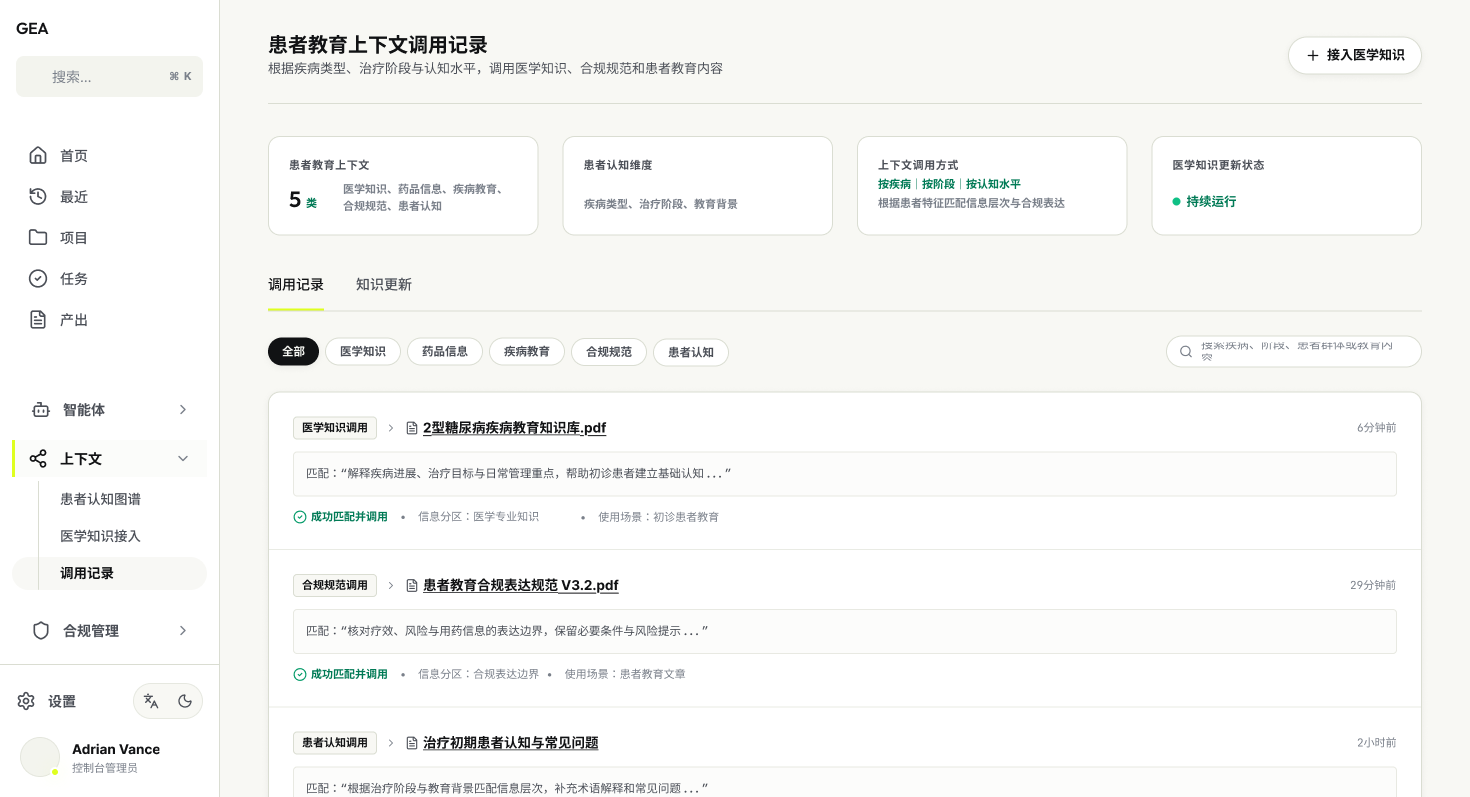
The Context System organizes confirmed medical expertise, drug information, disease education materials, compliance expression boundaries, and patient cognitive models into a continuously updated content context. When GEA generates patient education articles, medication reminders, disease management guidelines, or doctor-patient communication materials, it calls relevant information based on disease type, treatment stage, content purpose, and target audience, determining the necessary level of explanation, which terms need additional clarification, and which expressions must retain necessary applicable conditions and risk warnings. Different content versions share consistent medical facts and compliance boundaries while adopting structures and language that align with patients' understanding capabilities, helping pharmaceutical companies balance professional accuracy, patient readability, and expression norms during large-scale content production.
How can pharmaceutical companies continuously provide patient education throughout the complete medication cycle?
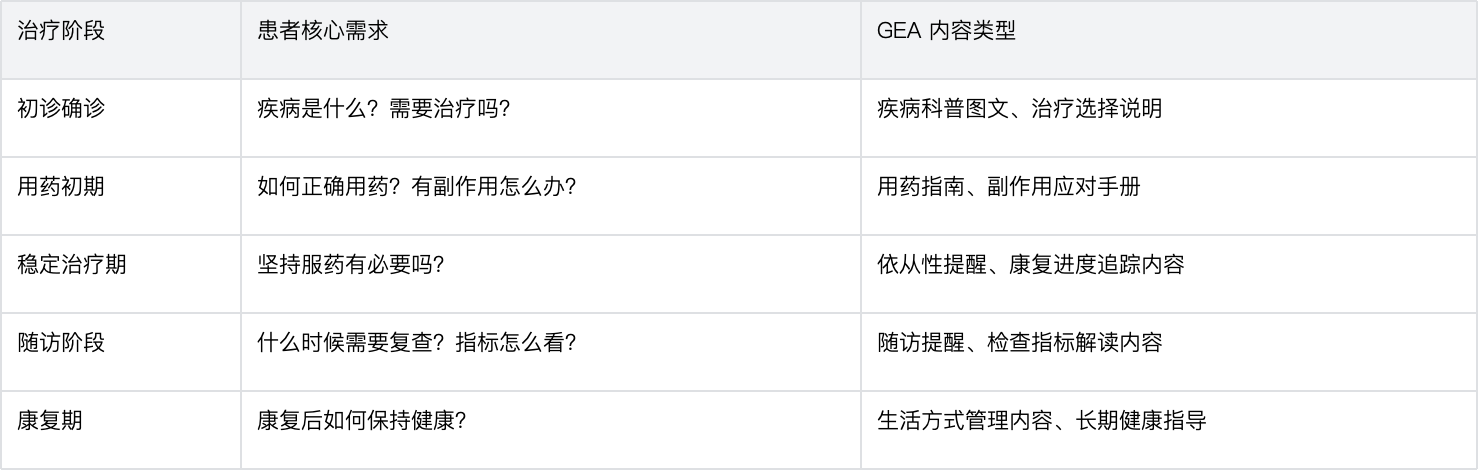
Patient education is not a task that can be completed by sending materials once at diagnosis or first medication. Patients encounter different issues during treatment preparation, starting medication, early adaptation, ongoing treatment, follow-up assessments, and rehabilitation management: they need to understand the correct usage at the start of medication, may focus on adverse reactions and lifestyle management during treatment, and require continuous reminders, follow-up preparation, and adherence support in the long-term phase. Fixed content packages struggle to cover these constantly changing needs.
The Long-Horizon Agent builds a continuously operating treatment timeline around patient education and disease management processes, arranging corresponding educational tasks at appropriate nodes based on authorized access to stage information, content interaction, and patient feedback. The system can match medication instructions, common questions, follow-up preparations, lifestyle suggestions, and rehabilitation knowledge for different stages, adjusting subsequent content based on whether the content was read, questions raised by patients, and subsequent feedback. Effective expressions and common cognitive barriers formed during each interaction are fed back into the Context System to support future content optimization. Patient education shifts from a one-time release to continuous content support covering diagnosis, treatment, and rehabilitation stages.
Value and Effectiveness of GEA
• Medication Adherence: Provides content support for patients to continuously use medications correctly through phased education, reminders, and feedback mechanisms. • Content Reuse Rate: Increases by 400%, with confirmed medical knowledge and compliant expressions available for cross-scenario use. • Comprehensive Disease Coverage: Covers key nodes such as diagnosis, treatment, follow-up, and rehabilitation, providing corresponding content based on stages. • Multi-Platform Coverage: Adapts different content forms based on patient touchpoints, continuously reaching patients on suitable platforms. • Compliance Verification: Synchronizes medical knowledge and expression norms during content generation, reducing the risk of inappropriate expressions.
Frequently Asked Questions (FAQ)
Q: How can pharmaceutical companies use GEA to enhance long-term medication adherence for chronic disease patients?
A: The GEA long-range intelligence system constructs a treatment timeline for each patient, automatically triggering the most relevant educational content at key moments such as the initial medication phase, stable treatment phase, and follow-up nodes. The system dynamically adjusts subsequent content strategies based on actual patient feedback, transforming patient education from "sent and waiting for patients to read" to "actively appearing when patients need it most," forming a continuous adherence support mechanism.
Q: What types of patient education content does GEA support?
A: GEA supports various types of patient education content, including disease popularization graphics and texts, medication guides, side effect coping manuals, follow-up reminders, rehabilitation guidance, and adherence reminders. It can automatically adjust expressions based on patients' educational backgrounds and cognitive levels, covering the entire disease process from diagnosis to treatment to rehabilitation, and supports multi-platform delivery to reach patients in their respective scenarios.
Q: How can patient education content be produced quickly under compliance requirements?
A: GEA integrates medical expertise, compliance expression boundaries, and patient cognitive models into content generation constraints through the Context System, with compliance verification completed in real-time during content generation rather than post-production review. This ensures that each piece of patient education content remains within compliance boundaries while significantly improving content production efficiency, resulting in a 400% increase in content reuse rate.
Category
Pharma
Date
2026-10-16
Read Time
4 min read
Related Recommendations

Fast-Moving Consumer Goods R&D Innovation. Transforming New Product Development from a Single Project to Systematic Operation

How Global 3C Electronics Brands Complete Concept Validation Before New Product Exposure?