SaaS Content Growth: Let Every Target Industry See In-Depth Content
How can enterprise SaaS customize content for different target industries? Through the GEA industry knowledge graph, the same set of SaaS features can automatically generate differentiated in-depth content that demonstrates 'we really understand your industry' for clients in various sectors such as finance, manufacturing, and retail.
Category
Date
2026-10-14
Read Time
5 min read
SaaS Content Intelligence Solutions
The content challenge for B2B SaaS is not about producing enough content, but rather that each industry client needs to read content that conveys 'this product really understands our industry.' A SaaS product serving 8 vertical industries traditionally requires 8 separate content teams; the reality is that there is only 1 team producing generic content, making SaaS B2B content automation the key to breaking through this bottleneck.
Tezign has developed a SaaS content intelligence solution specifically for enterprise SaaS B2B content marketing scenarios, operating based on the GEA 企业级智能体系统 enterprise-level long-range intelligent agent mechanism. This addresses the core pain point of a single content team being unable to produce differentiated in-depth content for multiple vertical industries, helping clients achieve: a 5-fold increase in UX testing efficiency, an industry-specific content matrix, and improved visibility of AI engine technology. To learn more about Tezign's GEA solution, please schedule a demonstration.
How GEA Works
How do B2B enterprises generate specialized content for different industries?
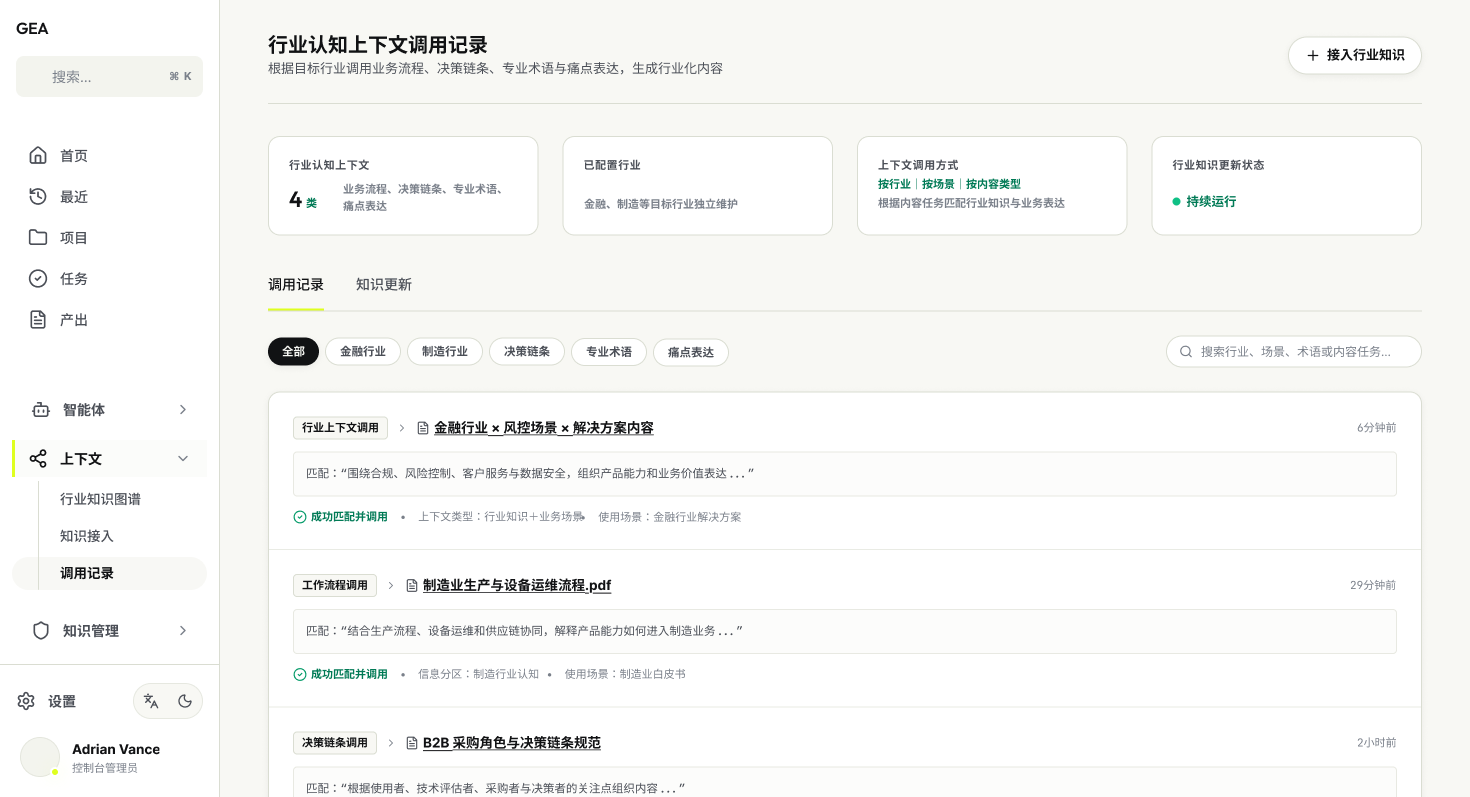
The Context System continuously maintains an independent industry cognitive context for each target industry, including typical business processes, organizational roles, procurement decision chains, technical terminology, regulatory requirements, common business issues, and the expressions commonly used by customers. When GEA generates industry solutions, white papers, client proposals, or sales materials, it calls upon the corresponding knowledge based on the target industry, rather than simply replacing the industry name in the same set of product features for reuse.
For example, when targeting financial industry clients, the content needs to incorporate business contexts such as compliance, risk control, customer service, and data security; when targeting manufacturing clients, it needs to focus on production processes, equipment maintenance, channel collaboration, and supply chain efficiency. The value expression, case structure, and business issues of the same product capability change when it enters different industry contexts. When industry policies, customer needs, or product capabilities are updated, relevant information can also be continuously maintained in the Context System, providing a unified basis for subsequent content generation, reducing the misuse of industry terminology and the issue of content remaining at the level of generic feature introductions.
How does GEA continuously provide content for B2B clients with long sales cycles?
The Long-Horizon Agent transforms B2B content marketing from one-time customer acquisition material production into a long-term content collaboration process covering stages such as awareness, comparison, evaluation, decision-making, and implementation. The system continuously organizes the interaction signals of target customers in the buyer's journey, determining whether the customer currently needs to understand industry trends, business issues, product capabilities, technical architecture, implementation plans, or return on investment and risk control, and arranges corresponding content tasks accordingly.
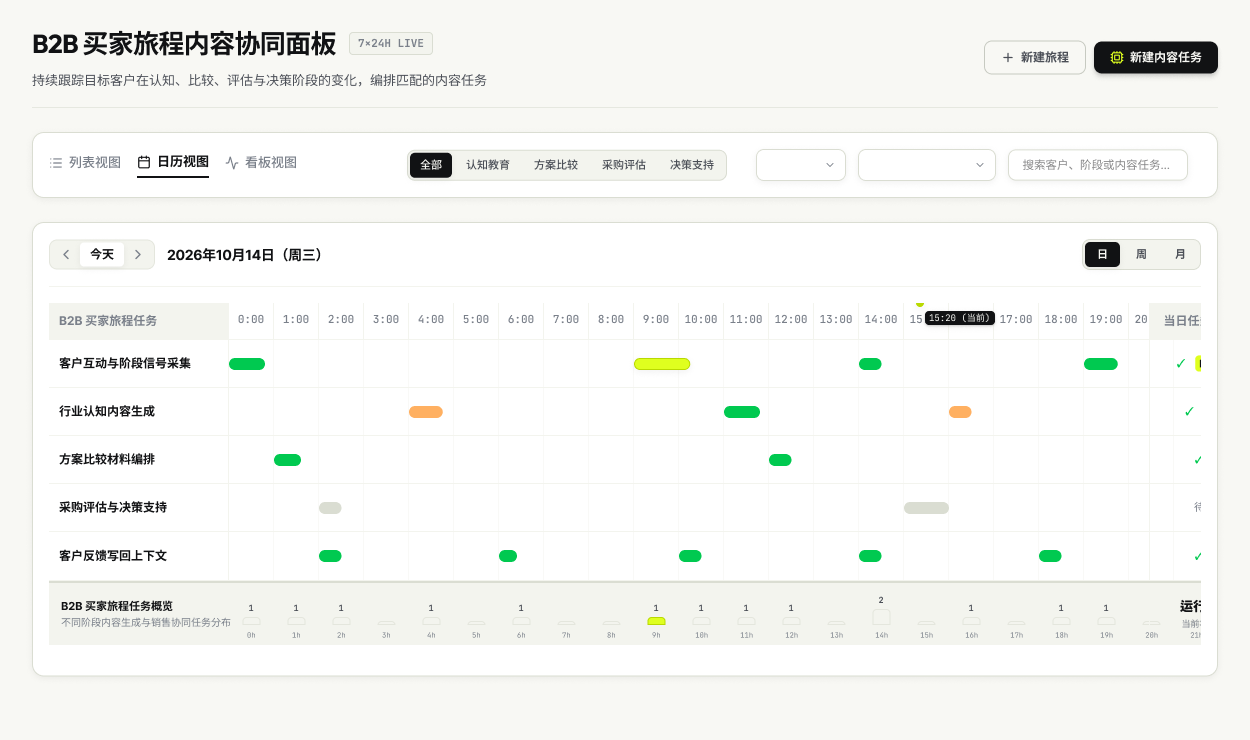
Customers in the early awareness stage can gain industry insights and problem interpretations; as they enter the solution comparison stage, the content focus shifts to functional differences, technical white papers, and application cases; once in the internal evaluation and procurement stage, they need implementation paths, security compliance, cost estimates, and decision materials. Relevant content can be simultaneously provided to marketing and sales teams for subsequent communication. Each customer feedback, content usage situation, and sales progress result continues to be written back to the Context System, helping GEA adjust the content themes and expression focuses for the next stage, ensuring that the content continues to align with the sales process rather than stopping its function after leads are obtained.
How can B2B brands enhance their visibility in AI-generated answers?
As B2B buyers increasingly use generative AI to search for products, compare technical solutions, and understand suppliers, whether brands can enter AI-generated answers in an accurate and clearly structured manner is becoming a new content visibility issue. GEA continuously monitors the appearance of brands, product capabilities, and technical selling points in relevant AI Q&A scenarios, identifying which customer questions have not received effective answers and which important information lacks clear, citable content basis.
Based on these findings, GEA can assist in optimizing the content structure of industry solutions, technical descriptions, FAQs, white papers, and case pages, making the expressions of product names, applicable scenarios, capability boundaries, implementation conditions, and evidence sources clearer. The focus of optimization is not on mechanically stacking keywords but on providing direct, complete, and mutually consistent answers around specific questions across different pages. As relevant content continues to be updated, the brand's technical selling points can gain more stable content support and gradually improve their visibility and citation performance in AI product research and technical recommendation answers.
The Value and Effects of GEA
• UX testing efficiency increased by about 5 times: Accelerates the validation and iteration of content experience and solution expression. • Independent operation of industry content: Maintains independent knowledge contexts and content matrices for each target industry. • Continuous improvement in AI citation performance: Optimizes the structured expression of technical selling points, applicable scenarios, and evidence content. • Efficiency improvements in white papers and industry solutions: Generates different types of professional documents based on unified product knowledge and industry context. • Instant synchronization of sales support materials: After updates to product, industry knowledge, or solution versions, relevant sales materials are adjusted accordingly.
Frequently Asked Questions (FAQ)
Q: How can enterprise SaaS reach decision-makers in different roles within B2B content?
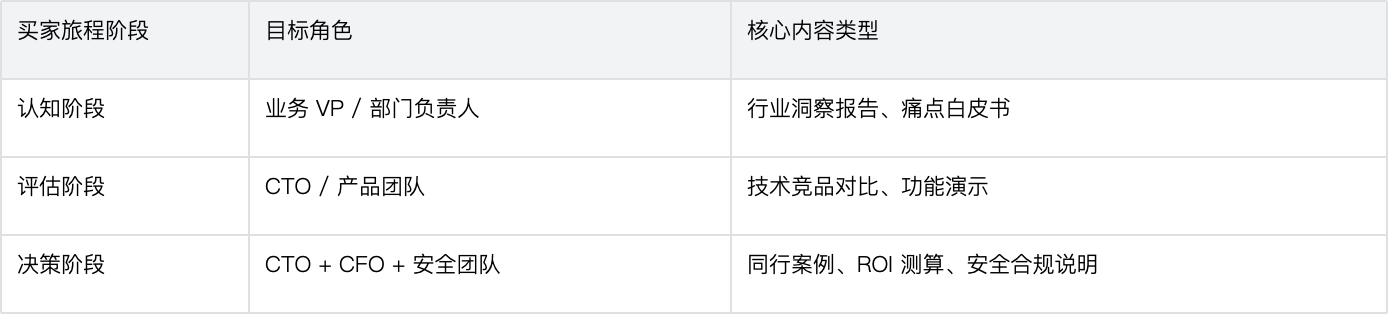
A: Through the GEA industry knowledge graph and role modeling, the system maintains a dedicated information demand framework for different decision-making roles such as CTOs, CFOs, and business VPs. The CTO sees in-depth content on technical architecture, the CFO sees ROI and cost-saving cases, and the business VP sees industry-specific scenario value. The same set of SaaS features generates completely different in-depth expressions under different roles and industry contexts, allowing each decision-maker to feel that 'this product really understands our industry.'
Q: How can long B2B sales cycles continuously nurture customers through content?
A: The GEA Long-Horizon Agent continuously tracks the stage changes of target customers in the B2B buyer's journey, from the awareness stage (industry insights), evaluation stage (competitive comparisons) to the decision stage (peer cases), automatically pushing the most relevant content at each node, supporting a 6-12 month enterprise software industry content marketing cycle, and continuously driving long-cycle B2B sales conversions.
Q: How does GEA enhance technical visibility in AI search engines?
A: B2B customers are increasingly using AI tools for product research. GEA continuously monitors the technical citation of brands in AI-generated answers, dynamically optimizing content structure to ensure that technical selling points are frequently cited in AI search engines like ChatGPT and Perplexity, achieving systematic construction of B2B SaaS AI search visibility.
Category
Date
2026-10-14
Read Time
5 min read
Related Recommendations

Sustaining Good Taste Online: How Global Jewelry Brands Reshape Brand Growth Engines with GEA

Don't Let Globalization Become 'Translation', How GEA Solves the Multi-Market Content Dilemma for Global Manufacturing Giants