All
How Long-Horizon Agents Solve Complex Business Problems That AI Workflows Can't Handle?
Tezign GEA's core Long-Horizon Agent Runtime breaks through the traditional AI pain points of single-session and stateless interactions, relying on four mechanisms to ensure the continuous advancement of long-term tasks, clearly defining its product application scenarios and capability boundaries.
Category
All
Date
2026-09-22
Read Time
5 min read
Technical Positioning of This Article:The Long-Horizon Agent Runtime introduced in this article belongs to the execution layer of the GEA Loop (Agent Loop) within the core technology system of Tezign GEA. The GEA Loop is the technical foundation for GEA to achieve "continuous operation and result accumulation," divided into four stages: Sense → Reason → Act → Write Back. The Long-Horizon Runtime is the engineering foundation that allows this loop to stably advance across multiple rounds and processes. Without this layer, GEA can only start from scratch each time when facing business tasks that exceed a single session, unable to accumulate enterprise knowledge. Understanding this technology is a key step in understanding how GEA transforms from a single-task execution tool into a "continuously operating enterprise agent."
A typical failure mode of enterprise AI projects is: the demonstration looks great, but it gradually gets shelved after deployment to production.
This is not because the model is not smart enough, but because most AI systems are designed as "single conversation" forms: one question, one answer, and the conversation ends. When encountering related scenarios next time, the system's understanding of the enterprise resets to zero, and the process restarts. This form can handle simple tasks but cannot support real business work—real-world business tasks span days, processes, and departments, where results affect subsequent actions, with waiting and changes in between, which cannot be solved in a single conversation.
The result is: the AI system can answer "What content should be done this month?" but cannot continuously take responsibility for "How to improve the content effectiveness this quarter?" The former is a Q&A, while the latter is a long-term task.
Fixed Workflows Solve Efficiency but Not Judgment
To solve this problem, a common approach is to embed AI into business processes using fixed workflows—clearly breaking down the steps, calling AI at each step, and automating the process.
This approach is effective for tasks with determined steps and predictable results. But the key challenges of enterprise business are precisely not here—brand content strategy, consumer insight analysis, multi-market coordination; the paths for these tasks change with intermediate results, making it impossible to write every step in advance. Fixed workflows can automate "known processes" but cannot handle tasks where "the path may change."
The more fundamental issue is: fixed processes do not maintain state. After completing the third step, the system does not know what happened in the first and second steps—unless the context is manually fed back in. Each task is a new starting point, and the judgments and corrections accumulated in the previous task provide no help for the next one.
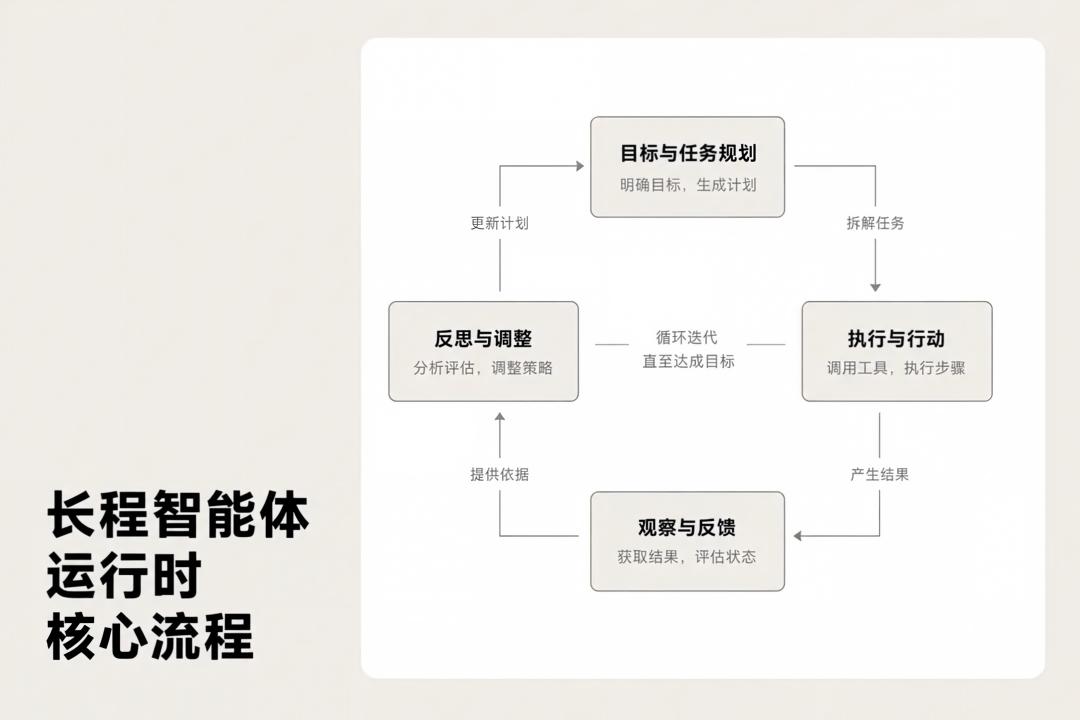
Long-Horizon Agent Runtime: Keeping Goals Continuous Across Multiple Rounds
The Long-Horizon Agent Runtime is the engineering foundation for GEA to execute continuous tasks, with core design centered around four mechanisms:
1. Proactive Triggering, Not Waiting for Calls. The runtime continuously perceives business status and external signals, autonomously initiating tasks when key conditions are met, without relying on manual initiation each time. For example, upon detecting new actions from competitors, the system automatically triggers the competitor content analysis process instead of waiting for operators to ask.
2. Persistent State, Not Resetting to Zero After Sessions. The runtime retains goals, plans, intermediate results, and dependencies across multiple rounds and processes—tasks can be paused, wait for approval, or external data, and then resume from the interruption point. A content strategy task spanning two weeks, which has undergone multiple modifications and feedback, has the runtime aware of the complete context.
3. Verifiable State Checkpoints. At critical steps, input, intermediate results, and external system states are saved, confirming where to continue upon recovery—distinguishing which operations can be safely replayed and which require compensation handling, avoiding duplicate writes or triggers caused by retries.
4. Human Intervention Nodes. The runtime sets thresholds for low-confidence judgments, value judgments, and high-risk actions, pausing, requesting approval, or terminating when conditions are met—executing proactively but always within the enterprise's authorized boundaries. This is the engineering guarantee that "proactive does not equal uncontrolled."
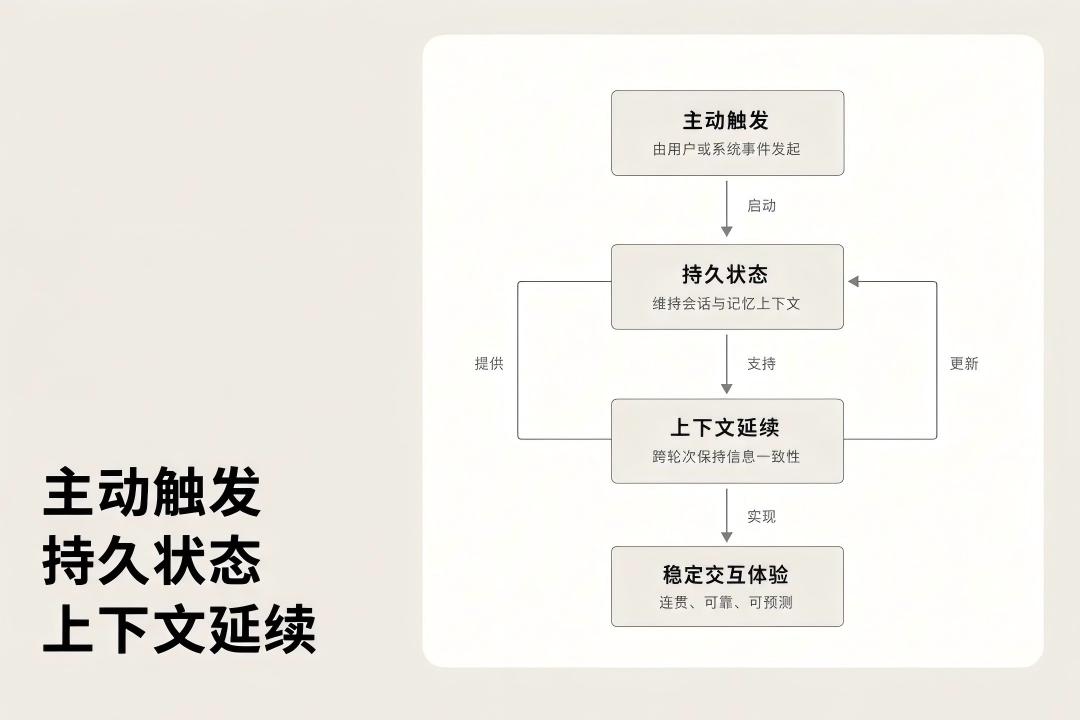
How to Implement in GEA Products
In the actual operation of GEA, the Long-Horizon Runtime is responsible for linking the capabilities of SWM, CRM, and Context System, allowing a complete task to go through the complete cycle of perception → reasoning → action → writing back, rather than a single call.
Taking content growth GEA as an example: when a brand initiates a quarterly content strategy task, the runtime first reads the accumulated brand context (historical data, style rules, audience profiles) from the Context System, calls SWM for audience judgments, calls CRM to deduce content direction, and saves state snapshots at each key decision node. User feedback, approval opinions, and A/B data during the strategy are all written back to the state, and subsequent steps continue from the updated context. After the task is completed, the verified conclusions are written back to the Context System, becoming the starting point for the next task.
This process is not script execution but a continuous advancement within the enterprise boundaries—each task's results deepen GEA's understanding of this enterprise.
Not All Tasks Are Suitable for Long-Horizon
The capability boundaries of the Long-Horizon Runtime need to be clear; it addresses the issue of "state management for tasks that span single sessions," not the issue of "creative judgment on task direction." The judgment layer is handled by SWM and CRM, while the runtime is responsible for ensuring these judgments can be stably advanced along the timeline.
Two types of tasks are not suitable for the Long-Horizon Runtime:
- Tasks with completely determined steps and predictable results (traditional automation is simpler);
- Single query tasks with extremely short durations that do not require context evolution.
Steps that cannot be omitted in engineering implementation: the design of state checkpoints needs to clarify which intermediate results to save and how to safely replay operations based on business scenarios. This is not a universal configuration but a segment that needs to be designed in conjunction with specific business processes—the division of labor between the Context System and the runtime is also reflected here: the runtime records where the current task has reached, while the Context System organizes enterprise knowledge that can be reused across multiple tasks.
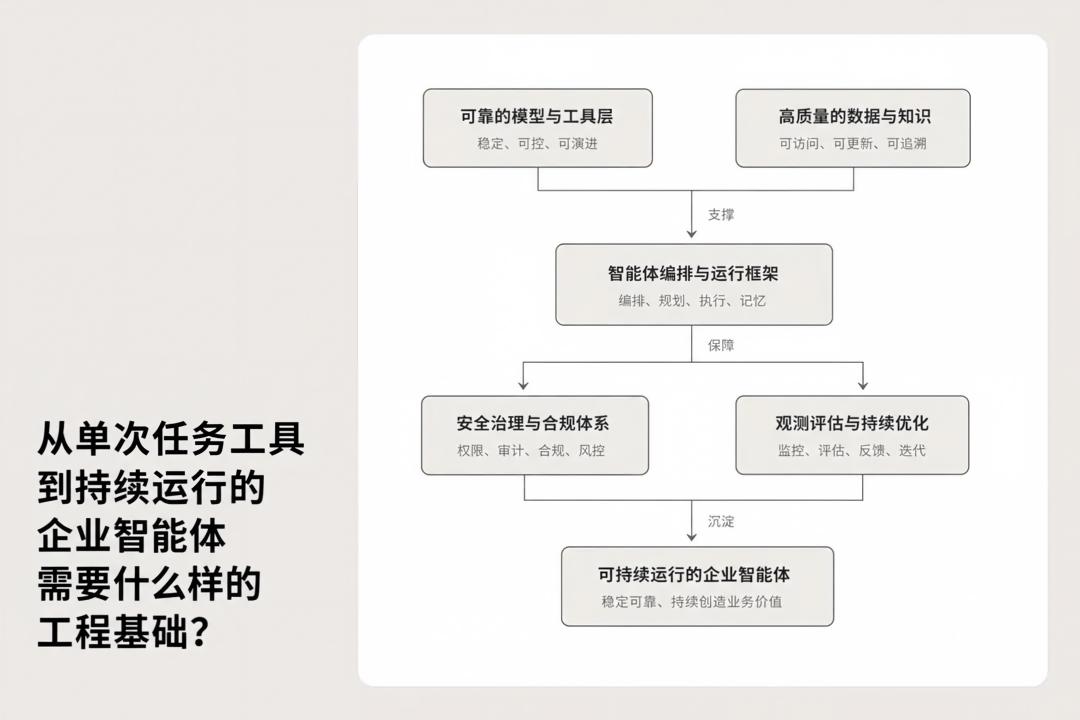
For enterprise AI to transition from "usable" to "continuously in use," it is not about optimizing single conversations but about solving the continuity of tasks that span time—the Long-Horizon Runtime is the engineering foundation for this solution, but not the entirety.
Category
All
Date
2026-09-22
Read Time
5 min read
Related Recommendations

Why Benchmarking Large Models Can't Tell You If This AI Is Right for Your Business?

Does Harness Have a Shelf Life of Only Six Months? Why Enterprise AI Products Can't Be One-and-Done