All
What Does the C-end Start to Roll Out Personal Agent Mean? Companies Need to Discuss AI Differently
Manus 2.0 highlights the Agent trend, revealing limitations in the traditional 'human uses AI' framework. Tezign's GEA confirms a new collaboration model: AI continuously operates to accumulate knowledge, while humans focus on key decisions, shifting the company's focus towards building an evolvable business system.
Category
All
Date
2026-10-08
Read Time
6 min read
Observations on Agentic Transformation
On the eve of National Day, Manus 2.0 has sparked another wave of discussion. It deserves attention not only because it has released a more complete set of Agent product capabilities but also because it clarifies a trend: on the C-end, Personal Agents are becoming an increasingly clear direction; on the enterprise side, the real questions that need to be answered are no longer just 'which tool to choose' or 'how to use the tool,' but rather what kind of collaborative structure AI will enter real business with. In other words, when companies discuss AI today, the focus should not remain on 'how humans can better use AI,' but should start to shift to another question: when AI can continuously operate, continuously perceive, and continuously write back results, how will the division of labor between humans and AI change?
In the past few years, the way companies have discussed AI has mostly stayed within one framework: humans assign tasks, and AI executes them. This framework has a structural limit—it locks AI into a passive position, leaving humans to manage all context and unable to accumulate any lasting cognitive assets.
The way companies discuss AI has mostly stayed within one framework: humans assign tasks, and AI executes them. This framework has a structural limit—it locks AI into a passive position, leaving humans to manage all context and unable to accumulate any lasting cognitive assets.
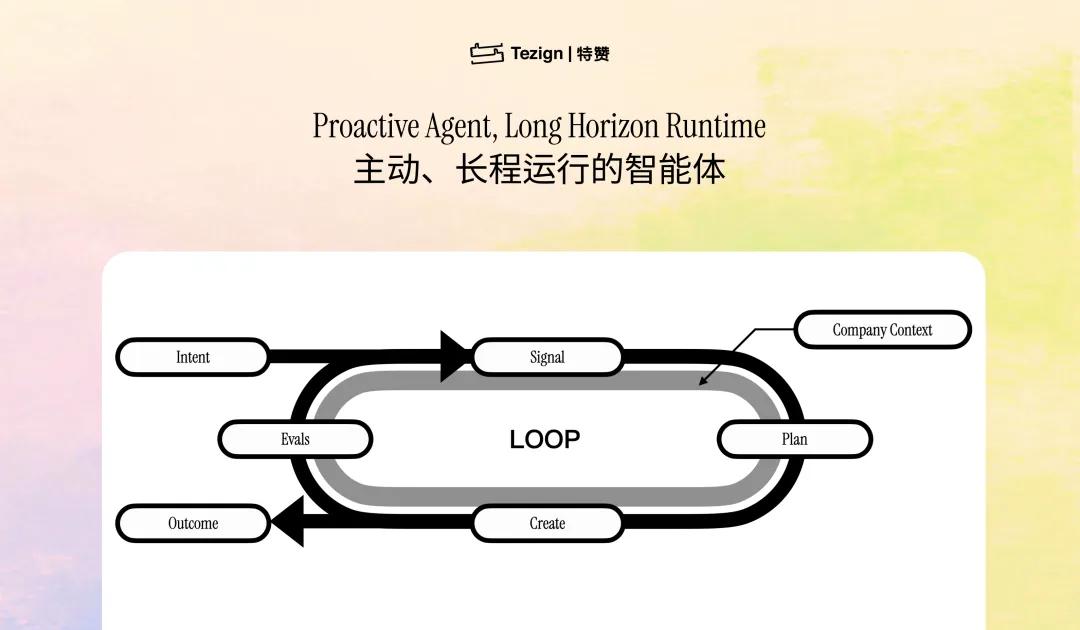
The real transformation is not that AI becomes smarter, but that the collaborative structure itself changes: AI systems continuously perceive business signals, continuously operate, and continuously write back results;
humans focus on judgment and decision-making. This is not about AI replacing humans, but rather humans and AI returning to their respective strengths.
In the past few years, the way companies have discussed AI has almost always been within the same framework: how to enable employees to use AI tools effectively, how to enhance human-machine collaboration efficiency, and how to lower the barriers to AI usage.
This framework has an implicit premise: humans are the decision-makers, and AI is the executor; humans assign tasks, and AI completes them; the better AI performs, the easier it is for humans.
This premise is becoming ineffective.
Not because AI is becoming 'smarter than humans,' but because in an increasing number of business scenarios, AI is no longer just executing single tasks assigned by humans—it is crossing time, crossing systems, continuously perceiving signals, and continuously making judgments. When an Agent runs continuously for weeks, constantly writing back results and continuously correcting judgment directions, the act of 'humans assigning tasks' is no longer sufficient to describe what is happening.
The Real Limits of the 'Human Uses AI' Framework
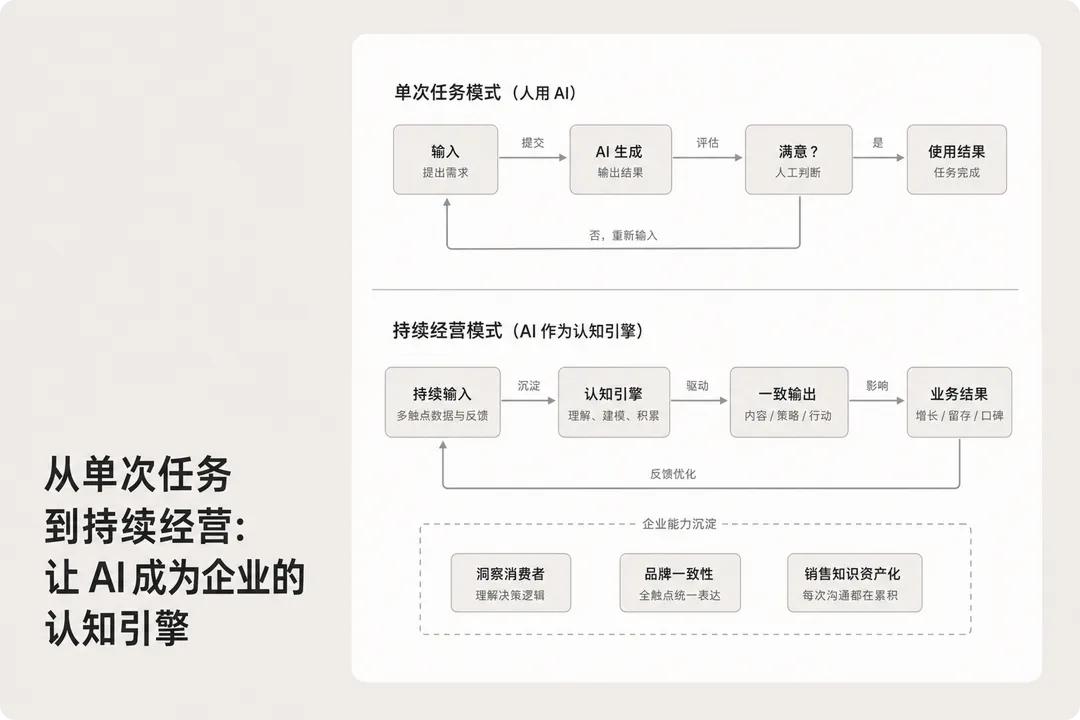
In the 'human uses AI' framework, AI is a tool that is called upon: you input, it outputs; if you are satisfied, you use the result; if you are not satisfied, you re-input. This interaction model works fine in single-task scenarios—writing an email, summarizing a document, generating a poster; AI is a productivity multiplier, the super typewriter of this era.
But the real challenges for companies do not lie at the single-task level.
The difficulty lies in: how to continuously understand the decision logic of a certain type of consumer? How to maintain brand consistency across all touchpoints during the three months after a new product launch? How to ensure that every communication by the sales team with customers accumulates into the company's cognitive assets rather than dissipating into thin air? These questions do not have the structure of 'input → output → completion'; they require the ability to continuously operate, continuously accumulate, and continuously adjust.
Using the 'human uses AI' framework to address these issues typically results in: humans exhaustively managing a pile of tools, with no context connectivity between the tools, having to re-explain the background every time they restart, and the company accumulating outputs rather than true cognitive capability.
The limits of 'human uses AI' do not lie in the upper limits of AI's capabilities, but in the structure of the framework itself—it locks AI into a 'used' position, placing all context management, task assignment, and result evaluation on humans, while failing to enjoy what AI can truly bring: continuous accumulation.
What Does 'AI Uses Humans' Mean?
'AI uses humans' is not a sci-fi scenario; it does not mean AI starts commanding humans to execute tasks. It describes a more accurate collaborative structure: AI systems continuously operate, perceive business signals, generate judgments and solutions; the role of humans in this process is to provide professional judgment, make key decisions, and correct direction—not to assign every task from start to finish.
In other words: humans keep the parts they excel at judging and hand over the parts that can be continuously advanced to AI to run.
Tezign has observed this transformation happening in real-time while serving clients in global fast-moving consumer goods, finance, pharmaceuticals, and other industries. A Chinese team from a dairy group used GEA 企业级智能体系统 to build a consumer insight system: after a quantitative survey of 1,000 people, instead of producing a report, archiving it, and waiting for the next project, they built five types of consumer groups into a sustainable AI Persona Panel. This system operates continuously—every time the product manager has a new product concept, they can directly 'ask' these five types of consumers; it is not about restarting a research project, but about calling upon a system that has already accumulated knowledge.

In this process, who is 'using' whom? The product manager is asking questions and making final decisions—this is what humans do. But the continuous accumulation of information, modeling consumer logic, and maintaining context across time is what GEA does. Humans are not replaced, but their roles have changed: from 'managing tools' to 'making judgments.'
What This Transformation Means for Enterprises
Organizations do not need to ask 'Are our employees capable enough to use AI tools?' but rather 'Have we designed a collaborative structure that allows AI to continuously operate and enables humans to focus on judgment?'
These two questions do not point to the same solution. The answer to the first question is training, tool selection, and usage incentives; the answer to the second question is architectural design—what signals AI continuously perceives, what decision nodes must be made by humans, and what results need to be written back to the system for future use.
The true competitive advantage for enterprises in the AI era does not come from how many AI tools they use, but from whether they have established a business system that 'will continue to become smarter'—each time AI executes results, it deepens the system's understanding of the industry, this type of user, and this market.
'Human uses AI' is about using tools. 'AI uses humans' is about building systems. The gap between the two lies not in current efficiency but in the amount of cognitive asset accumulation three years from now.
Category
All
Date
2026-10-08
Read Time
6 min read
Related Recommendations

The Most Comprehensive Interpretation: Can AI Simulate Consumers in Businesses?

Is Your Enterprise AI Still 'Single-Use'? How Loop Engineering Makes It Smarter Over Time