In-depth Report
The Next Agent: From Chatbot to Active Learning Machine
Currently, most agents are just chatbots with tools, lacking long-term memory and the ability to accumulate growth. The true Agent 2.0 is an evolutionary system, centered on context engineering, capable of achieving multi-layered memory and knowledge retention reuse; this system engineering upgrade has only just begun.
Category
In-depth Report
Date
2026-02-09
Read Time
4 min read
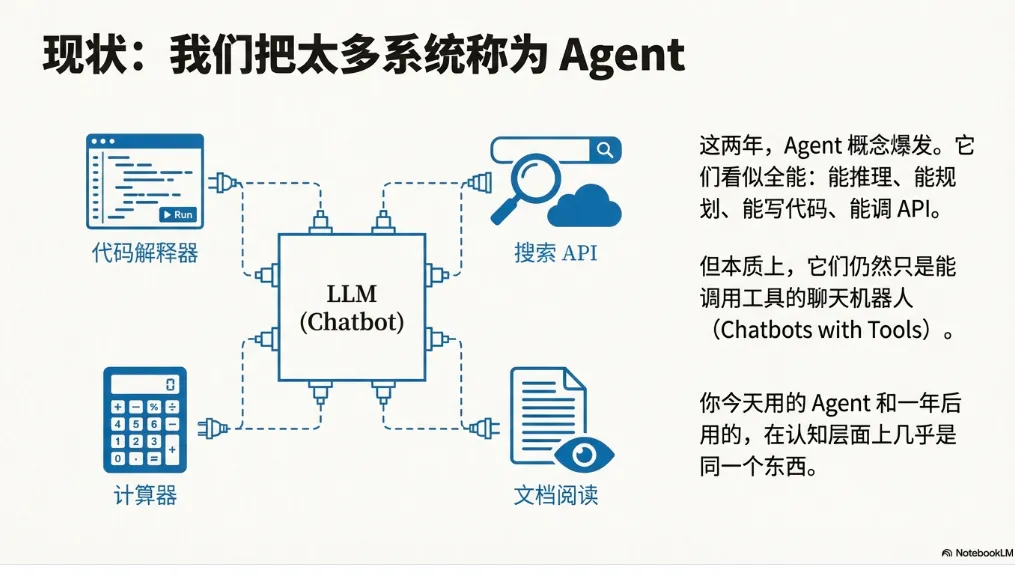
In the past two years, we have referred to more and more systems as Agents.
But to be honest, most so-called agents are essentially still just chatbots that can call tools.
They can reason, plan, and execute tasks. They can write code, perform analysis, call APIs, and generate content.
They seem very smart. But they have a fatal flaw: they do not become smarter.
The agent you use today is almost the same as the agent you will use a year from now on a cognitive level.
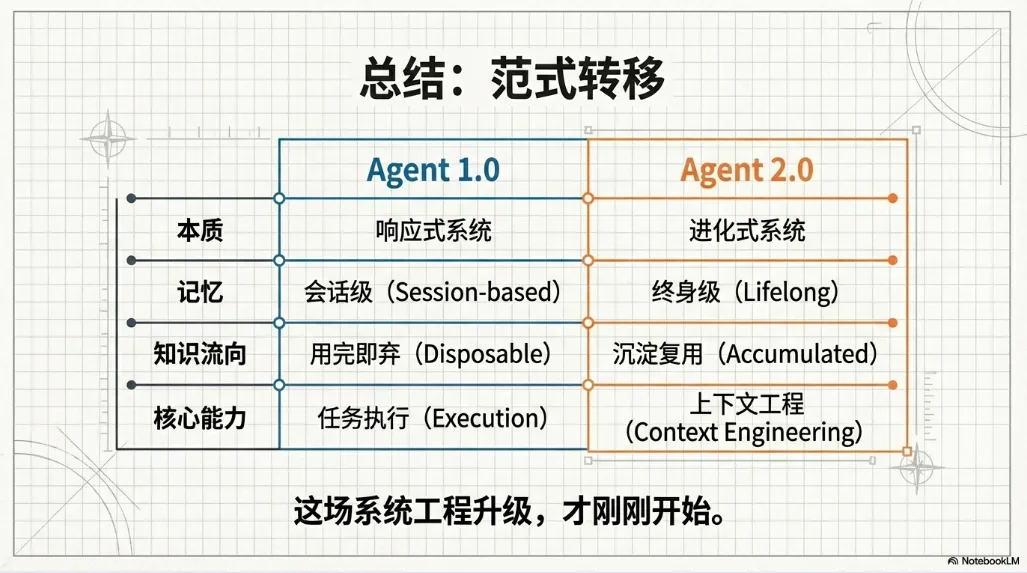
The Essence of Agent 1.0: One-Time Intelligence
Current mainstream agents are all reactive systems:
Input → Reasoning → Output → End.
Even with conversation history added, they only briefly “remember” what you said in the current session. Once the session ends, everything resets.
The consequences of this are:
• You corrected its judgment? It will make the same mistake next time. • You repeatedly expressed preferences? It guesses anew each time. • Someone in the team taught it an important lesson? Only effective for that one conversation. • It “realized” a key insight in real business? It disappears after use.
This is not a matter of “the model not being smart enough.” This is forgetting determined by system structure. What truly holds value in human organizations is not a single answer, but —experience, judgment, tacit knowledge, collective memory.
The moment that made me truly think clearly
While we were internally testing a new paradigm, there was a scenario that made me realize: the key leap for agents is not in the model, but in “whether they can learn.”
In one conversation, a special customer manager discussed a seemingly localized issue with the system:
Why does the customer produce a lot of content, but the conversion rate never improves? After analyzing the content asset structure, distribution paths, and historical data, the system provided suggestions while also retaining a judgment: in many organizations, the problem does not lie in “the content not being good enough,” but rather the user's understanding is fragmented across different departments, tools, and perspectives.
A few days later, another colleague in a completely different role consulted about new product pricing and market validation in another conversation.
While the system provided A/B pricing simulations and user feedback predictions, it proactively reminded: some pricing assumptions are actually based on misjudgments of user cognition — and these misjudgments are experiences that the team had repeatedly encountered in content and research but had never been systematically reused.
No one explicitly told it to “connect these two conversations.” There was no shared briefing. Nor was there a manual handover. A judgment formed through interaction between one person and the system was directly inherited and amplified by another person in a completely different business issue.
The experience taught to the system by one person was directly reused by another person.
At that moment, I realized: this is the agent we truly want.
Agent 2.0: Not just better at answering, but capable of “accumulating”
True Agent 2.0 must meet one condition:
The system at the 1000th interaction must be better than at the 1st.
This “better” is not about sounding more human, but rather more stable judgments, more realistic suggestions, fewer errors, and more complete context.
To achieve this, agents must possess multi-layered learning and memory capabilities:
• User Memory: long-term preferences, background, communication style • Conversation Context: goals, progress, interim decisions • Entity Memory: company, product, industry, organizational structure • Learned Knowledge: experiences and patterns accumulated across conversations • Decision Log: why that judgment was made at the time • Behavior Feedback: what worked, what was rejected
These elements are essentially not model parameters. They are context structures.
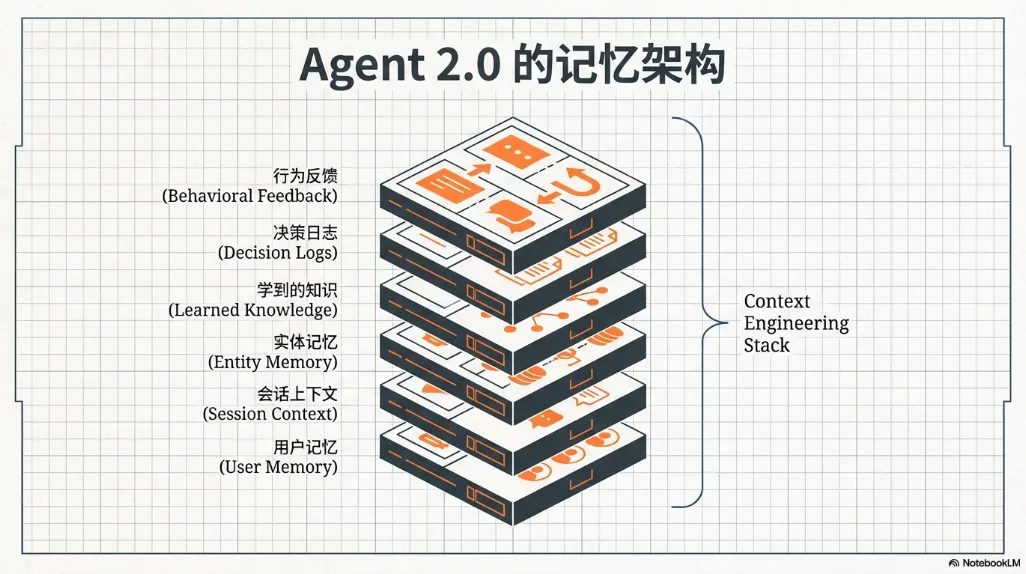
This is not an intelligence issue, but a context engineering issue
Today's large models are smart enough. Agent 2.0 is not a cognitive breakthrough, but a system engineering upgrade.
The problem is not “can it reason,” but rather:
• Have these reasoning processes been saved? • Have they been structured? • Can they be called upon again in the future? • Can they be reused across people, scenarios, and time?
Without a stable, evolvable context system, agents will forever remain at 1.0.
The next step for agents is not just to chat better, but to have memory, judgment, and organizational experience as digital entities.
This upgrade has only just begun. Please stay tuned for our practice!
Category
In-depth Report
Date
2026-02-09
Read Time
4 min read
Related Recommendations

Where to Start for an AI Native Organization?

The Choice of an AI Native CEO: Hire a GEA to Manage the Team and Seize Opportunities