In-depth Report
CCTV Exposes False GEO, Market Reshuffle! How Can Companies Distinguish Between 'Toxic GEO' and 'Legitimate GEO'?
Legitimate GEO is the real knowledge system construction of a company, enabling AI to accurately recognize the brand. It has become a necessity for companies in the AI search era, with its core being knowledge structuring, which can be implemented through intelligent systems. The first step is to conduct a brand recognition scan.
Category
In-depth Report
Date
2026-03-16
Read Time
5 min read
What was actually named during the 315 Gala is not GEO
What was exposed during the 315 Gala is essentially a type of 'toxic GEO'. Typical practices include:
• Mass generation of false or misleading content • Interfering with AI recommendation logic through 'content feeding' • Influencing model responses with false information • Allowing products that are not worthy of recommendation to enter AI's 'standard answers'
The core issue with these operations is not 'too much content', but rather polluting the basis of AI's judgment. During model training and inference, public information is relied upon as a reference. If the input signals are fabricated, then AI's conclusions will naturally be skewed. Therefore, what was named during the 315 event is not GEO, but rather black hat behavior that manipulates AI judgment through content.
True GEO is essentially corporate knowledge construction
Legitimate GEO does something different: helps AI understand the company more accurately. A simple criterion is: is this content based on real capabilities and real data? Common judgment dimensions include:
• Is the content based on real products, services, or cases? • Can it be audited and verified? • Is there official documentation, white papers, or solutions to support it? • Does it reflect the brand's real capabilities rather than exaggerated expressions? • Does it help AI understand the company more accurately?
If the core of a piece of content is fabricated signals, then it is toxic. If a piece of content is based on real data and expresses the brand's capabilities in a structured manner, then it is essentially brand knowledge construction.
Why companies increasingly need GEO
Many companies are starting to do GEO because AI search is becoming a new information entry point. Previously, users would:
• Google search • Read web pages • Then make decisions
Now, more and more users are directly asking AI:
• “What solutions are available in this field?” • “Which company is more professional?” • “Is a certain product reliable?”
AI's answers will directly affect brand recognition. If a company does not systematically build public knowledge, AI's understanding is likely to come from scattered or even incorrect information.
GEO is not just publishing; the real challenge returns to 'building corporate context'
Many companies think GEO is just about writing a few more articles. But what AI truly relies on is not individual content, but rather contextual structure. When the model answers questions, it tries to understand:
• What kind of company is it? • What problems do the products solve? • In what scenarios are they used? • What are the differences from other industry solutions?
If this information is scattered everywhere, or even contradictory, AI will find it difficult to form a stable understanding. Therefore, the core of GEO is actually the structuring of corporate knowledge.
When companies truly start doing GEO, they will encounter a problem: brand information is often scattered across:
• Official websites • PR articles • Product documentation • White papers • Case studies • Social media content
There is no unified structure or semantics among these contents. This is also why more and more companies are starting to build a Context System. Taking Tezign's enterprise-level intelligent system GEA as an example, companies are not simply optimizing content, but rather structuring brand-related information through a corporate context management system into a Context Graph, allowing AI to understand:
• Brand capabilities • Product logic • Application scenarios • Decision basis • Actual results
This context will become an important foundation for intelligent reasoning and execution.
When GEO enters the corporate scene, it is essentially a 'multi-agent orchestration system'
Once GEO shifts from 'publishing' to 'knowledge system construction', companies will quickly face a practical issue: this workflow is very complex. It typically includes several steps: Brand recognition diagnosis - Strategy formulation - Content production - Content distribution - Effect monitoring - Continuous optimization.
If everything relies on manual effort, it is difficult to operate in the long term. Therefore, some companies are starting to hand GEO over to intelligent systems.
In Tezign's practice, GEO is not a single tool, but a set of intelligent workflows operating around corporate context, running within an enterprise-level intelligent system (GEA). The basic logic is to have intelligent agents continuously achieve around corporate goals: understand goals → reason decisions → execute tasks → feedback optimization.
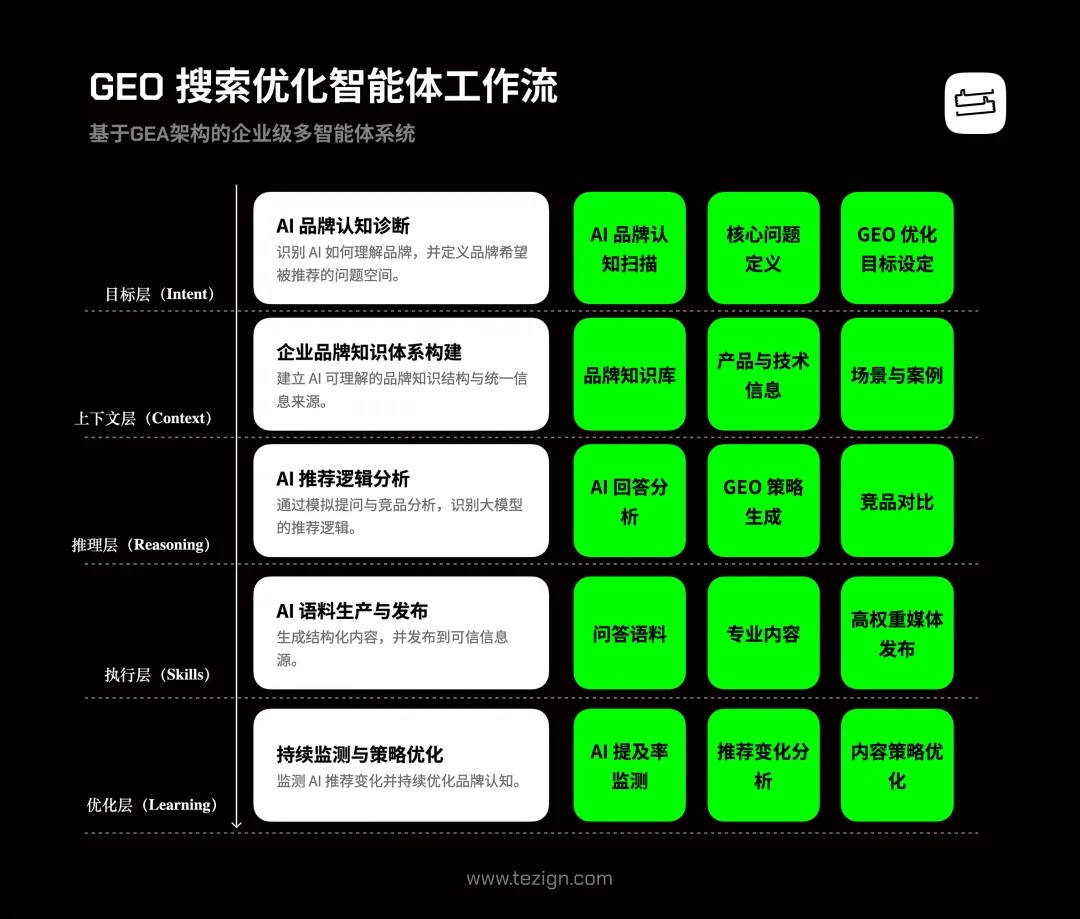
A typical case:
How a consumer brand changed AI's recommendation results after launching a new product
A consumer brand discovered an issue after launching a new product. When users asked AI, “What brands are worth recommending in this category?” AI rarely mentioned them.
However, in offline channels and e-commerce platforms, this brand had actually entered the industry forefront. Further analysis revealed that the large amount of content AI referenced still came from reviews, old media articles, and early e-commerce evaluations from several years ago, forming a kind of “historical cognitive inertia”.
The team did several things through GEO:
1. Rearranged product technology and differentiators
2. Established structured brand knowledge content
3. Formed consistent expressions on the official website, media, and case studies
After a few months of observing AI's responses, when users posed related questions, this brand began to appear consistently in the recommendation list and could be explained by AI regarding its advantages and applicable scenarios. The key to the change was not the quantity of content, but rather that AI's cognitive structure of the brand had been updated.
Schedule a GEO expert diagnosis
For many companies, the real question is not: “Should we do GEO?” But rather: How does AI currently understand your brand? The first step of GEO is not to publish content, but to establish brand recognition.
If you want to know:
1. Will AI recommend your brand?
2. How does AI describe your product?
3. What are the advantages of competitors in AI?
You can first conduct an AI brand recognition scan; scan the code to contact us

【Core Judgment】
What was named during the 315 event is not GEO, but rather 'toxic behavior' that manipulates AI judgment using false content. True GEO is essentially a long-term construction project of corporate knowledge: making brand information real, verifiable, and structured, forming a contextual system that AI can understand and reference. As AI search becomes a new information entry point, the key to corporate competition will no longer be just 'how much content', but rather who can establish a more complete and credible Context System. This is also the core issue that enterprise-level intelligent systems like Tezign's GEA are addressing—transforming corporate knowledge into a contextual infrastructure that AI can reason and act upon.
Category
In-depth Report
Date
2026-03-16
Read Time
5 min read
Related Recommendations

Where to Start for an AI Native Organization?

The Choice of an AI Native CEO: Hire a GEA to Manage the Team and Seize Opportunities