Media & Press
The Fundamental Logic of Enterprise Software is Transforming: From Seat Subscription to Decision Subscription, the Next Trillion-Dollar Company Belongs to This Type of Player
As large models enter the deep waters, the underlying logic of enterprise software is being restructured. The Tezign GEA architecture drives the shift from seat subscription to decision subscription, with Context becoming the new core to solve enterprise judgment challenges.
Category
Media & Press
Date
2026-03-27
Read Time
7 min read
As large models land in the deep waters, enterprise software is undergoing a fundamental transformation.
Looking back at the history of technological development, the emergence of ERP, CRM, and BI essentially addresses the "management" issues of resources, customers, and data.
In this context, Tezign, founded by Harvard PhD and Director of the Design and AI Laboratory at Tongji University Fan Ling, proposes the Tezign GEA, the Enterprise Agentic AI System architecture, which touches on a deeper question:
How do enterprises form judgments?
This represents a paradigm shift at the software architecture level.
If foundational models gradually become public utilities like electricity, the differentiated competition among enterprises will no longer depend on the size of model parameters.
At this point, the moat begins to shift to three dimensions:
• More emphasis on judgment quality than generation speed; • More emphasis on system collaboration than single-point capabilities; • More emphasis on privatized contextual structures than model scale.
In this context, the competitive logic of enterprise-level AI begins to shift from model capability competition to cognitive structure competition.
The Focus of the Tech Stack is Shifting from Interface to Agent
Microsoft CEO Satya Nadella has repeatedly emphasized that AI will change the form of software.
Initially, this "change" in judgment was often understood as Copilot-style feature enhancement, but the real change is not at the functional level, but in the control structure.
Before the advent of large language models, the enterprise software tech stack maintained a stable structure for a long time: humans trigger business logic through interfaces, logic calls databases to complete execution, the interface is the entry point, logic is the hub, and the database is the authority.
However, when reasoning capabilities become infrastructure, control begins to shift upward. Silicon Valley investor Naval Ravikant once proposed that AI is eating UX, meaning that the interface does not disappear, but is no longer the core that determines the experience.
A new core is forming, namely the reasoning layer structure of the Agent. The value unit of enterprise software is thus changing.
In the SaaS era, enterprises purchased seats; in the Agent era, enterprises purchase outcome capabilities.
This shift indicates that the value structure is changing.
Data is No Longer Central, Context is Becoming the New Enterprise Gravitational Structure
For a long time, enterprise software systems were built around the System of Record.
Former Salesforce co-CEO and current OpenAI board chair Bret Taylor compared the structure of enterprise software to the solar system: the database is the sun, and processes revolve around it.
However, when agents can schedule data across systems and complete reasoning and execution, the gravitational center begins to shift. The database answers "what happened," while Context answers "why it is so."
In the Agent era, the true gravitational center begins to shift from the System of Record to the System of Context.
Context is not just a collection of content, but a cognitive network composed of goal structures, decision paths, reasons for modifications, feedback loops, and historical experiences. When these structures are systematized, agents truly possess sustained reasoning capabilities.
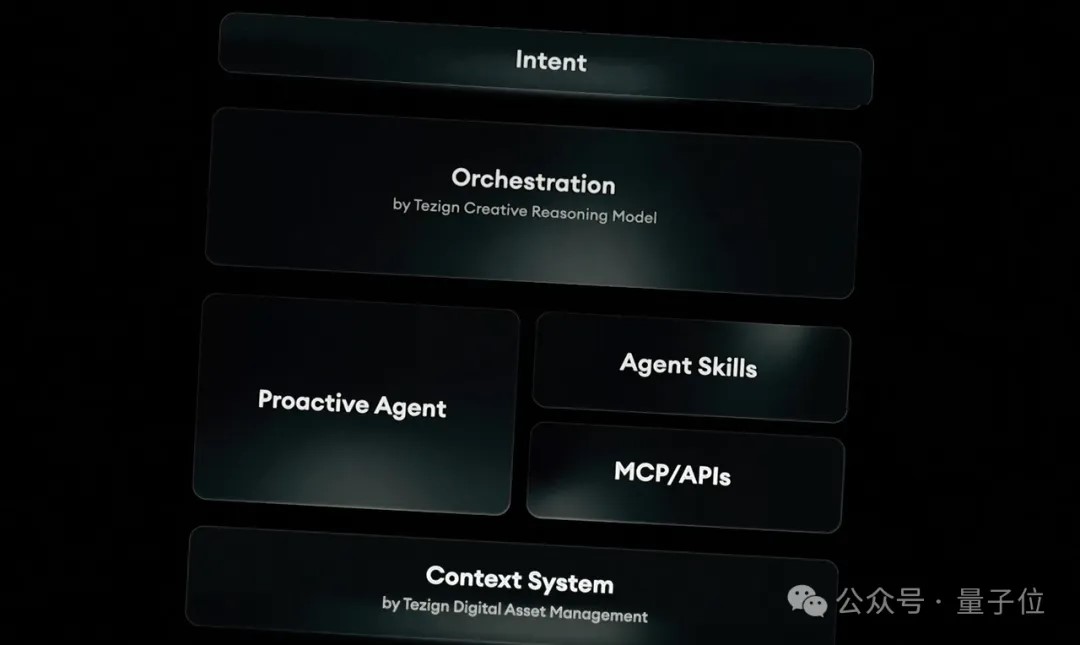
It is in this context that Tezign proposed the Context System and further built the Tezign GEA, the Enterprise Agentic AI System architecture, enabling agents to reason around business intentions and enter real business execution paths.
It answers another important question: How do agents continuously operate around business goals?
The Tezign GEA, the Enterprise Agentic AI System consists of four layers, from top to bottom:
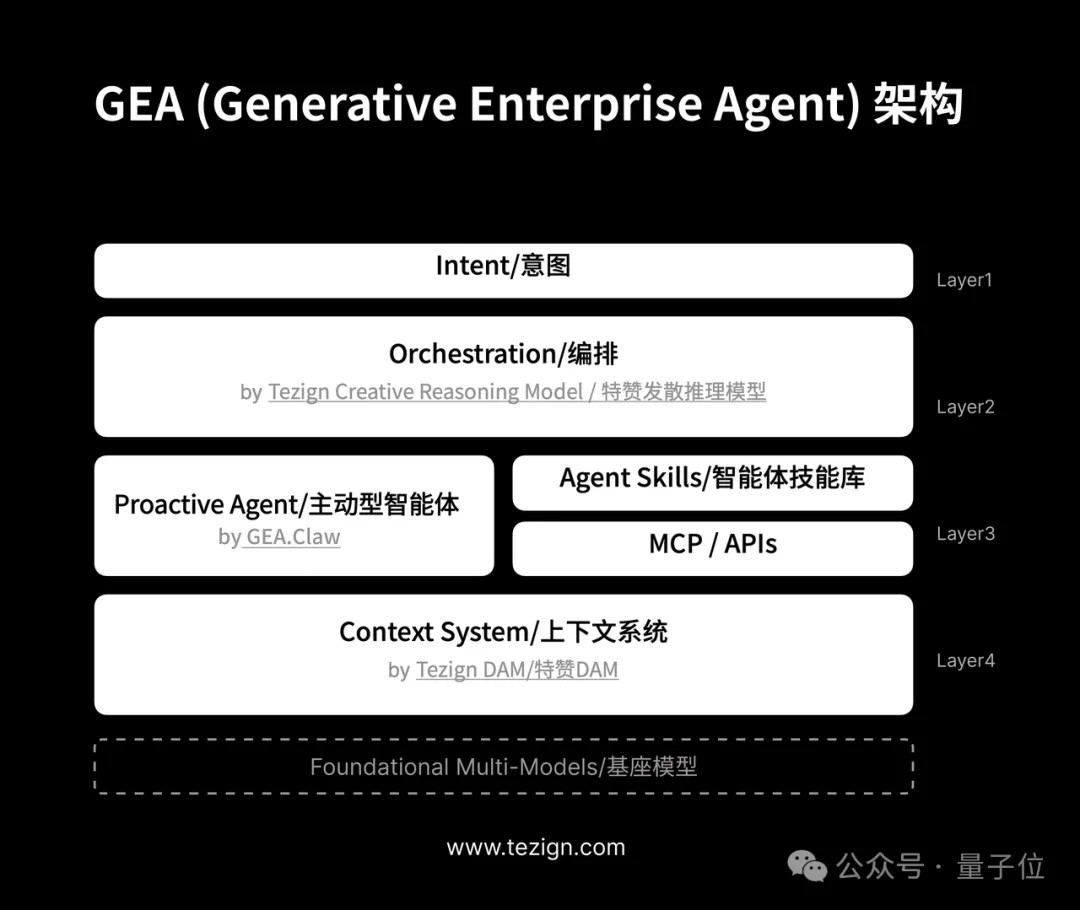
First Layer: Intent Layer
The starting point of GEA is not instructions, but business objectives.
Whether identifying growth opportunities, exploring product directions, or formulating brand communication strategies, the system first understands the problems the enterprise wants to solve itself, rather than specific operational steps.
This allows agents to operate around outcomes rather than prompts.
Second Layer: Orchestration Layer
Once the intent is recognized, Tezign's self-developed Creative Reasoning Model conducts divergent reasoning and path orchestration.
The system does not generate a single answer, but sequentially: breaks down multiple possible execution paths, evaluates path value and risk, and selects the optimal strategy combination.
This layer determines whether the agent possesses true business reasoning capabilities, rather than just content generation capabilities.
Third Layer: Execution Layer
Once the path is determined, the agent begins to enter the real business execution phase.
In this layer, GEA uses the Proactive Agent system to schedule model capabilities, Agent Skills, and internal enterprise system interfaces, allowing tasks to be continuously advanced rather than remaining at a one-time response level.
The execution layer system—GEAClaw is responsible for cross-system capability resource calls and dynamically adjusts execution strategies based on environmental changes, enabling agents to continuously participate in enterprise workflow operations.
This is also one of the important distinctions between enterprise-level agents and Copilot-type tools.
Fourth Layer: Context System
Supporting the entire architecture is the enterprise-level Context System. It organizes not just data, but: historical decision paths, brand asset structures, user research results, product evolution logic, and business feedback loops, which together constitute the source of the enterprise's long-term judgment capabilities.
When Context becomes a unified cognitive foundation, agents truly possess sustained reasoning capabilities.
It is on this four-layer structure that GEA is no longer just a model calling interface, but becomes an intelligent system capable of continuously operating around the enterprise's real goals. This is also one of the most essential differences between enterprise-level agents and traditional SaaS tools.
From Data Operating Systems to Decision Operating Systems
Similar structural changes have already occurred in the field of data infrastructure.
Data operating systems represented by Palantir are essentially not analytical tools, but a type of data infrastructure that can participate in the enterprise decision-making process.
They organize internal enterprise data relationships, allowing algorithms to continuously work around real business goals rather than around single query response inputs.
If the previous generation of data infrastructure solved how to organize data, then the new generation of enterprise-level intelligent agent systems is solving how to organize enterprise judgment.
This change means that enterprise software is transitioning from the data operating system phase to the decision operating system phase, and the enterprise-level agent architecture is one of the important infrastructure forms of this phase.
From Seat Subscription to Decision Subscription: The ARR Structure is Being Rewritten
From the perspective of the capital market, the most important change in Agentic AI is not in model capability, but in revenue structure.
The traditional SaaS ARR (Annual Recurring Revenue) is built on seat subscriptions and module licenses, while the ARR of enterprise-level intelligent agent systems begins to be established on the depth of business participation.
When the system can continuously participate in product innovation judgments, brand expression control, and growth path optimization, what enterprises purchase is no longer just a tool, but a capability structure that can influence business outcomes.
Software subscription relationships are shifting from seat subscriptions to decision subscriptions, and this change is becoming an important basis for the capital market to reassess the value of enterprise-level AI companies.
The GEA architecture proposed by Tezign revolves around this change, enabling agents to continuously operate based on enterprise Context and embed into real business processes, thus forming an accumulative intelligent capability structure.
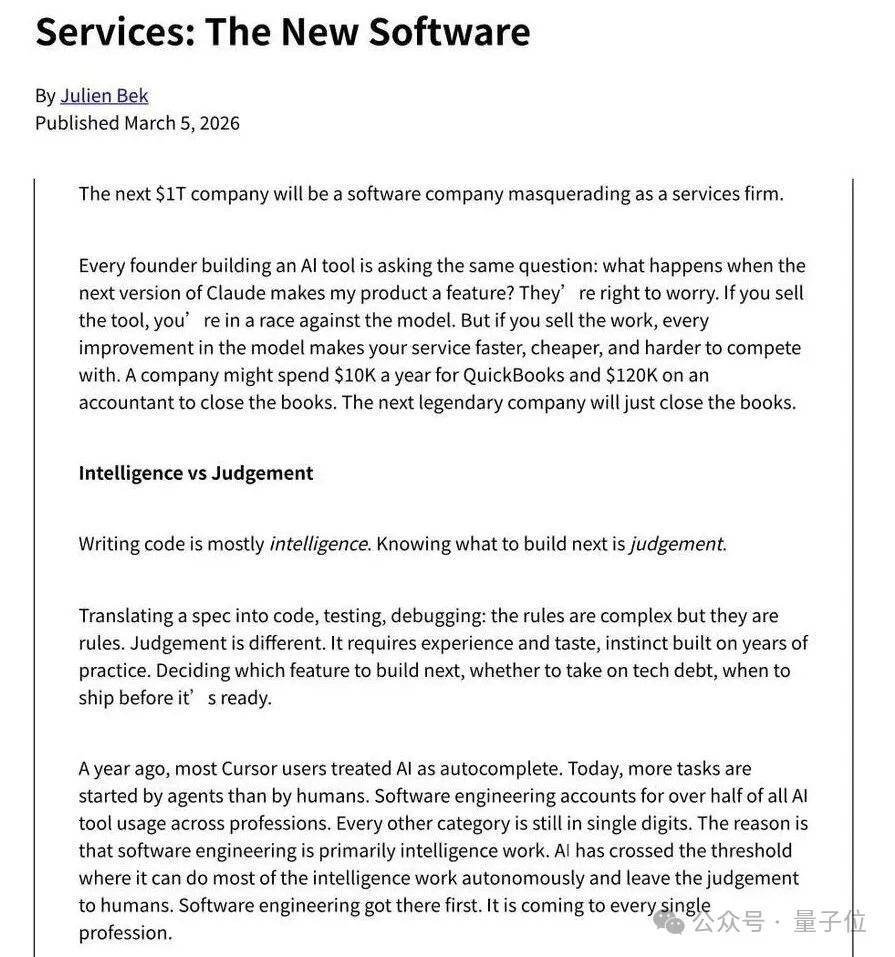
Sequoia partner Julien Bek proposed in his article “Service is the new software” (服务即新软件): the next trillion-dollar company will be “software companies disguised as service providers,” because they no longer just provide tools, but directly participate in the process of generating business outcomes. The value of software is no longer reflected in the feature list, but in whether it can continuously influence business results.
Enterprise Agentic AI System is Becoming the New Cognitive Infrastructure
From a broader historical perspective on technology, ERP addresses resource organization issues, CRM addresses customer understanding issues, BI addresses data interpretation issues, while the enterprise-level agent architecture is beginning to solve a deeper issue: How do enterprises form judgments?
Tezign's proposal of GEA is an attempt to shift at the enterprise software architecture level.
Once models become public infrastructure, what truly determines enterprise differentiation is no longer model scale, but contextual structure; no longer generation speed, but judgment quality; no longer single-point capability, but how the system continuously operates.
In the past decade, enterprises purchased software systems; in the past three years, enterprises have tried model capabilities; and in the coming decade, what enterprises will truly deploy is a set of intelligent systems capable of participating in business judgments.
Enterprise-level intelligence thus begins a new chapter.
Category
Media & Press
Date
2026-03-27
Read Time
7 min read
Related Recommendations

Improve the Compliance System for Multimodal Generative AI, with a Total of 7 Deep Synthesis Algorithm Filings

Self-developed Creative Reasoning Model awarded in Xuhui District, Shanghai, selected for the "Mosu Shencheng" model service provider whitelist