Product Updates
Insight Research GEA: From One-Time Research to a Continuous User Understanding System
Companies do not lack data or reports, but rather a system capability that can continuously understand users and validate judgments.
Category
Product Updates
Date
2026-03-25
Read Time
5 min read
In most companies, user research still exists in the form of "projects": one research study, one interview, one report, leading to phase conclusions, and then archiving.
This method was effective in the past, but today, it increasingly struggles to support real business. Users are continuously changing, the market is constantly evolving, while research is phase-based and lagging. Companies can obtain more and more data, but it is difficult to form a continuous, reusable understanding of users.
More critically, the results of user research often remain at the "descriptive" level: what users did, what they said, but it is hard to answer "why this is the case," and even harder to use for predicting future decisions.
This means that companies do not lack data or reports, but rather a system capability that can continuously understand users and validate judgments.
Core Technology: A Continuous User Understanding System
The core of Insight Research GEA is not about obtaining more data, but about building a user system that can be understood, reasoned, and continuously invoked.
With the support of the System of Context, the user data of the company—behavior records, feedback content, research results, historical decisions—are consolidated into structured user contexts; based on this, the Creative Reasoning Model performs divergent reasoning and path disassembly on these contexts, constructing AI Personas with behavioral logic and decision-making mechanisms.
Around this system, Insight Research GEA has built three core capabilities:
• User Context Modeling
Transforming scattered user data into structured contexts, forming a sustainable and updated foundation for user understanding.
• AI Persona Construction and Multi-Role Simulation
Generating Personas with preferences, behaviors, and decision logic based on user contexts, and supporting interactions and reasoning among multiple Personas.
• Decision Path Reasoning and Hypothesis Validation
Addressing key issues such as pricing, selling points, and communication strategies, evaluating potential outcomes and risks of different paths through divergent reasoning and user simulation.
Under this mechanism, users are no longer just objects of analysis, but become decision participants that can be understood, invoked, and simulated.
Typical Cases: From "User Feedback" to "Decision Validation"
In actual business, this capability has begun to change the way Insight Research is used.
Use Case 1: User Modeling—Understanding Consumption Motivation
Taking a global food company as an example, the company wishes to develop a new chocolate product concept for the Lunar New Year. Holiday gift products often do not sell flavors, ingredients, or packaging, but rather express emotions, relationships, and identities. The company wants to understand the true purchasing motivations of consumers.
In Insight Research GEA, the company connects historical interview records, user expressions, and historical research data to the System of Context, and the system generates multiple AI Personas representing different user groups based on these contexts. Through interaction with these Personas, the team can gain deep insights into:
• Why some consumers are willing to pay a higher price for chocolate • Why some consumers hesitate or even reject certain products • The emotional and social motivations behind consumer purchasing behavior
This allows the company to shift from the traditional "data collection" model to a sustainable, interactive, model-based user understanding process.
Use Case 2: Decision Simulation—Product Concept Exploration
A power tool brand wants to understand the real judgment logic of professional users when selecting equipment. Professional users, also known as "Prosumers," are both consumers and professional users. For them, the criteria for product selection include not only performance, reliability, and usage habits, but also factors such as community consensus.
In the GEA system, the company can create various AI Personas to simulate different types of users and organize Personas from different backgrounds through an AI Panel to discuss and analyze product concepts, understanding decision logic and judgment conflicts. For example:
• Why some Prosumers reject more powerful but expensive new products • In different contexts, which decision factors are most important to them
Through this multi-role simulation and reasoning, the company can better understand how users weigh their decisions in practice, thereby optimizing product design and marketing strategies.
Use Case 3: Behavioral Prediction—Predicting Market Changes
Many business decisions require predicting changes in market and user behavior in advance. For example, why a certain group may change its behavior at a certain time, or why a specific market trend may rapidly expand.
In GEA, the company can track and predict market dynamics in real-time by connecting AI Personas with market sentiment analysis. The system uses the Universal Research Agent to continuously run research tasks, observing user expressions, behavioral changes, and market signals, generating the following insights:
• Changes in behavioral trends • Dynamic feedback of market signals • Potential decision insights
These insights will form sustainable and reusable research assets, helping companies predict and validate future market behaviors, thereby reducing decision risks.
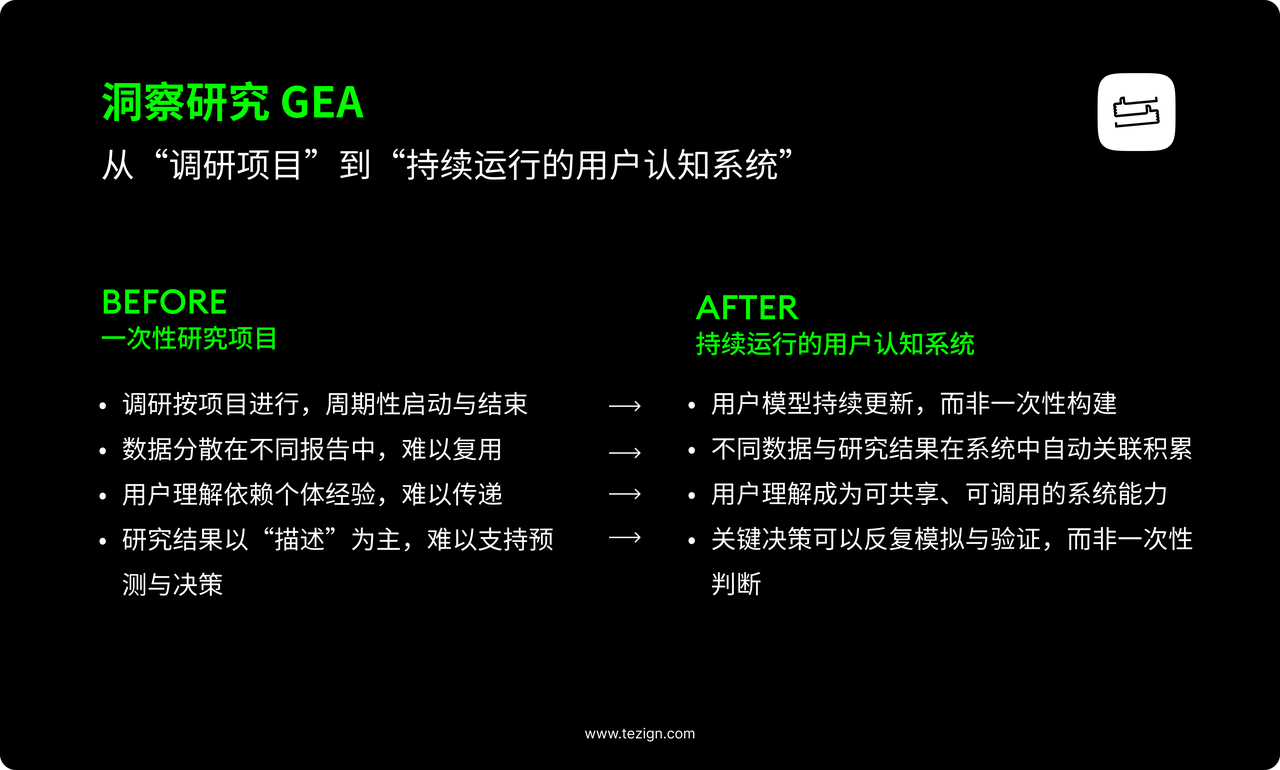
From One-Time Research to a Continuously Operating User Cognition System
In the GEA architecture, Insight Research is no longer an independent link, but an important part of the entire system. The Context System provides user contexts, the Creative Reasoning Model is responsible for reasoning and simulation, and the Agent is responsible for execution and feedback, forming a closed loop that enables companies to continuously understand users, validate judgments, and continuously optimize decisions.
As AI enters enterprises, the role of Insight Research is undergoing fundamental changes. Companies no longer rely on one-time research to approach users, but continuously understand users through the system; they no longer rely on single reports for judgment, but continuously correct direction through an ongoing mechanism.
Insight Research is no longer a series of projects.
It is becoming a foundational capability for enterprises.
Category
Product Updates
Date
2026-03-25
Read Time
5 min read
Related Recommendations

Tezign E-commerce Content Growth Service: No More Material Shortages or Gambling

Tezign Model Hub: A Platform for Divergent Reasoning and Multi-Model Orchestration - Transforming Model Governance from Engineering Usability to Business Manageability