Product Updates
Product Innovation GEA: From a Product Concept to a Continuous Innovation Decision-Making System
GEA empowers companies in product innovation by generating and reasoning optimized product concepts, and simulating user feedback through AI, as well as connecting to real device testing to validate concepts. Its architecture forms a closed loop, driving product innovation from ideas to systematic decision-making, reducing uncertainty.
Category
Product Updates
Date
2026-03-25
Read Time
5 min read
In many companies, product innovation often appears to be an "idea" activity, but those who have actually worked on products know that behind innovation are countless difficult judgments. Every day, a large amount of information emerges—industry changes, user discussions, competitor releases, new technologies, and so on. However, the real challenge for teams is not seeing this information, but judging which signals are truly worth turning into products.
If the direction is judged incorrectly, subsequent R&D, design, and marketing will be based on erroneous assumptions, making product innovation fraught with uncertainty.
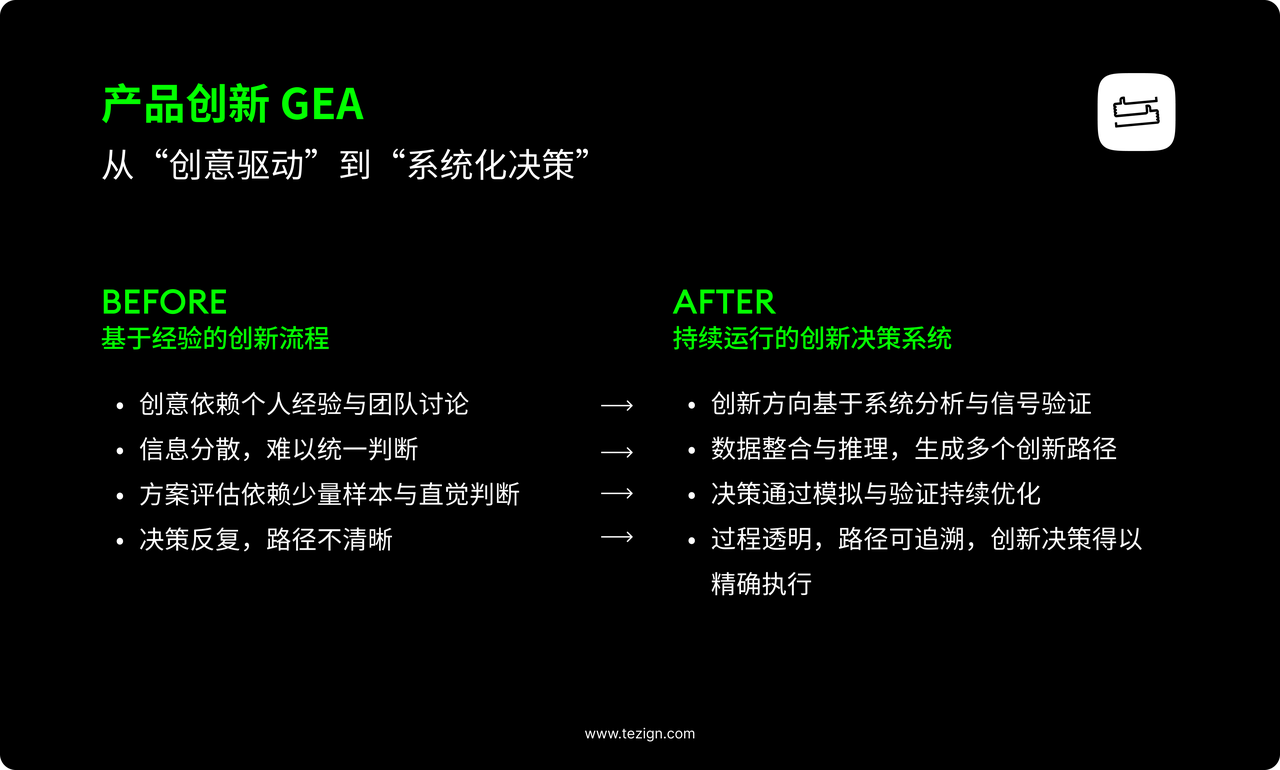
In most traditional processes, innovation relies on the experience, market feedback, and internal intuition of a single team, lacking the capability for continuous validation and systematic decision-making. As a result, product innovation remains stuck in the stages of "repeated discussions" and "experience-driven" approaches, failing to fully leverage the company's knowledge and data assets.
Now, Tezign is fundamentally changing all of this through the GEA architecture: innovation is no longer a series of scattered projects, but a continuously operating, system-supported capability chain.
Core Technology: A Continuous Innovation Decision-Making System
Under the GEA architecture, product innovation is not just a process of generating ideas, but a decision-making process supported by systems and continuous participation. Through technologies such as the Context System, Creative Reasoning Model, and Proactive Agents, GEA transforms product innovation from a "one-time idea" into a "continuous decision optimization" process.
In this process, GEA helps companies better identify opportunities, generate concepts, and systematically validate them through three core capabilities:
- Signal Insight and Cross-Validation
Based on multi-dimensional information integration, identify market signals and innovation opportunities worth paying attention to, and cross-validate their effectiveness through multi-source data.
- Product Concept Generation and Multi-Dimensional Reasoning
Using the Creative Reasoning Model, generate multiple product directions and concepts, and reason and evaluate different paths.
- User Validation and Decision Simulation
Through AI Persona and user simulation, validate the acceptance and conversion potential of product concepts and features among different user groups.
With these technological capabilities, product innovation no longer relies on experience and intuition, but is driven by a systematic, sustainably optimized decision-making process.
Typical Cases: From “Signal Judgment” to “Decision Validation”
In practical applications, product innovation GEA has begun to fundamentally change the way companies make innovation decisions. Here are three typical application scenarios that demonstrate how GEA plays a role in various stages of product innovation.
Use Case 1: Signal Cross-Validation—Identifying Truly Worthwhile Product Directions
A consumer electronics brand that launches multiple product lines each year faces the challenge of observing market signals daily in the early stages of product innovation, such as industry reports, user reviews, social media discussions, and competitor releases. However, these signals are often fragmented, and the biggest challenge for the team is not seeing this information, but judging which signals are truly worth entering the product innovation process.
In GEA, after the company inputs signals into the system, GEA first integrates information from different sources through the Memory Builder, including external public data, user reviews, social media discussions, and internal product data. This information is distilled into the company's "research memory." Next, AI Research conducts studies around these signals and performs cross-validation, ultimately outputting a set of judgments to help the team identify which directions should enter the product innovation process.
In this way, the team no longer sees scattered market signals but clear, valuable innovation opportunities.
Use Case 2: Product Concept Exploration—Generating and Reasoning Multiple Innovation Directions
As the product direction becomes clearer, the company enters the product concept exploration stage. In this stage, the company needs to generate multiple product concepts and conduct multi-angle evaluations to ensure the selection of the most suitable direction. Traditionally, this process relies on team experience and discussions, often lacking systematic support.
In GEA, the system organizes multiple AI Personas to discuss product concepts through the AI Panel. Through multi-dimensional reasoning, GEA can propose multiple product concepts, which are then refined and evaluated by different Agents (such as product ideas, packaging design, visual effects). Ultimately, the system outputs a set of product concepts that can be further advanced, presented to the team in the form of reports or design proposals.
In this way, the company not only generates multiple product concepts but also refines and reasons the pros and cons of different directions under systematic support, leading to better decision-making.
Use Case 3: User Validation—Simulating Feedback from Different Types of Users
Once the product concepts become clearer, the next step is to validate whether these concepts meet the needs and preferences of target users. Traditional methods typically rely on user research, which takes a long time and feedback comes from a small sample of users.
In GEA, the system generates AI Personas to simulate different types of user groups and directly interacts and tests with these simulated users through functions like AI Interview and AI Panel. GEA can also connect to real devices through OpenClaw for actual product testing and obtain real-time data, helping companies achieve more accurate product validation.
In this way, companies can not only obtain "user feedback" but also simulate user behavior responses in real situations, providing more precise evidence for decision-making.
From a Product Concept to a Continuous Innovation Decision-Making System
In the GEA architecture, product innovation is no longer an isolated link but an important part of the entire system. The Context System provides the information foundation, the Creative Reasoning Model is responsible for reasoning and path generation, and the Agents are responsible for execution and feedback. Together, they form a closed loop that enables companies to continuously identify opportunities, generate solutions, and optimize decisions.
As AI enters companies, the core of product innovation is shifting from "creative capability" to "decision-making capability." Companies no longer rely on inspiration-driven innovation but continuously generate better paths through systems; they no longer depend on repeated trial and error but reduce uncertainty through simulation and validation.
Product innovation is no longer just about creating new ideas.
It is becoming the capability for companies to continuously make the right decisions.
Category
Product Updates
Date
2026-03-25
Read Time
5 min read
Related Recommendations

Tezign E-commerce Content Growth Service: No More Material Shortages or Gambling

Tezign Model Hub: A Platform for Divergent Reasoning and Multi-Model Orchestration - Transforming Model Governance from Engineering Usability to Business Manageability