Media & Press
GEAClaw is Here: Enterprise-Level 'OpenClaw', a Lobster with Business Acumen
Business problems need to diverge before converging. Context is the core barrier of enterprise AI. Special praise for GEA's four-layer architecture, which centers on this, enabling proactive and continuous delivery of business value.
Category
Media & Press
Date
2026-03-24
Read Time
9 min read

In the past year, you may have encountered many such scenarios:
Someone raises a question, and immediately someone next to them pulls out their phone to ask AI, and three seconds later, an answer comes out, then they say—AI said it, so let's do it.
I am not criticizing this. The answers provided by AI are often reliable.
But what I want to say is: there is a default assumption behind this that deserves serious consideration.
We assume that business problems have a single correct answer.
Math Problems and Business Problems Are Not the Same
Current large language models are increasingly trained for stronger reasoning capabilities. Larger models, longer thought chains, higher benchmarks.
The way they solve problems is essentially convergent: facing a complex problem, narrowing down step by step, ultimately converging to the most confident answer.
This is completely correct in mathematics. It is also completely correct in coding.
But in the real business world, many problems are not like this.
For example: a CMO of a consumer brand is preparing to launch a new product. He uses a mature AI tool to ask for a strategy, and the AI, based on historical data and best practices, provides an optimal solution.
Reasonable, safe, mediocre.
The problem is not that the answer is wrong; the problem is that this type of business problem should not pursue a single optimal solution.
The real difficulty of launching a new product lies in whether you can see possibilities that others have not seen:
What if we don't do traditional advertising?
If the target audience you think is not actually the final buyer?
What if the competitor's strategy is based on a false assumption?
Business problems are complex issues with multiple constraints, roles, and objectives. Their value often lies not in rapid convergence but in first seeing more possibilities and then finding the most valuable path among them.
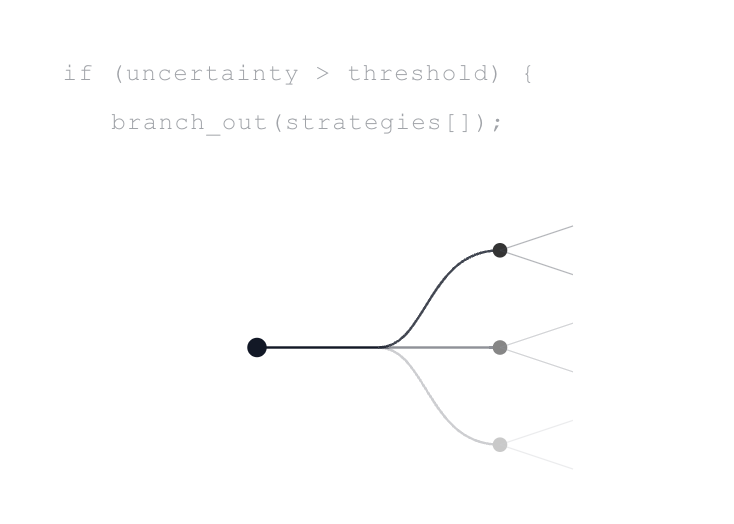
Diverge first, then converge.
This is the opposite of how most AIs work.
A Recent Statement by Andrew Ng
A few days ago, Andrew Ng released a tool called Context Hub.
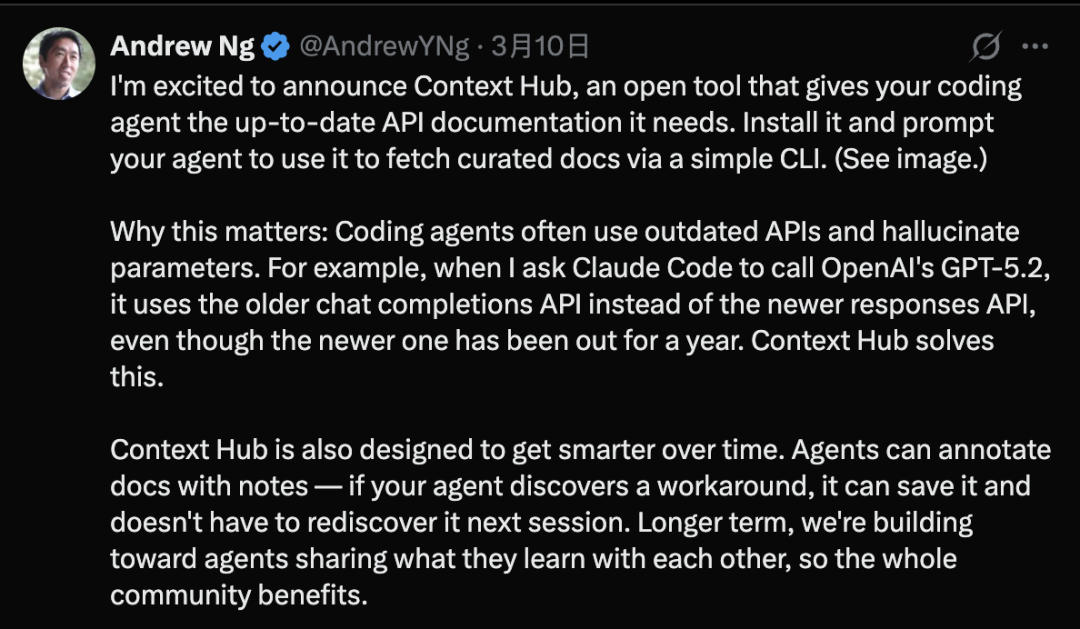
He explained the reason: AI agents often use outdated documentation when calling APIs, leading to incorrect parameters and even hallucinations. If the context is wrong, the answer is also wrong.
This issue speaks to a technical problem, but there is a larger insight behind it.
The same model, given different contexts, yields completely different results.
This logic holds even more in enterprise scenarios.
GPT, Claude, Gemini, DeepSeek... these models can be used by your company, and your competitors can use them too. When everyone can call the same set of models, the model is no longer a competitive barrier.
Models are public infrastructure, just like electricity.
No company will win the market because "our electricity is better."
So what is the barrier?
It is context.
With the same model, if you provide it with public information, you get a generic answer. If you provide it with your brand accumulation, historical decisions, and user insights, you get the answer that only you can obtain.
The model generates intelligence, and the context generates value.
A Company with Ten Years of Content Management Clarifies One Thing
Tezign is focused on doing this.
For many years, they have been doing DAM—Digital Asset Management. Simply put, they help companies manage content: images, videos, copy, design drafts, all stored in one place, managed uniformly.
It may not sound sexy, but this has allowed them to accumulate something that others do not have:
A large amount of decision-making trajectories behind enterprise content assets.
Not just "this image," but: under what marketing goal this image was created, what reviews it went through, in which scenario it was ultimately used, how effective it was, and what it was later replaced with.
These are the contexts of real enterprise business operations.
After the arrival of the AI era, they realized one thing: these content assets are not just for human use; they can also become enterprise context for AI to use.
The effect of this has exceeded their expectations.
A telling statistic: the same batch of content materials, which were previously manually called, were called an average of 12 times per thousand materials; now, after entering their context system, they are called by agents over 23,000 times.
From 12 times to 23,000 times. The same content has had its value amplified nearly 2000 times.
But this 2000 times is not achieved through repetitive labor; rather, it is the agents discovering associations, extracting insights, combining ideas, and driving decisions from these contexts 24/7—things that humans cannot do.
GEA: A Truly Business-Integrated Architecture
This year, Tezign officially launched their core product: GEA 企业级智能体系统—an enterprise-level intelligent system.
This is not a chatbot, nor is it just another AI tool.
To explain this system, we must start with the architecture. GEA has four layers, but you don't need to memorize them; understanding the significance of each layer in one sentence is enough:
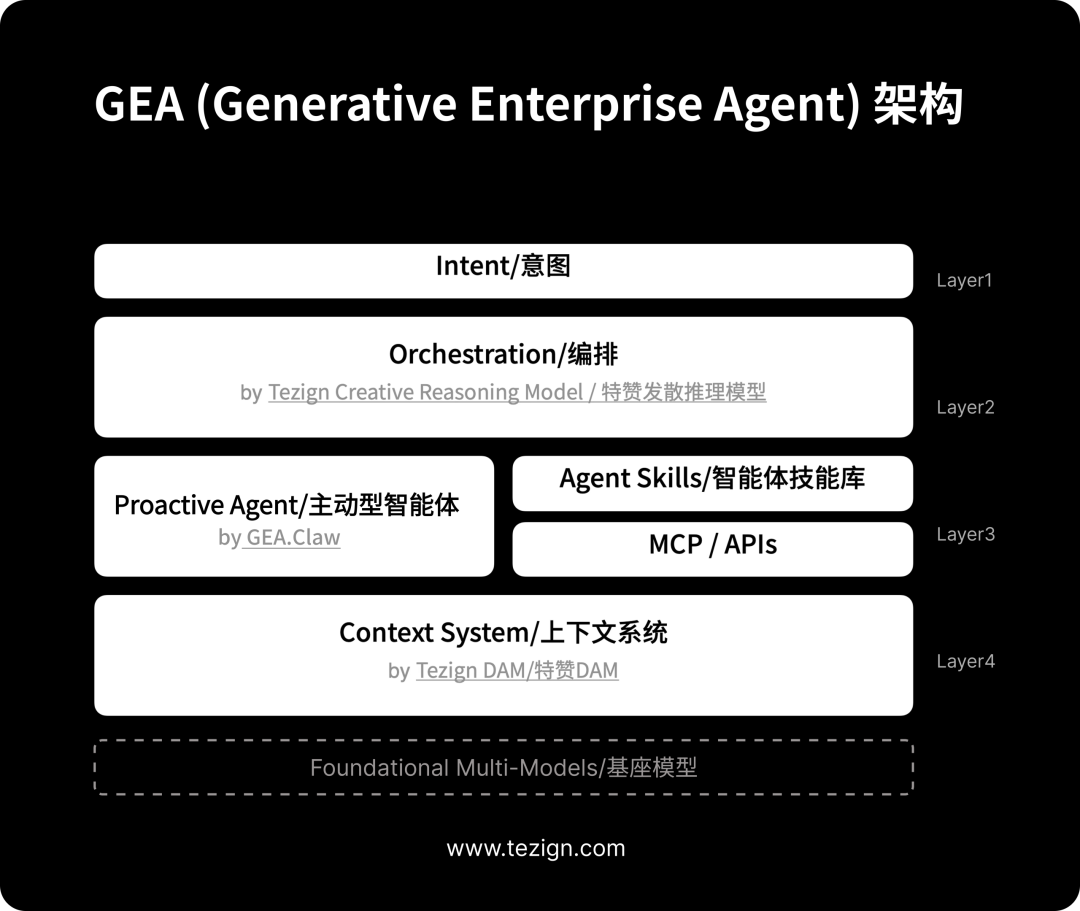
First Layer: Intent
You only need to tell the system what you want, without needing to think about how to do it. "Help me find growth opportunities in the Southeast Asian market for next quarter," this is an intent, not a prompt. GEA starts working from here.
Second Layer: Orchestration
Driven by a model called Creative Reasoning Model—this is Tezign's self-developed reasoning model, serving as the logical hub driving the entire orchestration.
This is the brain of GEA and also the most interesting part.
What it does is exactly the opposite of the convergent reasoning mentioned earlier—facing a business problem, it first diverges, breaking the problem down into multiple possible execution paths, evaluating the value of each path, and then orchestrating, routing each sub-task to the most suitable model for execution.
Like an excellent strategy consultant: first lays out all possible directions, then makes informed choices.
Tezign explained how this model was trained—they gathered strategy consultants, creative directors, and brand experts who have actually made business decisions on the platform, and they annotated not the correctness of answers but the value of thought paths: which directions are worth exploring, which possibilities are most easily overlooked, and which assumptions need to be questioned.
Third Layer: GEAClaw appears at this layer, Proactive Agent + Agent Skills (Execution Layer)
Note that word: Proactive. This is also the main feature of GEAClaw.
This layer is not a chatbot that waits for you to ask questions before answering. It will proactively monitor data anomalies and alert you, actively track competitor dynamics and generate analyses, and proactively discover execution deviations and adjust directions.
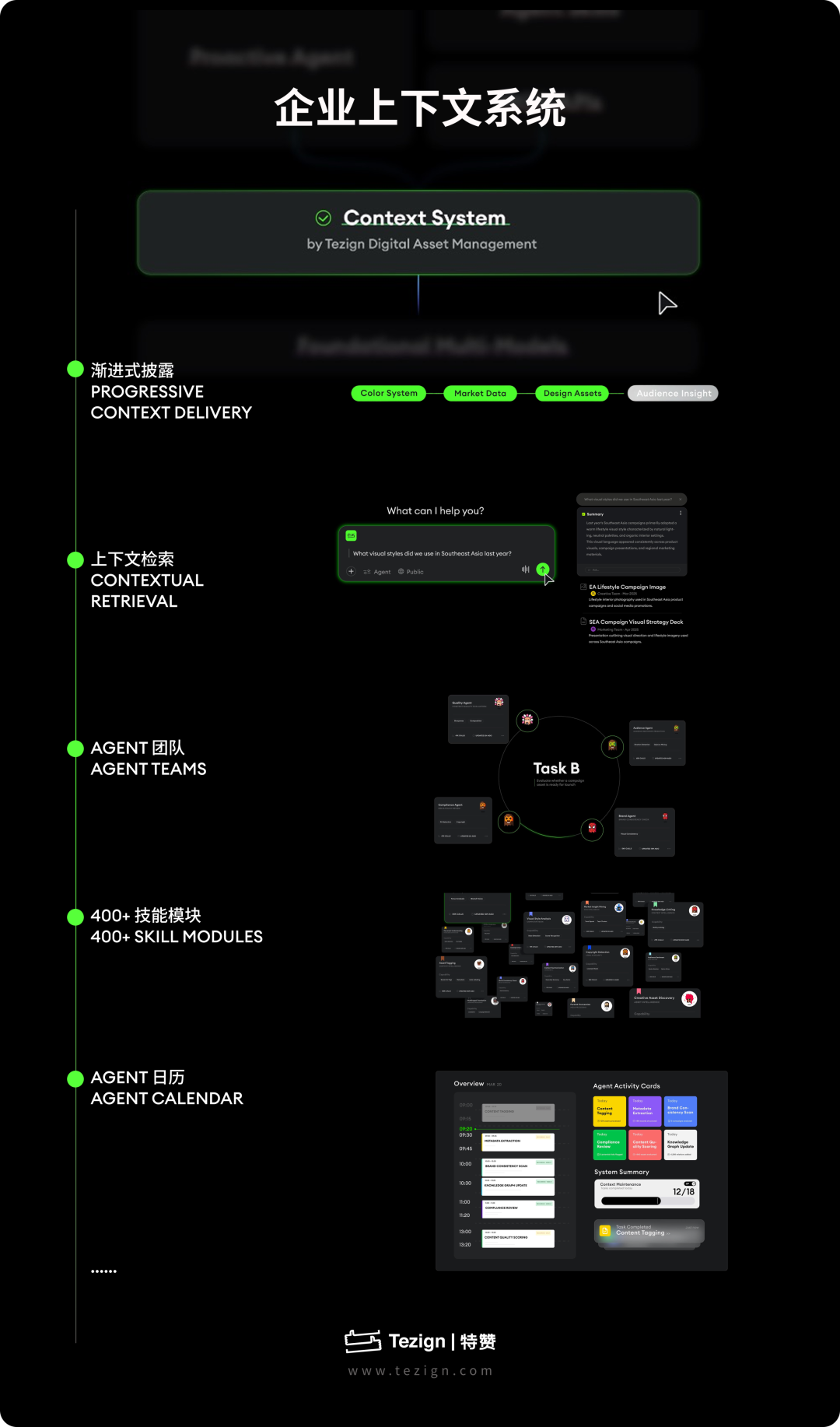
Combined with over 400 skill modules (Agent Skills), covering various business tasks from content generation to data analysis, from compliance review to creative evaluation.
Fourth Layer: Context System
Evolved from Tezign's DAM, this is the memory of the entire system.
Brand tone, material library, complete decision trajectories of each campaign, behavioral preferences of target users, what messages are most effective for which people in which scenarios... all enterprise contexts are uniformly managed here and can be called by any agent at any time.
If traditional DAM manages content, then the Context System manages the business context behind the content.
The entire architecture can be summarized in one sentence:
You provide an intent, the system understands you using context, dissects the problem using judgment, executes tasks with the most suitable model, and then proactively and continuously delivers results, becoming more and more attuned to you.
If OpenClaw is an AI employee that can work, then GEA is a whole AI team operating 24/7. OpenClaw demonstrates that AI can "work proactively," while GEAClaw enables AI to start "actively managing business and delivering business value."
What It Looks Like in Real Business
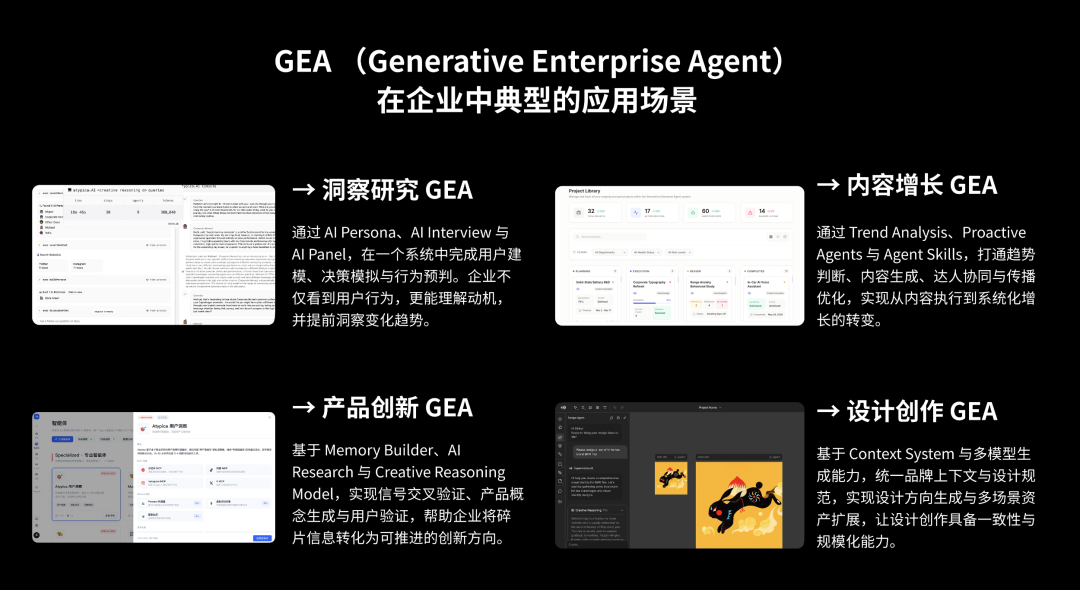
Talking about architecture is still abstract; let's look at two real scenarios in action.
Scenario One: Market Insights
A global fast-moving consumer goods brand faces a classic dilemma in market research: traditional research is limited by sample size, research cycles, and analytical perspectives, often resulting in a static report, while the market has already changed.
After GEA is integrated, it not only expands the sample size of the research but more importantly: the system continuously reasons within the existing context of the enterprise, comparing different market hypotheses, and proactively generates new insights.
What the enterprise receives is not a report, but a continuously evolving market cognition system.
Scenario Two: Social Media Growth
A global electronics 3C brand has its social media growth efforts scattered across different teams and tools: trend judgment is one group, content creation is another, KOL collaboration is yet another, and finally, effect analysis requires starting from scratch.
In this scenario, GEA takes on the role of a full-link growth agent. From trend judgment, content strategy, creator collaboration, to continuous optimization after dissemination—these work nodes are connected and continuously run within one system.
From one campaign to a continuously operating growth system.
This distinction is much greater than it appears. A campaign is project thinking, ending when completed; a growth system is product thinking, accumulating more value as it runs.
Why Tezign Is the One to Do It
A real question: why is this something Tezign is doing, rather than some big tech company's AI team?
The answer lies in the direction of accumulation.
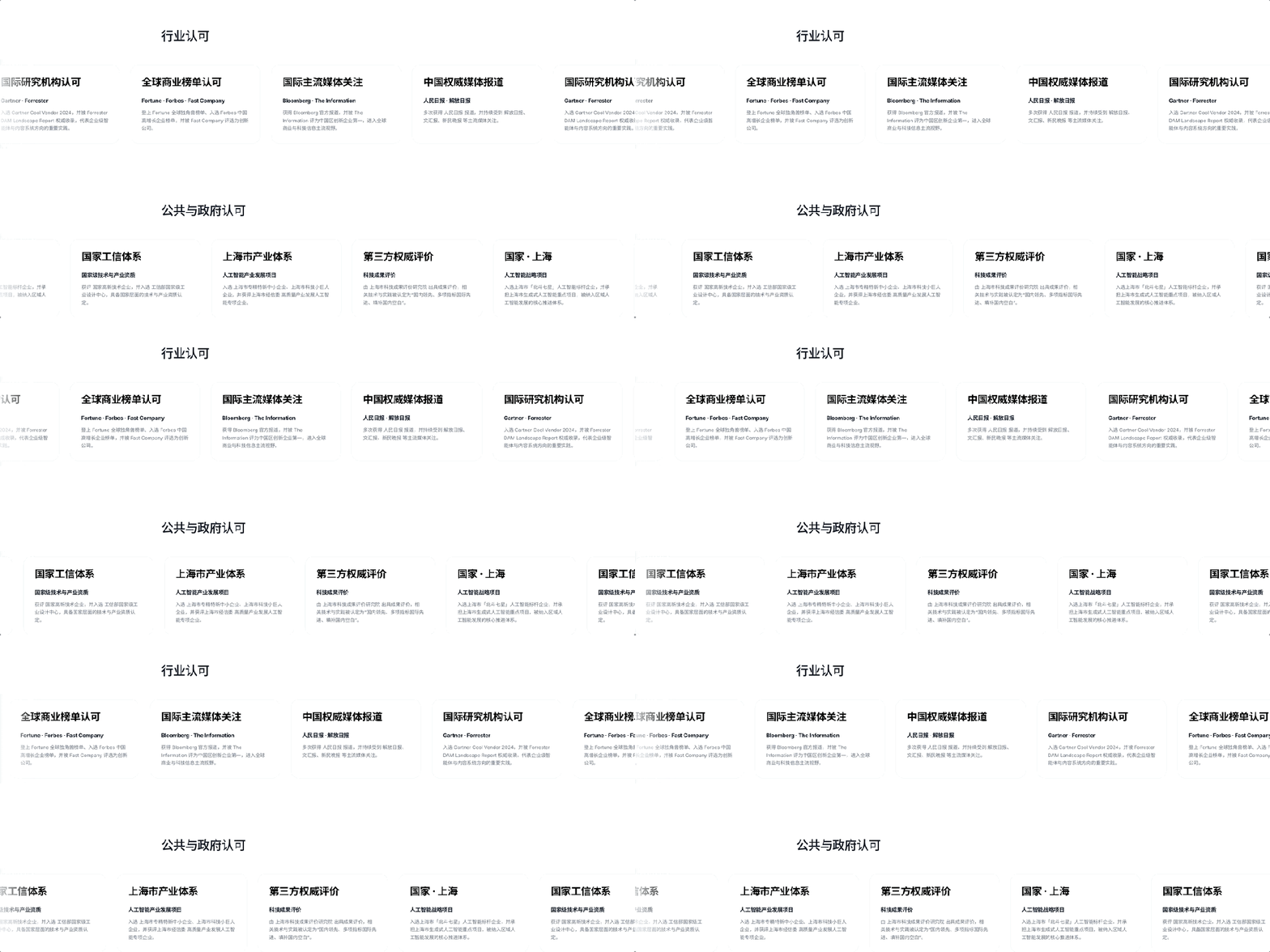
Tezign has been doing DAM for ten years, serving over 200 global enterprises and one million knowledge workers. What they have accumulated over these ten years is not just technology but a deep understanding of real enterprise business processes—what kind of content is used in what scenarios, and what decision-making logic drives what results.
.gif)
These are the raw materials for the Context System and are things that large tech AI teams find hard to replicate.
Their self-developed Creative Reasoning Model has completed national algorithm filing and applied for over 160 AI invention patents.
But more importantly, it is not about the number of patents; it is about doing something directionally correct: not pursuing a more conversational AI, but pursuing an AI system that can truly integrate into enterprise business and genuinely create business value.
Conclusion
This article has gone in a big circle, but it is actually about one thing:
AI is not lacking in intelligence; what enterprises lack is a system that can effectively apply AI intelligence to their specific business.
Divergent thinking is harder than converging answers.
Understanding context is more valuable than calling models.
Continuous evolution is more meaningful than one-time delivery.
Tezign calls this system GEA. Whether it can truly run effectively will ultimately be validated in specific business scenarios.
If your team is also thinking about how AI can truly enter workflows—not just for generating copy but for participating in judgment, understanding business, and driving results—you can schedule a GEA enterprise diagnosis and demo on Tezign's official website, as they are currently offering free consulting services to the first batch of enterprises.
Category
Media & Press
Date
2026-03-24
Read Time
9 min read
Related Recommendations

Improve the Compliance System for Multimodal Generative AI, with a Total of 7 Deep Synthesis Algorithm Filings

Self-developed Creative Reasoning Model awarded in Xuhui District, Shanghai, selected for the "Mosu Shencheng" model service provider whitelist