Product Updates
Subjective World Model: The First Fundamental Model Aimed at Understanding Humans
Tezign launched the first "Subjective World Model" aimed at understanding humans at the SuperAI conference in Singapore, modeling consumer psychology and behavior from four dimensions to help brands uncover real insights and achieve differentiated growth.
Category
Product Updates
Date
2026-06-12
Read Time
6 min read
Consumer research can be two things: proving what you already believe, or discovering something you never thought of.
Most of the time, it is the former.
Brands enter with a hypothesis, conduct surveys, focus groups, and data collection, and ultimately produce a PPT that neatly confirms their initial intuition. Research is archived, demand is frozen, and the next round of research repeats this cycle.
Here lies a fundamental problem: people often do not act as they say they do.
A person claims to be a rational consumer, but when faced with different consumption scenarios, their decisions are often not rational.
This is not a contradiction; it is human nature—there is always a gap between self-perception and actual behavior, which traditional research often fails to detect.
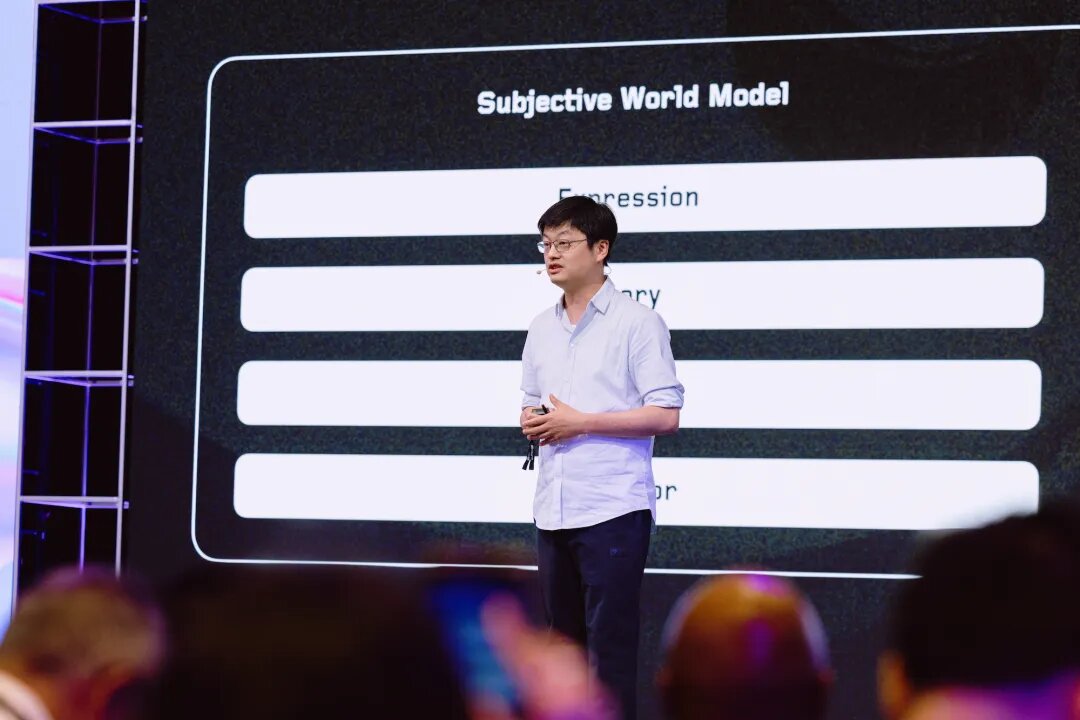
On June 10-11, Asia's top AI event, SuperAI, was successfully held in Singapore, where Tezign Technology, in collaboration with its subsidiary Atypica.AI and MuseAI products, presented the "Subjective World Model". A fundamental model aimed at understanding humans.
Too Much Data, Too Few Insights
Drucker said that the only valid purpose of business is to create consumers. But the reality is that most companies' AI investments remain on the supply side: faster copywriting, lower-cost content production, and more efficient processes. The demand side—what consumers really want and why they want it—lacks more effective ways to reveal.
This is not due to a lack of data, but precisely because there is too much data.
Today, a medium-sized brand generates more user behavior data in a day than a large company did in a year ten years ago, but the density of data does not equate to the depth of understanding. Data tells you what happened; insights tell you why—and what will happen next. Insights do not automatically emerge from data; they require a set of explanatory theories about humans: what psychological mechanisms produce such expressions, judgments, and behaviors?
Subjective World Model
In recent years, large models have become the protagonists in the AI world. Large models learn language—learning the distribution patterns of language from vast amounts of text, with the core goal of generating a reasonable next word. But language is a human output, not the human itself. It tells you what a person said but does not tell you why they said it, how they weighed their options, and how they will ultimately act.
The Subjective World Model (SWM) starts from here and does something different: it learns about people and understands them.
SWM learns from four layers of real human data how a specific individual expresses themselves, explains their behavior, weighs pros and cons internally, and ultimately acts under real constraints. It is not a foundational large model that wins by parameter scale, nor is it a variant or fine-tuned version of a general large model. Its innovation lies in its structure: breaking down the inherently difficult-to-quantify concept of "subjectivity" into four independently modelable yet mutually cooperative layers.
This is the question the Subjective World Model seeks to answer.
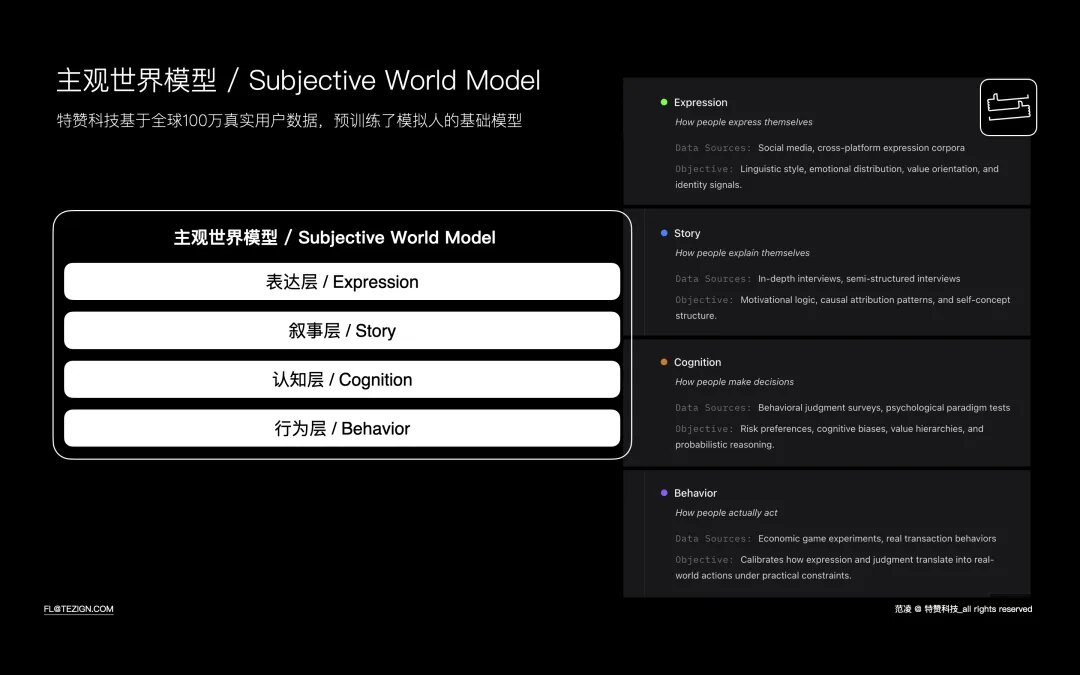
01. Expression Layer is the starting point. It collects billions of real samples from social media—Xiaohongshu, Weibo, Douyin, Instagram, X—and analyzes what vocabulary a person commonly uses, what emotional tone they carry, and how they present their self-image in public. What people say on platforms is the side they wish the world to see; this layer models the mapping relationship between language style, emotion, and identity signals.
02. Narrative Layer requires active digging and is the most time-consuming layer. Social posts tell you what a person said, but in-depth interviews reveal why they did it. This accumulation comes from our tens of thousands of hours of one-on-one long interviews, each lasting one to two hours, forming a corpus of five thousand to twenty thousand words. This layer captures not conclusions, but the causal chain of motivations—behind the same purchasing decision, different people have completely different internal logics, and these logics are rarely articulated in everyday conversations.
03. Judgment Layer captures things that even individuals may not be clear about. Everyone has a hidden decision-making operating system: a risk preference that prefers to earn less rather than incur losses, cognitive inertia that overestimates familiar things, and a value ranking between face and practicality... This layer is constructed through behavioral judgment questionnaires and psychological tests, using mature research methods from behavioral economics, with the training goal being to enable the model to restore an individual's true value weight system, rather than just labeling them as a consumer.
04. Action Layer is where the first three layers are tested. The first three layers describe a person's internal world, while the action layer asks: what behavior will this internal logic produce under real constraints? Through economic game experiments and real transaction records, it measures parameters of behavioral biases such as loss aversion coefficient, cooperation tendency, and impulse buying threshold, fitting them directly into the model rather than relying on self-reports in questionnaires.
Numbers from the Real World
Fast-Moving Consumer Goods Company | Product Innovation Scenario | From 0 to 70, then from 70 to 100
A fast-moving consumer goods company integrated the Subjective World Model into its product innovation process. The model runs continuously in the background, collecting competitive dynamics and consumer signals, automatically generating product ideas, which are then filtered through digital user testing before being sent to human teams for evaluation. AI completed all the work from 0 to concept prototype, allowing the team to refine and push it to market. As a result, the product development cycle was compressed from two to three months to three days, and starting from the fourth quarter of 2025, the number of products increased sixfold, with innovation costs reduced by 80%.
Mobile Phone Brand | Social Media Growth Scenario | 1.2 Billion Exposures, Zero Media Costs
Another mobile phone brand generated differentiated social content based on 700 consumer profiles, achieving daily automatic updates in conjunction with an attention model. The result in the first month was: 1.2 billion exposures, with zero media costs.
Snack Brand | Packaging Innovation Scenario | Verified "Unexpected Insights"
A leading snack brand had hit a growth bottleneck; based on the Subjective World Model, the team unexpectedly discovered that the core motivation for consumers purchasing the product was not taste, but the "light gifting demand" for workplace socializing. This insight directly drove the product packaging from "family size" to "sharing size," while simultaneously adjusting the marketing language to "little workplace happiness," ultimately achieving a 37% increase in quarterly sales against the trend.
Understanding Comes Before Creation
Competition on the supply side is ultimately convergent. When all brands use the same batch of AI tools to write copy, make placements, and optimize materials, the efficiency gap will quickly be erased, leading to homogenization and internal competition. True differentiation does not lie at the production end, but at the understanding end—your explanatory model built around consumers is accumulated over time, methods, and real data; there is no shortcut to replicate it with one click.
David Deutsch wrote in "The Infinite Beginning" that the growth of knowledge does not rely on accumulating more data, but on proposing better explanations. The reason good explanations are powerful is that they are difficult to alter arbitrarily. However, good explanations do not appear out of thin air; they require first encountering something unexpected—the place where it does not align with your existing cognitive framework.
Insights are the raw materials for hypotheses, and what the Subjective World Model aims to do is to make the experience of "encountering the unexpected" more systematic, repeatable, and accessible.
The Subjective World Model (SWM) is the underlying foundational model framework of Atypica
All of Atypica's product capabilities are built upon this.
Atypica 2.0 is about to be released, stay tuned
Category
Product Updates
Date
2026-06-12
Read Time
6 min read
Related Recommendations

Clipo idea Launch! A Social Media Team That Never Stops Working

Design Creation GEA: From Design Execution to a Continuously Evolving Brand Expression System