AI Can Advance Research on Its Own: This Global Dairy Brand Built a 1,000-Person AI Consumer Advisory Panel Exclusively for the Enterprise
Leveraging SWM and CRM, Tezign built a dynamically calibratable AI Persona Panel for a low-sugar cake project in the dairy sector, upgrading one-off research into a reusable consumer insight capability.
Category
Date
2026-11-19
Read Time
6 min read
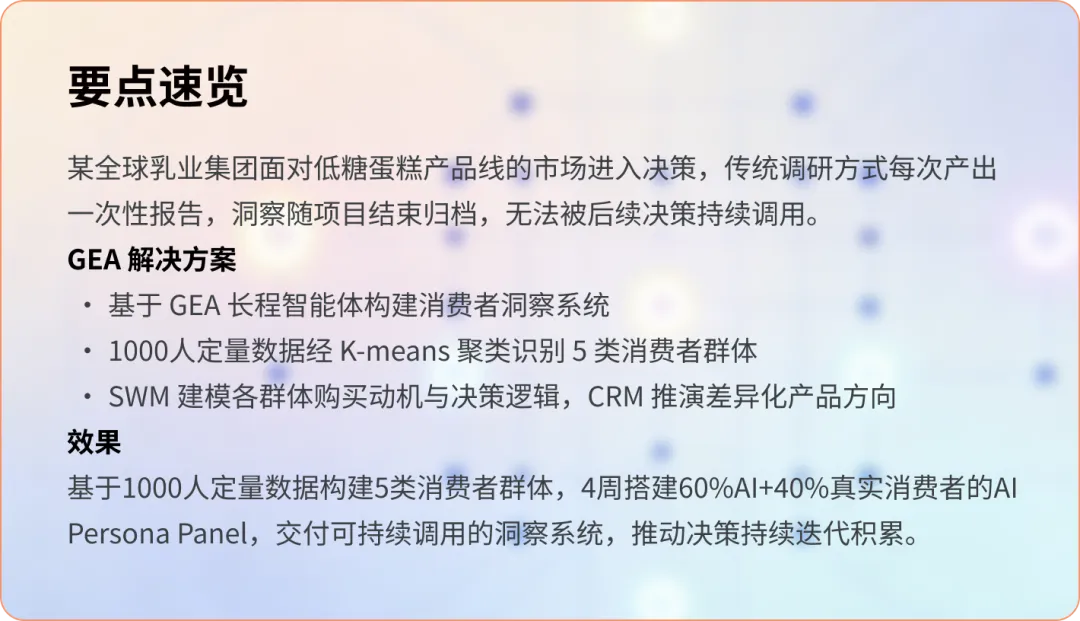
A China team at a global dairy group is advancing market decisions for a low-sugar cake product line.
The traditional process is clear: recruit the target audience, run surveys or focus groups, compile and analyze the results, produce a report, and use the data to support the product direction. This approach has been used for decades, and the process itself is not the problem—the problem lies in the structure of its output.
Every insight is one-off. When the research ends, the audience leaves, the data is archived, and the next project starts from scratch. What the enterprise accumulates are reports, not a continuous understanding of consumers.
1,000-Person Research, But Not for the Average
After Insight Research GEA stepped in, the first step was still to conduct research, but the purpose was no longer just to “get an average answer.”
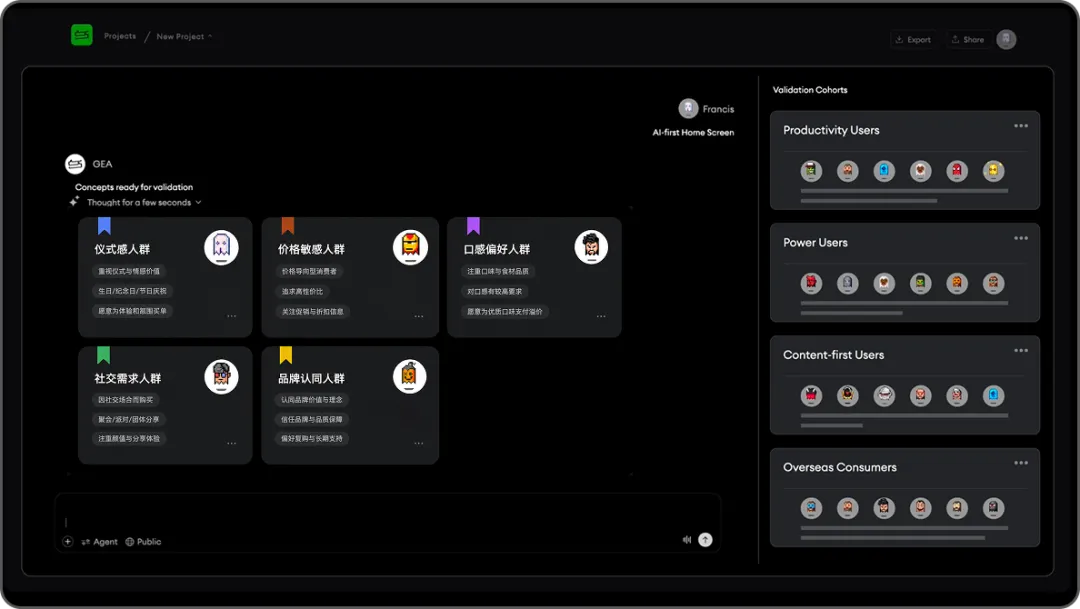
The team first completed a quantitative survey of 1,000 people. After the survey, instead of moving directly into traditional cross-analysis and report writing, they further segmented the respondents based on consumption behavior, preference logic, and decision-making paths. Using the K-means clustering algorithm, the team ultimately identified five consumer groups.
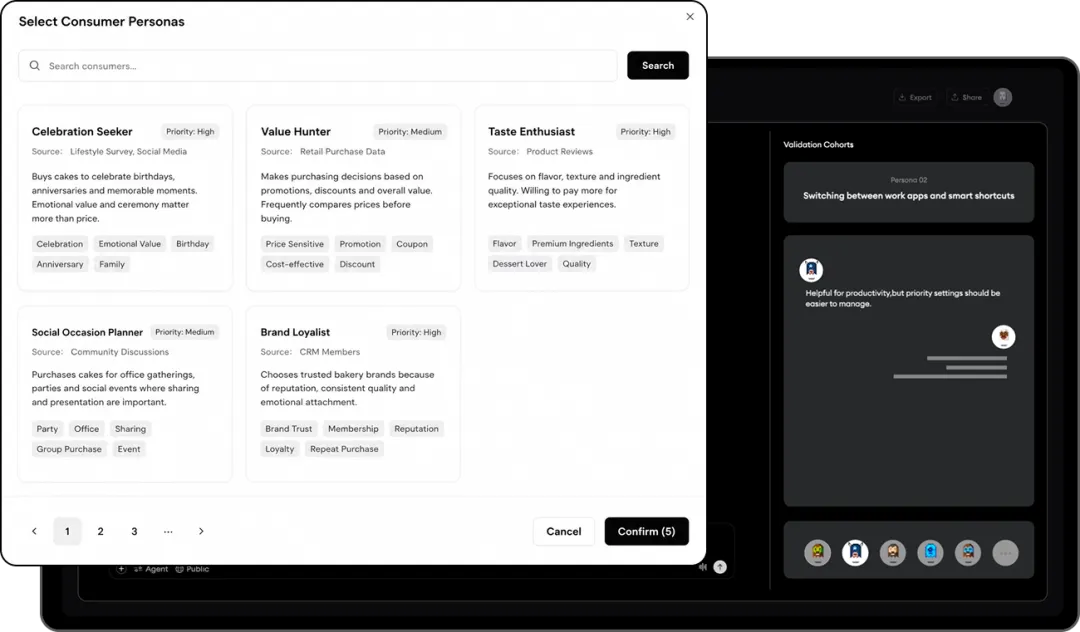
This step is crucial. For a brand, what truly affects decisions has never been “who the average consumer is,” but why different types of people buy, why they don’t buy, and in what scenarios they will buy. Some people buy cakes for a sense of ritual, some are mainly price-driven, some care about taste, and others are influenced by brand perception or social settings. These five groups are not simple demographic labels, but five distinct sets of consumption logic.
From a data perspective, the change has already begun to emerge. In the past, a round of research typically produced one overall report; this time, with the same 1,000-person sample, the output was no longer a single average conclusion, but five consumer structures that can be continuously referenced. This means the enterprise did not just obtain a one-time “market judgment,” but five entry points for directions that can continue to be interacted with and validated later.
From Using AI to Do Research, to AI Taking the Initiative
In the past, using AI meant this: the research team first defined the problem, organized the questionnaire, conducted interviews, reviewed the data, and wrote the report, then called on AI when needed to help summarize, polish, or perform part of the analysis. AI was a tool invoked within the entire process; when to start and when to stop was almost entirely driven by people.
This time was different. After the five segments were completed, the team did not leave them as descriptive reports. Instead, they further built them into an AI Panel. Each Persona has consumption memory, preference logic, and specific reactions to product details; it can be interviewed, probed further, and continuously used to test new product concepts, packaging options, and pricing logic.
The underlying support here is Tezign’s in-house Subjective World Model (SWM). SWM models not an abstract “average person,” but the cognitive preferences and trust anchors of end consumers, enabling the system to distinguish “how this type of person will react” from “why this type of person reacts that way.”
At the same time, the Panel is not purely simulated: 60% are AI Personas and 40% are real consumers. Real consumers serve as calibration anchors, continuously verifying whether there are significant deviations between AI-simulated responses and those of real people. In this way, the enterprise gets not just a faster research tool, but a consumer understanding system that can run continuously and calibrate itself over time.
This is the key shift from “people using AI” to “AI using people”: in the past, people kept initiating research, restarting workflows, and invoking tools; now, AI Personas and the Panel remain in the system, continuously being called upon and responding to new product questions, while people shift more toward asking questions, setting goals, correcting direction, and making key judgments.
Five Types of People, Five Non-Overlapping Directions Derived by CRM
But building the Personas was only the first step. The real differentiation happened in the reasoning stage—could the same consumer structure produce different creative directions? This is exactly where the Creative Reasoning Model (CRM) comes in. Built on top of SWM’s consumer understanding, CRM generates multiple non-overlapping product and communication directions for each Persona’s preference logic, rather than converging on a single “optimal solution.”
Consumers driven by a sense of ritual do not need low-price promotions, and price-driven consumers are indifferent to product storytelling—the value of CRM lies in allowing these two logics to unfold simultaneously, so the brand can say different things to different audiences at the same time, instead of finding a compromise and saying the same thing to everyone.
From a workflow perspective, a clear change also occurred here. In the past, one round of research usually supported only one decision: once the conclusion was set, the report ended, and the next study had to start over. Now, the five Personas and the directions derived by CRM remain in the system. Whether it is a new flavor, new packaging, new pricing, or post-launch optimization, the team can come back and “ask another round” at any time without restarting the entire research project.
The entire project was delivered in four weeks. But more important than speed is that the nature of the deliverable changed.
Traditional research delivers a report—an one-time document that is archived after use. This time, what was delivered was a consumer insight system that can keep running:
-A 1,000-person survey provided a foundational sample with sufficient coverage
-Five Personas preserved the structure of consumer differences
-An AI Panel of 60% AI Personas + 40% real consumers enabled the system to operate at scale while continuously calibrating itself
-SWM + CRM turned “understanding people” and “deriving directions” into a repeatable capability chain
The cost of the first insight now covers the support capability for many future decisions. By doing this project, the dairy group is essentially answering a deeper question: Is our understanding of consumers accumulating over time, or do we start from scratch every time?
The brand and Tezign are currently discussing extending this Persona Panel to subsequent product iteration scenarios—writing real consumer feedback after a new product launch back into the system, continuously calibrating the behavioral model of each group, and keeping the Panel updated as the market changes rather than freezing it on the day the research was completed.
The cost of the first insight now covers the support capability for many future decisions. Consumer understanding is no longer project-driven; it has become a normalized enterprise capability—always ready to be “asked,” always ready to be “tested,” with each invocation deepening the system’s understanding of this brand’s consumers.
Category
Date
2026-11-19
Read Time
6 min read
Related Recommendations

How GEA Understands a Family's Car Purchase Decision? Nordic Luxury Car Brands Reshaping Vehicle Development

When Consumer Insights Transition from Quantitative Surveys to a Continuous AI Panel System