Cloud Computing Technology Marketing: Providing Exclusive Content for the Entire Decision Chain
Tezign GEA integrates technology, finance, security, and contract information to generate differentiated content based on procurement stages and decision roles, continuously tracking customer feedback and compliance material changes, supporting procurement processes that last from six to twelve months, and reducing repetitive production and material version inconsistencies across teams.
Category
Date
2026-10-23
Read Time
6 min read
Cloud Computing Marketing Intelligent Agent Solution
How can cloud computing vendors ensure that the entire decision chain sees relevant content? By modeling decision roles with GEA, exclusive content is generated for the CTO (Technical Architecture), CFO (TCO), security team (Compliance), and business VP (Migration Risk), supporting the entire procurement cycle of 6-12 months.
The cloud computing procurement decision chain is complex: the CTO is concerned with technical architecture, the CFO focuses on TCO, the security team looks at compliance certificates, and the business VP is worried about migration risks. Traditional content marketing only covers one role, leaving other links in the decision chain without content support, resulting in longer sales cycles. In cloud computing vendors' content marketing, comprehensive coverage of enterprise digital procurement decision content is the key method to shorten the sales cycle.
Tezign has specifically created a cloud computing marketing intelligent agent for cloud computing technology marketing scenarios, operating based on the GEA 企业级智能体系统 enterprise-level long-range intelligent agent mechanism. It addresses the core pain points of complex procurement decision chains and the long sales cycles caused by traditional content marketing covering only a single role, helping clients achieve: full coverage for CTO/CFO/security/business VP, real-time synchronization of compliance content, and content support throughout the 6-12 month sales cycle.
How GEA Works
How can B2B companies provide corresponding procurement content for different decision roles?
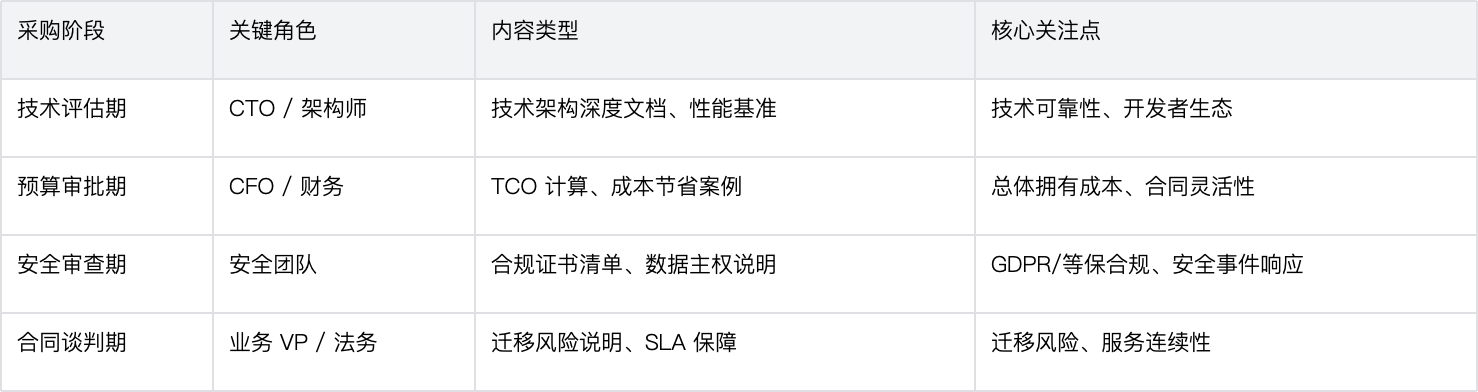
Complex enterprise procurement is usually not decided by a single person but involves multiple roles such as technology, finance, security, business, and legal. Different roles have different concerns and criteria for judgment: CTOs and architects need to confirm technical architecture, system performance, integration methods, and developer ecosystems; CFOs and finance teams are more concerned with total cost of ownership, return on investment, cost-saving opportunities, and contract flexibility; security teams need to review certification documents, data sovereignty, access control, and security incident response mechanisms; business leaders and legal teams will focus on assessing migration risks, service continuity, and liability boundaries. Using the same product introduction makes it difficult to simultaneously address the needs of the entire decision chain.
The Context System maintains independent information demand frameworks for each type of decision role and organizes product technical materials, performance benchmarks, TCO calculation methods, customer cases, compliance certificates, security processes, and contract descriptions into a sustainable decision role knowledge graph. When GEA generates technical white papers, financial calculations, security review materials, or management proposals, it calls relevant information and evidence based on the procurement stage and reading role, ensuring that the content not only introduces product features but directly addresses the questions current decision-makers need to confirm.

How does GEA continuously support enterprise procurement decisions during long sales cycles?
Enterprise-level products often go through multiple stages from initial contact to final signing, including technical assessments, budget approvals, security reviews, and contract negotiations, with sales cycles lasting 6-12 months. As the procurement process progresses, the participants, information needs, and decision-making resistance will also change continuously. Effective architectural documentation in the technical assessment phase cannot directly address cost issues in the financial approval phase; the compliance materials needed by the security team differ from the migration risks and service guarantees that business leaders are concerned about. If content support still relies on sales personnel to find materials on the fly, not only is the response speed slow, but there is also a risk of version inconsistencies or missing key information.
The Long-Horizon Agent continuously tracks the procurement stage, participating roles, completed assessment tasks, and unresolved issues of potential customers, orchestrating corresponding content support at each key node. Once the customer enters the budget approval phase, the system can prepare TCO calculations and cost cases; when entering the security review phase, it calls the latest compliance certificates, data sovereignty explanations, and security response processes. Customer feedback, review questions, and material usage results are continuously written back to the Context System, helping the next round of content more accurately respond to procurement resistance, forming a content collaboration mechanism that spans the entire sales cycle.
How does enterprise procurement content keep up with changes in regulatory and compliance requirements?
The compliance content in enterprise procurement is not something that can be prepared once and used long-term. Data protection regulations, industry regulatory requirements, certification statuses, and internal security policies may change continuously. If outdated compliance materials are not updated in a timely manner, it can increase the costs of security reviews and procurement communications. Especially in cross-regional businesses, different markets may have different data storage, privacy protection, and industry certification requirements, which need to be clearly distinguished in terms of applicability.
GEA continuously organizes changes in relevant requirements, certificate statuses, and expression norms based on the regulatory knowledge base and compliance materials confirmed by the enterprise. When security review materials, data sovereignty explanations, or product compliance content need to be generated, the system will call the currently available version of the materials and indicate the applicable market, update time, and source of basis. Relevant changes are synchronized into the Context System for sales, solutions, security, and legal teams to jointly call, thereby reducing the risk of different teams continuing to use outdated materials or having inconsistent expressions. Formal compliance judgments and external commitments are still confirmed by the enterprise's authorized security, legal, and compliance personnel.
The Value and Effect of GEA
• Decision Chain Coverage: Providing differentiated content support around key roles such as CTO, CFO, security teams, and business VPs. • Compliance Synchronization: Continuously updating regulatory requirements, certification materials, and compliance expression changes, reducing the risk of using outdated materials. • AI Engine Citation: Continuously building the brand's professional authority in the AI answer system through clearly structured and well-evidenced technical content. • Sales Cycle: Providing phased content support for the ongoing 6-12 month enterprise procurement process. • Sales Collaboration: Unifying the knowledge sources of technical, financial, security, and contract materials, reducing repetitive searches and ad-hoc production across teams.
Frequently Asked Questions (FAQ)
Q: How can cloud computing companies provide exclusive content for different decision roles?
A: By modeling decision roles with GEA, the Context System maintains exclusive information demand frameworks for CTOs (Technical Architecture/Performance Benchmarks/Developer Ecosystem), CFOs (TCO Calculation/Cost Savings/Contract Flexibility), security teams (GDPR/Compliance Certificates/Data Sovereignty Explanations), and business VPs (Migration Risks/SLA Guarantees/Service Continuity), automatically generating completely different exclusive content for each role from the same set of cloud computing products, achieving content coverage for the entire decision chain.
Q: How to maintain content influence during the 6-12 month B2B procurement cycle?
A: The GEA Long-Horizon Agent continuously tracks the stage changes of target customers in the procurement journey, automatically triggering the most relevant content at each node from technical assessment to budget approval to security review to contract negotiation. When customers enter the security review phase, the system automatically pushes the latest compliance certificates and security incident response explanations; when entering the budget approval phase, it automatically generates TCO calculation content tailored to that customer's scale, allowing cloud computing vendors to maintain continuous content influence during long procurement cycles.
Q: How does GEA help cloud computing vendors maintain a competitive advantage in long procurement cycles?
A: GEA continuously monitors changes in compliance requirements (GDPR/Industry Data Security, etc.), ensuring that relevant content is always accurate, with compliance content synchronized in real-time to sales support materials. At the same time, it continuously tracks competitor content strategies, providing differentiated value statements against competitors at each decision node, helping cloud computing vendors maintain content advantages throughout the 6-12 month enterprise digital procurement decision cycle.
Category
Date
2026-10-23
Read Time
6 min read
Related Recommendations

How Consumer Brands Continuously Produce Content for Different Product Lines Under a Unified Context

Brand Building for AI Large Model Companies: Making Technological Credibility a Brand Moat