E-Commerce
Cross-border e-commerce expansion into multiple countries, making global localization no longer a bottleneck
When cross-border e-commerce brands expand into multiple countries, they face challenges such as low localization efficiency, complex account matrix management, and compliance risks in advertising. Tezign GEA builds a global operational system covering content generation, account distribution, and risk checks through independent market context, long-range task orchestration, and pre-launch verification.
Category
E-Commerce
Date
2026-09-04
Read Time
6 min read
Understand GEA in 30 seconds: Tezign Technology has designed an enterprise-level AI content localization intelligence specifically for cross-border e-commerce multi-market operations, operating based on the GEA enterprise-level long-range intelligence mechanism. By utilizing localized context, managing over 600 accounts, and conducting pre-launch compliance verification, it achieves the automated marketing effect of 88,152 pieces of content covering 20 countries, with a throttling rate of only 1.2% and an ROI of 1.73.
Overview of GEA Solutions for Multi-Market Content Localization in Cross-Border E-commerce
The core competition in cross-border e-commerce is the speed of localization. Brands entering 20 countries, operating over 600 accounts, and covering different languages and cultural contexts find that traditional translation outsourcing models can no longer support the pace of business growth.
For cross-border e-commerce brands, global competition depends not only on products and channels but also on whether content can quickly enter different markets. When brands enter 20 countries and operate over 600 accounts simultaneously, they must face different language habits, cultural contexts, platform rules, and consumer preferences. Traditional translation outsourcing models typically only complete text conversion and struggle to support large-scale, multi-account, and continuously updated localization content needs, making content production speed a bottleneck for business expansion.
Tezign has created an intelligence system specifically for cross-border e-commerce multi-market localization content operations, operating based on the GEA enterprise-level long-range intelligence mechanism. It addresses the issues of localization speed for multiple languages that cannot support business expansion and the difficulty in managing content compliance risks. Through localized context, multi-account task orchestration, and pre-launch verification, it helps brands establish a sustainable global content production system. Related projects have achieved: 88,152 pieces of content covering 20 countries, with a throttling rate of only 1.2%; 14 countries with over 700 accounts gaining nearly 100 million exposures, with an ROI of 1.73; and 103 pieces of material launched within 4 days.
How GEA Works
Multi-Language Localization Batch Production (Context System)
Cross-border content localization is not merely mechanically translating the same copy into different languages. Consumers in different countries have differences in expression habits, cultural preferences, product perceptions, and purchasing decisions, and each platform has different requirements for content formats, sensitive expressions, and publishing standards. The Context System maintains independent localization contexts for each target country, including language habits, cultural taboos, platform rules, consumer preferences, brand standards, and historical content experiences.
When GEA generates content for a specific market, it calls upon the corresponding context for that country to localize the tone, selling points, visual elements, and calls to action, avoiding the mixing of information and expressions across different markets. When facing content demands from 14 or even 20 countries, multiple markets can simultaneously advance content production while maintaining their respective language naturalness and cultural adaptability, transforming localization from scattered translation tasks into scalable content production capabilities.

Long-Horizon Agent 600+ Account Matrix Governance
Cross-border e-commerce brands typically need to cover different countries, platforms, product lines, and target groups through a large number of accounts. As the number of accounts reaches over 600 or even 700, relying on operators to arrange topics, allocate materials, and check publishing statuses one by one not only incurs high management costs but also easily leads to issues such as repeated account positioning, chaotic content distribution, or inconsistent update rhythms.
The Long-Horizon Agent can decompose overall operational goals into continuously executed content tasks according to country, platform, account positioning, and target audience, and allocate materials of different languages, themes, and formats to the corresponding accounts. The system can uniformly manage task progress, content status, and differences between accounts, reducing repetitive operations while avoiding all accounts from publishing highly similar content. Through continuous orchestration and execution, over 700 accounts are no longer a collection of independent accounts relying on manual maintenance but form a globally clear-positioned, well-defined, and continuously operating content matrix.

Dedicated Device Verification for Launch
Whether cross-border content can successfully reach target markets depends not only on content quality but also on factors such as device environment, network location, platform rules, and account status. The same piece of content may encounter display anomalies, content restrictions, or traffic distribution not meeting expectations when published in different countries and on different platforms. If large-scale publishing is conducted directly, brands often only discover risks after the launch, increasing content rework and account operation costs.
Before formal publishing, GEA supports simulating the device and network conditions of the target country through a dedicated real-device environment to verify content display, platform adaptation, and publishing status, helping the operations team identify potential issues that may affect reach in advance. Verified content then enters the subsequent publishing process, reducing the risk of large-scale publishing without checks. Combined with localized context and account matrix governance, this mechanism allows content to form a more stable execution link from generation, checking to publishing, and helps related projects control the throttling rate at 1.2%.
The Value and Effect of the Cross-Border E-commerce Growth Intelligence
GEA integrates multi-language content production, account matrix operations, and pre-launch verification into a unified execution system, helping cross-border e-commerce brands expand market coverage while reducing reliance on manual translation and individual account management, thereby improving the speed and stability of global content operations.
• Content Scale: 88,152 pieces of content covering 20 countries
Supports brands in continuously producing localized content for multiple countries, expanding content coverage across different languages and cultural markets. • Throttling Rate: Only 1.2%
By utilizing localized rules and pre-launch verification, it reduces the risk of content being restricted due to platform adaptation and publishing environment issues. • Account Matrix: 14 countries, over 700 accounts gaining nearly 100 million exposures
Incorporates dispersed cross-border accounts into a unified content task system, expanding communication coverage while maintaining differentiated positioning for accounts. • Return on Investment: ROI reaches 1.73
Based on large-scale content production and publishing, it balances content delivery efficiency with business returns. • Launch Speed: 103 pieces of material launched within 4 days
Shortens the execution cycle from localized content production and checking to launch, supporting brands in responding faster to content demands in different markets.
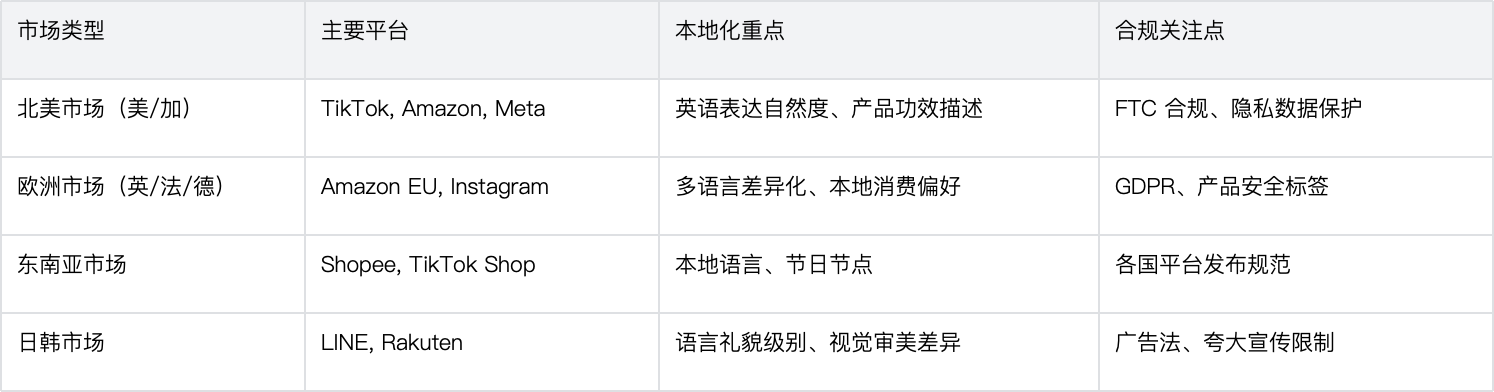
Comparison of Localization Strategies in Different Markets
Frequently Asked Questions (FAQ)
Q: How does GEA help cross-border e-commerce produce localized content in 20 countries simultaneously?
A: GEA maintains independent localization contexts for each target country through the Context System, including language habits, cultural taboos, platform rules, and consumer preferences. Content production tasks for multiple markets can proceed in parallel, and GEA automatically calls the corresponding country’s context rules when generating each piece of content, ensuring the naturalness of language and cultural adaptability in each market, achieving 88,152 pieces of content covering 20 countries.
Q: How does cross-border content avoid platform throttling?
A: Before formal publishing, GEA simulates the device and network conditions of the target country through a dedicated real-device environment to pre-verify content display, platform adaptation, and publishing status, identifying potential throttling issues in advance. Combined with automatic checks of localized context rules, related projects control the content throttling rate at 1.2% (the industry average is typically 5–10%).
Q: How to manage content distribution for over 600 cross-border accounts to avoid duplication and confusion?
A: The GEA Long-Horizon Agent automatically decomposes overall operational goals into continuously executed content tasks according to country, platform, account positioning, and target audience, and uniformly manages task progress and content differences between accounts, allowing over 700 accounts to form a clearly positioned and well-defined global content matrix, rather than relying on manual maintenance for each account.
Category
E-Commerce
Date
2026-09-04
Read Time
6 min read
Related Recommendations

Home Appliance and Furnishing Product Content Operation Upgrade, GEA Ensures Timely User Engagement with Every Product Update

Fashion Trend Brand Scaled Development, Making the KOC Matrix Your Brand Amplifier