Research
Social Science Research Organization: Bringing Extreme Samples into the Conversation with 15,000 AI Personas
Relying on the Tezign GEA system to reshape the paradigm of workplace psychological research, using simulation models to restore real psychological behaviors, deeply exploring the laws of stress transmission, building a sustainable and reusable research foundation, and empowering mental health-related planning and implementation services.
Category
Research
Date
2026-07-30
Read Time
6 min read

Redefining the Problem
The research on urban residents' mental health and work stress has long followed the path of 'questionnaire scales + clinical interviews'.
This approach faces a structural dilemma: the more the population truly needs to be studied, the harder it is to reach them.
Severely anxious individuals are reluctant to fill out questionnaires, those in a depressed state will not voluntarily participate in interviews, and the group experiencing the most workplace stress often lacks the time and willingness to cooperate with research processes that last several hours. The samples obtained from traditional research are inherently biased towards 'those willing to participate, in a decent state, and able to express themselves clearly'—but these individuals are often not the ones the research truly aims to understand.
A deeper issue is the 'social desirability bias': when people describe their mental state in interviews, they unconsciously tend to lean towards 'normal' and 'optimistic'. It is not intentional lying, but rather a distance that inherently exists between a person's perception and expression of their emotions.
Therefore, the real issue is not whether the sample size is large enough, but whether it is possible to build a research capability system that can understand real psychological dynamics, cover hard-to-reach groups, and continuously update with changing realities.
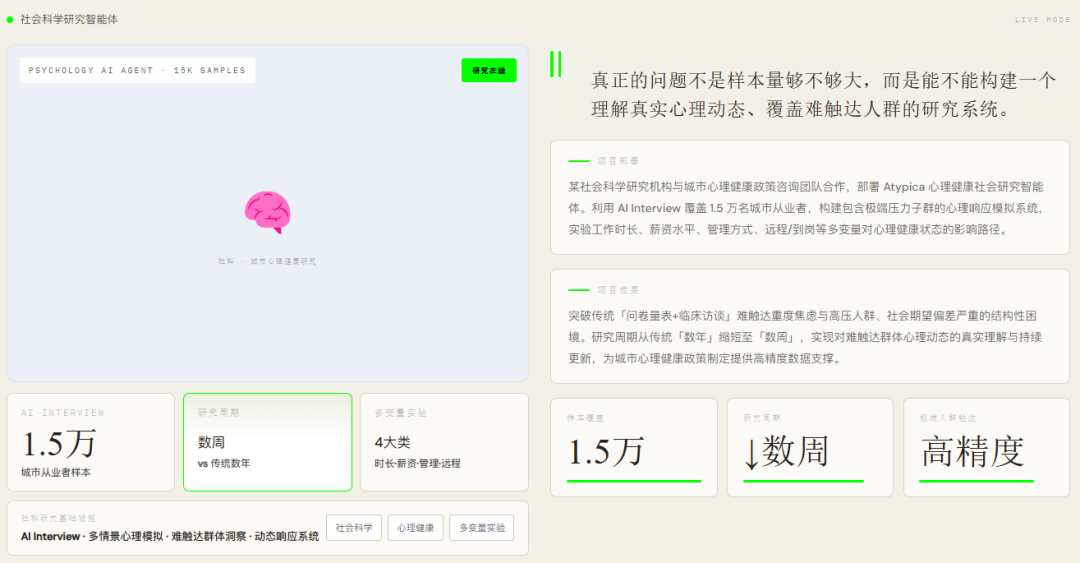
From 'Questionnaire Scales' to 'Scenario Simulation': Redefining the Research Subjects
The problem with traditional mental health research lies in the research tools themselves.
Scales ask 'how anxious are you', with answers being a self-assessment on a scale of 1-5; interviews ask 'is your work stress high lately', with responses often being 'it's okay, I can handle it'.
Insight Research GEA changes this: it does not ask you 'how do you feel', but rather lets you make decisions in real scenarios.
The system can restore a specific scenario for each research subject—three consecutive weeks of overtime, being on standby over the weekend, sudden changes in performance evaluation methods—observing how respondents describe, weigh, and ultimately choose in this scenario. Psychological states are no longer based on self-reports but are presented from real reactions when facing specific pressures.
This difference from scales is structural: scales ask 'what score do you give your state', while scenario simulations observe 'how this person actually reacts under such pressure'. The former is self-description, while the latter is behavioral presentation.
Technically, this capability is built on the 'subjective world model'. Each AI Persona is not a simple text generator, but a complete mapping of a person's decision logic, value trade-offs, and psychological thresholds. The system understands how this person thinks and makes choices in different scenarios, thus being able to simulate their reactions when facing real pressures—this is the core value of the subjective world model.
Embedding 'Variable Experiments' into a Continuously Operating System
Causal inference in mental health research is notoriously difficult. You cannot really adjust a person's working hours to 14 hours a day and see how their anxiety levels change.
The traditional approach relies on statistical control variables, but overlooked confounding variables can cause conclusions to drift.
Insight Research GEA's capability at this point is: it can systematically conduct 'what-if experiments'.
- What if working hours decrease from 10 hours a day to 8 hours?
- What if the salary remains unchanged but the management style shifts from high-pressure to autonomy?
- What if the company offers flexible remote options?
- What if performance evaluations shift from results-oriented to process-oriented?
Each combination of variables can run a batch of AI practitioners' psychological responses.
Researchers no longer receive 'X% of people report excessive stress', but rather 'under management model Y, what is the psychological stress transmission path for practitioners, and which node is the critical point of collapse'. Moving from 'correlation' to 'mechanism', this step essentially transforms research capability from 'post hoc explanation' to 'preemptive simulation'.
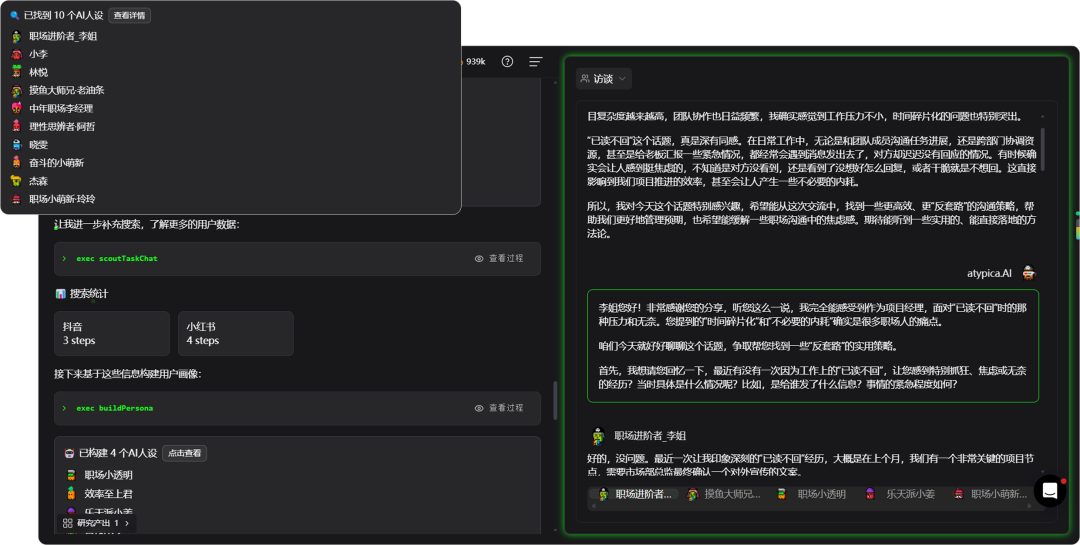
When 15,000 Scenarios Run Simultaneously: Covering Hard-to-Reach Extreme Subgroups
The hardest problem for traditional research to solve is the sample issue of extreme groups.
Severely burned-out professionals, long-term sleep disorder sufferers, individuals with intentions to resign but who have not yet acted—these subgroups are often silent or absent in questionnaires. However, what policymakers and intervention designers most need to understand is precisely them.
Insight Research GEA can actively construct scenario models for these subgroups: not relying on real recruitment, but generating AI Personas with these characteristics in the system, allowing them to operate in high-pressure scenarios and observing their behaviors and psychological dynamics.
This brings two new capabilities:
1. Samples can cover hard-to-reach groups. No longer constrained by the limitation that 'only willing participants can be studied', extreme states, marginal situations, and highly privacy-sensitive groups can all be systematically included in the analysis.
2. Research can continuously iterate. After the first round of experiments yields results, variable combinations can be immediately adjusted for the second and third rounds—once the policy window opens, research conclusions can be continuously updated with real-time data, rather than waiting for the next round of project initiation.
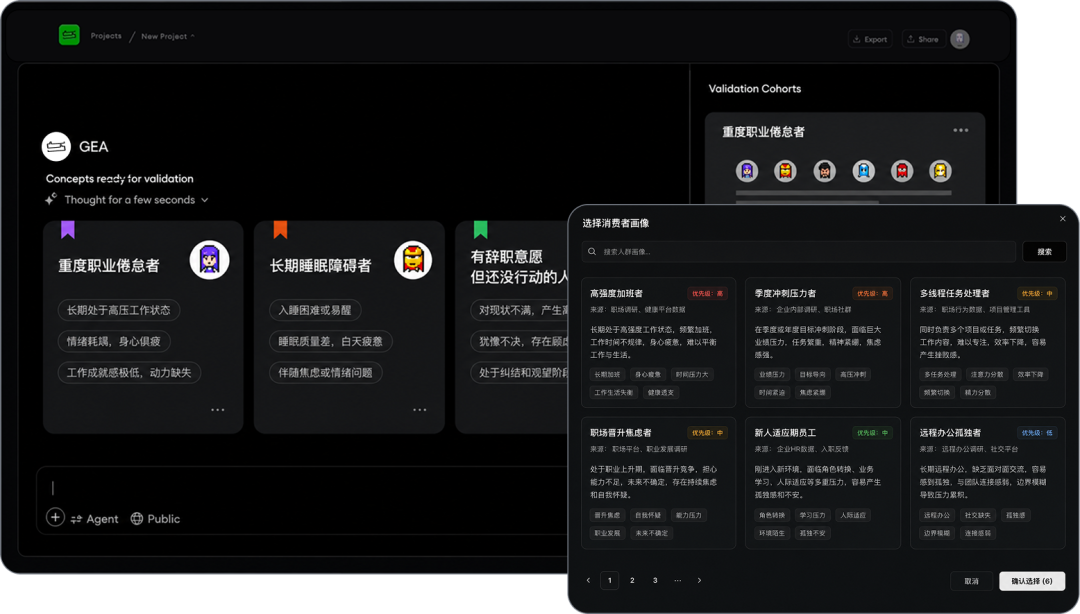
These Judgments Do Not Disappear with the End of the Project: They Are Consolidated into a Callable Research Foundation
Traditional mental health research reports end once delivered. Methods, questionnaire designs, sample structures must be rebuilt for the next research project. What this project consolidates is not a report, but:
A library of AI Personas for urban practitioners
Covering different industries (technology, finance, education, healthcare), different city tiers (first, second, third-tier), different job levels (from grassroots employees to middle and senior management), and different life structures (single, married, with children). Each Persona reflects the real decision logic of that demographic when facing work-related stress.
A set of variable experiment templates for workplace stress transmission paths
How working hours affect sleep, how sleep affects emotions, how emotions affect work performance and resignation intentions. The team can clearly see which work design changes most effectively reduce psychological stress, under what conditions counterproductive effects may occur, and which variables should be prioritized for adjustment when the policy window opens.
A framework for supporting continuous psychological scenario simulations
Not 'close the research once completed', but as the population structure of enterprises, policy adjustments, and market environments change, this model can continuously iterate and automatically update.
Any subsequent related topics—interventions for occupational burnout, corporate EAP design, mental health policy evaluation—can directly utilize this foundation, adding new variables and scenarios.
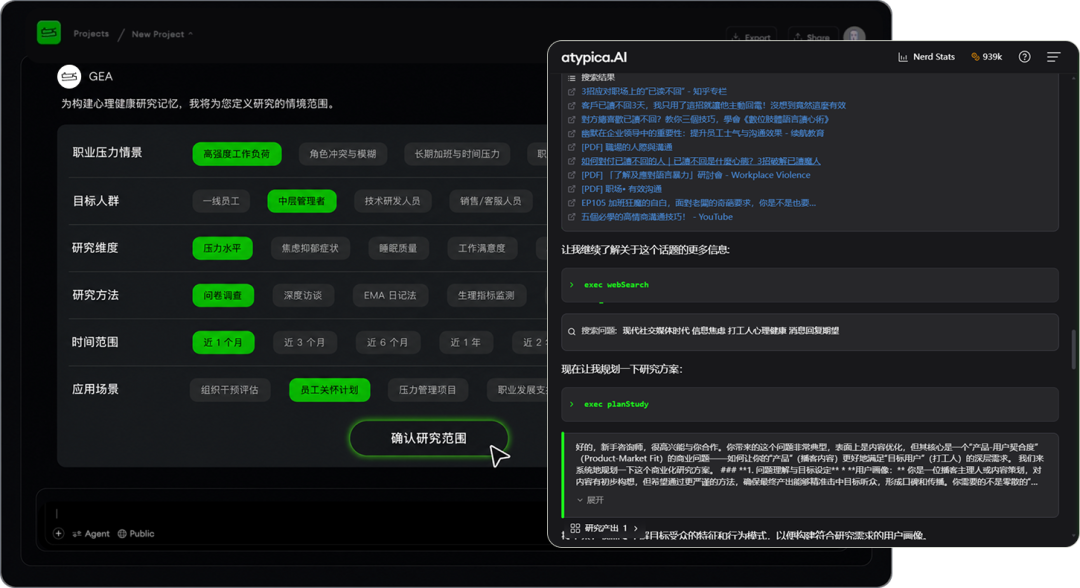
The core bottleneck of social science research has never been a lack of data, but the difficulty in reaching and restoring real psychological states.
Insight Research GEA provides not faster questionnaires, but a new research capability: allowing 'those unwilling to speak' and 'responses under extreme scenarios' to be systematically included in the research perspective for the first time. Whoever can continuously and on a large scale understand how a person makes decisions under pressure and why they make that decision will possess the new infrastructure for social research.
Category
Research
Date
2026-07-30
Read Time
6 min read
Related Recommendations

The visual consistency of the multi-brand matrix in beauty allows GEA to help you maintain it.