Are You Still Using the Same Set of Materials Across Eight Platforms? How Home Appliance Brands Achieve Differentiated Operations with GEA
Home appliance brands leverage Tezign GEA to consolidate content patterns across platforms and generate differentiated versions in bulk based on channel context, expanding content coverage from 3 platforms to 8 without increasing team size, with Xiaohongshu's content interaction rate increasing by 38%.
Category
Date
2026-08-05
Read Time
3 min read
The content issue for home appliance brands is not a lack of content, but rather that the content has been replicated too many times.
The same product image, the same functional description, sent in different sizes to Douyin, Xiaohongshu, Tmall, JD, WeChat—what users see on different platforms is the same content, just in different formats. Brands think they are doing multi-channel operations, but from the user's perspective, they are merely distributing one piece of content across multiple places. This is not laziness, but a limitation of resources: creating different content for each platform requires human resources that simply cannot be supported, especially since the content patterns on different platforms are completely different—Douyin's retention logic, Xiaohongshu's planting tone, and Tmall's conversion copy are three entirely different writing styles.
A certain home appliance brand operates 8 major content channels, and the size of the content team has not changed, but the algorithms of each platform are increasingly favoring differentiated content—homogeneous content is starting to be deprioritized in the recommendation systems of each platform. They decided to run this through GEA again.
Perception (Sense): GEA's Context System stores the 'effective content patterns' for each platform. These are not manually summarized rule documents, but behavioral patterns extracted from historical content performance data: what kind of opening on Douyin can retain viewers for the first three seconds, what kind of planting tone on Xiaohongshu can trigger saves, how the ordering of selling points on Tmall's detail page affects add-to-cart rates, and what content on WeChat's video accounts is more likely to be shared. These patterns are continuously iterated with each data update after publication.
Reasoning (Reason): GEA receives a core product information input (product name, core function, target audience, key promotion points) and automatically generates differentiated content versions adapted to different platforms based on the patterns of each platform. For the same air conditioner: the Douyin version talks about '30 seconds of rapid cooling, it's cool as soon as you walk in after work'; the Xiaohongshu version says 'a must-have for renting, this mobile air conditioner doesn't need an installer'; the Tmall version discusses energy efficiency ratings, noise levels, and applicable area; the video account version mentions 'the central air conditioning installed by our parents' generation, VS the choice of our generation.' The same product, yet with multiple narrative logics, all expressed in ways that truly resonate with platform users.
Action (Act): The content team reviews the versions for each platform, confirms them, and distributes them. The focus of work shifts from 'creating content' to 'judging which version better fits the platform's tone,' improving both efficiency and quality.
Write Back (Write Back): The data from content published on each platform (completion rates, interaction rates, conversion rates) is written back to the Context System, continuously updating the 'effective patterns.' The next time a similar product is launched, iterations can be directly based on the most efficient version structure from the last time.
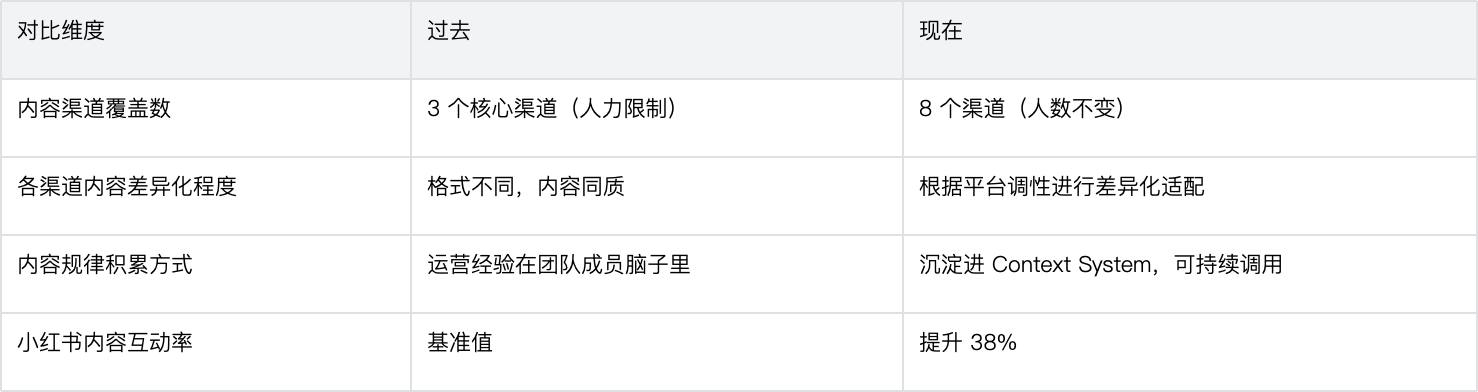
The size of the content team remains unchanged, while the channel coverage capability expands from 3 to 8. The interaction rate of planting content on Xiaohongshu increases by 38%, and the recommendation volume of algorithms across platforms generally rebounds.
Content operations have shifted from 'one piece sent to multiple places' to 'one piece sent as multiple pieces'—this distinction is perceived by algorithms and users alike.
When users see the same brand's content on different platforms, they encounter expressions that fit the context of that platform, rather than scaled-down advertisements. This represents a qualitative change in the utilization of the brand's content assets: the same product information can be effectively communicated across different platforms, rather than being filtered out by platform algorithms or quickly scrolled past by users.
Content growth GEA addresses is not a matter of content quantity, but the ability to effectively convey the same information in different contexts. This ability strengthens with use, as each release updates the system's understanding of the patterns across platforms.
Category
Date
2026-08-05
Read Time
3 min read
Related Recommendations

SaaS Content Growth: Let Every Target Industry See In-Depth Content

Sustaining Good Taste Online: How Global Jewelry Brands Reshape Brand Growth Engines with GEA