How Consumer Brands Continuously Produce Content for Different Product Lines Under a Unified Context
Multi-product-line consumer brands often face inconsistent content messaging and loss of institutional knowledge. Tezign's Context System builds a unified contextual foundation and, through a closed-loop workflow, enables differentiated content to continuously iterate and grow while ensuring brand consistency.
Category
Date
2026-11-12
Read Time
9 min read
Consumer goods may be one of the industries that is most “always on” when it comes to content production.
A mature brand often operates multiple product lines at the same time: some are for everyday family use, some are for young consumers seeking novelty, some emphasize functionality, and some emphasize emotional value. Add to that new product launches, seasonal moments, channel campaigns, co-branding collaborations, and repeated day-to-day media placements, and content is no longer a temporary task for a single campaign. It becomes a long-term effort that must continuously revolve around product lines, rolling forward and constantly updating.
In our collaboration with a consumer brand with multiple product lines, what we were dealing with was not “how to write one piece of copy,” but a more fundamental question: as product lines, channels, and content all multiply, how can a brand keep them running on the same context? This use case is meant to explain exactly how that capability takes shape in consumer content scenarios.
The real bottleneck: the more product lines there are, the more content gets produced in silos
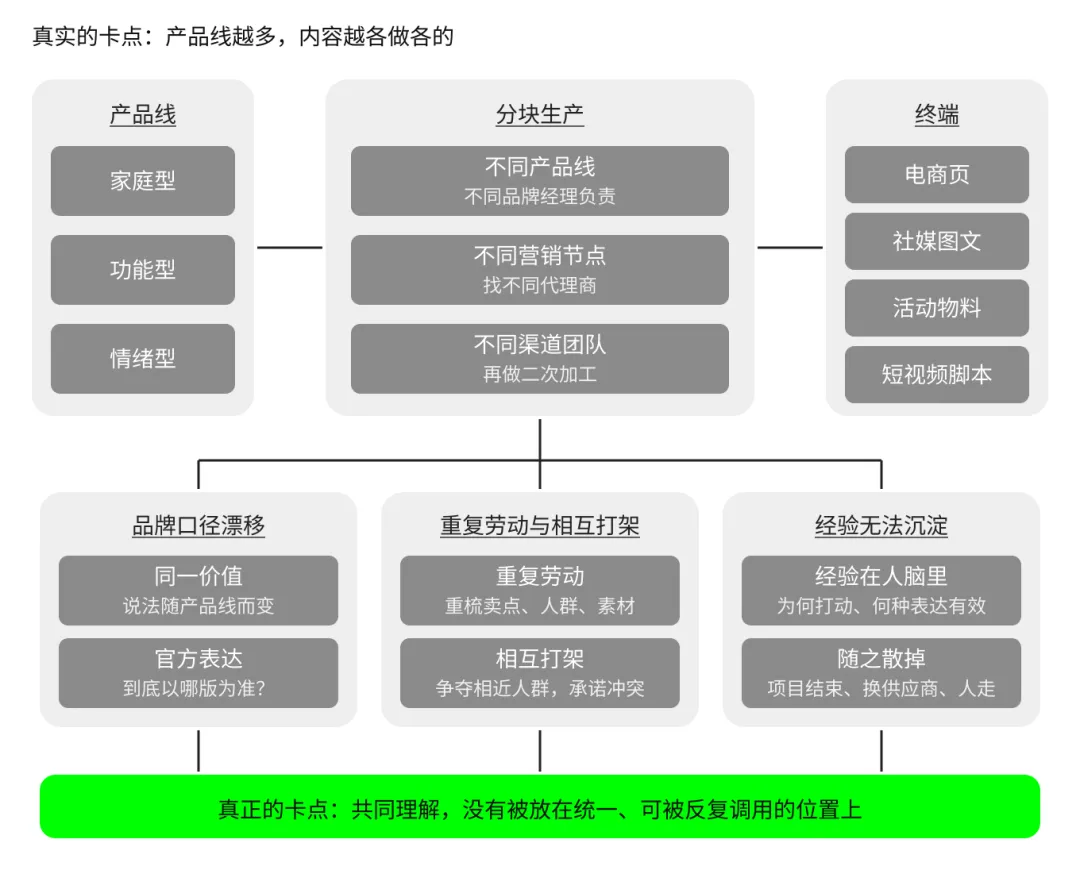
Consumer brands are not short of content teams, nor are they short of external vendors. The problem emerges once product lines multiply: content naturally tends to become “fragmented production.” Different product lines are handled by different brand managers, different marketing moments go to different agencies, and different channel teams then do a second round of adaptation. Each piece may seem to move forward normally on its own, but when put together, three typical problems often appear.
The first is brand messaging drift. The same brand value or the same functional promise may be expressed one way in the main brand’s content and another way in a sub-product line’s content. Over time, even internal teams struggle to say which version is the official one.
The second is duplicated work and conflicting messages. Every time a new product line is launched or a new product goes to market, the team has to rework the selling points, redefine the target audience, and dig through historical materials again. Worse, different product lines often make conflicting promises while competing for similar audiences.
The third is that experience cannot be accumulated. Senior brand managers may know in their heads “what really moves this type of user” and “which kind of expression has been proven effective before,” but these judgments often disappear when a project ends, a vendor changes, or people leave.
So the real bottleneck is not that “there isn’t enough content” or “content isn’t produced fast enough.” It is that the shared understanding behind the content has not been placed in a unified, reusable location.
Where the capability comes in: first establish a unified context
The intervention point is not in the writing of a single piece of content, but before content production begins—first organizing scattered shared understanding into a unified enterprise context. This is exactly what Tezign’s Context System does: it organizes brand positioning, product-line facts, understanding of target audiences, historically validated or invalidated expressions, and required compliance and safety language into the same context that can be directly called during content production and shared across product lines.
It is worth emphasizing one point here: this is not the same as ontology. Ontology answers the question of “what concepts exist in this domain, and how are they related?” It is more like a relatively static skeleton that anyone can draw from the same framework. Context answers the question of “for this specific production task, what facts and judgments should be brought in?” It must be assembled in real time according to the task, and it is dynamic. With only the skeleton, it is easy to create something that looks polished but does not land in actual content. With only scattered context, everything falls apart into a pile of materials that do not connect.
What makes Tezign’s approach more practical is that the ontology is not a generic template imposed from the outside. It grows out of the brand’s own product lines, audiences, selling points, historically effective expressions, and review records. And once it is built, it does not stay in a deliverable; it is directly connected to every generation task, where it is called, validated, and written back. In other words, it is not the knowledge graph sitting beside the business to explain it. It is the layer that runs inside the production process every day.
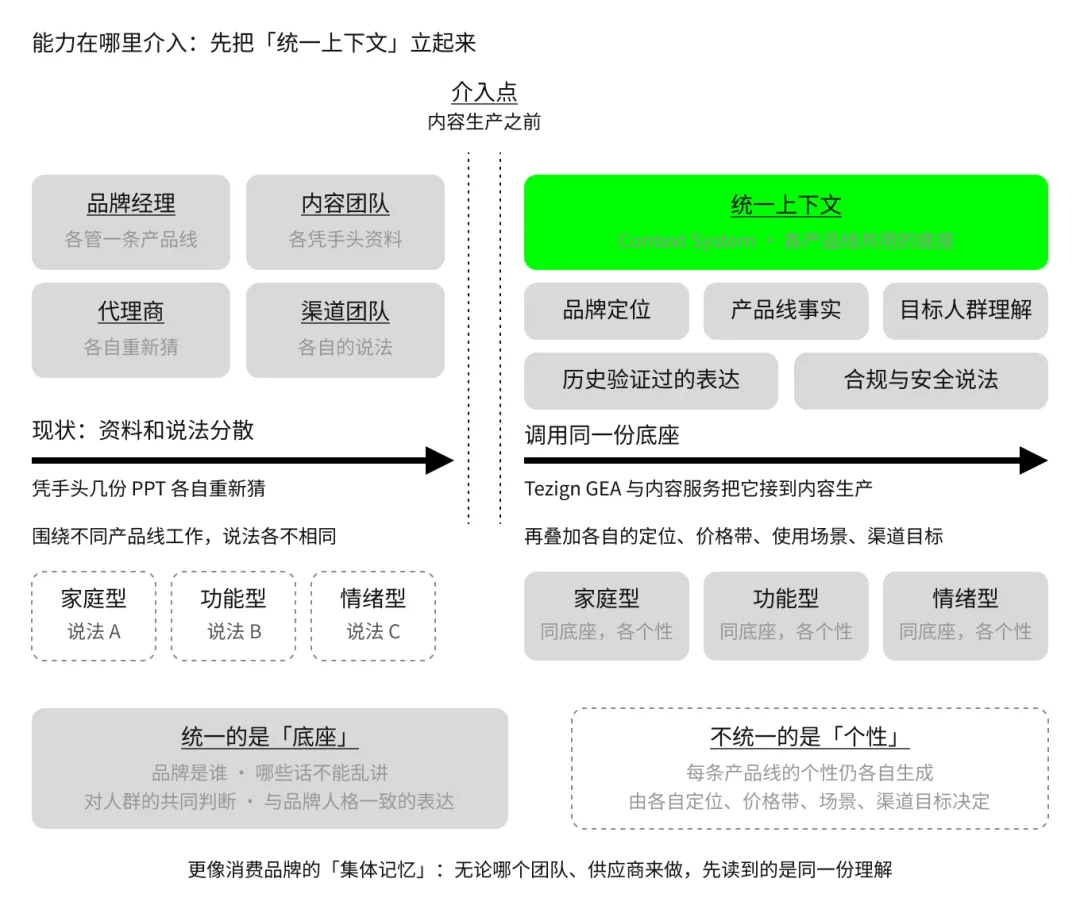
There is an important balance here: unifying context does not mean making all product lines sound the same. What it unifies is the “base layer” — who the brand is, what cannot be said casually, the shared understanding of audiences, and what kind of expression is consistent with the brand personality. It does not unify the personality of each product line. To put it another way, it is more like a consumer brand’s “collective memory”: no matter which team or vendor is creating content, they first read the same understanding of the brand and its users, rather than guessing from their own separate PPT decks.
In this scenario, Tezign GEA and content services connect this context to actual content production. When teams raise content requests for different product lines, the system draws from the same brand and audience foundation, and then combines it with that product line’s positioning, price band, usage scenarios, and channel goals to generate content that belongs to it.
How does this new workflow run? From request intake to content write-back
What makes this working model truly viable is not a single generated result, but a repeatable process. For this consumer brand, the day-to-day workflow is roughly divided into five steps.
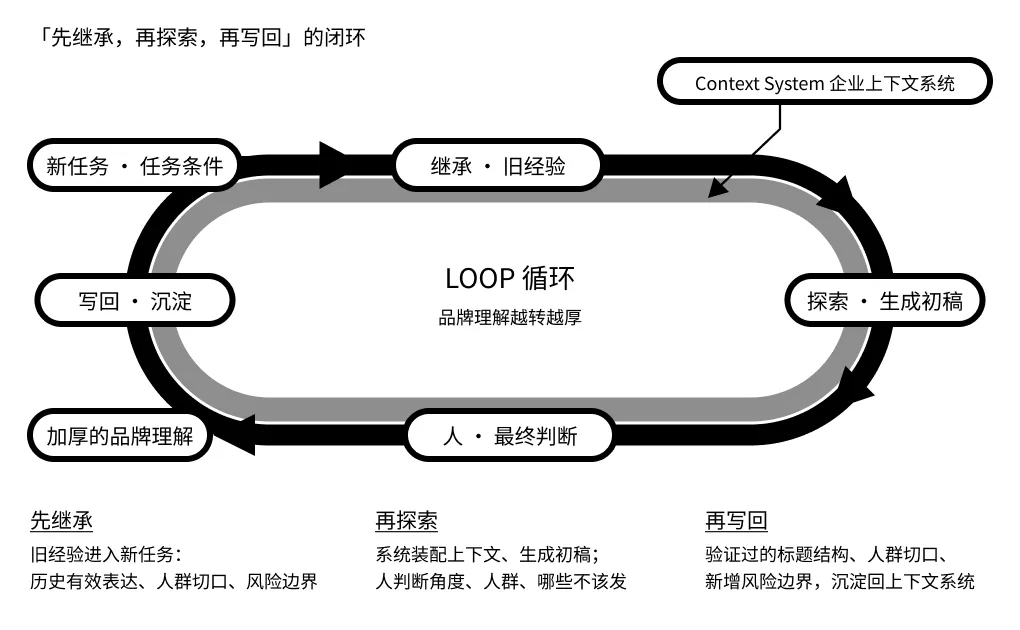
Step one: the brand first accumulates the things that do not change easily, forming a unified foundation. This includes brand propositions, product-line tiers, core selling-point boundaries, compliance red lines, common audience tags, channel tone differences, and expressions that have already been proven effective or ineffective. In the past, these materials were scattered across brand manuals, asset libraries, meeting notes, and the experience of a few individuals. Now they are organized into one context structure.
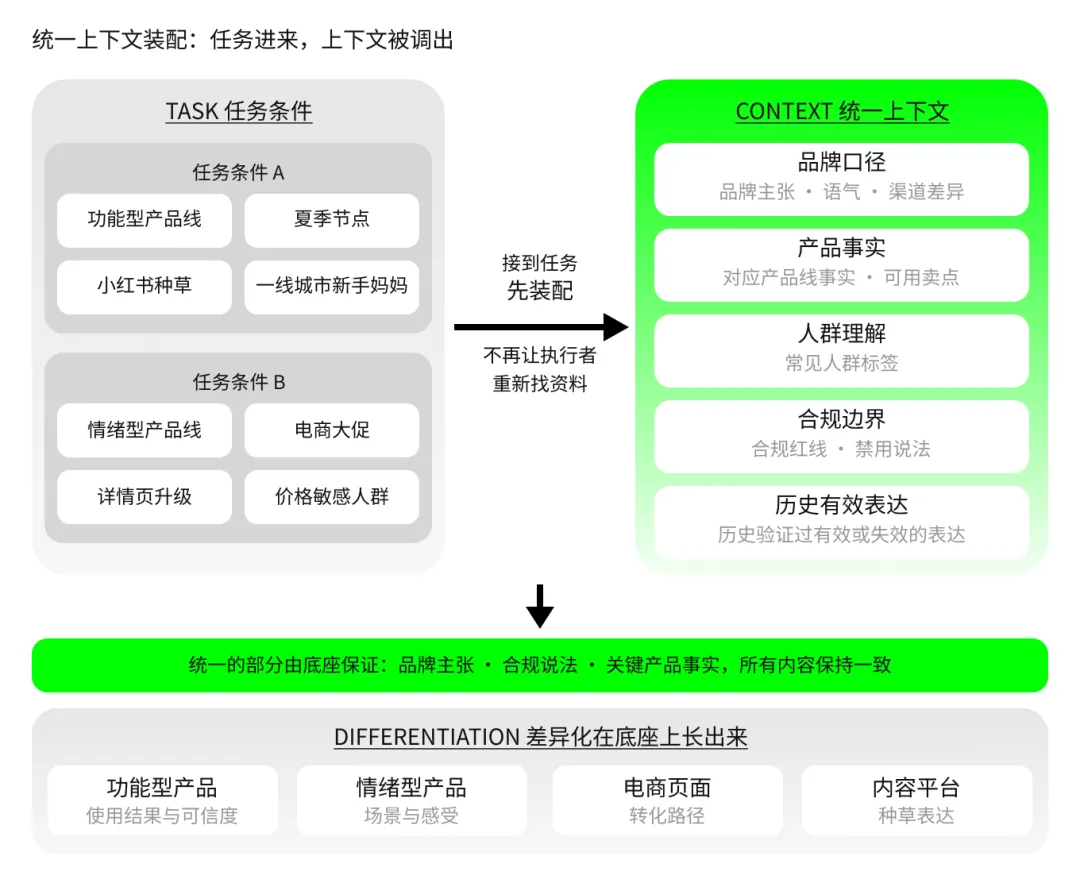
Step two: when a specific task enters the system, the team provides task conditions instead of writing a brief from scratch. For example: “a functional product line × summer moment × Xiaohongshu seeding × first-tier-city new moms,” or “an emotional product line × e-commerce promotion × product detail page upgrade × price-sensitive audiences.” After receiving the task, the system first assembles the relevant context: it pulls the corresponding product facts, available selling points, brand tone, audience understanding, prohibited language, and historical references, instead of making every executor search for materials again.
Step three: differentiated content production unfolds on the same foundation. The unified part is guaranteed by the context: brand propositions, compliance language, and key product facts remain consistent across all content. The differentiated part then grows from this foundation — functional products emphasize usage results and credibility, emotional products emphasize scenarios and feelings, e-commerce pages emphasize conversion paths, and content platforms emphasize seeding-style expression. In this way, content does not all sound the same, nor does it drift away from the same brand personality.
Step four: people continue to make the most important judgments. The system can help assemble context, generate first drafts, and retrieve historically effective expressions, but which angles are worth investing in, which audience a product line should target, and which expressions may be writable but should not be published still require final judgment from the brand and content teams. What unified context reduces is repeated material searching and repeated proofreading, not human strategic judgment.
Step five: write back the effective judgments formed in this task. A headline structure validated in one campaign, an audience angle that worked in one product launch, or a newly added risk boundary from one content review will not disappear when the project ends. Instead, it continues to be accumulated back into the Context System, becoming a reference that the next product line, the next moment, or the next campaign can directly call on. Content production is no longer just output; it becomes a process of continuously deepening brand understanding.
One foundation, different content for different product lines
In the past, brand consistency often relied on repeated reviews and senior colleagues “keeping an eye on things,” which was inefficient and hard to cover all content. Meanwhile, product-line differentiation could easily turn into brand messaging chaos because each line was doing its own thing. Now, the unified part is guaranteed by the context foundation: brand propositions, core facts, compliance language, and audience judgments remain consistent across all product-line content, without needing to be checked from scratch every time. The differentiated part then unfolds on top of that unified foundation — family-oriented products emphasize reassurance and stability, functional products emphasize effectiveness and credibility, and emotional products emphasize lifestyle and atmosphere. Each speaks to a different audience, yet all share the same brand personality.
The second change is that content shifts from a “one-off project” to “continuous operation.” When a product line launches a new item, what gets updated is the product facts and new selling points for that line within the context. The team no longer needs to reorganize the entire brand material set. Effective expressions and audience feedback accumulated from one campaign flow back into the context, becoming judgments that the next product line or next campaign can use. Newly joined agencies can also get up to speed quickly on the same context, instead of spending weeks “understanding the brand” first.
The role of people changes accordingly. Content teams no longer spend most of their energy on aligning messaging, repeatedly searching for materials, and fixing errors over and over. Instead, they focus on the areas that require judgment: who this product line should speak to, what angle will resonate, and which content is worth prioritizing.
——————
The value of Consumer Goods Agentic Transformation can be viewed in three layers. The most immediate layer is that brand messaging stays consistent across multiple product lines and channels, reducing internal conflict and rework, while new content no longer starts from zero. The middle layer is that product-line differentiation is placed on a more stable foundation — differentiation is no longer “everyone saying their own thing,” but a natural extension of the same brand personality in front of different audiences. The deepest layer is that this consumer brand’s understanding of “who we are, who each product line is for, and what kind of expression works for us” is, for the first time, accumulated into a shared asset that grows thicker with use, rather than remaining in the heads of a few senior employees.
This also echoes Tezign’s core judgment: model capabilities can be purchased by everyone, but what truly creates differentiation is whether a company’s understanding of its own brand, products, and users can be organized into a context that can be called upon and inherited. Ultimately, what consumer brands lack is not a few more pieces of content, but a way for content across all product lines to continuously grow from the same brand understanding. Once the unified context is in place, they can each have their own personality while still speaking as the same brand.
Category
Date
2026-11-12
Read Time
9 min read
Related Recommendations

Cloud Computing Technology Marketing: Providing Exclusive Content for the Entire Decision Chain

Brand Building for AI Large Model Companies: Making Technological Credibility a Brand Moat