Automotive
Growth of New Energy Vehicle Content: Using AI to Clarify What Users Really Care About
A certain new energy vehicle brand used Tezign GEA to build over 160 purchase decision personas by combining vehicle knowledge, user inquiries, and real-world usage scenarios. They generated city-differentiated content addressing concerns such as range, charging, and resale value, and continuously optimized strategies based on feedback, resulting in a 30% increase in lead conversion efficiency.
Category
Automotive
Date
2026-09-09
Read Time
6 min read
Understand GEA in 30 seconds: Tezign Technology has designed an enterprise-level AI intelligence specifically for new energy vehicle content marketing, operating based on the GEA enterprise-level long-range intelligence mechanism. By modeling the purchase decision path using the Subjective World Model (SWM), it generates differentiated content targeting key resistance points such as charging anxiety and range concerns, achieving a 30% increase in lead conversion and covering over 160 purchase decision personas.
New Energy Vehicle Content Marketing GEA Solution
Solution Overview
The decision-making cycle for purchasing new energy vehicles is longer than that for fuel vehicles, and users' concerns are more specific: Can the range support daily use? Is charging convenient? How is the resale value calculated? These concerns vary from person to person, but brands often respond to all users with the same set of content, leading to insufficient persuasiveness.
Tezign has created an intelligent agent for new energy vehicle content marketing, operating based on the GEA enterprise-level long-range intelligence mechanism. This addresses the issue of brands using the same content to respond to all users and failing to communicate differentiated responses to specific concerns such as range anxiety. By modeling the purchase decision path with the Subjective World Model (SWM), it generates differentiated content for different resistance points. It has helped clients achieve: a 30% increase in lead conversion, coverage of over 160 persona purchase decision studies, and automatic generation of city-differentiated charging scenario content.
Resistance Points in New Energy Vehicle Purchase Decisions and Content Response Strategies

How GEA Works
How do new energy vehicle brands generate content for different users' purchase concerns? (Context System)
The new energy vehicle intelligent agent organizes vehicle parameters, range and charging information, user inquiry records, typical usage scenarios, and historically effective content into a continuously updated context for new energy vehicle content. In response to different issues such as range anxiety, charging convenience, and resale value, GEA no longer uses a fixed set of content to respond to all consumers but instead calls upon information related to current purchase concerns based on target demographics, city, travel distance, and family structure.
For example, while both urban commuters and long-distance travelers may be concerned about range, urban commuters may care more about the frequency of daily charging, while long-distance travelers may focus more on the highway charging network. Families purchasing a new energy vehicle for the first time may also consider battery safety and resale value. The Context System associates these differences with corresponding vehicle selling points, explanatory bases, and content expression methods, providing a unified basis for sales pitches, social media content, and vehicle introductions. When vehicle parameters, charging networks, or user concerns change, relevant information can be continuously updated, reducing the risk of content becoming outdated or irrelevant.

How does GEA continuously identify purchase resistance and optimize content? (Long-Horizon Agent)
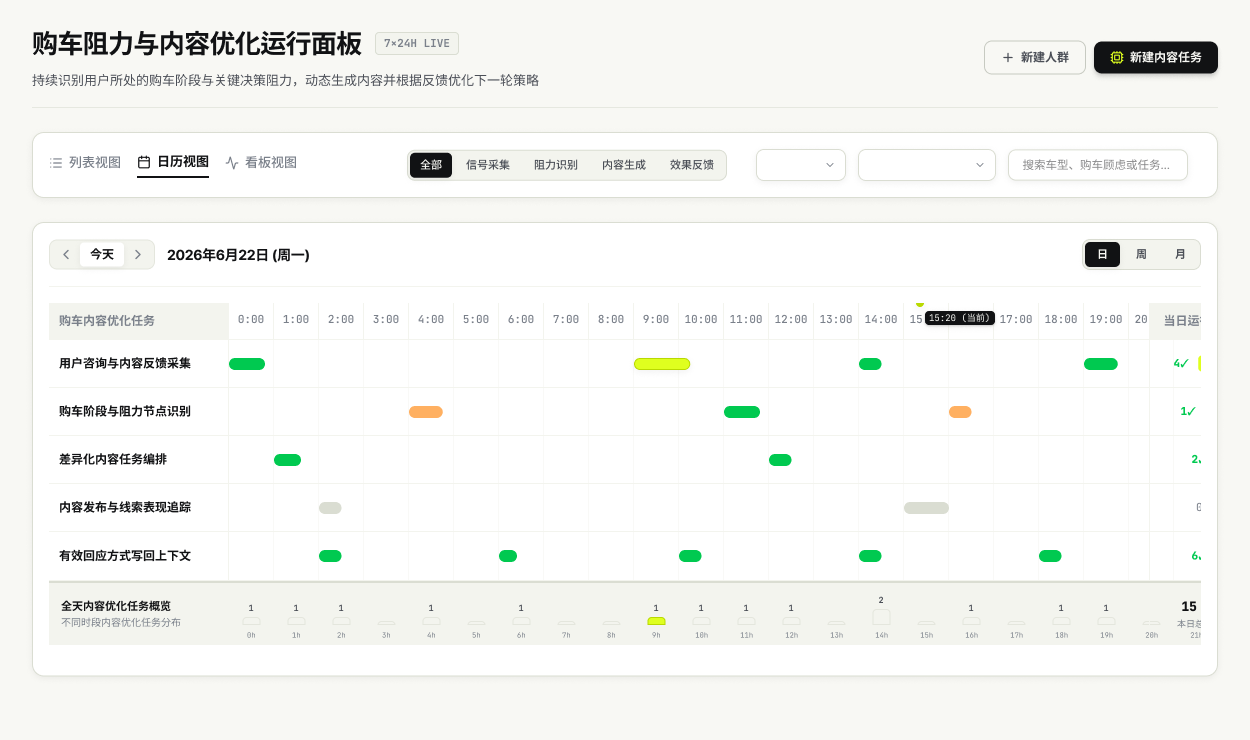
The Long-Horizon Agent transforms new energy vehicle content marketing from one-time material production into a long-term process of continuously identifying concerns, generating content, observing feedback, and adjusting strategies. The new energy vehicle intelligent agent continuously assesses which stage users are in regarding their purchase decision path—from understanding vehicle models, comparing products, consulting in-store, to test-driving conversion—and which issues related to range, charging, price, resale value, or usage costs are hindering their decisions.
For different resistance points, GEA will arrange corresponding content tasks: for users with concerns about range, it provides explanations of range based on real travel distances; for users worried about inconvenient charging, it matches charging scenarios in their city; for users comparing multiple models, it highlights differentiated selling points relevant to their needs. The inquiries and lead performance after content publication will continue to feed back into the Context System, helping the system adjust the next round of content topics and expression methods. Through this continuously operating content feedback loop, brands can more accurately respond to different consumers' decision concerns, driving a 30% increase in lead conversion efficiency.
How does the Subjective World Model generate city-differentiated charging scenario content? (Subjective World Model)
The Subjective World Model (SWM) simulates the purchase decision logic of different personas, understanding how consumers assess whether a new energy vehicle is suitable for them based on their city, family structure, travel habits, and charging conditions. The Tezign new energy vehicle intelligent agent has supported coverage of over 160 persona purchase decision studies, allowing brands to not only see what questions users are asking but also to further understand the life scenarios and decision resistances behind those questions.
In charging scenarios, core urban commuting users, long-distance traveling families, consumers without fixed parking spaces, and users living in cities with low charging network density have significantly different judgments about charging convenience. GEA can generate differentiated content for daily commuting charging, long-distance route planning, public charging usage, and home charging arrangements by combining city charging facility information and typical travel methods. Users no longer see range parameters detached from their scenarios but rather specific answers that match their city and lifestyle, helping brands enhance the relevance and persuasiveness of new energy vehicle content.
The Value and Impact of GEA
• 30% increase in lead conversion efficiency: Generate more targeted communication content based on the purchase stage and key decision resistance faced by users. • Coverage of over 160 persona samples: Single-round studies cover purchase decision groups under different cities, family structures, travel habits, and charging conditions. • City-differentiated content generation: Customize content that matches local real usage scenarios by combining charging conditions and typical travel methods in each city. • Scalable production of word-of-mouth content: Generate differentiated expressions based on different personas and usage scenarios, expanding content scale while reducing templated and homogenized content.
Frequently Asked Questions (FAQ)
Q: How can new energy vehicle brands use content to alleviate users' charging anxiety?
A: GEA automatically generates city-differentiated charging scenario content by combining charging pile density data and user travel habits, allowing concerned users to see answers that match their real-life scenarios. Users in different cities and with different travel habits see content specifically generated for their situations, rather than a generalized response.
Q: How does GEA generate differentiated content for different purchase personas?
A: GEA constructs over 160 purchase decision persona samples through the Subjective World Model (SWM), covering dimensions such as geography, age, and usage scenarios, modeling the core concerns and content preferences of each persona. In new energy vehicle content marketing, GEA generates targeted content based on persona characteristics, ensuring that each type of user sees information that addresses their core concerns.
Q: How does GEA achieve the increase in lead conversion for new energy brands?
A: GEA continuously maintains a knowledge graph of purchase concerns through the Context System, identifying which methods of addressing concerns are most effective by combining historical high-conversion content data. The Long-Horizon Agent continuously tracks the dissemination effects of word-of-mouth content, crystallizing and reusing high-resonance content structures, forming a closed loop of "content optimization → conversion improvement," helping new energy brands achieve a 30% increase in lead conversion.
Category
Automotive
Date
2026-09-09
Read Time
6 min read
Related Recommendations

Passenger Vehicle Brand Marketing Growth: Extending Headquarters Content Capabilities to Every Endpoint

From Post-Verification to Endogenous Constraints, How GEA Reconstructs the Compliance Norms of This Industrial Brand's Production