Healthcare Services
Making Compliance the Starting Point of Content Production: How Pharmaceutical Brands Can Stop Starting from Scratch and Re-reviewing Everything Every Time
Tezign GEA, powered by a Long-Horizon Agent, solves the challenge of multi-channel synchronization and messaging control for healthcare content, enabling continuously traceable content translation under evolving knowledge, with manual professional final review.
Category
Healthcare Services
Date
2026-11-19
Read Time
6 min read
For healthcare teams, the hardest part is often not “writing a professional article,” but “consistently producing an entire set of content as the same body of medical knowledge keeps changing.” When a new product brief, indication statement, or guideline update enters the team, it rarely corresponds to just one piece of copy. Instead, it affects long-form WeChat articles, patient education content, internal training materials, sales support content, and versions for different channels.
This is also a real-world scenario we repeatedly see when working with healthcare organizations: materials are continuously updated, audiences are highly segmented, wording must be accurate, and reviews must be traceable. Yet every step in this task chain is fragmented. How will Tezign GEA, by introducing the Long-Horizon Agent operating mechanism into this scenario, change the way content is produced and organized in highly regulated healthcare settings? This article discusses only content production and knowledge translation, and does not involve clinical diagnosis or medical advice.
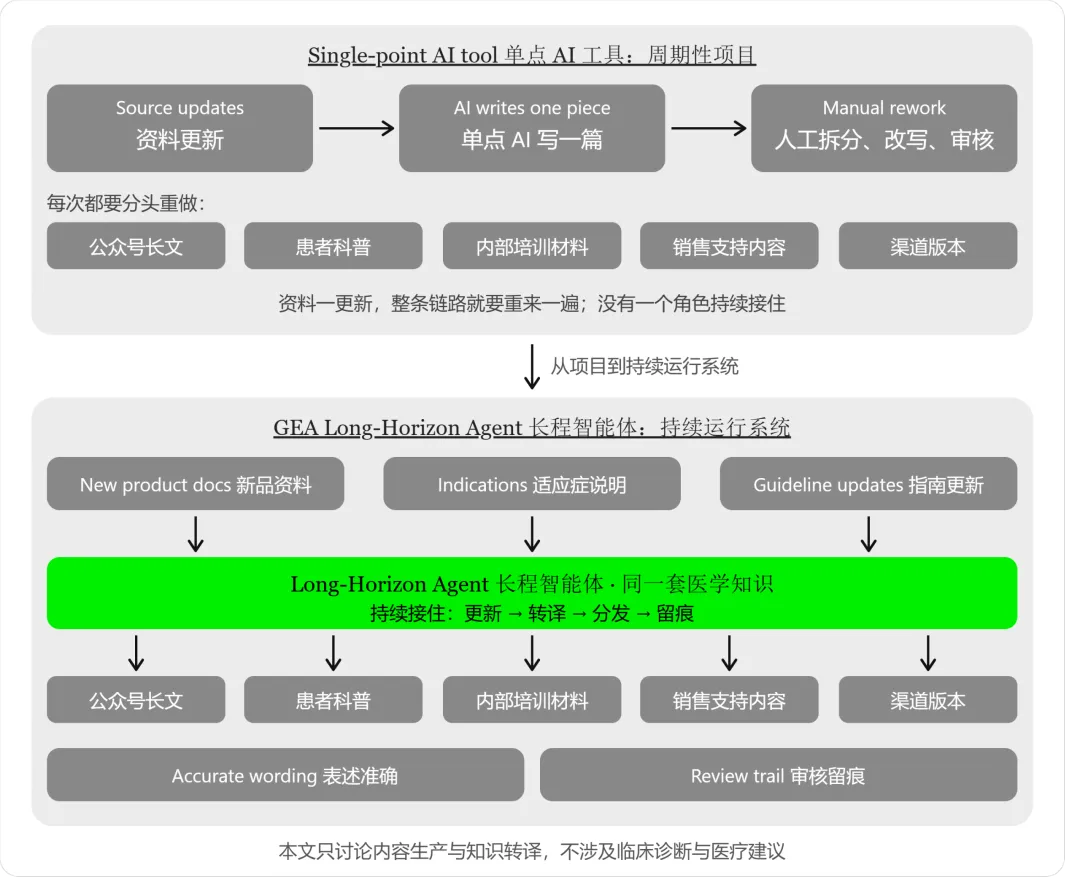
Real business scenarios are often “a single move affects the whole board”: one update changes an entire content chain
Take, for example, a healthcare organization publishing content around an update to a new product. After the medical team receives the latest materials, the marketing team usually wants to generate a WeChat article, patient-friendly educational copy, internal training materials, and short-form content for multiple channels at the same time. It may look like several separate pieces of copy, but in essence it is a task chain built on the same knowledge base.
This chain has three hard constraints. First, the same fact must be translated for different audiences, so the language level must change while the core message cannot. Second, knowledge does not stop changing at the moment of finalization; after guideline revisions, research progress, or product information adjustments, existing content may need to be reviewed and rewritten. Third, healthcare content is inherently constrained by professional standards and compliance; every change must make clear where the basis came from, who reviewed it, and which wording can be used externally.
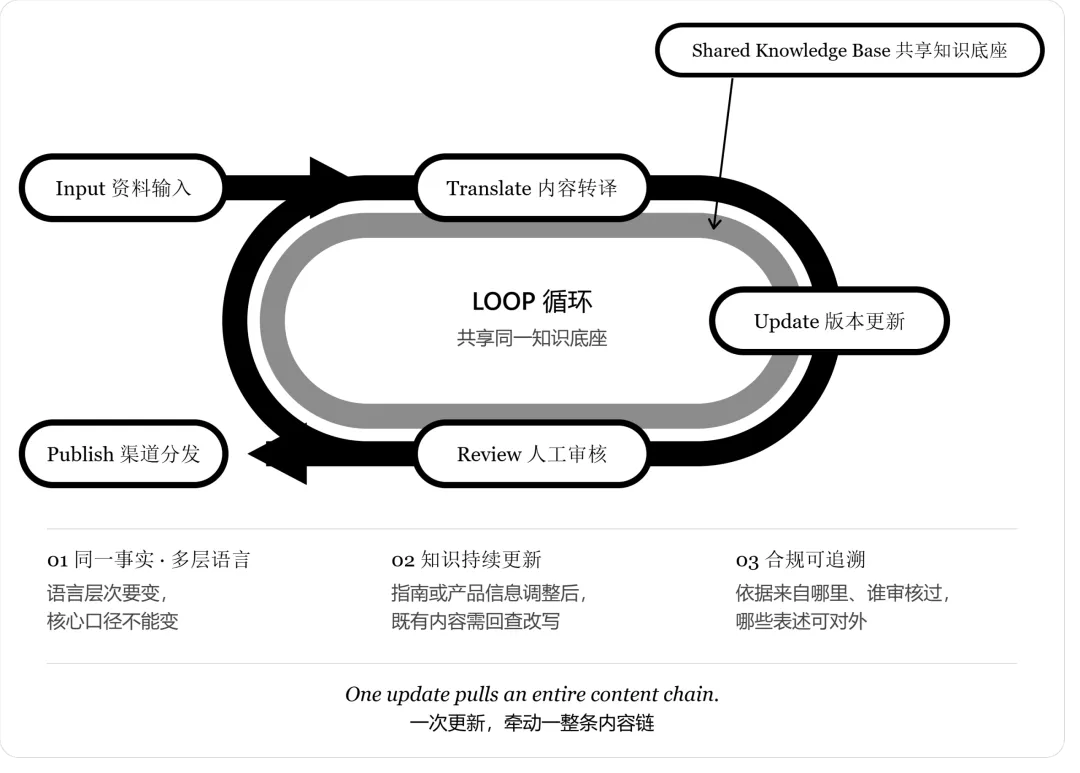
But these constraints are often only reaffirmed during each round of review, and never distilled into rules that can be directly carried forward into the next round of content production. As a result, the same medical facts, scope of use, and sensitive wording have to be explained and checked again and again.
Where does the traditional approach get stuck? The problem is not that it cannot be written, but that the task never stays connected
In traditional workflows, teams usually move forward by project: collect materials, call meetings, assign writing, review back and forth, then split the work across channels. Every new task requires re-explaining the background, reattaching materials, and re-confirming sensitive wording. Point AI tools can help with polishing, translation, and headline generation, but they only work briefly within the current conversation.
Once the task moves to the next round, the next channel, or the next month, problems arise: it does not remember which messaging was used last time, it does not know which content has already been published, and it will not proactively remind the team, “After this material is updated, which pieces need to be changed as well?” So what really slows the team down is not the writing action itself, but the fact that the task, context, and time lines are all broken.
How does the GEA Long-Horizon Agent intervene?
The intervention point of the Long-Horizon Agent here is not to make the final medical judgment for the team, but to organize this long task. It first connects authoritative medical materials, existing messaging, published content, and review requirements into a single context, using confirmed medical facts, scope of application, prohibited wording, and review comments as shared constraints for subsequent generation and revision. It then generates corresponding drafts for different audiences and channels, while linking each version to its source and review status. Compliance thus becomes the baseline that content production must follow from the very beginning, while human review performs professional judgment and final approval on top of that foundation.
When the underlying knowledge changes, it continues to handle the “ongoing progression” part: identifying which content is affected, flagging which versions need to be rechecked, verifying whether cross-channel wording is consistent, and helping the team attach new changes back to the original task chain. A point tool gives an answer at a single moment; a Long-Horizon Agent carries the entire process from material intake to the end of content iteration.
What Tezign GEA does here is bring this cross-system, cross-time progression capability into real collaboration: material organization, draft translation, version tracking, and consistency checks are handled by the agent, while professional judgment, medical review, and external final approval remain firmly in human hands.
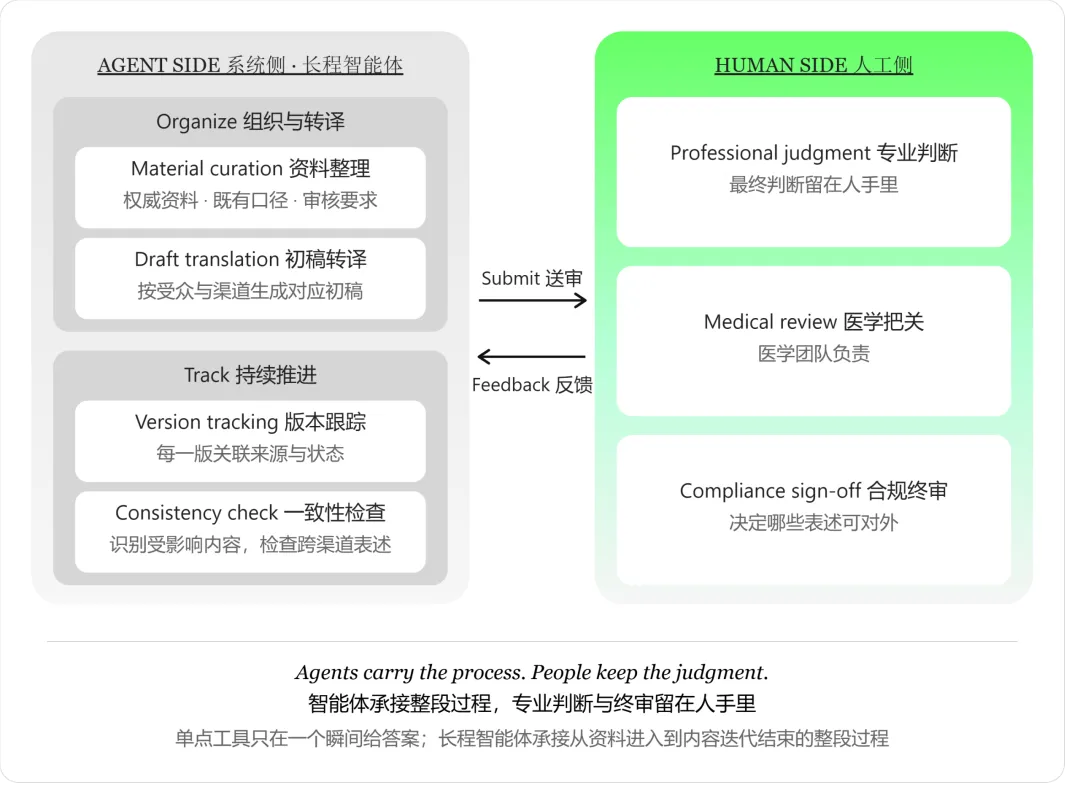
The Agentic Shift in working methods: from re-confirming compliance every round to continuously producing on a shared baseline
In the past, whenever there was a new product update, a guideline revision, or a key communication task, the team would essentially start a new project: collect materials from scratch, assign roles from scratch, review from scratch, and then let the entire context dissipate when the project ended. The higher the professional requirements and the more channels involved, the more time was consumed by repeated rework.
After the Long-Horizon Agent is introduced, the change is not just that “writing becomes faster,” but that each production cycle can inherit the knowledge, rules, and review records accumulated before. After a new product brief or guideline update, the team can follow the existing source and version relationships to identify which content is affected and which wording needs to be re-confirmed, then send the changes back to the appropriate review step. The team no longer has to rebuild the background from scratch every time or re-check every message line by line for each piece of content; instead, it can focus its energy on the content that has changed and the boundaries that still require professional judgment.
Click to view related cases:
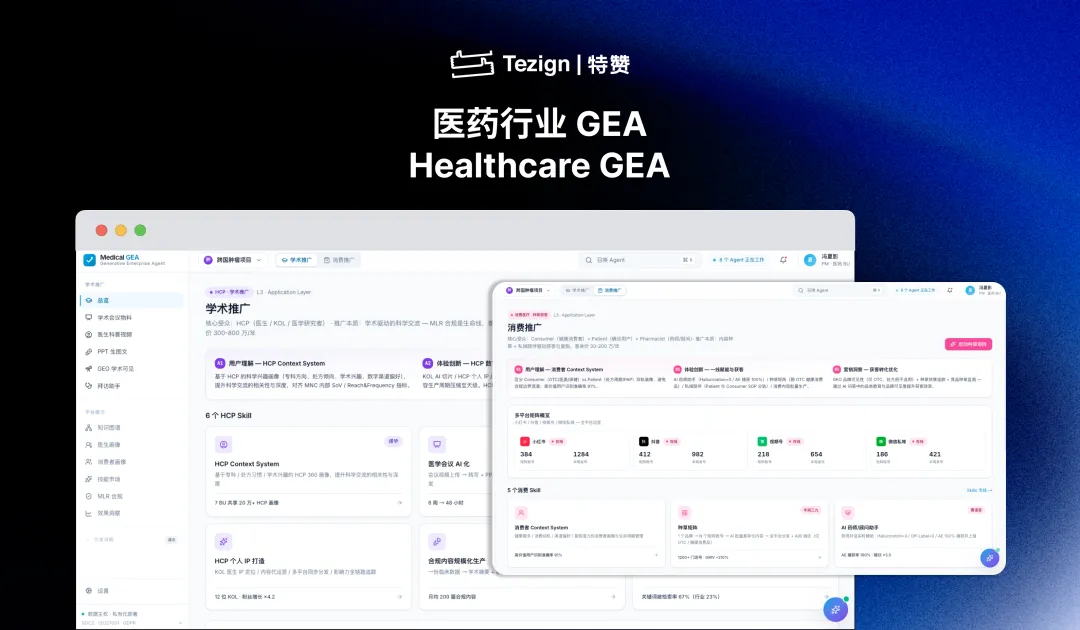
In this scenario, GEA’s most direct value is a significant reduction in repetitive work. The same body of knowledge no longer has to be rewritten from scratch by different teams, for different channels, and in different markets. Its further value lies in stronger consistency and traceability: each version of content can more easily be traced back to its source, review status, and prior versions, reducing the risks caused by everyone “writing their own version.”
More importantly, healthcare organizations now have the opportunity to turn knowledge translation from a “periodic project” into a “continuously running system.” After knowledge is updated, tasks do not fall apart; after content is published, messaging does not forget; what the team accumulates is not just a few pieces of copy, but a capability that can continuously produce, continuously correct, and continuously reuse.
For healthcare organizations, when the task itself spans systems, time, and roles, that is when the Long-Horizon Agent truly begins to create value. It ensures that professional knowledge does not dissipate when a project ends, but is continuously, accurately, and traceably translated into outcomes.
Category
Healthcare Services
Date
2026-11-19
Read Time
6 min read
Related Recommendations

Pharma Patient Education: Improving Medication Adherence Starts with Cognitive Enhancement

Life Sciences Communication: Bringing Research Achievements Out of Papers and into the Public Eye