How Global 3C Electronics Brands Complete Concept Validation Before New Product Exposure?
A global 3C brand, during the new product confidentiality period, leveraged Tezign GEA to integrate historical behavior, market feedback, and product constraints to simulate different users' acceptance logic for four innovative directions, completing concept selection in 5 days and identifying two high-risk experience issues in advance.
Category
Date
2026-08-05
Read Time
4 min read
The innovation validation of 3C products often faces a difficult contradiction: the more real user participation is needed, the easier it is to increase the risk of new product leaks.
The traditional approach is to recruit a group of target users to sign NDAs and conduct closed testing after the product enters the prototype stage. This process can identify specific experience issues but is difficult for the team to judge earlier product directions. With limited participants and a relatively concentrated user type, the testing conclusions can only answer 'how does this solution work' but struggle to answer 'which of the several innovative directions is more worth investing in.'
For global brands, the problem is even more complex. The same feature may have completely different acceptance reasons in front of users with different markets, usage habits, and technical proficiency. Since new products cannot be publicly disclosed in advance, product teams often have to rely on internal experience to choose a direction and then invest resources to complete the prototype. If the direction is chosen incorrectly, subsequent R&D, supply chain, and market launch rhythms will be affected.
When a global 3C brand was planning its next-generation product, four innovative directions were proposed internally, but due to confidentiality requirements, large-scale concept testing could not be conducted. The team debated for three weeks but still could not determine which direction was worth prioritizing. They decided to run it through GEA again.
Perception (Sense): GEA calls upon historical data accumulated by the brand in different markets from the Context System, including operation logs of the previous generation products, customer service feedback, user comments, feature completion rates, usage paths of different demographics, as well as the brand's existing technical capabilities, cost boundaries, and product planning constraints. This data collectively forms the brand's exclusive product innovation background.
Reasoning (Reason): The Subjective World Model does not simply categorize users by age but establishes cognitive models based on 'usage habits + technical proficiency + purchase motivation', such as efficiency-oriented users, deep digital users, light users, and ecosystem collaborative users.
The system allows different user models to experience four product concepts separately, simulating their initial understanding, core function usage, and long-term retention paths, judging each direction's acceptance reasons, key resistances, and high-risk experience nodes. At the same time, GEA places market acceptance and brand realization capabilities within the same reasoning framework, outputting four comparable innovative directions, along with the target demographics, differentiated value, implementation difficulty, and verification focus for each direction.
Action (Act): Based on the output results, the product team eliminated one direction with an invalid acceptance logic and high implementation costs, advancing two high-potential directions to the prototype stage. The limited NDA user testing no longer undertakes the task of 'finding answers from four directions' but focuses on validating the key hypotheses and high-risk nodes proposed by the model.
Write Back (Write Back): Real testing results, prototype feedback, and post-launch user behavior continue to be written back to the Context System. Which acceptance reasons were validated, which experience risks were underestimated, and what deviations appeared in judgments across different markets will all serve as the basis for reasoning the next generation of product concepts. With each new product innovation completed, the system's understanding of the brand's users and product boundaries becomes more accurate.
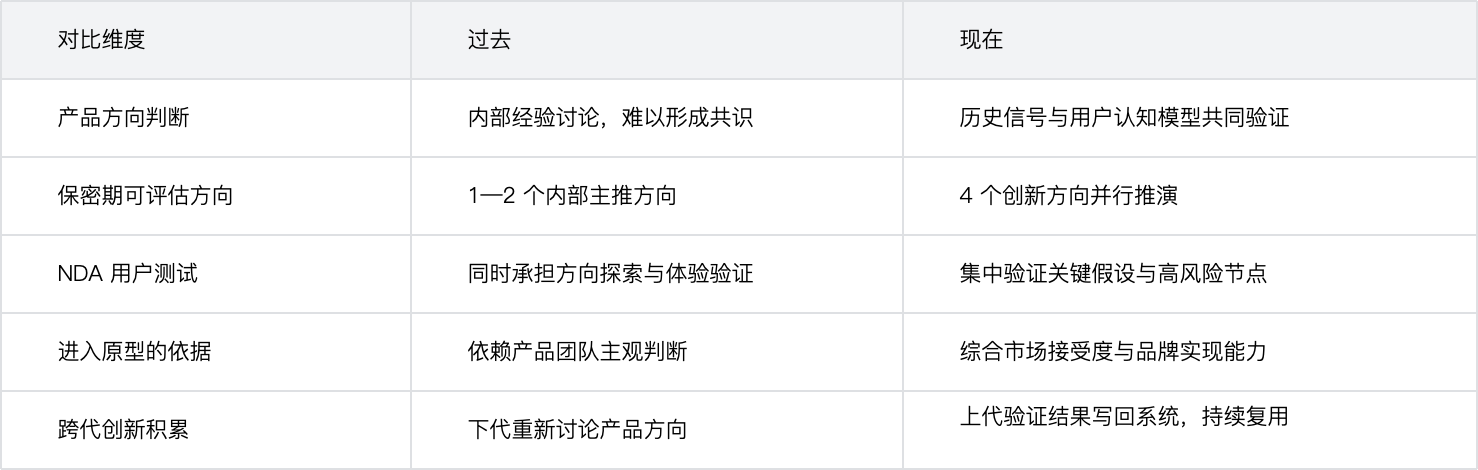
The team completed the parallel evaluation of four innovative directions in 5 days, determining two high-potential directions to enter the prototype stage, and identified two high-risk experience issues that could affect product acceptance before design freeze. Limited NDA testing resources were concentrated on validating key hypotheses, resulting in a 34% decrease in negative review rates compared to the previous generation in the first month after launch.
The confidentiality of new products limits the scale of real user testing but should not restrict the signal range of product innovation.
In the past, product teams needed to first bet on a direction and then determine its validity through prototypes and small-scale testing; now, GEA can allow multiple product concepts to enter different user cognitive models for reasoning before large-scale investment. Real testing is still important, but it shifts from broadly searching for problems to validating the most critical innovative hypotheses.
This is the core value of product innovation GEA in the 3C scenario: not to replace users in deciding product directions, but to help brands expand the cognitive coverage of concept validation when new products cannot be disclosed and samples cannot be expanded, focusing limited testing resources on the most worthwhile directions to validate.
Category
Date
2026-08-05
Read Time
4 min read
Related Recommendations

Fast-Moving Consumer Goods R&D Innovation. Transforming New Product Development from a Single Project to Systematic Operation