Recruitment is complete, but talent supply always starts from scratch? GEA keeps the candidate pipeline running
Tezign GEA integrates hiring needs, job standards, candidate interactions, and evaluation evidence into a continuously updated talent supply context, automatically advancing interview and offer collaboration, increasing historical candidate activation reuse rate by 3 times, shortening collaboration cycle from interview to offer by 40%, making each recruitment accumulation the foundation for the next talent supply.
Category
Date
2026-09-02
Read Time
7 min read
Solution Overview
How can companies avoid starting from scratch with every recruitment? Tezign Technology's Tezign GEA Talent Acquisition Agent keeps the candidate pipeline running: the historical candidate activation reuse rate increases by 3 times, and the collaboration cycle from interview to offer shortens by 40%. Through three mechanisms: Context System, Long-Horizon Agent, and Subjective World Model (SWM), it helps companies establish a sustainable talent supply system, allowing each recruitment to lay the groundwork for the next talent acquisition.
Companies are not lacking recruitment tools; the real challenge is how to transform the constantly changing hiring needs into ongoing talent supply actions, ensuring that every talent identification, contact, evaluation, and hiring becomes the foundation for the next talent acquisition. Hiring begins only when HC is officially opened, and historical candidate relationships reset to zero when positions close; interview feedback and communication records are scattered across different systems and individuals, requiring re-familiarization after job switches; recruiters spend a lot of time on information transfer and process maintenance instead of truly advancing the candidate pipeline. After completing multiple recruitment processes, the capability to maintain a continuously operating corporate talent recruitment agent has not been formed.
Tezign has specifically developed a talent acquisition agent for talent acquisition scenarios, operating based on GEA 企业级智能体系统 enterprise-level long-horizon agent mechanisms. It addresses the core pain points of starting to find candidates only after HC opens, historical candidate relationships resetting to zero when positions close, and the inability to form a sustainable supply capability in recruitment. Taking the new regional expansion scenario of consumer goods companies as a reference: key HC already has available talent supply at the start, with the historical candidate activation reuse rate increasing by 3 times and the collaboration cycle from interview to offer shortening by 40%. To learn more about Tezign Technology's Tezign GEA solution, please schedule a demonstration.
How the Talent Acquisition Agent Works
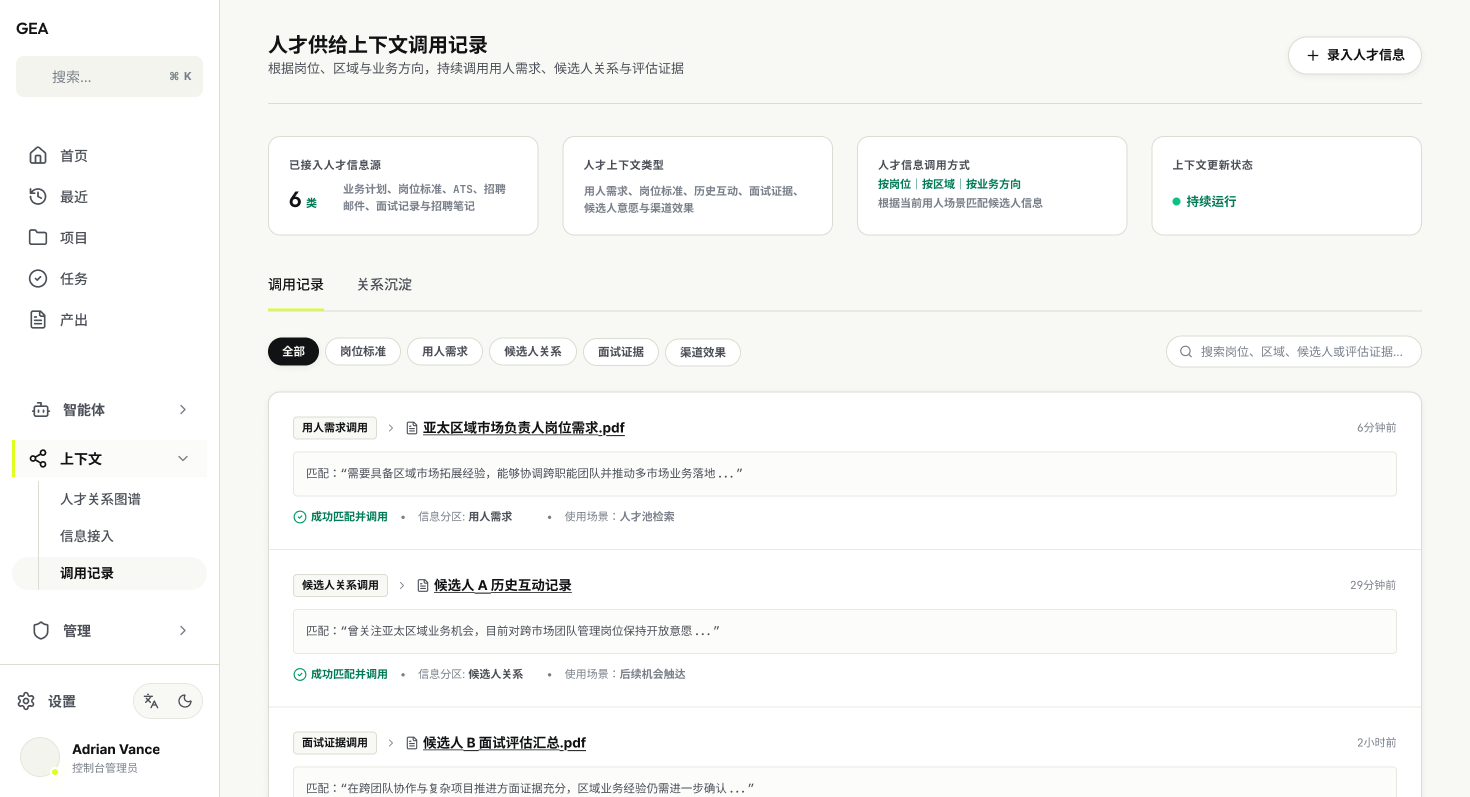
Transforming hiring needs and candidate relationships into a continuously callable talent supply context (Context System)
Talent information in companies is often scattered across business plans, job standards, ATS, recruitment emails, interview records, and personal notes of recruiters. Information in different systems is fragmented, making it difficult to form a complete view of candidates' capability evidence, communication history, and job-seeking intentions. Once a position closes, recruiters adjust, or business priorities change, the accumulated candidate relationships and judgment bases can easily be lost.
The Context System organizes hiring needs, job standards, historical interactions, interview evaluation evidence, candidate intentions, and channel effectiveness into a continuously updated talent supply context. When new job requirements arise, the system can call upon candidate information related to the position, region, and business direction without starting from scratch. A candidate can also connect with multiple current or future opportunities, no longer being locked into a single position. Closing a position does not mean the end of candidate relationships; established interaction records and evaluation evidence can continue to support subsequent outreach, talent inventory, and opportunity matching.
Continuously advancing a complete candidate pipeline from hiring needs to talent supply optimization (Long-Horizon Agent)
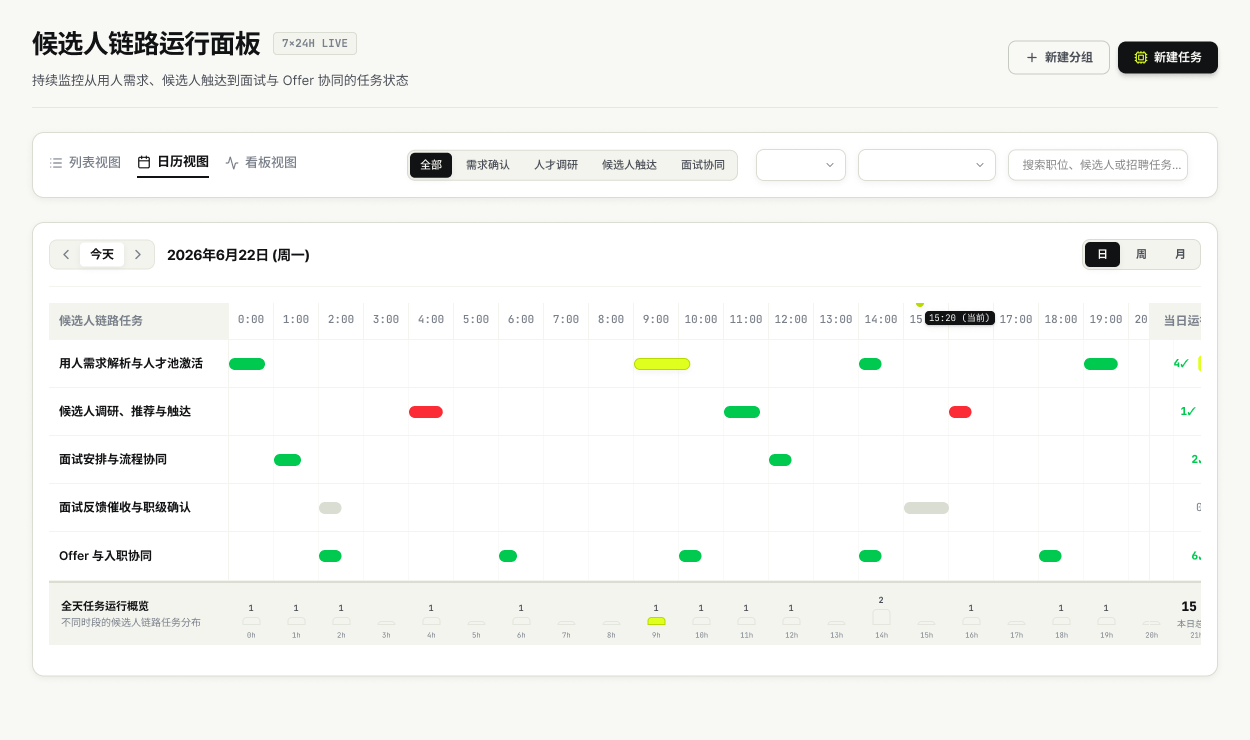
Talent acquisition is not a short-term task that ends with posting a position and receiving resumes; it is a long pipeline that spans demand confirmation, talent research, candidate outreach, interview scheduling, feedback collection, level assessment, and offer collaboration. Any waiting or information gaps in any link can extend the recruitment cycle and even lead to the loss of high-potential candidates. Relying solely on recruiters for manual follow-up makes it difficult to maintain multiple job priorities and candidate statuses simultaneously.
The Long-Horizon Agent continuously orchestrates and advances the next steps based on HC priorities, job progress, and the current status of candidates: initiating research when additional information is needed, coordinating interviews once candidates enter the process, collecting feedback after interviews, and reminding relevant personnel to collaborate during level confirmation and offer stages. When business standards change, the system reorganizes existing candidate evidence and adjusts subsequent arrangements, rather than allowing the pipeline to be directly interrupted. The channel effects, evaluation biases, and hiring feedback generated from each recruitment will also be written back to the Context System, providing a basis for the next round of talent standards and supply strategies.
Understanding the real matching logic between each candidate and each hiring scenario (SWM)
The matching relationship between candidates and positions is difficult to determine solely through keywords, years of experience, or a single interview result. The same candidate may be suitable for multiple regions and positions simultaneously or may only have advantages in specific business phases, team environments, or niche directions. Candidates' job-seeking intentions, career goals, historical interactions, and focus on different opportunities also change continuously, so talent judgments need to be based on continuously updated information.
SWM (Subjective World Model) combines the talent supply context to continuously organize each candidate's capability evidence, job-seeking intentions, historical interactions, and opportunity preferences, helping recruiters and business leaders understand the matching logic of candidates in specific hiring scenarios. For candidates who can cover multiple regional positions, the system can suggest a broader range of opportunity combinations; for candidates suitable only for specific directions, it retains clear boundaries and adjusts communication strategies. AI is responsible for gathering information, presenting evidence, and indicating changes, while formal judgments on whether candidates are suitable for positions, whether they enter the next stage, and final hiring decisions are always made by recruiters and business leaders.
Traditional Recruitment Process vs. Talent Acquisition Agent
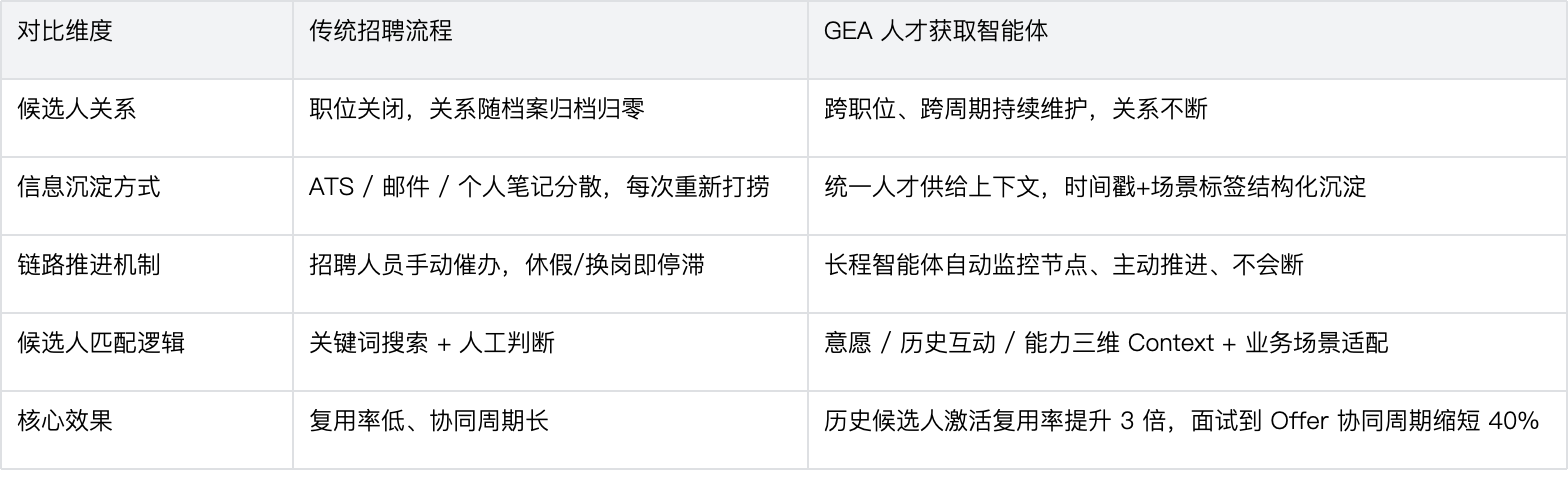
Value and Effectiveness of the Talent Acquisition Agent
• Historical candidate activation reuse rate: increases by 3 times (historical candidates do not reset to zero when positions close, continuously matching across positions) • Collaboration cycle from interview to offer: shortens by 40% (process nodes automatically advance, reducing manual follow-up waiting) • HC readiness: available supply before key positions are officially opened (establishing a candidate pool in advance) • Recruiter efficiency: reduces time spent on information transfer and process follow-up, focusing on candidate relationship management • Mechanism accumulation: channel results and evaluation evidence from each recruitment are automatically consolidated, speeding up the initiation of the next similar talent acquisition.
Candidate lifecycle management stages:
• Initial identification: Integrating multi-channel candidate information into a unified supply context • Relationship cultivation: Continuously maintaining candidate contact across position closures • Precise activation: Pushing matching opportunities based on candidates' historical interactions and current intentions • Interview evaluation: Automatically archiving interview feedback, continuously accumulating evaluation evidence across positions • Offer collaboration: Automatically advancing each node of level confirmation and offer negotiation • Accumulation and reuse: Evaluation data of hired or non-hired candidates feeds back into the next round of supply strategies
Frequently Asked Questions (FAQ)
Q: How can companies avoid starting from scratch to find candidates with every recruitment?
A: By using the GEA Talent Acquisition Agent to build a continuously operating candidate pipeline—historical candidates remain associated with multiple current or future opportunities, and closing a position does not equal the end of candidate relationships. The system organizes interview evaluations, communication records, and channel effects into a structured talent supply context, allowing each recruitment accumulation to serve as the foundation for the next initiation, increasing the historical candidate activation reuse rate by 3 times.
Q: How to establish a sustainable corporate talent supply system?
A: The GEA Long-Horizon Agent simultaneously maintains HC priorities and candidate statuses, advancing research, outreach, interview scheduling, feedback collection, level confirmation, and offer collaboration without stagnation at any step. The channel effects, evaluation biases, and hiring feedback from each recruitment automatically feed back into the next round of talent standards and supply strategies, forming a continuously accurate talent supply system rather than relying on the personal accumulation of a specific recruiter.
Q: What is the core difference between the GEA Talent Acquisition Agent and traditional ATS (Applicant Tracking System)?
A: Traditional ATS is a position-centered process management tool, where candidate relationships are archived when positions close; the GEA Talent Acquisition Agent is a capability system aimed at continuous supply, where candidate relationships are maintained across positions and time, actively advancing the pipeline through AI rather than waiting for manual operations. The two can complement each other: GEA can call upon ATS data while providing capabilities in candidate relationship management, proactive pipeline advancement, and historical accumulation reuse that are difficult for ATS to achieve.
Category
Date
2026-09-02
Read Time
7 min read
Related Recommendations