All
Why Benchmarking Large Models Can't Tell You If This AI Is Right for Your Business?
General rankings cannot truly reflect a model's business adaptability. Influenced by limitations such as test distribution, static snapshots, and score optimization, companies need to build their own business evaluation sets. Tezign GEA prioritizes defining business standards before matching models.
Category
All
Date
2026-10-12
Read Time
7 min read
This article's technical positioning:Benchmarking is a standardized testing system for evaluating the comprehensive capabilities of large language models, comparing models' general abilities with uniform questions. It is suitable for research institutions to publish rankings, technical teams for preliminary screening, and functional boundary comparisons, but it is not suitable as the main basis for enterprise AI selection—because the question distribution differs from real business tasks, static tests cannot cover dynamic contexts, and scores can be optimized for specific purposes, making transfer difficult. Benchmarking measures whether a model 'can do' something, while business evaluation measures 'whether it is suitable to do'—the two answer different questions and do not have a stable mapping relationship. Enterprises should shift from pursuing general rankings to building a privatized evaluation system strongly tied to their own business.
Every so often, a new batch of rankings emerges in the AI community: MMLU, HumanEval, MATH, GSM8K, GPQA... These names may sound unfamiliar, but the logic behind them is quite simple—just as standardized exams compare students, Benchmarking compares AI models using uniform questions.
The emergence of this mechanism is reasonable. In the early days of the large language model explosion, various vendors had wildly different promotional claims, with phrases like 'the smartest AI' and 'surpassing human levels' flying around. Benchmarking provides a relatively neutral reference frame: at least on these several hundred questions, Model A has an accuracy rate 3.2 percentage points higher than Model B. For researchers, this is valuable information.
Thus, Benchmark scores began to become an important basis for enterprise selection. Technical teams carefully compare the rankings of Claude, GPT, and Gemini across various lists, and procurement decisions increasingly anchor on the question of 'which model ranks highest on the list.'
The problem is that this logic has an unspoken premise from the very beginning: the questions in Benchmarking are sufficiently relevant to your business scenario.
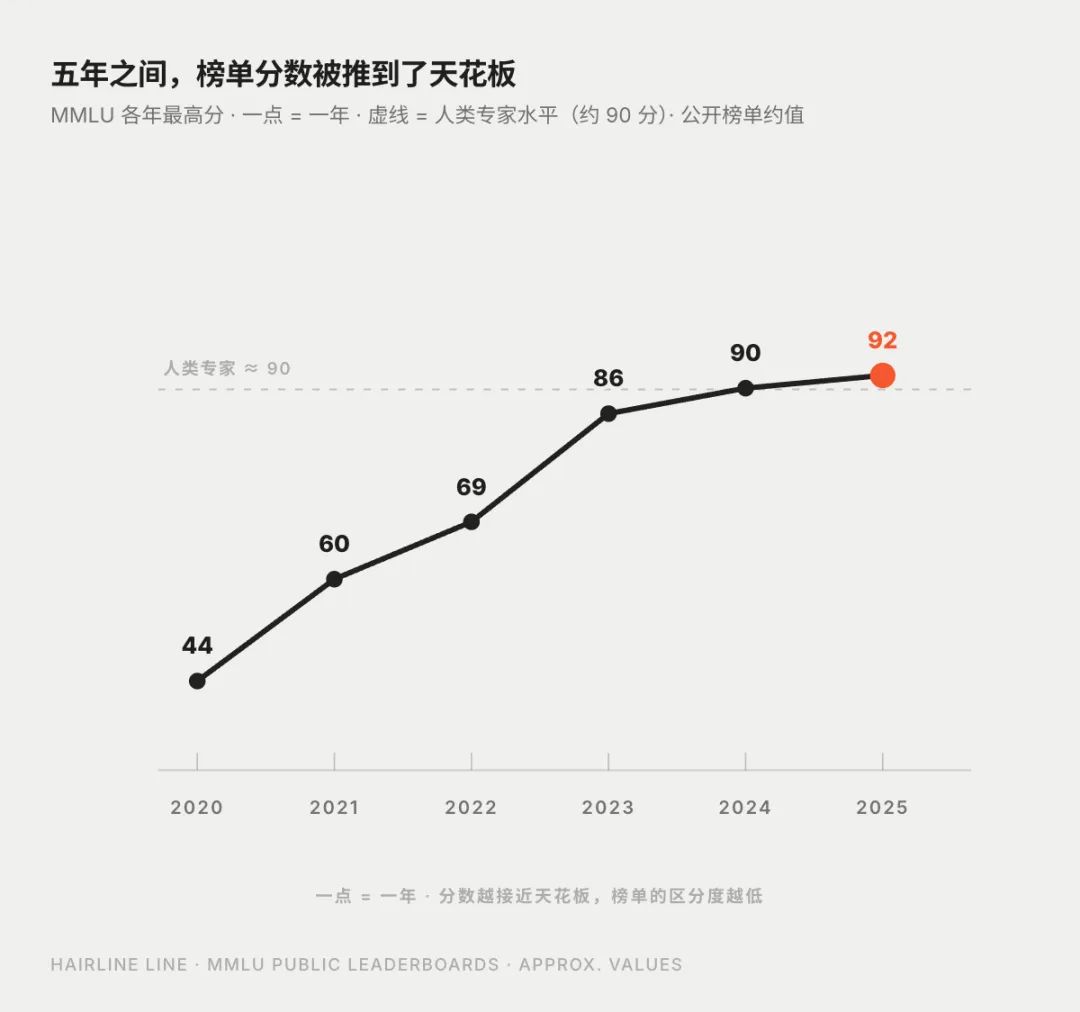
The Limitations of Benchmarking: It Doesn't Test What You Want
To understand the limitations of Benchmarking, one must first understand what it tests.
Taking the most common MMLU as an example, it includes 57 subjects and approximately 15,000 multiple-choice questions, covering a wide range from mathematical reasoning to historical knowledge. A model scoring 90 on MMLU indicates it performs well on average across these 57 subjects. However, there is an almost insurmountable gap between this and 'can it help the brand write product copy that fits the tone.'
This gap arises from three levels:
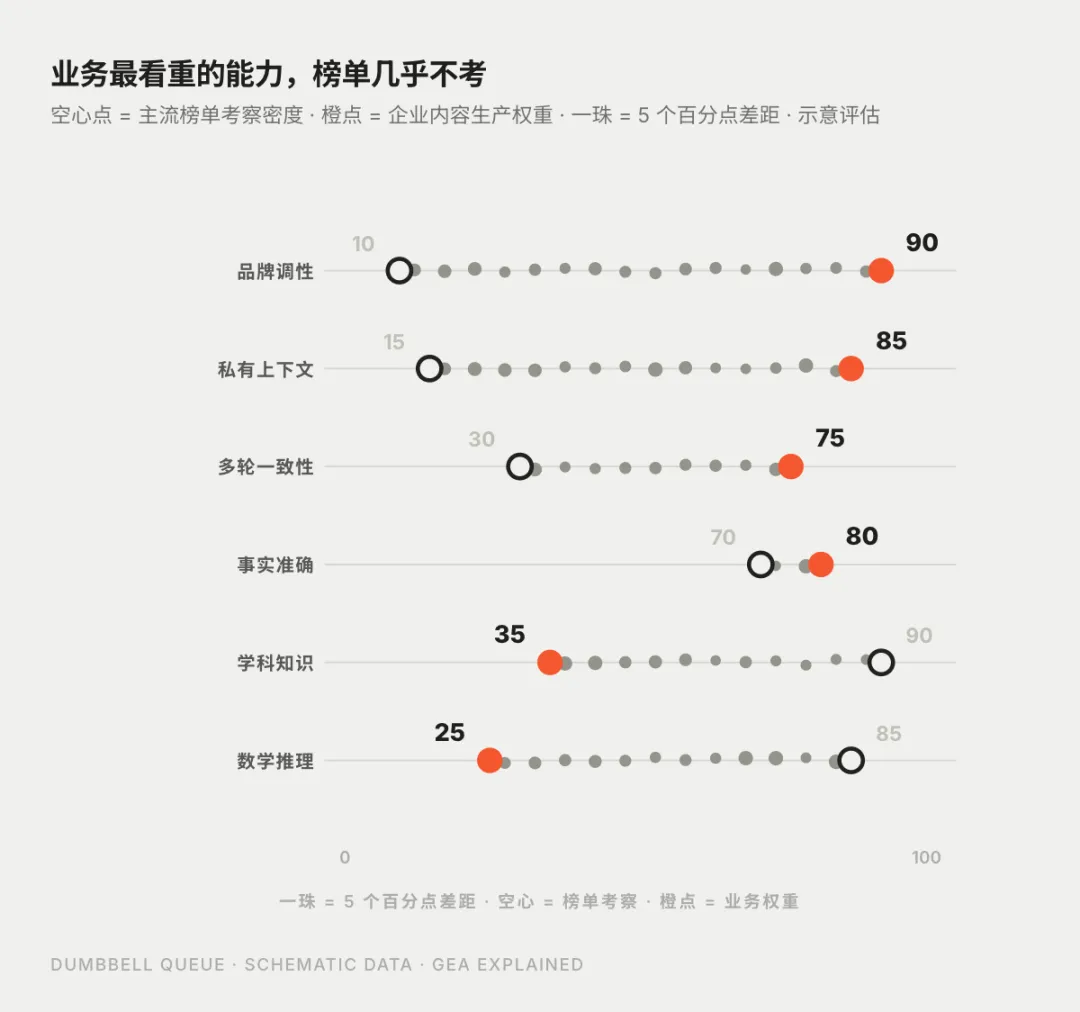
First, the test distribution differs from real tasks. Most Benchmark questions come from textbooks, competitions, and academic datasets, with significant differences in language style, task types, and the needs of daily content production in enterprises. A model that scores high on MATH may not accurately understand soft constraints like 'our brand's tone is warm but not overly familiar.'
Second, Benchmarking is a static snapshot, while business is a dynamic context. Each question in standardized testing is independent and does not rely on context. However, real enterprise AI tasks—such as generating new copy based on historical content style or outputting according to brand manual constraints—require models to continuously process a large amount of private information and maintain consistency across multiple interactions. This capability is not fundamentally tested by Benchmarking.
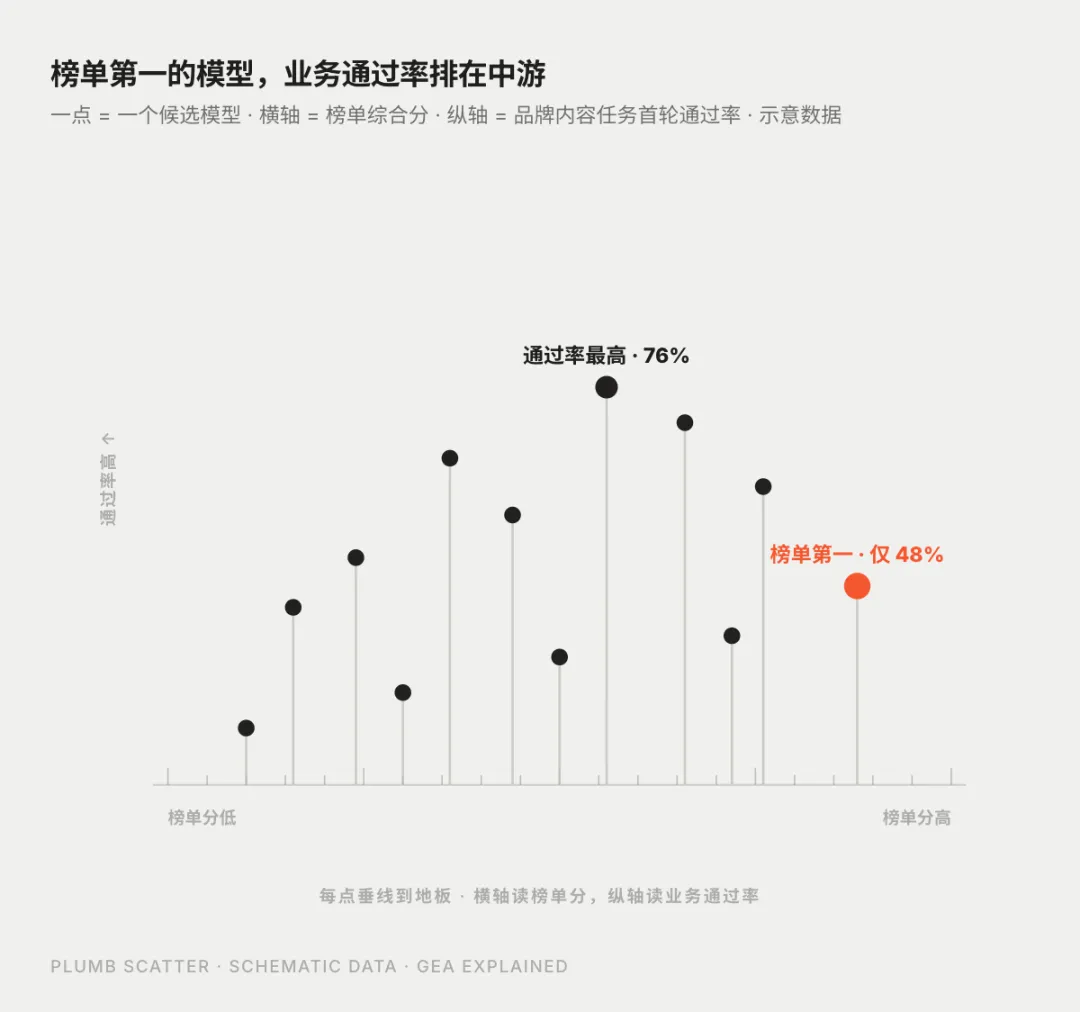
Third, scores can be optimized but cannot be transferred. There is a consensus in the industry: as Benchmarking becomes more famous, model vendors will specifically enhance training performance on corresponding datasets. A model's high score on HumanEval may partly stem from data leakage or targeted optimization rather than a genuine improvement in coding ability. When enterprises use this score for selection, the signal-to-noise ratio is actually decreasing.
What Enterprises Really Need to Evaluate
If Benchmarking answers 'how smart is this model,' then the real question enterprises need to answer is: 'What quality can this model achieve in my scenario, using my data, to solve my tasks?'
The answers to these two questions almost do not have a stable mapping relationship.
Taking content production scenarios as an example. A brand's content specification document states 'do not use words like 'leading' and 'empowering',' 'focus on short sentences, with no more than 4 sentences per paragraph,' 'capitalize the first letter of English when mixed with Chinese'—these constraints will not appear in any Benchmark, but they directly determine whether AI output can enter the production process.
A more effective method to evaluate whether a model is suitable for an enterprise scenario is Private Evaluation: combining real historical tasks, real data, and real review standards into a test set, scoring with one's own quality control process. This process is much slower than downloading a ranking list, but the conclusions drawn are credible.
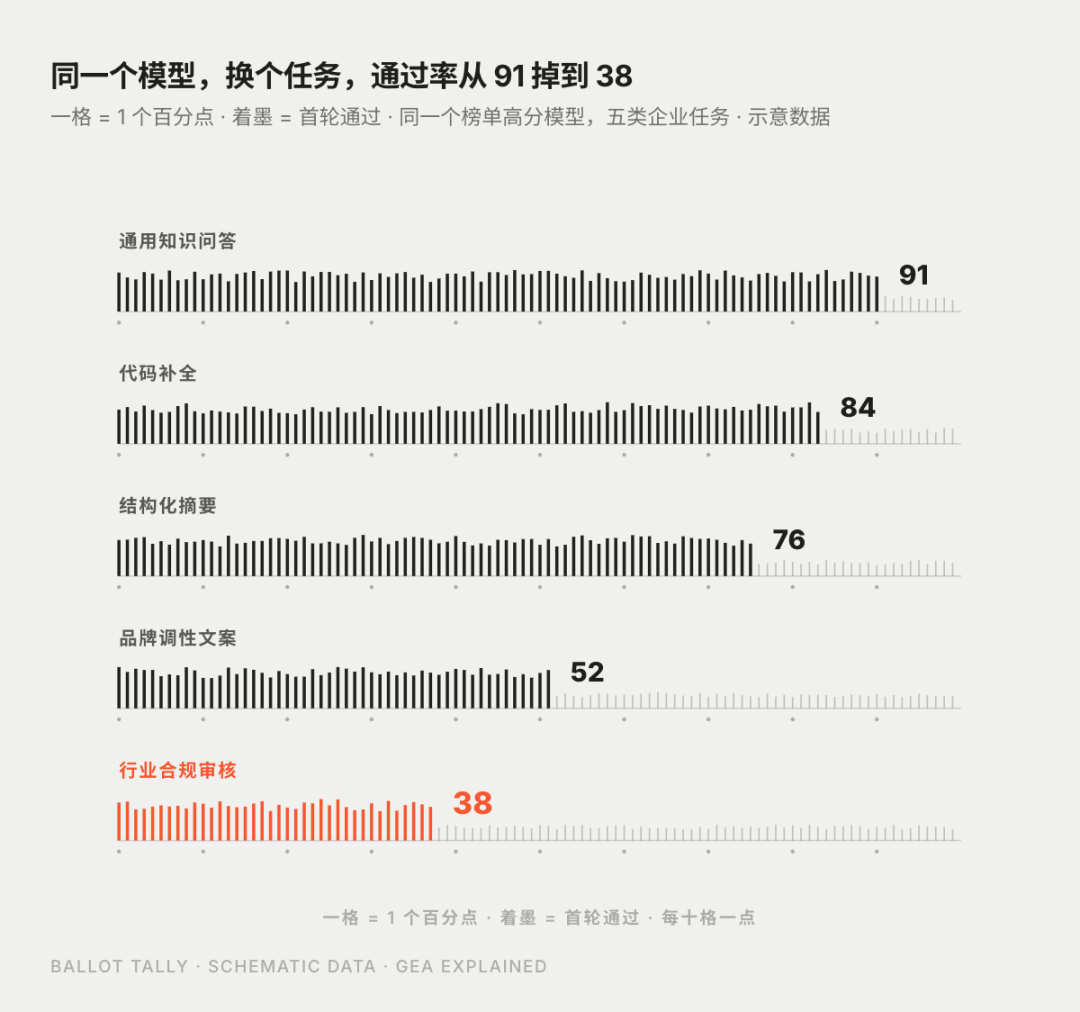
Tezign Technology has internalized this logic into product design while building GEA (Enterprise-Level Intelligent Agent): the model itself is a replaceable component, but the context system—enterprise brand specifications, historical content, style preferences—is the key variable that truly determines output quality. No matter how good the foundational model is, without corresponding contextual input, it is just an average answering machine in an enterprise scenario.
This also means that what enterprises really need is not to chase one general ranking after another, but to establish a Benchmark suitable for their own business scenarios—combining real business tasks, real historical data, and real quality control standards into their own evaluation set. There are no shortcuts to this, but it is worth the investment because it directly determines whether AI can move from 'demo looks good' to 'production usable.' This is also the direction Tezign is continuously delving into: distilling the evaluation methodologies of different industries and content production scenarios into reusable capabilities to help enterprises build their own evaluation systems that are strongly tied to their business.
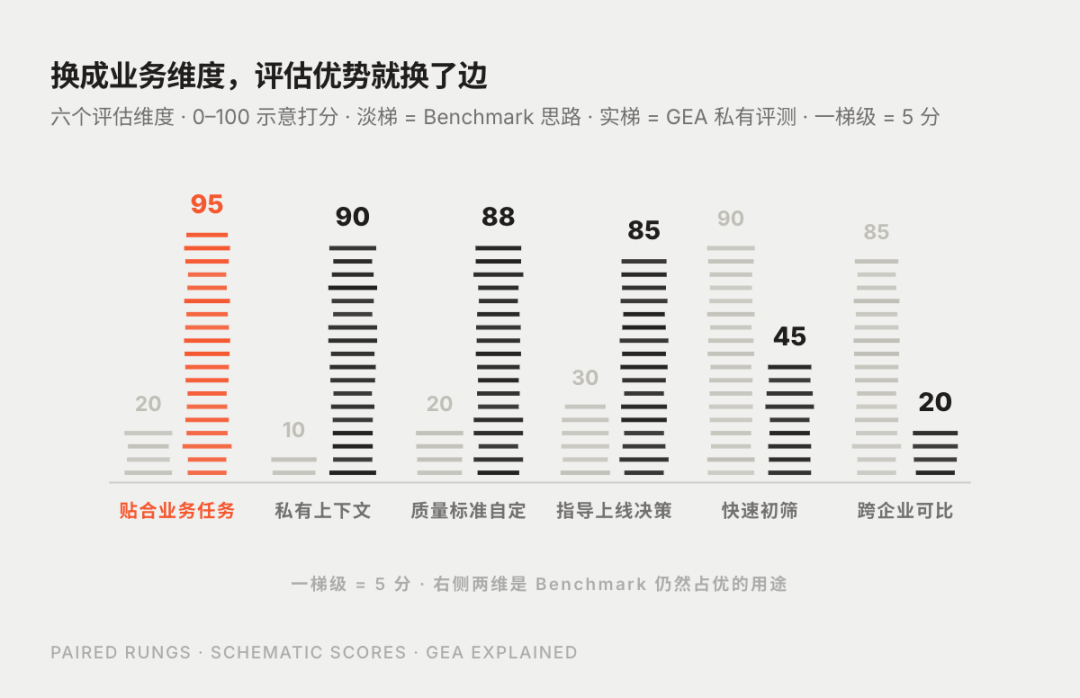
What 'Evaluation' Means in GEA
When GEA addresses this issue, it follows a path completely different from Benchmark-driven selection.
It does not first select a model and then build a process; instead, it first defines tasks and quality standards, and then decides which model fits into which step.
Taking a typical content production task as an example: Brand A needs to produce 30 product introduction copies each week for different regional consumers. GEA's evaluation starting point is not 'which model has the strongest language ability,' but: among these 30 copies, which variables are fixed (product information, compliance requirements), which variables are dynamic (regional preferences, timeliness of expression), which steps require human review, and what are the review dimensions.
Once these questions are clarified, evaluation becomes a data problem: using the brand's historically quality-controlled copies as a reference, testing the distance between GEA's output under different configurations and the historical pass rate. The smaller this distance, the more suitable this configuration is for the brand's scenario.
This is a pragmatic evaluation method—focusing not on the model's performance on standardized question banks, but on its pass rate under your production standards.
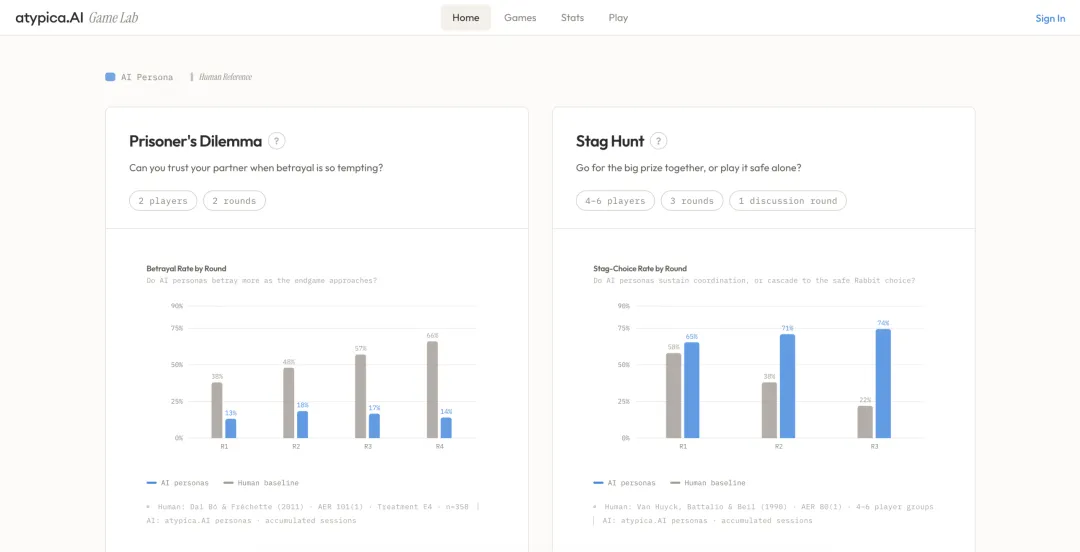
Tezign's GameLab is a typical practice of this evaluation approach. The core question GameLab seeks to answer is straightforward: Is the simulation of the AI Persona accurate? How to prove it? Its approach is not to check general rankings, but to have real people and AI personas perform the same economic behavior experiments—from the prisoner's dilemma, ultimatum game to the trolley problem, currently 10 experiments have been launched, accumulating hundreds of sessions. By comparing the decision data of both in the same game, it judges whether the AI Persona's simulation is on point: highly close data indicates effective calibration, while significant deviation leads back to data for retraining. This benchmark itself grows out of the business scenario (AI Persona simulation), rather than being taken from a general question bank. Using real human behavior data as a benchmark and continuously calibrating AI performance is the concrete form of 'Benchmarking suitable for business scenarios' moving from concept to reality.
The Boundaries and Correct Usage of Benchmarking
At this point, it is not to deny the value of Benchmarking, but to place it back in its appropriate context.
What Benchmarking is suitable for: initially screening out obviously substandard models, making quick comparisons at the functional boundary (whether it supports long texts, whether it supports understanding images and text), serving as a reference indicator for technical research.
What Benchmarking is not suitable for: serving as the main basis for enterprise AI selection, determining whether a model is suitable for a specific business scenario, or replacing the privatized evaluation process.
For enterprises, if the time spent looking at Benchmark exceeds the time spent building their own evaluation set, this priority itself is worth reconsidering. The AI configuration that truly suits you is not in the top rank of the list, but in your own data and tasks.
Category
All
Date
2026-10-12
Read Time
7 min read
Related Recommendations

How Long-Horizon Agents Solve Complex Business Problems That AI Workflows Can't Handle?

Does Harness Have a Shelf Life of Only Six Months? Why Enterprise AI Products Can't Be One-and-Done