All
What Does AI Rely On to Determine 'This Reasoning Path is Correct' When Performing Reasoning Tasks?
Creative Trajectory, as a core technology of Tezign GEA, addresses the pain points of unstable, un-auditable, and hard-to-iterate AI outputs through comprehensive reasoning trajectory recording and step rewards, helping AI develop a decision-making capability that continuously adapts to business needs.
Category
All
Date
2026-08-20
Read Time
5 min read
Technical Positioning of This Article:The Creative Trajectory technology introduced in this article is an important component of the Tezign GEA core technology system. GEA achieves 'judicious business decision execution,' and Creative Trajectory addresses one of the most critical issues: what does AI rely on to determine 'this reasoning path is correct' when executing business decisions. Without Creative Trajectory, AI merely produces answers in a black box, unable to accumulate experience, be audited, or improve continuously. Understanding this technology is a key step in grasping how GEA transforms from 'a tool that starts from scratch each time' to 'a decision partner that understands you better the more you use it.'
An AI has written you a great piece of copy.
You tell it, 'Good, keep this style.' The next day, it delivers a completely different piece of content—as if yesterday's conversation never happened.
This is not because it 'forgot.' It is a more fundamental issue: it did not record 'why the last time was correct' during the reasoning process.
It only knows the result, not the path.
The Paradox of Reasoning Stability in Enterprise Scenarios
There is a long-standing paradox in the field of AI: models perform well in public evaluations but struggle to reproduce stable results in real enterprise scenarios.
The reason is not complicated: evaluations rely on scoring output results, but enterprise business decisions require stability in the reasoning process.
When a brand asks AI to produce a large number of SKU copy, different tones, different price ranges, and different audiences, each piece must follow a set of interconnected judgment logic. Merely having feedback that 'this output is good' does not inform the model 'where in the reasoning you went wrong,' nor does it allow the model to reproduce the correct reasoning path in the next batch of tasks.
Traditional Reinforcement Learning from Human Feedback (RLHF) addresses 'making the model's output more aligned with human preferences,' but this method rewards results, not processes. For enterprise business decisions that require multi-step reasoning and parallel constraints, this is akin to only telling a chef 'this dish is delicious' without informing them which aspect of timing, ingredients, or sequence is most critical.
The Advantage of Process Rewards: From Rewarding Answers to Rewarding Reasoning
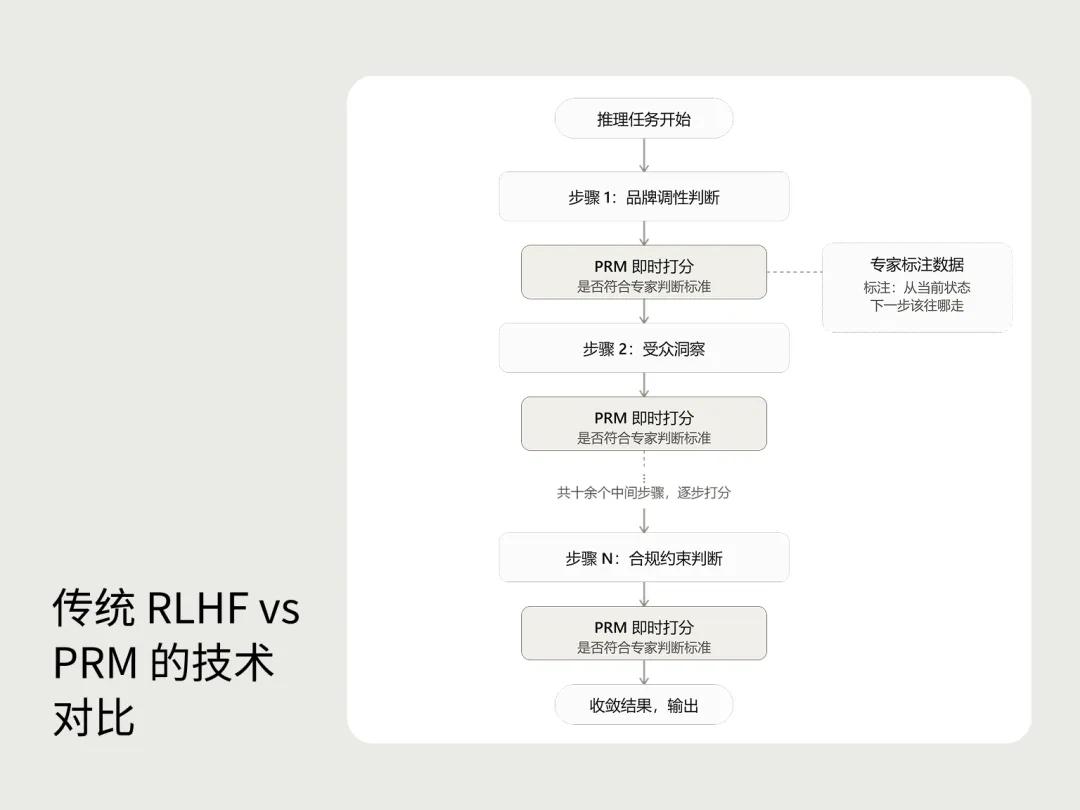
Creative Trajectory literally means 'creative trajectory'—recording the complete path of a decision-making reasoning task from start to finish. The core mechanism behind it is PRM (Process Reward Model).
The essential difference between PRM and traditional reinforcement learning lies in the position of the reward signal:
- Traditional RLHF: Scores the output results after task completion, rewarding the model for producing 'good-looking answers.'
- PRM / Creative Trajectory: Scores immediately after each reasoning step, rewarding the model for 'taking the right path.'
For a content task that needs to consider brand tone, audience insights, decision diversity, and compliance constraints simultaneously, the reasoning chain may contain dozens of intermediate steps. PRM evaluates at each step: 'Does this step's reasoning direction align with expert judgment standards in similar scenarios?'
This reward mechanism requires a large amount of expert-annotated data support—not annotating 'is this article good or not,' but annotating 'in this scenario, starting from this reasoning state, which direction should the next step take.' This is the most costly and highest threshold part of implementing Creative Trajectory.
How Does Creative Trajectory Specifically Implement in GEA?
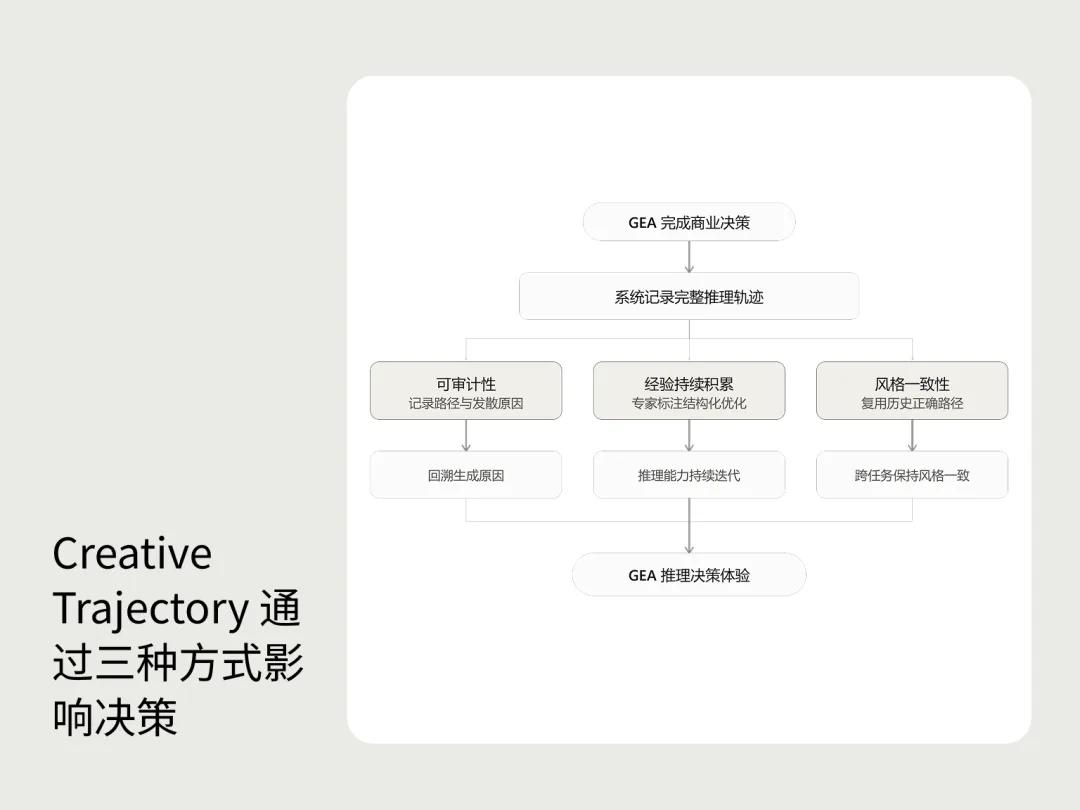
In the product implementation of Tezign GEA, Creative Trajectory influences the actual reasoning decision experience in three ways:
First, the auditability of reasoning paths.
Every time GEA completes a business decision, the system not only saves the output result but also records the complete reasoning trajectory—what capability was invoked at which step, what judgments led to which divergent paths, and what the reasons were for converging to the current result. This allows the content team to trace back 'why AI generated this direction this time,' rather than facing an unexplainable black box.
Second, continuous accumulation of experience.
GEA has accumulated a large amount of expert-annotated reasoning trajectory data, covering multiple industry scenarios and various content types. Every time an expert adjusts and confirms reasoning results in the GEA product, it optimizes the model in a structured way, allowing the system's reasoning capability to iterate continuously.
Third, cross-task style consistency.
When a brand accumulates enough Creative Trajectory data on GEA, the system will prioritize referencing the reasoning paths that have been 'marked as correct' in the brand's history when arranging new tasks. This is the technical foundation for GEA to achieve cross-task style consistency—not by stuffing a lot of style descriptions into prompts, but by relying on reasoning-level path memory.
What Are the Boundaries of Reasoning?
Creative Trajectory addresses the issue of learnability of the reasoning process, but it has clear preconditions:
The quality of expert annotations determines the upper limit. The reward signals of PRM come from expert annotations, and the quality of annotations directly affects the model's learning effectiveness. If there are significant subjective disagreements in the annotations (for example, different reviewers have vastly different judgment standards for 'decision diversity'), PRM will learn noise rather than patterns.
The cold start problem still exists. For a brand new brand or a completely new content scenario, if there is no historical trajectory data, the system can only rely on general priors for reasoning, and the initial output quality is proportional to the frequency of human guidance. This is also why GEA requires a certain amount of 'expert correction rounds' during the onboarding phase for new clients.
Not suitable for unconstrained business decisions. The design assumption of Creative Trajectory is 'there are reasoning steps that can be judged as right or wrong.' For completely open-ended conceptual creativity (for example, 'give me a disruptive industry idea'), each step in the reward process is not more meaningful than rewarding the result.
The core question that Creative Trajectory answers is not 'Can AI generate good content?' but 'Can AI continuously generate content that aligns with judgment logic in the same business scenario?'
The former is a tool capability, while the latter is a system capability.
An AI that only rewards results treats each task execution as the first time. A system that rewards the reasoning process shortens the distance between each task execution and the last one.
Category
All
Date
2026-08-20
Read Time
5 min read
Related Recommendations

Does Harness Have a Shelf Life of Only Six Months? Why Enterprise AI Products Can't Be One-and-Done

How Can Long-Term Intelligent Agents in Enterprises Maintain Trust in Production Environments?